


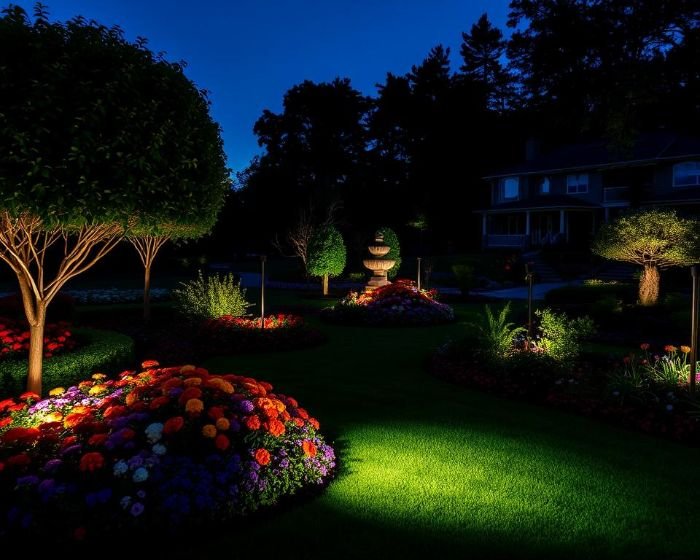
Highlight trees, statues, and water at night with clean, glare-free beams that lead the eye. For garden uplighting, begin 2-5 ft from the subject and aim 30-45 degrees across texture. Use 150-400 lumens per head, warm 2700-3000K for foliage, and 3000-3500K for stone or water. Mock up at dusk, move fixtures 6-12 inches, and hide hardware so the feature leads without glare.
Key Takeaways
- Pick one focal point per view to guide attention
- Set fixtures 2-5 ft out and aim 30-45 degrees
- Use 150-400 lumens per subject based on size
- Match color to material for natural texture and contrast
- Add a second beam only to recover hidden detail
Table of Contents
Using Garden Spotlights Effectively
Garden spotlights work best when every beam has a job. Pick a subject, decide what story it should tell at night, and shape light so the eye lands there first. Keep backgrounds modest, hide sources from common sightlines, and let shadow do part of the work.
How to use spotlights in a garden?
Aim a focused beam 30-45 degrees off the subject from roughly 2-5 ft away, hide the emitter with shielding, and cross-light when depth needs a second angle. Set one primary focal point per view and keep surrounding areas dimmer so eyes lock onto the feature. Mount on stakes or short risers where planting can hide hardware, or on small brackets when a stable base is needed near stone. Check for forward glare by standing in visitor positions; if you can see the LED face, tilt or relocate. Failure signals include hard-edged scallops on bark, blown-out statue highlights, and mirror-like hot spots on wet surfaces. Correct by widening the beam, softening aim across texture, or pulling the head farther off-axis.
How spotlights shape focal points
Contrast drives attention. A feature reads well when its illuminance sits about 3:1 to 5:1 above the immediate surround. Lower backgrounds help metal, stone, or bark hold detail without clipping highlights. Use a narrow beam for fine features like a statue’s face or hands and a wider beam for the torso or plinth so the whole form feels coherent. For multi-feature views, assign one hero and one or two supporting accents; equal brightness across many targets creates visual noise and weakens the scene.
Pro tip: a small dimmer module or lower-wattage lamp is often a cleaner fix than changing fixture count.
Uplighting vs spotlighting – picking the right approach
Garden uplighting pushes light upward to reveal form and volume. It suits trunks, branching structure, and large foliage where upward shadows add drama. Use uplighting trees when canopy shape matters more than leaf detail and when you want the crown to read from a distance. Spotlighting throws a directed beam from a visible or concealed position toward the subject. It favors sculpture, textured bark, and architectural elements that benefit from defined highlights and controlled shadow. For lighting water features, set beams to skim across moving surfaces so ripples sparkle, and avoid bright light into the viewer’s eye line to prevent glare off still water.
Good spotlight work starts with intent – one subject, one story, minimal spill. With roles decided, placement geometry and technical settings become straightforward in the next steps.
Placement Strategies for Garden Spotlights and Uplights
Good placement is geometry and restraint. Set the head where the beam skims texture, keep sources out of common sightlines, and let shadow shape the form. Most features read well when the fixture sits 2-5 ft from the base and the beam meets the surface at 30-45 degrees.
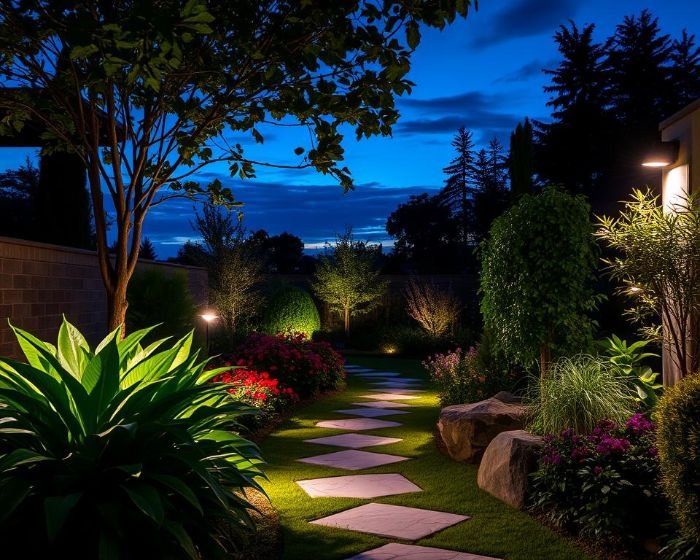
Where to put garden spotlights?
Place garden spotlights just off the viewer’s sightline, 2-5 ft from the subject, aimed 30-45 degrees across the surface, with the emitter hidden by planting or hardscape. Start with one key light and add a second from a different angle only if depth looks flat. Keep heads outside foot traffic and mower paths, and consider garden path lighting for safe walkways when designing routes used at night. If glare catches the eye, drop the mounting height, widen the beam, or shift the head farther off-axis.
Positioning around trees
Trees benefit from uplighting that reveals trunk texture and branch structure. For a single-trunk specimen, set one uplight 1-2 ft from the trunk and tilt 60-75 degrees to graze bark and pick up primary limbs. Broad canopies need two or three heads spaced roughly 120 degrees apart, each 3-5 ft from the base, with one tighter beam on the trunk and wider beams opening the crown. If the canopy throws a harsh hotspot, pull the head back 6-12 inches or lower the tilt so light rides along the bark rather than punching through leaves.
Pro tip: Pause at dusk and move one head 6 inches at a time; small shifts make big changes on foliage.
Practice note: For mature oaks or maples, a low uplight plus a soft cross-light from 6-8 ft out gives bark depth and avoids a “flashlight” look. Use the phrase uplighting trees once in this section naturally.
Lighting statues and sculptures
Sculpture needs modeling, not flood. Use one directional beam 15-25 degrees wide to lift the face or focal surface, then add a softer fill from the opposite side only if shadows hide key form. Keep the lamp slightly below the viewer’s eye and off to the side so highlights read without glare. Place the head 2-4 ft from small pieces and 4-6 ft for larger works, adjusting angle until edges show a clean rim without blowing out bright stone or metal. For glossy materials, avoid front-on hits that sparkle into the eye; shift 10-15 degrees sideways to clean the specular highlight.
Accenting water features
Water rewards skimming light. For moving water like a cascade, aim an outdoor spotlight across the sheet at 20-30 degrees so ripples sparkle and depth reads. Keep fixtures low and shielded to avoid direct glare. For still ponds, light what frames the water: stone edges, marginal plants, or a nearby boulder as a reflective “anchor.” Set heads back 3-5 ft and keep beams out of common viewing lines to prevent mirror-like hotspots on the surface. If fish are present, use warm 2700-3000K and moderate output so behavior stays natural.
Spotlight placement guide by feature
| Feature | Distance from base | Beam angle | Heads | Common mistake |
|---|---|---|---|---|
| Single-trunk tree | 1-2 ft (trunk), 3-4 ft (canopy) | 15-25 trunk, 36-60 canopy | 1-2 | Over-widened beams that flatten bark |
| Multi-stem tree | 2-4 ft | 25-40 | 2-3 | All heads same angle, no hierarchy |
| Small statue | 2-4 ft | 15-25 | 1-2 | Front-on glare into the viewer |
| Large sculpture | 4-6 ft | 25-40 | 2-3 | Double shadows from parallel beams |
| Waterfall or rill | 2-3 ft off edge | 20-30 | 1-2 | Aiming straight in, harsh sparkle |
| Still pond edge | 3-5 ft back | 25-40 | 1-2 | Lighting the water surface directly |
Use the table to set starting positions, then fine-tune at dusk. I lock angles only after a night check confirms clean texture, controlled highlights, and quiet backgrounds.
Brightness, Beam Angles, and Color Choices
Outdoor spotlights earn their keep when output, beam, and color match the subject. Set numbers that reveal form without glare, then fine-tune at dusk. I favor warm tones for foliage, slightly cooler light for stone and water, and beam spreads that fit the feature’s size and viewing distance.
How many lumens for a garden spotlight?
Most garden spotlights read well between 150-400 lumens per head, set by subject size and ambient light.
- Small pieces like urns or low statues need 150-250 lumens;
- larger sculptures and broad tree trunks take 250-400 lumens.
In bright urban yards, stay near the upper end; in dark rural settings, drop 50-100 lumens to keep contrast. If highlights blow out or nearby plants look washed, trim output or step down one optic size.
Beam spread selection
Beam angle controls shape.
- Narrow beams at 10-25 degrees carve detail on sculpture or tight trunks and hold punch from 8-15 ft away.
- Medium beams at 25-40 degrees handle most garden spotlights on features viewed from patios or paths.
- Wide beams at 40-60 degrees open tree canopies or large stone panels, especially when two heads cross-light.
Failure signals include hard-edged circles on backgrounds or double shadows; correct by widening the optic, moving the head back 6-12 inches, or offsetting the second beam.
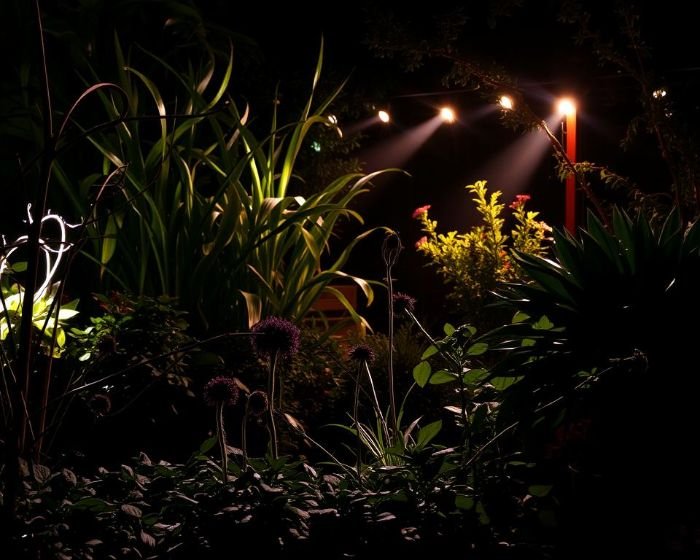
Color temperature for natural results
Color sets mood and material accuracy:
- Warm 2700-3000K flatters bark and foliage by keeping greens rich and shadows calm.
- For carved stone, metal, or water edges, 3000-3500K adds crisp definition without looking icy.
Keep color consistent within one scene so eyes do not read patches as unrelated parts. Aim for 80+ CRI so leaves, bark, and sculpture tones stay true on camera and in person.
Pro tip: If a surface is glossy, pair a slightly warmer source with a lower output to keep specular sparkle under control.
Quick reference:
- Small statue – 150-250 lumens, 15-25 degrees, 3000-3500K;
- Large sculpture – 250-400 lumens, 25-40 degrees, 3000-3500K;
- Single trunk – 200-300 lumens, 15-25 degrees, 2700-3000K;
- Broad canopy – 2 heads at 200-300 lumens each, 36-60 degrees, 2700-3000K;
- Water cascade – 200-350 lumens, 20-30 degrees, 3000-3500K.
Set numbers as a starting point, then confirm on-site. Clean edges, readable texture, and quiet backgrounds tell you the mix is right.
Powering and Weatherproofing Outdoor Spotlights
Spotlights work reliably when power is stable and housings keep out water and soil. Set up a clean 12V system, pick the right ingress rating, and keep connectors where you can service them after rain or irrigation.
Low-voltage wiring basics
Run outdoor spotlights on a 12V low-voltage circuit fed by a magnetic or quality electronic transformer. Load the transformer to 70-80% of its rating to leave headroom. Place the unit off the ground on a wall or post, protected by a cover, and feed it from a GFCI-protected outlet. Use 12-gauge cable for long or higher-load runs and 14-gauge for short, lighter branches. Keep any single branch short and balanced; long daisy chains lead to dim last heads. If the far end looks weak, move that leg to a closer hub, shorten the run, or step up cable gauge. Hire a licensed electrician for any controller that ties into mains power.
⚠️ Safety note on electrical connections
Outdoor wiring mistakes can cause short circuits, fire risk, or injury. Low-voltage reduces danger but still requires care. If you are not experienced with outdoor electrical systems, hire a licensed technician who can size the transformer, ground the system properly, and meet code.
Weather ratings and durability
Ingress ratings matter outdoors. IP65 handles rain and sprinkler spray; IP67 adds protection for brief immersion, which helps near water features or low spots. Use cast brass, marine-grade stainless, or powder-coated aluminum in coastal or high-salt locations. Create drip loops before entries into housings so water does not track along the jacket. Keep all splices above standing water and use gel-filled or heat-shrink connectors rated for direct burial. Where freeze-thaw is common, leave slack at fixtures and avoid rigid right-angle exits that crack under heave.
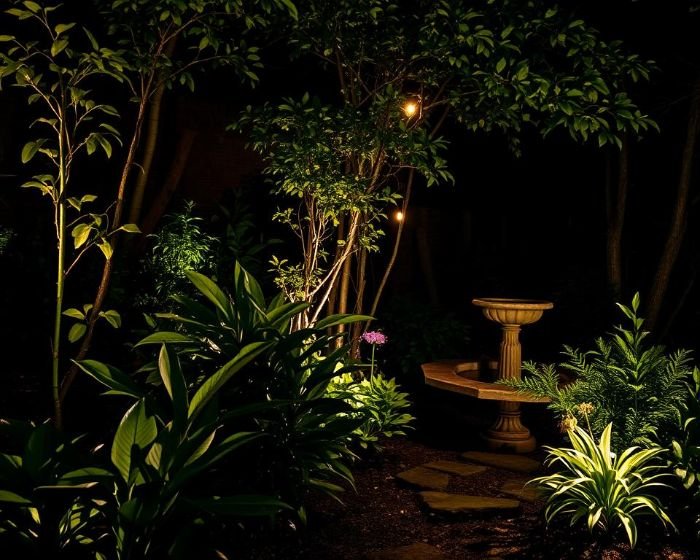
Maintenance access
Plan access before you bury a foot of cable. Leave 6-12 inches of service loop at each fixture, and set junctions in accessible pockets behind planting, not under stone you will regret lifting. Lenses collect pollen and mineral film that flatten texture; wipe them quarterly and after heavy irrigation cycles. After storms, check that gaskets sit clean and screws are snug. If you see flicker, look first for a loose splice or a waterlogged connector before blaming the driver. I keep one spare head and a set of connectors on hand so a night failure does not leave the focal point dark for a week.
A solid power plan and weatherproof details keep output even through heat, cold, and rain. With reliability handled, you can focus on night tests and fine-tuning to get texture and shadows right.
Testing and Fine-Tuning Garden Spotlights at Night
Final quality comes from field checks after dark. Set a temporary rig, walk the viewing routes, and adjust until texture reads cleanly without glare. Small moves matter more than new hardware, so change only one thing at a time and recheck from the main vantage point.
Night testing and adjustments
Test with actual fixtures on temporary stakes or ground spikes. Power them with a safe outdoor extension and run 30 minutes after sunset and again at full dark, because ambient light shifts quickly. Stand in the approach a guest will use, then step 10-15 ft to either side to catch stray glare. Move a head 6-12 inches before you touch output or optics; a short pullback softens hotspots and a small tilt change can recover texture on bark or stone.
Use simple thresholds to make decisions. If the feature looks flat, narrow the beam or reduce output until edges regain contrast. If a bright seam jumps off the background, widen the optic or angle the head across the surface. For neighbors and interiors, check for light trespass through windows and over fences; lower the tilt or add a louver if you see spill.
Pro tip: Take two photos per view with the same phone exposure locked. Side-by-side images make tiny gains obvious and help you pick a final aim the next day.
Cross-lighting and layering
Add a second beam only when the first hides important form. Set separation between heads at 30-60 degrees so shadows overlap softly instead of doubling. Keep one beam as the key and run the fill at half the output or with a wider optic. For sculpture, use a narrow key at 15-25 degrees for the face or focal surface and a softer fill to lift shadowed planes. For trees, pair a tight trunk spot with a medium canopy wash so bark reads and crown volume opens.
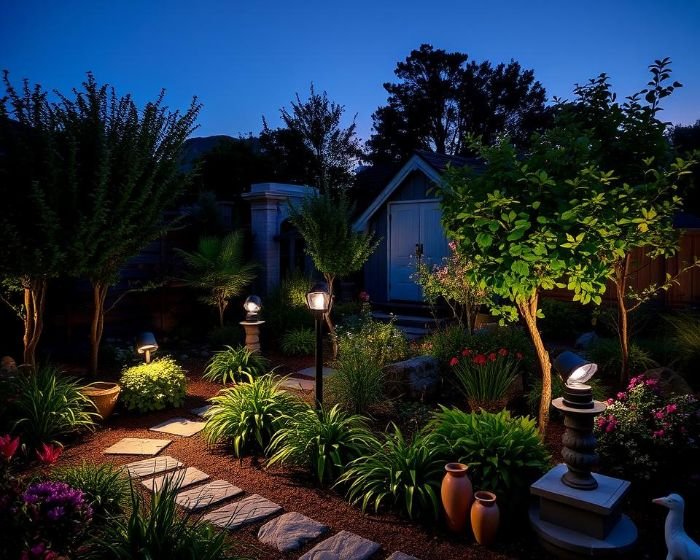
Failure signals and quick fixes are straightforward. Double shadows mean the two beams run too parallel; rotate one head or widen its optic. Sparkle on metal or wet stone means the beam hits front-on; slide the head sideways 10-15 degrees to clean the highlight. Mirror glare on still water calls for a lower angle from the side or a shift to light the edge stone instead of the surface.
Good fine-tuning trades power for placement. When beams land at the right angles and backgrounds stay quiet, garden spotlights read with depth and the feature leads the scene without shouting.
Common Mistakes With Garden Spotlights and Uplighting
Most problems come from too much light, the wrong angle, or hardware in plain view. Catch issues at dusk, change one variable at a time, and recheck from the main approach.
Too much light, no shape
Over-lighting wipes out texture and turns a feature into a flat patch. If a statue reads like a white blob or bark looks chalky, step output down or switch to a narrower optic. Keep garden spotlights near 150-250 lumens for small subjects and 250-400 lumens for larger forms. Aim for a 3:1 to 5:1 contrast between subject and background so edges hold definition.
Pro tip: When in doubt, reduce power first and increase distance second; it keeps shadows intact.
Glare, hotspots, and light trespass
Glare happens when the lamp sits in the viewing cone or hits reflective surfaces front-on. Move the head outside common sightlines, lower the tilt, or add a louvered shield. Hotspots on stone or metal mean the beam is too tight or too direct; widen the optic or slide the head 10-15 degrees sideways. Check for trespass into neighbor windows and patios; if light spills, drop output or re-aim across the surface. For garden uplighting on wet foliage, a small pullback of 6-12 inches often calms sparkle without losing punch.
Visible hardware and messy cable runs
Hardware should disappear so the eye lands on the feature. Sink stakes deep enough that fixtures sit level, and tuck outdoor spotlights into planting pockets rather than open lawn. Paint conduit to match trim or bark where it crosses a visible surface. Keep splices above standing water and leave a 6-12 inch service loop behind shrubs for maintenance. If cables wander or create trip risks, reroute along bed edges and pin them before burying.
Patchwork color that breaks the scene
Mixed color temperatures make one space feel like several unrelated zones. Keep foliage near 2700-3000K and reserve 3000-3500K for stone, metal, or water edges that benefit from a crisper read. Use one color family per viewing scene so eyes do not jump between warm and cool pools. If a feature looks cold while everything else reads warm, swap that lamp first before changing angles.
Good lighting comes from restraint and small, deliberate moves. When beams stay out of sight and the subject leads the scene without glare, the garden reads cleanly at night.
Practical Wrap-Up
Treat feature lighting like a field exercise, not a catalog choice. Pick one focal point per view, then build depth with small moves and night checks. Start with two temporary garden spotlights on stakes, place them 2-5 ft from the subject, and aim 30-45 degrees so light skims texture. Hold contrast around 3:1 to 5:1 so the subject leads and backgrounds stay quiet. Glare means the head sits in the viewing cone, so drop the tilt or add a shield. Flat wash means output or beam is too broad, so narrow the optic or pull the head back 6-12 inches.
Lock a cadence that keeps results steady. Test at dusk on install day, confirm again at full dark, then recheck at the first leaf-out and after major pruning. Wipe lenses quarterly to clear sprinkler film and pollen. After heavy rain or freeze-thaw, re-level stakes and check connectors for moisture. If double shadows appear, separate beams by 30-60 degrees and keep the fill about half the key.
- Choose one focal point per view
- Stage two test lights at dusk
- Set 2-5 ft distance, 30-45 degree aim
- Match beam to size, 15-25 or 36-60 degrees
- Confirm 3:1-5:1 contrast, then hide hardware
FAQ
How many garden spotlights should I use on a mature tree?
Match head count to canopy spread and viewing angles. A narrow or columnar tree under 12 ft wide reads with one head. A 12-20 ft canopy usually needs two heads set 120 degrees apart to open volume. Anything wider than 20 ft benefits from two or three heads so trunk texture and crown layers both show. Keep outputs modest per head so contrast stays readable rather than washed.
Will uplighting trees harm roots or bark over time?
LED fixtures run cool and do not scorch bark when aimed correctly. Keep fixtures 1-2 ft off the trunk so heat vents, avoid screws or straps on living tissue, and set mounts in soil without compressing surface roots. Use stand-off brackets on trunks only for wiring that must pass a tree and leave expansion clearance so hardware never bites into growth.
How do I prevent neighbor glare and skyglow with spotlights?
Keep beams below the viewer’s eye line and below the canopy top, use shields or louvers, and aim across surfaces rather than straight at them. If light shows in a window or over a fence, lower the tilt a few degrees or move the head outside the common sightline. A curfew timer that steps off around 22:00 reduces late-night spill without changing the scene for evening use.
What IP rating do I need when lighting water features?
Use IP67 fixtures within splash zones or near grade where water can collect, and IP68 for submersion rated gear inside a pond. Keep junctions out of standing water, add drip loops before every housing, and feed from a GFCI-protected circuit. For lighting water features, match color temperature across all nearby heads so reflections look intentional rather than patchy.
Can I mix solar markers with a low-voltage spotlight scene?
Yes, but match color temperature and plan for different runtimes. Solar heads dim earlier on cloudy days, so reserve them for short side paths or borders and keep the focal feature on low-voltage. Sync start times with a shared photocell if possible, and avoid placing a bright wired beam next to a dim solar head that will fade mid-evening.
How do I keep fixtures stable in mulch and shifting soil?
Use heavy-duty stakes driven 8-12 in deep, then pin cable runs before backfilling so wires do not tug heads out of level. In loose mulch, set a small gravel pad under the stake to stop lean after irrigation. Re-level after freeze-thaw or heavy rain and trim foliage that presses against housings, which can force angles off target.
How should I light a reflective statue without harsh sparkle?
Offset the beam 10-15 degrees from the main viewing line, drop output one step, and use a slightly wider optic so highlights soften. A cooler 3000-3500K source keeps edges crisp on metal, but keep intensity moderate and pair with a softer fill from the opposite side only if shadow swallows important detail.
How do I keep results consistent through leaf-out and leaf drop?
Schedule two seasonal checks – early spring after leaf-out and late fall after drop. In spring, widen one canopy beam or add a second head if foliage blocks the trunk read. In fall, narrow optics or reduce output so bare branches do not glow too hard. Quick photo comparisons taken with a locked exposure help repeat adjustments year to year.