





Updated April 17, 2026
Water conservation techniques in arid and drought-prone gardens work best when they reduce loss before they add more irrigation. Water disappears fastest where soil sheds it, bare ground heats up, and mixed plantings force one schedule across plants with very different demand.
A twenty-minute run can still leave the root zone dusty four inches down. If the surface darkens and the bed looks stressed again by late afternoon, the issue is usually shallow delivery before it is low volume.
The gardens that hold up in arid climates usually follow the same pattern. They get water into the soil, hold it in the root zone, shield the surface from heat and wind, and keep the highest-water planting small on purpose. The same system also works in drought-prone climates where rain comes in short seasons and then disappears for weeks.
Key Takeaways:
- Fix runoff, crusting, and mixed zones before adding minutes
- Use drip at dawn so roots get water first
- Hold organic mulch deep enough to cool the surface
- Keep high-water planting tight and visually intentional
- Check wetting depth monthly, especially during first heatwaves
Water conservation in arid and drought-prone gardens depends on soil improvement, drip irrigation at dawn, three to four inches of mulch, hydrozones, runoff basins, and roof-runoff capture. If irrigation darkens the surface and the soil is still dry four inches down half an hour later, the technique needs correction before the schedule gets longer.
Table of Contents
Water Conservation In Arid And Drought-Prone Areas – Fix Loss Before Adding Water
The biggest water mistake in arid regions is assuming every dry-looking plant needs more minutes on the schedule. Quite a lot of dry-climate waste happens before roots ever get a drink. Hard soil sheds water, bare soil bakes it off, wind strips moisture from exposed foliage, and mixed beds force one schedule across plants that never wanted the same rhythm.
| Loss point | What it looks like | Fix that pays fastest |
|---|---|---|
| Surface runoff | Water moves to paths or low spots within minutes | Slow the application, split the cycle, add basins |
| Shallow wetting | Top looks dark, lower soil stays warm and dry | Use drip or longer soak to reach root depth |
| Evaporation from bare soil | Bed crusts by midday and weeds erupt after watering | Add organic mulch and more plant cover |
| Mixed water-use planting | One plant wilts and another yellows | Build hydrozones and separate the thirstiest plants |
| Narrow shrub watering | Wet soil near trunk, dry soil at canopy edge | Move water outward toward the drip line |
A dry-climate irrigation plan should control loss before adding more water. A timer cannot correct a bed that runs off into the path. A drought-tolerant shrub planted beside thirsty annuals will live on the annuals’ schedule. The layout in a truly water-efficient garden solves those conflicts before the hose comes out.
Water thoroughly, then wait; prevent runoff; and expand the wetted area as shrubs and trees grow. Save water at the loss point, not just at the valve.
Soil Structure In Dry Gardens – The First Water-Saving Device Is The Soil
The fastest way to waste water is to apply it to soil that cannot accept it. In arid gardens, the root zone fails in two opposite ways. Sandy or rocky soil lets water slide through too fast. Tight clay or crusted desert soil sheds it sideways before it can move down. Both problems end with thirsty roots.
For many non-native plantings, adding one to two inches of organic material and working it about six inches deep can improve pore structure, water movement, and moisture storage. Compost does two jobs at once: it creates larger pores that improve infiltration and smaller pores that hold moisture by capillary force after the watering stops. That is why a compost-amended bed does not just wet faster. It stays useful longer.
Push a finger into healthy soil a day after irrigation and it should feel cool, slightly resistant, and crumbly, not slick or powdery. When a bed has gone hydrophobic after repeated drying, the first watering may bead on the surface with a faint oily sheen before it finally breaks through. In that condition, soil failure comes before any timer problem.
Not every arid bed wants heavy amendment, though. Many native dryland plants need loosened soil more than rich soil. That tradeoff matters. Desert natives and silver-leaved shrubs that evolved in lean mineral ground can push soft growth or hold too much winter moisture when the bed is amended like a vegetable patch. Add organic matter where you need better infiltration or better holding capacity. Do not assume every xeric planting wants the same recipe.

One other fix is pure housekeeping. Break surface crust, keep foot traffic off root zones, and do not let weeds occupy the top few inches that were meant for your crop or shrub. Aeration improves water movement into soil and cuts runoff. In dry climates, that is water savings you can actually feel under your hand.
Drip Irrigation In Arid Climates – Slow The Flow Until The Root Zone Wins
In arid climates, more water is lost by bad delivery than by short supply. Microirrigation systems can use twenty to fifty percent less water than conventional sprinkler systems because they deliver water directly to the root zone, slowly enough to reduce runoff and evaporation. That one change alone moves the garden away from wet leaves and shiny paths and back toward dark soil where the plant can use it.
Dawn is still the winning window in most gardens. Irrigate in early morning or just before dawn because wind is lower, evaporation drops, and wet foliage dries sooner than it would after evening watering. Best times to water the garden matter most in dry climates when the cool dawn window lets soil keep more of what lands.
Runoff is not a sign that the bed has had enough. It is a sign that the application rate outran infiltration. Pulse irrigation lets water soak in between short runs. Ten minutes, pause, ten minutes again will often beat one long burst on slopes, crusted soil, and mulched beds that were allowed to go fully dry. The same logic works with hand watering. If the surface turns glossy and starts pushing water sideways, stop and let the soil catch up.
After changing a runtime, push a bamboo skewer four inches into the soil thirty minutes later. If the lower half comes out pale, warm, and dusty, split the cycle into two dawn passes before adding more total minutes.
Wetting pattern matters as much as timing. Trees and shrubs should be watered under the drip line and beyond, not tight against the trunk, because the feeder roots are farther out. That small placement change saves water by putting it where absorbing roots are active and away from a spot that cannot use much of it.
Salt management matters because arid-water irrigation leaves minerals behind. Watering twice as long once or twice a year can help leach salts below the active root zone. If leaf tips brown even though the bed is getting regular water, do not assume the answer is more frequent irrigation. Sometimes the root zone needs a deeper rinse, not a tighter schedule. Microirrigation works best when slow delivery, root-zone placement, and runoff control are managed together.
When the schedule still feels unclear, soil moisture monitoring confirms whether the lower root zone is actually wet. That check prevents schedule changes based on surface appearance alone.
Mulch, Shade, And Wind Protection – Stop Midday Evaporation Before It Starts
Most arid gardens do not fail because last night’s irrigation disappeared. They fail because today’s surface got cooked. Bare soil heats fast, loses moisture fast, and breaks the capillary bridge that would have kept deeper moisture available to roots a little longer.
Mulch depth for moisture conservation usually falls around three to four inches in planted areas, with slightly deeper layers possible where the material stays airy. Pull mulch back from trunks and crowns so stem bases do not stay damp.
Lift mulch on a hot afternoon and the contrast is obvious. The top layer feels brittle and sun-warmed. Underneath, the soil is darker, cooler, and less likely to crust. That temperature change matters because cooler soil slows evaporation and reduces heat stress at the feeder-root layer.
The worst afternoon wilt usually shows up where the soil is visible between plants, not where the hose ran shortest. Bare gaps heat fast, crust fast, and break the moisture bridge back to the root zone.
Shade and wind control extend the same logic. A small tree on the west side of a bed, a taller shrub that breaks desiccating wind, or a trellis that throws patterned afternoon shade can save as much water as a modest schedule increase because evapotranspiration drops when leaf temperature drops. In many beds, less afternoon heat load matters more than one extra watering day.
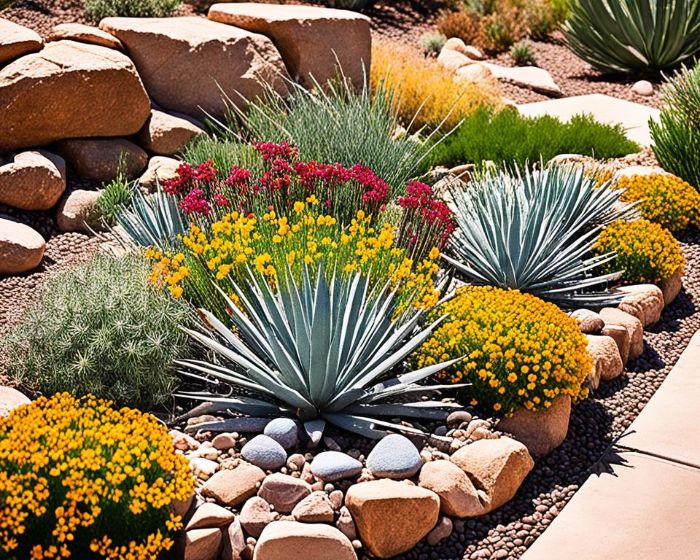
Rock mulch needs a caution. Gravel can fit windy sites and true xeric plantings, but rock mulch in sunny areas around non-arid plants can radiate heat and worsen scorching. In a cactus bed, stone can work beautifully. In a mixed herb or perennial bed beside a south wall, it can turn the root zone into a griddle.
Hydrozones And Plant Choice – Keep High-Water Areas Small
A dry-climate garden gets expensive the moment one thirsty zone sets the schedule for the whole yard. Group plants into high, moderate, and low water-use zones, with high-water zones under ten percent of the landscape, moderate zones at thirty percent or less, and low-water zones at sixty percent or more. That benchmark came from a humid state. The planning logic is even sharper in arid climates: the thirstiest planting should be tiny, deliberate, and worth defending.
| Zone | Best use in an arid garden | Water pattern |
|---|---|---|
| High | Entry pots, kitchen herbs, one productive bed, nursery starts | Frequent checking and regular irrigation |
| Moderate | Mixed borders, fruiting crops in season, favorite perennials | Deep watering after the upper root zone dries |
| Low | Established shrubs, natives, dry borders, non-turf fillers | Establishment water first, then infrequent deep soaking |
The plant palette still matters. Riparian or wetland plants should not sit in the same zone as drought-adapted plants because the water mismatch is built in from day one. Useful dry-site leaf traits include smaller leaves, gray or silver cast, thicker surfaces, and tougher texture. Those details are not cosmetic. They are transpiration control in plain sight.
The same dry-site traits found in drought-tolerant plants only pay off when they are not being over-irrigated by thirstier neighbors. A sage planted beside canna, basil, or thirsty annual color will live on the wrong schedule. That is the practical value of grouping plants by water needs: it removes the compromise rhythm that wastes water and weakens both sides of the bed.
Turf also belongs in the water-use plan. In an arid garden, lawn should sit where feet actually need it, not where the plan had empty space. Productive beds, a shaded seating edge, and a small play strip usually justify irrigation better than a decorative rectangle nobody uses.
Water Harvesting In Arid Gardens – Keep Rain On Site
Even very dry places still get pulses of water. The waste is letting those pulses leave too fast. Water harvesting in an arid garden starts with the simplest question on the property: where does roof runoff go now, and where could it do useful work?
A basic rainwater-harvesting setup needs a roof catchment, gutters, a storage vessel, and a way to move water where it is needed. A fifty-five gallon barrel under a downspout is the entry-level version. The more strategic move is often routing that same downspout into a mulched basin, tree well, or planted swale that slows water and lets it infiltrate before it reaches the street.
Layout matters at the runoff point. A shallow basin on the downhill side of a fruit tree, a slight berm that keeps overflow in a shrub bed, or a dry stream line that carries roof water toward a low-water zone all turn short storms into stored soil moisture. Those same moves fit naturally into water-efficient garden layout planning because they treat the site as a catchment first and an irrigation problem second.
Start with a runoff map, not a shopping list. Mark every downspout, hard edge, and low spot that already receives water during a storm, then decide which flows can be sent to mulch basins or storage without pushing water toward the foundation. A barrel without an overflow route fills once and stops helping. A basin without enough rough mulch can seal at the surface and shed the next burst.

Storage also has limits. In a truly arid place, a small barrel will not carry the whole garden through summer. It still matters for hand-watering containers, seedlings, or one high-value bed, and overflow still matters if it soaks into a useful root zone. In drought-prone climates with short heavy storms, that overflow design can matter as much as the barrel itself.
Best Water Conservation Fixes By Problem – Where To Start
Water runs off before the bed darkens at depth
Do not add more minutes first. Split the watering into two dawn cycles, lower the application rate, and shape a shallow basin so water has time to enter. Then confirm the result with the sort of root-zone moisture check that proves the lower profile is actually wet.
The bed still looks stressed even though you water often
Look for a shallow wetting pattern or a mixed planting problem. If the top inch is dark and the lower soil is dry, shift to slower root-zone delivery. If one side of the bed is lush and the other side is sulking, the planting probably needs cleaner hydrozones more than a richer schedule.
Established shrubs still need the hose all summer
Widen the wetted footprint toward the canopy edge, clear turf or weeds from under the shrub, and water deeper with longer rest between cycles. A mature shrub living on a tiny ring of damp soil near the trunk is not being watered deeply, even if it is being watered regularly.
Containers collapse by midafternoon
Take them off the bed schedule completely. Patio pots lose moisture from every side, and dark containers near masonry heat even faster. Two emitters or two short dawn cycles usually work better than one long run because the mix wets more evenly before the day starts pulling water back out.
Conclusion
Fixes should follow the water-loss sequence. If soil cannot absorb water, a longer schedule will not rescue the bed. If the root zone stays bare and exposed, extra irrigation will feed evaporation before it feeds roots. Fix infiltration first, then delivery, then surface protection, then plant zoning. Only after that should runtime get longer.
Check mulch depth twice each hot season and flush drip lines at spring startup and again midseason if your water is hard. Revisit timers after the first real heatwave and after any rare storm that changes soil moisture more than the forecast suggests. Success shows when runoff stays in the bed, the soil under mulch feels cool at knuckle depth, and shrubs still hold posture late in the day.
FAQ
Can you keep vegetables productive in arid regions without watering every day?
Yes, if the bed is mulched, the soil actually wets to root depth, and the crop mix is not fighting itself. Fruiting vegetables still need regular moisture. Daily light sprinkling is the wrong pattern. In hot dry weather, fewer deep dawn irrigations with drip usually build a cooler root zone than quick surface splashes. Containers are the exception because potting mix loses water from every side.
What happens if you water lightly every day in desert heat?
Most gardeners think daily light watering is safer. It usually trains roots into the hottest inch or two of soil. The surface stays damp just long enough for weeds to enjoy it, then the lower profile stays dry, warm, and unused. Plants look dependent because they are.
Is rock mulch a good choice for water conservation?
In cactus beds and very lean desert plantings, yes. Around salvias, vegetables, roses, or any planting beside a south or west wall, rock often turns into a heat battery. EPA WaterSense warns that rock mulches in sunny areas can radiate enough heat to increase scorching and water loss around non-arid plants.
What if your soil is clay and the bed sits on a slope?
That combination wastes water fast because the surface seals and runoff starts before the lower root zone wets. Use shorter pulse cycles at dawn, shape shallow basins on the downhill side of plants, and keep organic mulch rough enough to slow flow instead of shedding it. Fast spray irrigation is a poor fit there. Low, repeated soak is the safer pattern.
Should you water right after a summer storm in a drought-prone climate?
Not automatically. Many hot-weather storms wet only the top inch and leave the lower root zone dry by the next day, especially in wind or high heat. Check moisture three to four inches down before skipping the next cycle. If the lower soil is still cool and slightly damp, wait. If only the surface changed color, the storm did not replace a real irrigation.
Can a rain barrel matter in a very dry climate?
A single barrel will not run the whole garden through summer. It can still matter a lot for high-value zones such as containers, seedlings, or one herb bed because those are the places where hand watering is otherwise most frequent. The real gain comes when downspouts also feed basins or mulched tree wells so even overflow stays on site.
Do the same techniques work in drought-prone climates that are not true deserts?
Yes. The main shift is cadence, not method. In drought-prone climates, the same core system still wins: improve infiltration, mulch deeply, water at the root zone, keep thirsty planting small, and capture runoff when rain does come. The schedule may relax in wetter months, then tighten fast when the rainfall pattern shuts off.
Why do drought-tolerant plants still fail in arid gardens?
Transpiration control only works if roots can explore soil that stays aerated and moist long enough to recover between heat cycles. A drought-tolerant plant set into a small overwatered pocket, a hydrophobic root ball, or a bed with reflected heat from masonry can still collapse fast. Plant choice matters. Placement and irrigation pattern decide whether that choice gets a fair chance.