
Updated April 11, 2026
Aquaponics looks simple from a distance: fish live in a tank, plants grow in water, and a pump keeps everything moving. The real system is more interesting than that. Aquaponics is a managed ecosystem where fish, plants, and bacteria depend on one another through a recirculating water loop.
That is why aquaponics is not regular gardening and not ordinary hydroponics either. You are not feeding plants directly with a bottle of nutrients. You are feeding fish, managing water, and creating conditions where microbes can convert waste into plant food.
Aquaponics works on balance, not on gadget count. In plain terms, it is a soilless growing method that combines fish culture, plant production, and biological filtration in one recirculating loop. Once that clicks, the pumps, beds, fish tanks, and test kits all make more sense.
Aquaponics In One Minute
- Fish produce waste and uneaten feed breaks down in the water
- Bacteria convert that waste from ammonia into forms plants can use
- Plants and root-zone microbes remove nutrients from the circulating water
- Cleaner water returns to the fish tank and the loop repeats
- The whole system depends on oxygen, reliable water movement, and biological balance
Aquaponics suits growers who want to manage a living system and watch water, fish, and plants together. It is a weaker fit for anyone looking for a low-attention shortcut.
Key Takeaways:
- Aquaponics combines aquaculture and hydroponics in one recirculating system
- The hard part is balancing fish, plants, bacteria, and water quality at the same time
- Media beds, NFT, and floating rafts each suit different crops and management styles
- Leafy greens and herbs are usually easier than heavy fruiting crops
- Aquaponics saves water, though it does not remove the need for daily attention
Table of Contents
What Aquaponics Is – A Living Loop, Not Just Fish Under Plants
The USDA National Agricultural Library defines aquaponics as the practice of combining aquaculture and hydroponics in one system. That definition is accurate, though still a little flat for what actually happens in a healthy unit. FAO describes aquaponics as the management of a complete ecosystem that includes fish, plants, and bacteria. That fuller description is the one beginners usually need.
Aquaculture gives you the fish side. Hydroponics gives you the soilless plant side. Aquaponics joins them through recirculating water and biological filtration. Fish release waste. Feed particles break down. Microbes convert those wastes into forms plants can use. Plant roots and associated microbes help clean the water before it returns to the fish tank.
That loop is why aquaponics attracts people who want to grow food in greenhouses, backyards, patios, schools, and urban spaces. Small-space food production and water reuse in cities are major reasons aquaponics in urban gardening attracts interest, but the system still depends on fish health, microbial conversion, water movement, and plant uptake.

The concept is elegant. The management is less automatic than the diagrams suggest. Aquaponics does not run on fish waste alone. It runs on a stable relationship between organisms, oxygen, water movement, solids handling, and daily observation.
How Aquaponics Works – The Nitrogen Cycle In Plain English
The main loop starts with fish feed, not with plants. Fish eat, excrete waste, and leave behind uneaten particles. That waste creates ammonia in the water. Ammonia is dangerous to fish in buildup, so an aquaponic system needs microbes that can convert it into safer forms. ATTRA, the sustainable agriculture program run by NCAT, calls microorganisms the important link between aquatic animals and plants in aquaponics. Without them, the loop does not function.
The conversion usually happens in two biological steps. Nitrifying bacteria turn ammonia into nitrite. Other nitrifying bacteria turn nitrite into nitrate. Nitrate is far less toxic to fish at normal system levels and is one of the main nitrogen forms plants can absorb. That is why aquaponics depends so heavily on cycling and maturation. A new system can move water on day one. It cannot behave like a mature biofilter on day one.

Once plants take up nitrate and other dissolved nutrients, the water heading back to the fish tank is cleaner than it was at the start of the loop. Cleaner does not mean finished or perfect. Solids still need to be managed. Oxygen still needs to stay high. Temperature still shapes fish health, plant growth, and bacterial activity. Aquaponics works because several living processes overlap at once.
Water tests matter because they show how well the loop is behaving. Ammonia and nitrite tell you whether the bacterial side is keeping up. Nitrate gives you a sense of ongoing conversion and plant use. pH matters because fish, plants, and bacteria all respond to it, though not with exactly the same preference. Aquaponics usually lives in a workable middle ground, not in a perfect number chosen for only one part of the system.
| Living part | Main job in the loop | What failure looks like |
|---|---|---|
| Fish | Supply waste nutrients through feeding and metabolism | Stress, low appetite, poor growth, or losses from bad water quality |
| Bacteria | Convert ammonia and nitrite into plant-available nitrate | Ammonia or nitrite spikes in immature or disrupted systems |
| Plants | Use dissolved nutrients and help polish the returning water | Slow growth, pale leaves, or nutrient mismatch with fish load |
The key biological point is easy to miss. Aquaponics is not fish feeding plants directly. It is fish feeding microbes, microbes transforming waste, and plants taking advantage of that transformation.
The Parts Of An Aquaponic System – What Each One Does
Most aquaponic systems have the same jobs even when the layouts look different: hold fish, grow plants, move water, add oxygen, and provide enough surface area for biological filtration. In small media-bed systems, several of those jobs happen in one component. In larger raft or commercial layouts, they are often split into separate tanks and filters.
The fish tank is the nutrient source. The grow area supports roots and gives plants access to recirculating water. Pumps move water between components and aeration keeps dissolved oxygen up for fish, roots, and microbes. Solids removal matters because too much trapped waste can create dirty low-oxygen zones that stress the whole system.
ATTRA notes that flood-and-drain media systems often do not need a separate biofilter because bacteria colonize the media itself. That is one reason media beds stay popular with hobby growers. Larger floating-raft systems often use clarifiers, filters, degassing, and more deliberate water treatment. The University of the Virgin Islands model, summarized by ATTRA, is a good reminder that productive aquaponics can look more like engineered water management than like a decorative tank with basil on top.
Aquaponic System Types – Media Bed, NFT, And Floating Raft
Aquaponics does not have one standard design. There are several. The system type changes how solids are handled, what crops fit best, and how forgiving the setup feels in daily use. ATTRA groups the common options into nutrient film technique, flood and drain media systems, and floating raft systems.
| System type | Usually best for | Main strength | What to watch |
|---|---|---|---|
| Media bed / flood and drain | Home systems, mixed crops, early learning | Media supports roots and provides a large surface for bacteria | Heavy beds, trapped solids, and clogging if waste builds up |
| NFT | Light greens and herbs | Good oxygen exposure around roots and efficient water use | Less forgiving with solids and pump interruptions |
| Floating raft / DWC | Lettuce, basil, and larger productive systems | Stable root-zone water volume and strong output at scale | Usually needs better solids management, aeration, and system design |
Media beds are often the most intuitive for beginners because one component does several jobs at once. The bed supports plants, provides microbial surface area, and gives the system some buffering. NFT channels are lighter and efficient, though roots do not enjoy dirty water and solids very much. Raft systems can be highly productive, especially for greens, though they reward cleaner water and more deliberate engineering.
The type also affects what people imagine they can build in small spaces. Aquaponics can fit patios, side yards, classrooms, rooftops, and greenhouses. It can even borrow spatial ideas from vertical gardening in small spaces. The biology still needs enough water volume, oxygen, and maintenance access, so layout tricks do not remove the fundamentals.
Aquaponics Vs Hydroponics – Same Soilless Idea, Different Management
Hydroponics and aquaponics both grow plants without soil. That surface similarity confuses a lot of people. In hydroponics, growers deliver dissolved nutrients directly and can adjust the formula with precision. In aquaponics, fish feed is the main nutrient input and biology does the conversion work. That means aquaponics is less like mixing plant food and more like maintaining a living nutrient economy.
ATTRA makes the distinction plainly: aquaponics is not hydroponics plus aquaculture alone. It also depends on a diverse microbial community that drives nutrient cycling. That extra living layer changes how you troubleshoot. A hydroponic grower can often correct a plant deficiency fast by changing the solution. An aquaponic grower has to think about fish load, feed rate, bacterial health, pH drift, solids, and plant demand together.

That does not make aquaponics inferior. It makes it different. It can reuse water efficiently, link fish and crop production, and build a more biologically active system. It also means you give up some of the quick precision hydroponics is known for. ATTRA’s summary of the University of the Virgin Islands system is useful here: even mature professional aquaponic systems still monitor pH daily and supplement calcium, potassium, and iron when needed.
Expectations need to stay practical. Aquaponics does not mean fish waste magically supplies every nutrient at perfect levels forever. It means biology does a large share of the work, then management closes the remaining gaps.
What Grows Well In Aquaponics – Plants, Fish, And System Match
Plant choice is one of the easiest places to make a smart beginner decision. ATTRA lists lettuce, basil, chives, spinach, watercress, and other leafy greens or herbs as well adapted to aquaponic systems. They have moderate nutrient demand, grow quickly, and tend to fit the conditions that smaller systems can supply without strain.
Heavy fruiting crops are a different conversation. ATTRA notes that tomatoes, bell peppers, and cucumbers perform better in mature, well-established systems with higher nutrient availability. That does not mean you can never grow them. It means a new hobby build should not assume tomatoes are the default test crop simply because they are familiar.
Fish choice also needs to match temperature, regulations, and system goals. ATTRA notes that many North American commercial systems rely on tilapia because it tolerates recirculating conditions well. Other species can work too, including trout, perch, bass, and char, though the climate demands change quickly between warm-water and cold-water fish. Outdoor systems need to fit real seasonal conditions, not optimistic averages, which is why your local climate zone matters more than many beginners expect.
The species decision is sharper than it may seem at first. Warm-water fish can simplify one kind of management and complicate another if the setup runs cool. Cold-water fish can fit the climate better outdoors and create a different plant schedule. The right match is less about the most famous aquaponics fish and more about what your temperatures can support consistently.
For most beginners, the sharpest decision is simple: choose greens before fruiting crops, and choose fish by temperature fit before popularity.
Space changes expectations as well. Small indoor or patio builds can teach the biology and produce herbs or greens. They are rarely the same thing as a household fish-and-vegetable supply. For simple edible production in tight spaces, container gardening in small spaces is usually easier to scale and troubleshoot than aquaponics. Aquaponics earns its place when the integrated system itself is part of the goal.
Beginner Reality – What Aquaponics Does Well And What It Does Not Simplify
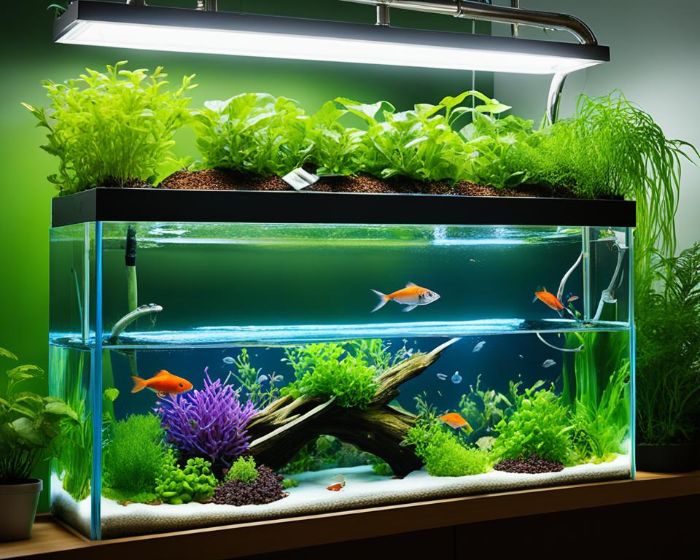
Aquaponics does several things very well. It reuses water through circulation. It links fish culture and plant production in one system. It can produce a lot of greens in a compact footprint. It can fit greenhouses, schools, and small urban spaces more easily than field growing. Those strengths are real.
It does not simplify every part of food growing. Fish do not wait for you to learn water chemistry slowly. Pumps and air failures matter fast. New systems need cycling time before they behave predictably. Solids still need to be removed or managed. Temperature still drives outcomes. A pretty layout does not compensate for dirty low-oxygen water.
Cycling is the early phase when bacterial populations establish enough to process waste reliably. That period is easy to underestimate because the system may look finished long before the biology is ready. Many beginner frustrations start there. The plumbing is complete, the tank is full, the plants are in place, and the invisible part of the system is still catching up.
- Adding fish too early creates ammonia and nitrite stress before the system is biologically ready.
- Choosing tomatoes or cucumbers first raises nutrient demand before the loop has matured.
- Overfeeding fish to chase plant growth usually degrades water faster than it improves nutrition.
- Ignoring climate means fish and plants get pushed outside their comfort range.
- Treating aquaponics as zero-maintenance leads to the same neglect pattern that harms any recirculating system.
Pro Tip: Aquaponics fails when bacteria, cycling, and solids management are ignored, even if the tanks, beds, and plumbing look attractive.
Aquaponics functions as ecosystem management, not as a shortcut to automatic food production. FAO’s guide to management of aquaponic systems emphasizes the same need for biological balance, observation, and practical system control.
If you keep the expectations grounded, aquaponics becomes easier to judge fairly. It is not magic. It is not a gimmick either. It is a biologically active water-reuse growing method that rewards patience, observation, and better-than-average system thinking.
Conclusion
Aquaponics makes sense once you stop picturing it as fish under plants and start seeing it as a loop of feed, waste, bacteria, plant uptake, and recirculated water.
The core lesson is simple. Fish supply nutrients. Bacteria unlock them. Plants use them. Water carries the relationship between all three. The stronger your understanding of that loop, the easier it is to judge system types, crop choices, climate limits, and beginner claims realistically.
FAQs
What is aquaponics in simple terms?
Aquaponics is a way of growing plants and raising fish in one recirculating system. Fish waste and decomposing feed create nutrients, bacteria convert those nutrients into forms plants can use, and the plants help clean the water before it returns to the fish.
How does aquaponics work step by step?
The loop starts with fish feed. Fish produce waste and leftover feed breaks down into ammonia. Nitrifying bacteria convert ammonia into nitrite and then nitrate. Plants take up nitrate and other dissolved nutrients from the circulating water. Pumps and aeration keep the water moving and oxygenated so the cycle can continue safely.
What is the difference between aquaponics and hydroponics?
Hydroponics feeds plants directly with a measured nutrient solution. Aquaponics relies on fish waste, bacteria, and recirculating water to supply much of the fertility. That makes aquaponics more biological and more interconnected. It also means nutrient control is less direct than in hydroponics.
Is aquaponics hard to maintain?
Aquaponics is not difficult in the same way every day, though it is more demanding than a passive pot or raised bed. Once a system is mature, the routine often becomes manageable and repetitive. The harder part is that fish, plants, bacteria, pumps, oxygen, and water quality all need to stay within a workable range at the same time. That is why aquaponics rewards consistency more than improvisation.
What plants are best for beginner aquaponics systems?
Leafy greens and herbs are usually the easiest place to start. Lettuce, basil, chives, spinach, and similar crops fit smaller systems and moderate nutrient levels better than heavy fruiting crops. Tomatoes, peppers, and cucumbers usually perform better once the system is mature and well balanced.
What fish are commonly used in aquaponics?
Tilapia is one of the most common fish in commercial warm-water aquaponics because it tolerates recirculating conditions well. Other species such as trout, perch, char, and bass may also be used, though the right choice depends heavily on water temperature, local rules, and system goals.
Is aquaponics good for beginners?
It can be, though only if the beginner wants to learn water biology as well as plant growing. Aquaponics is very rewarding for people who like systems and observation. It is less forgiving than a simple pot or raised bed when pumps fail, fish are overfed, or the system is stocked before it is cycled.
Can aquaponics work outdoors year-round?
That depends on the climate, the fish species, and how the system is protected. Outdoor aquaponics can work well in suitable conditions, though seasonal temperature swings often limit fish choice and plant performance. Many growers use greenhouses or seasonal schedules to keep the biology within a workable range.