
Last Updated September 23, 2026
Grapevines don’t need large quantities of fertilizer – but they do need precision. Nitrogen, phosphorus, potassium, and micronutrients support different parts of the plant’s development, and each is absorbed more effectively at specific growth stages.
Applying nitrogen too late increases canopy growth at the expense of fruit. Lack of potassium limits sugar accumulation in berries. Ignoring timing or soil conditions doesn’t just waste fertilizer – it reduces yield and weakens vine resilience.
Effective fertilization means matching the right nutrient to the right phase: root establishment, bud break, flowering, veraison, and post-harvest recovery. Each has its own demand curve – and getting it right drives both fruit quality and long-term vine health.
Key Takeaways
- Grapevines require different nutrients at different growth stages – timing is as important as content.
- Excess nitrogen reduces fruit quality by promoting excessive foliage and delaying ripening.
- Confirm potassium, phosphorus, and magnesium needs before applying them.
- Fertilizer type should match soil conditions, vine age, and training system – there’s no one-size-fits-all formula.
- Avoid blanket applications – use tests, vine vigor, and growth stage to guide feeding.
Table of Contents
Nutrient Requirements in Grapevines – Element Roles, Uptake Timing, and Deficiency Signs
Grapevines depend on a narrow set of macro- and micronutrients, each with specific physiological functions and absorption timing. Fertilization without alignment to these dynamics leads to wasted input, vegetative imbalance, or compromised fruit quality.
Macronutrients – Roles, Demand Peaks, and Deficiency Symptoms
| Element | Function | Timing or Diagnostic Note | Deficiency Indicators |
|---|---|---|---|
| Nitrogen (N) | Shoot elongation, leaf expansion | California guidance: relatively low uptake from bud break to bloom, then high from bloom to veraison | Pale foliage, weak growth, short internodes |
| Phosphorus (P) | Energy transfer, root and reproductive function | Use regional soil-test interpretation rather than a fixed seasonal peak | Symptoms are not specific enough for diagnosis alone |
| Potassium (K) | Sugar transport and water regulation | California guidance: demand is highest between bloom and veraison | Marginal leaf injury and uneven ripening can occur |
| Magnesium (Mg) | Chlorophyll formation, photosynthesis support | Check tissue status, especially where potassium is high | Interveinal chlorosis on older leaves |
| Calcium (Ca) | Cell structure and membrane function | Assess soil chemistry and local test guidance before correction | Visual symptoms alone are unreliable for diagnosis |
Micronutrients – Sensitivity Zones and Risk Profiles
- Zinc (Zn) – Required early for shoot elongation and fruit set. Deficiency causes short internodes, small leaves, and cluster failure.
- Iron (Fe) – Involved in enzyme systems that regulate chlorophyll formation and respiration. Deficiency presents as interveinal chlorosis in young leaves, especially on alkaline soils.
- Boron (B) – Supports flower development and cell division. Both deficiency and toxicity are problematic.
- Manganese (Mn) – Affects photosynthetic enzymes. Deficiency may mimic iron chlorosis.
Micronutrient imbalances are frequently pH-driven. Correction without a soil or tissue test risks compounding errors.
Diagnostic Methods – Visual Clues vs. Tissue Analysis
Visual assessment can detect advanced deficiency symptoms but often misses early imbalances. Soil testing is most useful for pH and the root-zone nutrient supply, while tissue analysis shows what the vine has actually absorbed. University of Minnesota Extension recommends soil testing before planting and every 3 to 5 years in established vineyards, with tissue testing at bloom or veraison. See the grapevine soil and tissue testing guidance.
Fertilizer Selection for Grapevines – Matching Formulas to Soil, Growth Stage, and Yield Goals
Fertilizer selection isn’t about brand or NPK numbers alone – it’s a matter of aligning formulation, delivery method, and timing with vineyard-specific variables. Soil type, vine age, growth phase, and expected yield all shape what will work and what will waste input or cause imbalances.
Soil and Site Conditions Affect Fertilizer Choice
Soil texture and pH change how nutrients move and how available they remain to roots. Sandy soils lose nitrate more readily than heavier soils, while high-pH soils can limit iron, zinc, and manganese availability. Correct the diagnosed constraint rather than assuming that one fertilizer formulation suits every block.
Avoid uniform approaches across blocks. Even within one vineyard, slope, compaction, and drainage alter how nutrients behave.
Growth Phase Requires Nutrient Prioritization
Grapevines don’t need the same inputs year-round. Effective fertilization is phase-specific.
| Growth Phase | What to Check | Fertilizer Decision |
|---|---|---|
| Early growth (bud break to pre-bloom) | Vine vigor, tissue status, spring leaching risk | Apply nitrogen only when a regional recommendation and vine condition support it |
| Bloom to veraison | Nitrogen and potassium status during active uptake | Correct only confirmed deficiencies at a test-based rate |
| Post-harvest | Remaining green canopy, climate, documented nutrient need | No routine fertilizer; avoid late nitrogen where winter hardening is a concern |
For mobile nutrients such as nitrogen, split doses can reduce leaching risk when irrigation and timing are managed correctly.
Adjust for Vine Age and Crop Intensity
Young vines do not automatically need a special high-phosphorus or low-nitrogen program. If the site was prepared well and growth is healthy, they may need little or no fertilizer during the first few years. Poor early growth is often linked to water stress, weeds, crop load, or disease rather than fertility. For new plantings, the site-preparation sequence in starting a vineyard for grapes matters more than a routine feeding schedule.
Product choice and timing both matter. Neither can compensate for a nutrient need that has not been diagnosed.
When to Fertilize Grape Vines – Timing by Growth Stage and Seasonal Cycle
Timing fertilization correctly is as important as choosing the right formula, but the timing is not universal. Nutrient uptake changes through the season, and regional climate affects whether an application is useful or too late. Base the schedule on the nutrient being corrected, vine condition, and local guidance rather than the calendar alone.
Dormancy to Bud Break – Foundation Phase
This phase is mainly for soil preparation and correction. Apply amendments only when soil testing or a regional recommendation shows a need. Avoid routine high-nitrogen feeding before active growth because early nitrogen may be unnecessary and can be vulnerable to leaching.
Optional inputs:
- Low-N organic matter (composted manure, cover crop residue)
- Lime or gypsum if pH or Ca/Mg ratios need correction
Bud Break to Pre-Bloom – Vegetative Push
Root activity and shoot growth are increasing, but nitrogen uptake is not universally at its seasonal peak. California grapevine guidance reports relatively low nitrogen uptake from bud break to bloom. Early nitrogen may still be used in some regional programs when a documented need exists, but routine heavy feeding is not justified by growth stage alone.
- Use tissue results and vine vigor to decide whether nitrogen is needed
- Delay heavy nitrogen where spring rain or irrigation raises leaching risk
- Apply zinc or boron only when deficiency and local guidance support it
Avoid overfeeding – excess nitrogen can increase canopy density and delay normal maturation.
Flowering to Veraison – Fruit Development Phase
Bloom to veraison is a major uptake window for both nitrogen and potassium. California Department of Food and Agriculture guidance reports that about half of annual nitrogen demand and roughly 60% of annual potassium demand can occur during this period. That describes uptake timing, not an automatic fertilizer requirement. See the California grapevine fertilization guidelines.
- Confirm potassium need with soil and tissue data before adding K
- Check magnesium when high potassium status accompanies older-leaf chlorosis
- Do not infer fertilizer need from seasonal uptake demand alone
Do not cut nitrogen solely because fruit has set; uptake can still be high before veraison. The decision should come from tissue status, canopy vigor, and the regional program rather than a blanket fruiting-stage rule.
Post-Veraison to Harvest – Maintain, Don’t Stimulate
Once ripening is underway, routine nitrogen is difficult to justify in a healthy vine. Potassium uptake is lower than it was before veraison, and foliar potassium cannot supply the full seasonal K requirement of a deficient vine.
Do not use leaf appearance alone to choose a corrective spray. Confirm the nutrient problem first, especially when chlorosis could reflect magnesium imbalance, pH, water stress, or root damage.
Post-Harvest – Recovery and Reserve Building
The vine can continue moving nutrients into perennial structures after harvest, but post-harvest fertilization is conditional rather than automatic. It is most defensible where a documented nutrient need exists and the canopy remains healthy and active long enough for uptake.
- Consider nitrogen only when testing shows need and the canopy remains active
- Avoid late nitrogen in cold climates where it can delay hardening
- Use calcium, gypsum, or organic amendments only from soil-test guidance
Where a post-harvest application is justified, match the product and rate to the nutrient being corrected and the remaining uptake window.
Fertilizer Application Methods for Grapevines – Soil, Foliar, and Irrigation-Based Strategies
Application method determines how effectively nutrients reach active uptake zones. Soil type, vine age, root depth, irrigation access, and nutrient form all influence what works best. Choosing the wrong method reduces availability or creates runoff losses. The right method enhances absorption and minimizes waste.
Soil Application – Granular and Band Placement
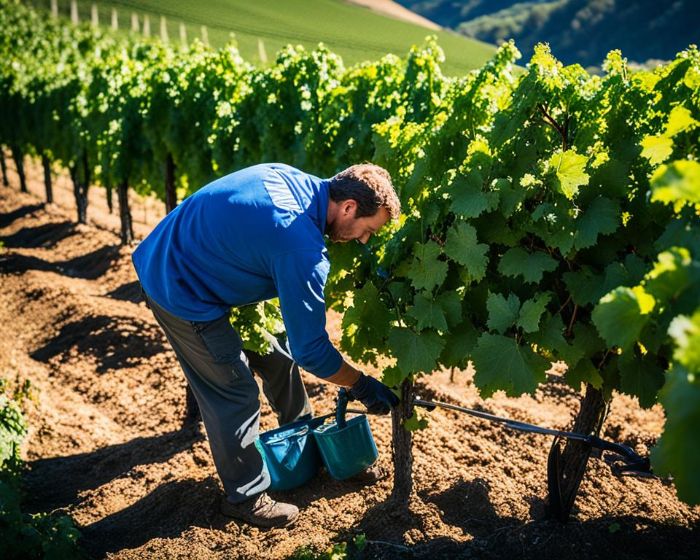
Granular fertilizers are common in non-irrigated vineyards and for soil-test-directed pre-plant correction. Surface-applied material needs rainfall or irrigation to dissolve and move into the root zone. Keep fertilizer away from the trunk and follow the product label or regional recommendation for placement rather than using one fixed distance for every material.
When to use:
- Soil-test-directed phosphorus or potassium correction
- Measured nitrogen where vine status shows a need
- Pre-plant amendments that need root-zone placement
Caution: On slopes, surface application increases runoff risk unless incorporated or irrigated in.
Fertigation – Precision Through Drip Systems
Fertigation integrates nutrient delivery with grapevine irrigation. Liquid or soluble fertilizers are injected into drip systems, so the nutrient schedule has to work with the irrigation schedule rather than compete with it.
Advantages:
- Low labor cost
- Split-dose capability
- Split-dose control when irrigation volume is managed correctly
Limitations:
- Requires compatible system (drip, venturi injector)
- Not suitable for all organics
- Precipitation-prone blends may clog emitters
Apply only when the nutrient is needed and the irrigation event can keep it in the active root zone. Avoid fertigation into saturated soil or before conditions likely to cause runoff or deep leaching.
Foliar Feeding – Micronutrient and Emergency Support
Foliar sprays bypass some soil limitations and deliver nutrients directly through the leaf surface. Uptake is limited, but response can be fast. They are most useful for diagnosed micronutrient deficiencies, with timing based on the nutrient and local recommendation.
Application tips:
- Apply at the timing specified by the product label or local recommendation
- Use products labeled for foliar application of the diagnosed nutrient
- Follow label concentration and temperature limits to avoid leaf injury
Foliar feeding can correct some micronutrient deficiencies, but it does not replace soil and root-zone management. Foliar potassium is especially limited because grapevines require more K than the leaves can practically absorb.
No single application method suits every vineyard. Soil broadcasting may be sufficient for pre-season correction, while fertigation offers tighter control during active growth. Foliar feeding is a tactical tool, not a full solution. The most effective fertilization strategy often involves combining methods – selected by timing, soil behavior, and the vine’s current physiological demand.
Calculating Fertilizer Requirements – Nutrient Demand, Application Rates, and Soil Test Integration
Accurate fertilization starts with quantifying what vines actually need – not estimating based on visual cues or fixed schedules. Nutrient demand shifts with yield targets, growth stages, and soil nutrient reserves. Calculating proper input rates aligns fertilization with vine physiology, minimizing waste and maximizing effect.
Establishing Nutrient Demand by Growth Stage and Yield Target
Grapevines draw nutrients from soil reserves, stored vine reserves, and fertilizer. Annual nutrient uptake varies with cultivar, yield, vine size, irrigation, and region, so uptake data should not be treated as a fertilizer prescription. Start with a soil or tissue recommendation calibrated for grapes in your region.
| Input | What It Tells You | How to Use It |
|---|---|---|
| Soil test | pH and root-zone nutrient supply | Use the laboratory or Extension recommendation for the tested soil method |
| Tissue test | Nutrients actually absorbed by the vine | Compare with grape sufficiency ranges for the sampling stage |
| Vine vigor | Whether growth is weak, balanced, or excessive | Use as context for nitrogen decisions, not as a stand-alone diagnosis |
Do not assign young vines a fixed percentage of a mature-vine fertilizer rate. A well-prepared site may need little or no fertilizer during the first years, while a genuinely infertile site requires a recommendation based on local conditions.
Interpreting Soil Test Data for Input Adjustment
Soil-test categories such as low, medium, high, or very high are not interchangeable between laboratories. Use the fertilizer recommendation supplied with the test or an Extension interpretation calibrated to that laboratory method. Do not convert a generic category into an arbitrary percentage of a fertilizer rate.
Soil pH still matters because a nutrient can be present in the soil but poorly available to roots. Correct the pH or nutrient-availability problem identified by the test rather than treating every low tissue result as a simple fertilizer shortage.
Sample Calculation – Translating Theory into Field Practice
Once a regional recommendation gives the amount of actual nutrient required, use the fertilizer analysis to convert that nutrient target into product weight. The arithmetic is simple; the nutrient target itself must come from the test interpretation, not from a generic grapevine rate.
- If the recommendation is 20 lb actual N/acre and the product is 20% N: 20 ÷ 0.20 = 100 lb product/acre
- If the recommendation calls for split applications, divide the product amount by the specified number of applications
This example demonstrates conversion only; 20 lb N/acre is not a universal grapevine recommendation. Keep the units used by the laboratory and fertilizer label consistent, and confirm whether phosphorus and potassium are reported as P2O5 and K2O before converting product rates.

Precision fertilization depends on translating laboratory and regional recommendations into the actual treated area. Use soil and tissue results as the starting point, check vine vigor and irrigation, and then align the calculated product rate with the chosen application method.
Common Fertilization Mistakes and How to Avoid Them
Fertilizer programs fail not from lack of inputs, but from misapplication – wrong timing, wrong dose, or wrong product for the conditions. Many yield losses and fruit quality issues in vineyards are traceable to predictable errors. Identifying these mistakes before they scale is central to long-term productivity.
Applying Nutrients Without Quantitative Basis
Visual symptoms are unreliable for nutrient status. Applying “just in case” can create nutrient antagonism, especially between potassium and magnesium. Overfeeding nitrogen can drive canopy overgrowth and delay normal maturation.
Avoidance: Base every decision on soil and tissue test data. Use lab-calibrated thresholds, not visual estimations.
Ignoring Application Timing
Inputs given outside an effective uptake window can be lost or produce the wrong growth response. Late nitrogen is especially risky in cold climates because it can prolong vegetative growth and reduce winter hardening. In warmer regions, post-harvest nitrogen may still be used when the canopy remains active and a documented need exists.
Avoidance: Align inputs with root uptake curves and phenological phases. Use split dosing when feasible.
Misaligned Fertilizer Form and Soil Type
Nitrate moves readily through sandy soils, while surface-applied urea can lose nitrogen through ammonia volatilization under unfavorable conditions. High-pH or carbonate-rich soils can also reduce the availability of iron, zinc, and manganese.
Avoidance: Match product chemistry to soil texture, pH, and buffer capacity. Choose delivery method accordingly.
Treating All Vineyard Blocks the Same
Uniform programs ignore slope, drainage, vine age, and past performance. One-size-fits-all fertilization causes overfeeding in low-vigor zones and underfeeding in high-demand areas.
Avoidance: Zone the vineyard based on vigor mapping, yield history, or NDVI. Adjust programs per block.
Effective fertilization avoids broad-spectrum correction and embraces precision. Most mistakes stem from assumptions – assuming all vines behave the same, that more input means better output, or that visible problems define root causes. Replace assumptions with data, timing, and context-specific strategy to keep inputs working as investments, not losses.
Conclusion – Building a Targeted, Responsive Fertilization Program
Fertilizing grapevines is not about more – it’s about match. Matching nutrient types to soil chemistry. Matching dose to vine demand. Matching timing to physiological readiness. The cost of fertilization errors isn’t just in wasted input – it’s in missed yield potential, reduced fruit quality, and long-term vine imbalance.
A high-performing fertilization program is data-driven, phase-specific, and site-calibrated. Soil and tissue tests provide the baseline. Growth stage refines timing after the nutrient need is established. Application method defines delivery. And correction is iterative – guided by observation, not assumption.
Precision outperforms routine. Targeted input outperforms general feeding. Responsive fertilization isn’t complicated – it’s disciplined.
FAQ – Fertilizing Grapevines
How often should grapevines be fertilized?
There is no fixed number of fertilizer applications per season. Some healthy vines need no fertilizer in a given year. Use soil and tissue testing, vine vigor, and regional recommendations to decide whether an application is needed; split doses are useful when a recommended nutrient is better divided.
Can overfertilizing grapevines reduce fruit quality?
Yes. Excess nitrogen can promote excessive vegetative growth and delay ripening. Excess potassium can also depress magnesium uptake, which may contribute to magnesium-deficiency symptoms.
What’s the best fertilizer ratio for grapevines?
There is no universal NPK ratio for grapevines. Choose a fertilizer after identifying which nutrient is deficient. A balanced product such as 10-10-10 can add unnecessary phosphorus or potassium when only nitrogen is required.
Is foliar feeding effective for grapevines?
Foliar feeding can correct some diagnosed micronutrient deficiencies, but it does not replace soil and root-zone management. Follow regional recommendations and the product label because concentration, timing, and the specific nutrient determine whether a foliar treatment is appropriate.
When should fertilization stop in grapevines?
The cutoff depends on climate and the nutrient being corrected. Cold-climate guidance commonly avoids late-summer nitrogen because it can stimulate growth that fails to harden before winter. Warmer regions may use post-harvest nitrogen only when the canopy remains active and a documented need exists.