





Updated March 25, 2026
Garden fountains do more than animate a space visually – they change how the garden sounds, who visits it, and how long anyone stays near it. That low, continuous sound of moving water masks street noise, draws birds within weeks of installation, and triggers a documented drop in mental arousal that marine biologist Wallace J. Nichols describes as the “blue mind” effect in his research on water and cognition. Whether you want a modest bubbling urn on a patio or a tiered stone centerpiece at the end of a garden path, the decision between types is more practical than it looks: material, climate, and placement determine long-term satisfaction more reliably than aesthetics alone.
The types available today span traditional tiered designs through disappearing pondless features and solar-powered spheres, each with a different maintenance load, sound profile, and price range. For gardens with a defined style – formal, Japanese, or naturalistic cottage – the question of which fountain type fits that aesthetic is worth working through before committing to a type, and matching a fountain to your garden’s existing character deserves its own consideration once the basics here are clear.
Key Takeaways:
- Choose disappearing fountains for households with young children – the reservoir sits underground, eliminating any open water surface
- Run any recirculating pump continuously during warm months; still water sitting 72 hours or longer gives mosquitoes the conditions they need to breed
- Granite and dense cast concrete survive freeze-thaw cycles in Zones 4-7; ceramic and unglazed terracotta crack if left outdoors below 28-30°F without draining
- Match pump GPH to total water volume for one full circulation per hour – undersized pumps create still, warm zones where algae establish faster
- Solar panel output drops 20-30% after five years, which narrows the cost advantage over wired pumps on a ten-year timeline
Table of Contents
Types of Garden Fountains – What Each One Actually Does
Fountain types fall into five functional categories. Manufacturers blend aesthetics endlessly, but the underlying mechanics – how water moves, where it collects, and what keeps it running – remain distinct across types.
Tiered and Pedestal Fountains
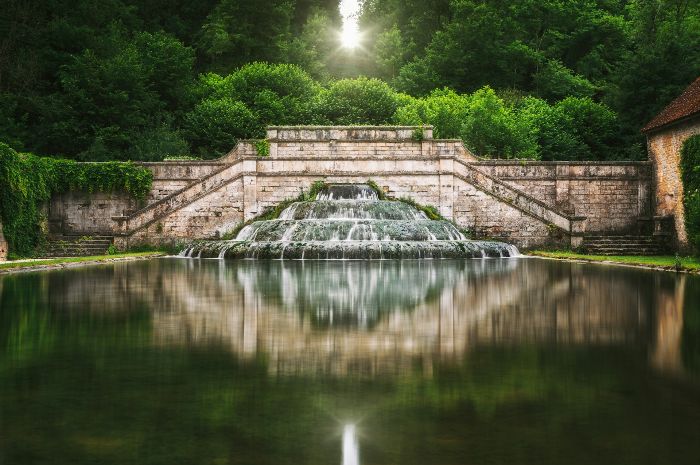
The tiered fountain is the archetype: stone or resin bowls stacked vertically, water spilling from tier to tier into a basin at the base. The design traces its lineage to Roman atrium gardens and Moorish palace courtyards, where moving water signaled both wealth and engineering skill. Today they work best in formal settings and open spaces where there is enough room to read the vertical profile from a distance. Placed at the end of a garden path or at the center of a circular planting bed, a tiered fountain becomes a focal point that organizes the space around it. The more tiers, the louder the cascade.

Pedestal fountains follow the same recirculation logic but concentrate the visual weight into a single column with a basin or bowl at the top. They tend to suit smaller formal spaces where a multi-tier stack would overwhelm the surrounding planting.
Wall Fountains and Weeping Walls
Wall fountains mount against a fence, masonry surface, or freestanding panel and recirculate water from a spout or sculpted face down into a basin at the base. They solve a problem tiered fountains cannot: narrow gardens, side passages, and walled courtyards where floor space is limited. A weeping wall – where water sheets across a textured stone or slate face rather than pouring from a fixed spout – produces a quieter, more diffuse sound than a tiered design. That sheet-flow effect also hides pump hardware more naturally within the wall assembly, leaving a cleaner visual line.
Disappearing and Pondless Fountains
Disappearing fountains sit on a buried reservoir covered by a decorative grate, gravel, or arranged boulders. Water bubbles up through an urn, sphere, or drilled stone and drains back below the surface invisibly. No open basin is visible from above. This design has grown faster than any other category over the past decade for three compounding reasons: no standing water removes the mosquito breeding surface, no open basin eliminates the child safety concern that stops many parents from installing any water feature at all, and the underground reservoir requires almost no debris management compared to an open pool. The tradeoff is access – servicing the pump and reservoir requires moving the surface grate and reaching below grade.
Sphere, Urn, and Bowl Fountains
These are self-contained sculptural pieces – usually sitting on a plinth or nestled directly into planting – where water wells gently from the top or trickles down curved sides. They suit modern, minimalist, and Japanese-influenced gardens particularly well. Smaller versions work as tabletop features for covered patios and enclosed porches. The low visual profile makes them easy to integrate without dominating the space around them.
Solar-Powered Fountains
Solar fountains use photovoltaic panels – integrated into the unit or mounted separately – to run a recirculating pump without any wired electrical connection. They work best in full-sun positions and produce a modest, intermittent flow. The honest limitation: output is tied directly to light levels. They run strongest at midday, slow on overcast days, and stop at night unless paired with battery storage. Panel efficiency also degrades over time, a detail we return to in the cost section.
| Type | Best setting | Sound level | Maintenance load |
|---|---|---|---|
| Tiered / pedestal | Formal gardens, open lawns | High | Moderate |
| Wall / weeping wall | Narrow spaces, courtyards | Low to medium | Low |
| Disappearing / pondless | Family gardens, modern landscapes | Low to medium | Very low |
| Sphere / urn / bowl | Patios, mixed borders | Very low | Low |
| Solar | Sun-exposed informal spaces | Variable | Low (panel care needed) |
Garden Fountain Benefits – The Ones That Hold Up Under Scrutiny
The visual case for a fountain is immediate. The functional benefits are less commonly explained with any precision.
Sound masking. Moving water produces broadband, continuous sound that overlaps with the frequency range of traffic, air conditioning units, and nearby conversations. The brain processes natural water sound differently from mechanical or speech sounds – as environmental background rather than a signal requiring attention. Research into natural soundscapes, including work by the European Centre for Environment and Human Health at the University of Exeter, consistently shows that water sounds reduce self-reported stress and improve perceived environmental quality more than other natural sound types. The practical effect: a fountain positioned between a seating area and a street does not eliminate road noise, but it shifts the dominant sound in the listener’s awareness toward something the brain categorizes as neutral.
Wildlife, with specifics. Still water attracts wildlife; moving water attracts more of it, faster. Birds prefer moving water because agitation at the surface signals freshness. Shallow basins with rough-textured interiors give small birds the grip needed to bathe without slipping. The National Wildlife Federation recommends water sources no deeper than 2-3 inches for most songbirds and perching birds, with gently sloped sides or partially submerged stones that provide footholds. Deeper tiered bowls serve larger species – mourning doves, robins – while hummingbirds use very shallow misters or spray features they fly through rather than land in.

Mosquito prevention. Female Aedes and Culex mosquitoes require water that has been still for a minimum of 72 hours to lay viable eggs. A recirculating pump moving as little as one gallon per hour disrupts the surface conditions they need. This matters most in the South and Gulf states, where mosquito season runs from April through October, and across the Midwest during humid summers. The fountain does not repel mosquitoes from the broader yard, but it removes the breeding site from within the garden itself.
Pro Tip: Angle the pump outlet upward to break the water surface rather than pointing it toward the basin floor. A pump positioned to push water upward creates agitation across more of the surface area, preventing the outer edges of the basin from becoming the calm, warm zones where algae and mosquito activity begin.
The psychological case. Wallace J. Nichols, in his research on water and human cognition documented in “Blue Mind” (2014), describes a measurable calming effect triggered by water proximity – a shift in brain activity away from the default mode network, which governs rumination and self-referential thought. A garden fountain produces a modest version of this effect, not the immersive response of sitting by the ocean, but consistent enough that it compounds over time with regular garden use. For gardens where the goal is spending more time outdoors rather than passing through, a water feature designed around recovery and stress reduction extends this approach further.
Fountain Materials and Frost – What Survives in Your Climate
Material choice determines maintenance load and lifespan more reliably than aesthetics does. The deciding variable in most cases is your USDA hardiness zone and, specifically, how many freeze-thaw cycles the fountain will experience each winter.
Granite and quarried stone are the most durable materials available for outdoor fountains. Granite’s crystalline structure has a near-zero water absorption rate – water cannot penetrate and expand during freezing. A well-constructed granite fountain will outlast the garden around it. Some granite pieces weigh 500 lbs or more, which limits repositioning, but that permanence is also the point. Stacked granite boulders used in disappearing fountain designs have the additional quality of looking more naturalistic as they age, unlike cast materials that often look worse over time rather than better.
Cast concrete and cast stone mimic natural rock and age reasonably well outdoors. Dense, properly cured concrete resists freeze-thaw cycling in Zones 4-7 with seasonal care – drain in late fall, cover if hollow-cast. Lower-quality concrete with higher porosity absorbs water during warm months and cracks when that water freezes. When purchasing, ask specifically for frost-resistant formulation; it is a real specification difference, not just marketing language.
Corten steel and copper age through deliberate surface oxidation – the patina is structural, not cosmetic damage. Corten steel develops its protective rust layer within two to three years; once formed, it seals the metal beneath and halts further corrosion. Copper develops verdigris on a similar timeline. A Corten fountain that looks compromised in year one is fully protected by year three. Both materials suit contemporary and industrial-influenced gardens and perform well across all climate zones. Metal surfaces heat up in direct afternoon sun, which accelerates algae growth in warmer months – afternoon shade extends water quality between cleanings.
Fiberglass and resin are lightweight, accurately mimic stone or metal appearances, and arrive at a fraction of the cost of natural materials. The failure point that product pages consistently omit: UV radiation makes fiberglass brittle over 8-15 years, with degradation accelerating in high-sun climates like Arizona or the Texas Gulf Coast. Resin fountains fade and chalk within 5-7 years without UV-resistant coatings. These materials make practical sense for renters, for gardens still evolving in layout, or as lower-commitment starting points.
Ceramic and terracotta suit covered patios and mild-climate gardens in Zones 8-10. Both crack when retained water freezes and expands inside. Glazed ceramic handles temperature swings better than unglazed terracotta, but both should be drained and moved indoors in any zone that sustains temperatures below 28-30°F for more than a few consecutive days. The cool, slightly mineral smell of wet glazed ceramic on a July morning is one of the more specific sensory pleasures this material produces – worth the seasonal effort in mild climates, not in cold ones.
| Material | Frost tolerance | Expected lifespan | Best zone range |
|---|---|---|---|
| Granite / quarried stone | Excellent | 50+ years | All zones |
| Cast concrete (dense) | Good | 20-40 years | Zones 4-9 |
| Corten steel | Good | 30+ years | All zones |
| Copper | Good | 30+ years | All zones |
| Fiberglass / resin | Fair (UV-limited) | 8-15 years | All zones |
| Ceramic (glazed) | Fair | 15-30 years | Zones 7-10 outdoors |
| Terracotta (unglazed) | Poor | 5-20 years | Zones 8-10 outdoors |
Fountain Sizing and Placement – The Decisions Most Buyers Skip
A fountain 20% too small for its space looks like an afterthought. One that is oversized crowds the planting around it and competes with everything it was meant to anchor.
Matching Scale to Space
The rule of thumb used by most landscape designers: a fountain’s height should roughly match the width of the planting or hardscape zone immediately surrounding it. A tiered fountain standing 36 inches tall suits a planting island 4-6 feet across. For wall fountains, the fixture width should not exceed one-third the width of the wall it mounts on – wider than that and it reads as furniture rather than an architectural element. These are calibration points, not rigid geometry, but they prevent the most common sizing decisions buyers regret six months after installation.
Sound as a Design Variable
Two mechanical factors control how audible a fountain is from 15-20 feet away: the height water falls and the volume flowing per minute. A 12-inch drop sounds different from a 30-inch drop running the same pump. Increase drop height when you want the sound to reach a seating area across the garden; reduce it for ambient background presence in a small enclosed courtyard. If the goal is to hear the fountain from a patio 20 feet away, target a design with at least a 15-18 inch water drop and a pump rated above 250 GPH.
Shade from afternoon sun slows algae growth and reduces evaporation – a fountain positioned to receive morning sun and afternoon shade manages both simultaneously. Avoid placing any open-basin fountain directly below deciduous trees: fallen leaves decompose in the water and create a nutrient spike that feeds algae faster than any other variable in the garden. If an open basin is part of the design, understanding how water features interact with the broader garden ecosystem pays off during the planning stage rather than after the fact.
Pump sizing. The standard guidance from landscape contractors: pump GPH should at minimum equal total water volume to achieve one full circulation per hour. A fountain holding 40 gallons needs a minimum 40 GPH pump. Undersized pumps fail to move water through the entire basin, creating warm, oxygen-poor zones along outer edges where algae colonize first. If a fountain that ran clean suddenly develops persistent algae after a pump swap, an undersized replacement pump is usually the explanation.
Garden Fountain Costs – Realistic Numbers Before You Shop
Cost ranges are almost entirely absent from pages currently ranking for this topic, which is unusual given that budget is typically the first filter buyers apply.
| Type | Entry-level | Mid-range | High-end |
|---|---|---|---|
| Tabletop / small patio urn | $30-$150 | $150-$400 | $400+ |
| Wall fountain (resin/fiberglass) | $150-$350 | $350-$900 | $900-$2,500 |
| Tiered (resin or fiberglass) | $150-$500 | $500-$1,200 | $1,200-$3,000 |
| Tiered (cast stone or granite) | $600-$1,500 | $1,500-$4,000 | $4,000-$15,000+ |
| Disappearing fountain (kit) | $300-$600 | $600-$1,500 | $1,500-$5,000 installed |
| Sphere / urn / bowl | $200-$500 | $500-$1,200 | $1,200-$4,000 |
Observation: I have noticed that buyers consistently underestimate operating cost. A pump running 24 hours a day at 80 watts costs approximately $7-$10 per month at average US electricity rates. Solar eliminates that ongoing cost, but a quality panel with battery backup runs $150-$400 upfront, and panel efficiency degrades 20-30% over five years. On a ten-year horizon, the total cost of a solar setup and a wired low-voltage setup often lands within a few hundred dollars of each other – considerably closer than the upfront price difference suggests.
Large granite or cast stone fountains above 200 lbs commonly require freight delivery ($200-$600 additional) and sometimes professional installation when the site is not accessible by dolly. In enclosed courtyards surrounded by narrow gates or fencing, crane access may be needed. That cost rarely appears in product listings, but it appears on the invoice.
Narrowing It Down
If you are working with a narrow urban garden or walled courtyard where floor space is limited, a wall fountain attached to an existing fence or masonry surface gives you moving water without claiming any square footage. A small basin at the base, a submersible pump, and a weekend is enough to install most kits. The fountain for a space this size does not need to be large – a 24-30 inch wall-mounted piece in an enclosed setting produces more perceived sound and visual movement than the same piece would in an open lawn.
If children under five use the garden regularly, a disappearing fountain removes the safety concern entirely. There is no open basin, no visible water surface, and no accessible pump housing. The aesthetic result – water bubbling up through stones or a sphere – works well in contemporary and informal gardens, and the underground reservoir means debris management stays minimal year-round.
If the goal is a long-lived centerpiece for a formal or traditional garden and the budget allows, a tiered cast stone or granite fountain on a level surface will outlast every other investment in that garden. Drain it before the first hard freeze in Zones 6 and colder, clean the pump filter twice a season, and the maintenance commitment stays light indefinitely. It is also the fountain type most consistently associated with measurable property value increases in gardens where curb appeal carries weight.
If you are in the first or second year of a new garden and the layout is not yet settled, a self-contained sphere or urn fountain is the right starting point. It is portable, relatively inexpensive, and repositionable as the planting develops around it. Getting water into the garden now – in any form – will tell you more about where the sound is needed than any amount of planning on paper.
Conclusion
A garden fountain earns its place through accumulation – the background sound that makes the rest of the garden feel quieter than it is, the birds that appear within weeks of installation, the way a seating area used occasionally becomes one that pulls people into the garden without effort. Type matters less than the fit: a modest disappearing fountain in the right location does more perceptible work than a large tiered piece dropped onto a lawn without attention to scale or sound.
The material and climate decisions deserve as much attention as the aesthetic ones before purchase. A granite fountain that looks indistinguishable from its fiberglass counterpart on the product page will still look that way in fifteen years; the fiberglass one will not. Match the material to your hardiness zone, drain before the first sustained freeze below 28°F, and the maintenance arithmetic stays honest for the life of the piece. The sound of water falling a foot over wet stone on a still morning – that part stays constant regardless of the material.
FAQs
What type of garden fountain is the easiest to maintain?
Disappearing fountains require less ongoing attention than any other type. Because there is no open basin, leaves and debris fall through the surface grate into the underground reservoir rather than floating and decomposing in a visible pool. The pump runs submerged below grade and typically needs filter cleaning once per season in moderate climates. Open-basin tiered and wall fountains require more frequent attention – debris removal, algae brushing, and water top-offs in hot months amount to roughly 20-30 minutes of maintenance per week during summer. The pump is the component that fails first regardless of fountain type, usually after 3-8 years depending on quality and how often it runs dry.
What happens if a fountain pump is undersized?
An undersized pump fails to circulate water through the entire basin volume within a reasonable cycle time, which means the outer and lower sections stay warm and oxygen-poor. That combination – warm, still, nutrient-present water – is exactly what algae need to establish a foothold. Growth accelerates, water quality deteriorates faster between cleanings, and the pump works harder against partial blockage. If a fountain that ran clean through the previous season suddenly develops persistent algae after replacing the pump, a smaller replacement GPH rating is almost always the cause. Matching pump GPH to total basin volume corrects the problem without any other intervention.
Can you leave a garden fountain running through winter?
In Zones 7 and warmer, where temperatures rarely drop below 28°F for extended stretches, running a fountain year-round is generally safe as long as water keeps flowing – moving water resists freezing at temperatures that would lock a still surface. In Zones 6 and colder, a fountain cycling through a hard freeze risks cracking the pump housing, pipes, or basin as water expands inside them. Standard practice in colder climates: drain the fountain and store the pump indoors before the first sustained freeze, usually between mid-October and mid-November depending on location. Ceramic and terracotta pieces should be moved indoors entirely; cast stone and granite can stay outside if fully drained.
Are garden fountains safe to have around small children?
Open basins of any depth present a risk for children under three, and child safety guidelines treat any accessible outdoor water feature as a hazard at that age regardless of depth. A disappearing fountain with an underground reservoir removes the open water entirely – there is no accessible surface, and the buried reservoir is covered and weighted. If an open-basin fountain is already installed, a steel mesh grate fitted over the basin top – rated to support a child’s weight – is a practical retrofit that does not significantly change the fountain’s appearance. Standard tiered basins are typically 4-8 inches deep at the lower bowl, which is shallow but not safe for unsupervised toddlers.
Do garden fountains attract mosquitoes?
A fountain with a functioning recirculating pump prevents mosquitoes rather than attracting them. Female Aedes and Culex mosquitoes need water that has been still for at least 72 hours to lay viable eggs, and continuous pump operation prevents that condition from developing. The risk appears only when the pump is off: during power outages, pump failures, or at the end of the season when the fountain is shut down but the basin is left full. The practical rule is to drain any open basin before an extended pump shutdown rather than leaving standing water in place. A disappearing fountain with a covered underground reservoir presents almost no mosquito risk even when not running, because the reservoir is sealed and shaded from the surface warmth that accelerates larval development.
How long does an outdoor garden fountain last?
Lifespan depends almost entirely on material. A granite or dense quarried stone fountain maintained in a temperate climate lasts 50 years or more without structural deterioration – some Roman stone fountains remain functional today. Dense cast concrete typically runs 20-40 years before surface spalling becomes significant. Fiberglass and resin degrade from UV radiation regardless of care; 8-15 years is a realistic expectation, faster in high-sun climates. Glazed ceramic stored indoors during winter can last 15-30 years outdoors; left outside through freeze-thaw winters without draining, it typically cracks within 3-5 seasons. The pump fails independently of the fountain body, usually after 3-8 years for quality submersible models, and is straightforward to replace without disturbing the fountain itself.
Can a solar garden fountain run at night?
A solar fountain without battery storage stops running when light drops below the panel’s operating threshold – around dusk, or earlier on overcast days. This means no sound and no movement at night, which is when many people actually use a garden seating area. Solar fountains with integrated battery backup maintain flow through the evening and on cloudy days, but the battery adds $50-$150 to the unit price and represents a component that degrades over 3-5 years and will eventually need replacement. For gardens where continuous day-and-night operation matters, a low-voltage wired pump connected to an outdoor GFCI outlet remains more dependable than any consumer-grade solar configuration. For a water feature used primarily as a daytime visual element in a sun-exposed bed, battery-free solar is a reasonable and low-maintenance option.
What is a realistic size for a small garden fountain?
A tabletop fountain operates in as little as a 12-inch footprint with a reservoir holding 1-2 gallons, though outdoor exposure to direct rain can overflow shallow basins quickly. The smallest outdoor fountain with meaningful sound and visual presence is typically a self-contained sphere or urn design standing 18-24 inches tall with a 4-6 gallon basin. Below that size, the water volume is too low to maintain quality for more than a few days without daily top-offs, and the sound produced is audible only at arm’s length. For most outdoor garden contexts, 24 inches in height is the practical lower limit for a self-sustaining feature that does not require daily attention. Wall fountains are an exception – a 20-inch wall-mounted piece in a small enclosed courtyard reads larger than the same dimensions would suggest in an open space.