Last Updated August 09, 2026
How to grow pineapples starts with treating the plant as a bromeliad, not as a miniature fruit tree. A grocery-store crown can root and eventually produce fruit, and it needs much brighter light than an average houseplant plus less moisture around its shallow roots than many beginners expect. Start it in a modest pot with a fast-draining mix, introduce stronger sun gradually, and allow roughly 18 to 36 months for the full journey from planting to harvest. A firm crown base and fresh leaves emerging from the center are the early signs that you are on the right track.
Begin with a clean crown, slip, sucker, or healthy nursery plant. Give it full sun outdoors or the brightest warm indoor position, keep its shallow roots in a fast-draining mix, and expect roughly 18 to 36 months from planting to harvest.
Key Takeaways
- Remove every trace of fruit flesh before rooting a crown.
- Use a modest pot and let the upper mix begin drying between waterings.
- Provide full sun outdoors or the strongest warm indoor light available.
- Allow 18 to 36 months for a crown to progress from planting to harvest.
Table of Contents
How to Grow Pineapples: Quick Start
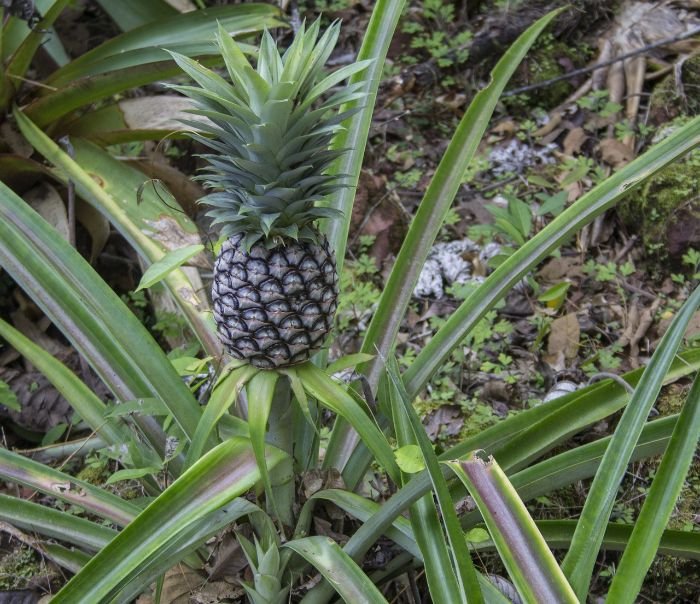
A pineapple belongs to the bromeliad family. Its leaves form a rosette around a short central stem, and a surprisingly small root system sits close to the surface. That is why a deep, constantly wet pot causes more trouble than a brief dry spell. The leaves need strong light; the roots need warmth, air, and reliable drainage.
Your starting material determines how long the first stage will take. A grocery-store crown is easy to obtain and starts small. Slips and suckers taken from a healthy fruiting plant have more stored energy and often mature sooner. Buying a nursery plant skips the rooting stage entirely. Check the label because some compact pineapples are ornamental cultivars selected for appearance, not for a useful edible crop.
- Fruit crown: an inexpensive propagation project with the longest wait.
- Slip or sucker: a larger start when a healthy mature plant is available.
- Nursery plant: skips rooting; confirm that it is an edible Ananas comosus cultivar.
In a frost-free climate, a pineapple can stay outside in full sun. Everywhere else, a container is the practical choice because the plant can be moved before cold nights. Do not interpret drought tolerance as permission to leave it dry for weeks, though. Repeated drought slows leaf production; prolonged saturation rots the roots. The useful middle ground is evenly available moisture followed by enough drainage and air.
Start a Pineapple Plant From the Top
When choosing a pineapple to propagate, look past the size of the fruit and inspect the crown. The inner leaves should be green and firmly attached. Leave behind a crown with a sour smell, gray softness at the base, obvious scale insects, or a center that pulls apart in your hand. Clean potting mix cannot rescue tissue that is already rotting.
- Twist off the crown or cut about 1 inch below it.
- Trim away every piece of sweet, moist fruit flesh.
- Remove several lower leaves to expose the short stem.
- Let the cut surface dry in shade for several days.
- Set the bare stem into a coarse, damp rooting medium.
- Keep it warm in bright, indirect light during root formation.
The short drying period is simple insurance against rot. When you pot the crown, bury only the stripped section of stem; the lowest green leaves should remain above the mix. If the crown wobbles, support it with a loose stake without pressing the mix into a hard plug around the stem.
Iowa State University recommends perlite, vermiculite, or coarse sand for rooting a pineapple top and notes that roots commonly develop in six to eight weeks. Keep the medium slightly moist, never wet. There is no need to pull the plant out to check: new center growth and gentle resistance when you tug the crown tell you that roots have started. A blackened, soft center means rot has taken hold.
Choose the Pot, Soil, and Location
Do not move a newly rooted crown straight into an oversized container. A pot about 6 to 8 inches wide is enough for the first stage and dries more predictably around a small root system. Move up when roots hold the mix together and new leaves are appearing regularly. For long-term fruiting, UF/IFAS recommends a 3- to 7-gallon container with drainage holes. Choose a broad or heavy base because the mature rosette and fruit stalk can become top-heavy.
Use fresh potting mix, not soil dug from the garden. A commercial bromeliad mix is suitable, or you can open up ordinary potting mix with coarse bark, perlite, or another durable drainage material. The mix should hold some moisture without remaining dense and glossy-wet for days. Use the same principles as a well-drained container soil mix, then adjust for how quickly pots dry in your climate.
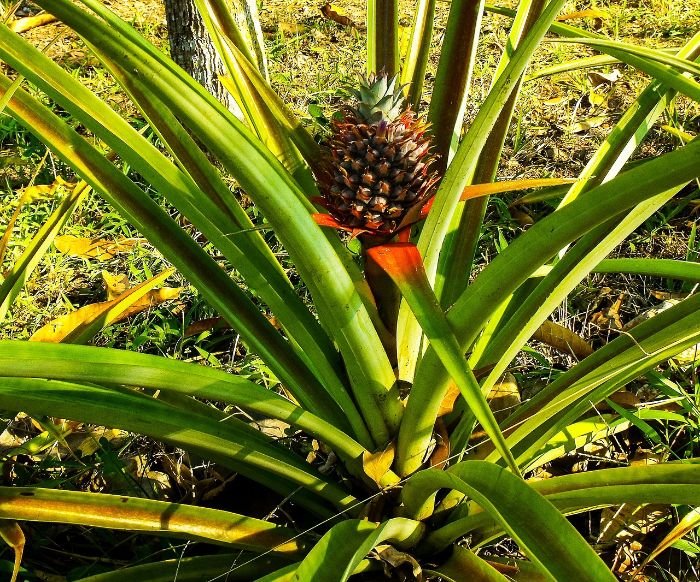
For outdoor plants, choose a warm site that receives full sun and sheds water after heavy rain. UF/IFAS gives a spacing range of 12 to 36 inches; use the wider end when you want larger plants and easier access around their sharp leaves. Keep lawn equipment away from the short central stem, where a cut can open living tissue to decay.
Full sun is the target after acclimation. Leaves formed indoors can scorch in hard midday light, so begin with morning sun and extend the exposure over a week or two. Bleached tan patches after the move indicate sunburn. Long, floppy leaves and an open, stretched rosette usually mean the plant still needs more light.
Pineapple Plant Care: Water and Fertilizer
There is no useful universal watering schedule for pineapple plant care. Check the upper 1 to 2 inches of mix with a finger or wooden skewer. When that layer has begun to dry, water until excess runs from the drainage holes, then empty the saucer or outer pot. A pineapple often tolerates being a little late for water; it does not tolerate sitting in cold, airless mix.
Do not diagnose leaf color without checking the pot. Folded older leaves on a light, dry container call for a thorough drink. Red-yellow decline in mix that remains wet points to stressed roots. Brown margins may come from drought, fertilizer salts, hard water, or wind exposure, so the moisture check should come before the watering can.
Choose a complete pineapple plant fertilizer that supplies nitrogen, phosphorus, potassium, and micronutrients. A product labeled for edible container crops or fruiting tropical plants is the safest fit. Apply it to moist soil at the label rate during active leaf production. Several light feedings are easier on confined roots than one heavy dose, and feeding should slow when cool weather or weak indoor light stops active growth.
| Visible sign | Likely cause | First correction |
|---|---|---|
| Soft base and sour smell | Crown or root rot | Remove decayed tissue and correct wet, cold conditions |
| Pale folded older leaves | Dry root zone or restricted roots | Check moisture and container fill before watering |
| Brown tips with salt crust | Fertilizer salts or hard water buildup | Flush the mix and reduce fertilizer concentration |
| White cottony clusters | Mealybugs | Isolate, inspect leaf bases, and control ants outdoors |
| Leaning fruit stalk | Fruit weight or weak support | Use a padded stake before the stalk creases |
Look into the leaf bases every few weeks. Mealybugs and scale hide where the stiff leaves overlap; ants may protect them outdoors. Isolate an infested pot and remove visible pests before they spread. Any treatment must be labeled for pineapple or edible crops. Work gently around the center of the rosette because that growing point will produce every future leaf and, eventually, the flower stalk.
Grow Pineapples Indoors or Outside
You can grow a pineapple indoors. Keeping one alive is easier than getting it to fruit. Use the brightest window available – usually a south-facing window in the Northern Hemisphere – and keep the leaves away from cold glass and heating vents. If winter growth becomes thin or stops altogether, a suitable grow light is more useful than moving the pot around a dim room.
A summer outdoors can make a noticeable difference because the plant can build a broader, sturdier rosette in real sun. Wait for warm nights, acclimate the leaves gradually, and bring the pot back in before frost. Leave room around it: Ventura County UC Cooperative Extension notes that a healthy pineapple can spread several feet, and the sharp leaf tips soon become awkward beside a doorway or narrow path.
Where the pot sits also changes how often it needs water. A dark container on hot paving may dry quickly; a nursery pot hidden inside a glazed cachepot can remain wet at the base. Check reflected heat, wind, and drainage as well as light when deciding where a container plant should sit.
Permanent outdoor planting makes sense only in a warm, frost-free district or a genuinely protected microclimate. As with other tropical fruits grown beyond their native climate, winter protection must be part of the plan before planting. A container provides the simplest escape from a cold snap. A plant in the ground cannot be moved, and even nonlethal cold may delay flowering or ruin a developing fruit.
Flowering, Fruit, and the Long Wait
Flowering starts in the center of a mature rosette. The new growth tightens, the center may take on a reddish color, and small violet-blue flowers appear around a short spike. Those individual flowers eventually fuse into the single pineapple fruit. Until that change begins, fresh center leaves are the best indication that the plant is still building toward maturity.
How Long Does It Take to Grow a Pineapple?
In home conditions, planting to harvest commonly takes about 18 to 36 months. UF/IFAS places many Florida plantings near 18 to 24 months and gives a wider 18-to-36-month range for subtropical sites. A small crown usually occupies the slower end; a large sucker or slip may mature sooner. Once flowering begins, the fruit itself generally needs another five to seven months.
The calendar is only a range. Starting size, cultivar, warmth, light, water, and nutrition all affect it, and a plant spending winter in weak indoor light may take much longer. Size matters at flowering as well: a small rosette has fewer leaves supplying the developing fruit, so an early flower often means a smaller pineapple.
The current Florida home-landscape pineapple guidance lists cool weather, short days, and drought among the conditions that may trigger flowering. That does not make a weak plant ready. Home methods using ripening apples rely on ethylene, and results vary with maturity and temperature. Avoid calcium carbide in home fruit production because unsuitable material can contain harmful impurities.
After the fruit appears, avoid swings between bone-dry and saturated soil. A leaning stalk can be tied loosely to a bamboo stake before it creases. If the main fruit is the priority, remove excess slips and suckers; keep one strong sucker when you want the mother plant to continue into a ratoon crop.
Harvest Fruit and Keep the Plant Going
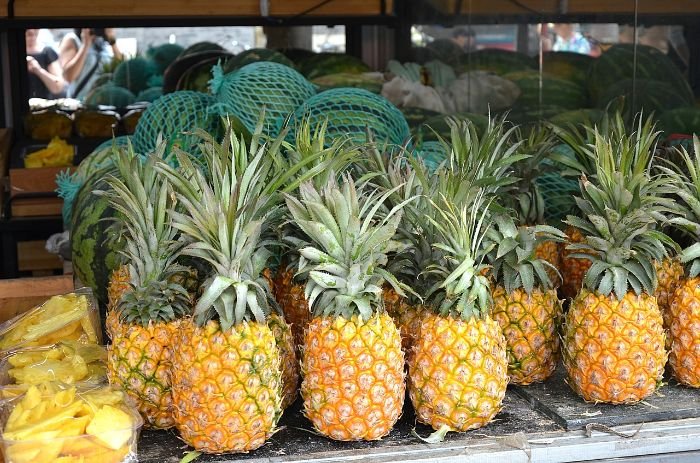
Check the base first when deciding whether to harvest. The eyes flatten, green begins to turn yellow, and a sweet pineapple scent becomes noticeable close to the shell. Some cultivars color less than others, so use full size and aroma alongside the color change. Pineapple gains little sweetness after picking; an immature fruit may soften indoors without developing the flavor it would have gained on the plant.
Wear gloves and cut the ripe fruit with a short section of stalk attached. Save its crown if you want another propagation project. The original growing point will not produce a second main fruit; the mother plant can continue through one well-placed sucker growing on as a ratoon crop. Pot the remaining healthy slips and suckers separately or remove them so they do not crowd the replacement.
Fresh Pineapple, Bromelain, and Portion Size
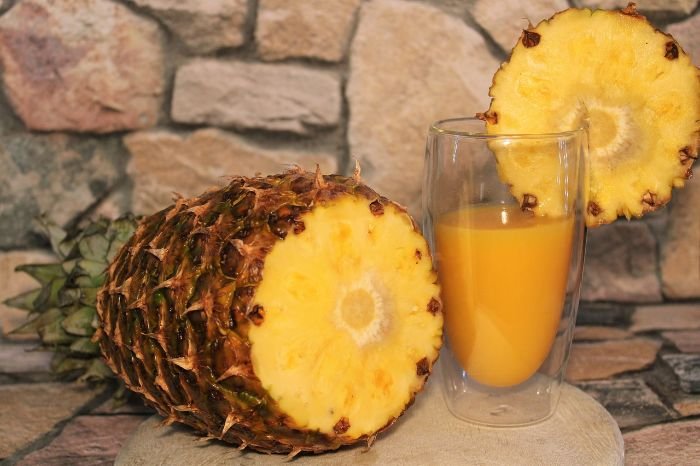
Fresh pineapple contains bromelain enzymes, especially in the tougher stem and core tissues used for commercial extraction. Heat reduces that enzyme activity, which is why fresh pineapple can tenderize protein and canned fruit usually cannot. Acidity and active enzymes can also leave a prickly feeling in a sensitive mouth; a smaller portion with a meal may be more comfortable than a large serving on its own.
Keep the health claim in proportion. Eating the fruit is not the same as taking a standardized bromelain supplement, and pineapple should not replace treatment for pain or inflammatory disease. The National Center for Complementary and Integrative Health discusses oral bromelain products separately from ordinary food use. Fresh pineapple still provides vitamin C, water, carbohydrate, and fiber, as shown in USDA FoodData Central. If the core feels too woody, slice it thinly, chop it small, or blend it into another dish.
Conclusion
If you remember one rule, protect the shallow roots from cold, wet soil. Begin with a clean, dry crown base, use a modest pot, and wait for the upper mix to begin drying before watering again. Once new center leaves appear, increase the light gradually and feed lightly during warm, active growth.
A crown is a slow project, commonly taking 18 to 36 months from planting to harvest. The checkpoints are easy to read: firm new leaves mean it has rooted, a compact rosette shows that the light is adequate, and yellowing plus a sweet aroma at the base signal that the fruit is ready. After harvest, keep one strong sucker if you want the plant to continue into a second crop.
FAQ
Can you grow a pineapple from a grocery-store top?
Yes. Remove all fruit flesh, expose the lower stem, let the cut surface dry for several days, and place it in a coarse, slightly moist medium. New center growth and resistance to a gentle tug show that roots are forming.
Can pineapple grow indoors?
Yes. Fruiting requires more light than simple survival. Use the brightest warm window available, add a grow light when winter light is weak, and move the pot outdoors gradually during frost-free weather when possible.
Does a pineapple plant produce more than one fruit?
The original center produces one main fruit. After harvest, one sucker can remain on the mother plant and develop into a ratoon crop. Other slips, suckers, and the harvested crown can start separate plants.
Why is my pineapple plant turning yellow or red?
Check the potting mix first. A light, dry pot may need water. Red-yellow decline in wet soil points to cold or damaged roots. Salt buildup, root restriction, and nutrient problems can cause similar color changes.
Should you cut brown tips from pineapple leaves?
You can trim dead brown tissue with clean scissors, leaving a narrow dry margin. Trimming only improves appearance, so also check watering, fertilizer salts, hard water, wind exposure, and cold damage.