


Updated April 22, 2026
The first sentence any watering can buyer hears is “it depends on your garden” – which is technically true and practically useless. A 10-liter galvanized steel can looks authoritative on a garden center shelf, but filled to capacity it weighs close to 22 pounds, and a can you dread picking up is a can you use less. Every choice here has a real consequence for your plants and your back.
This guide cuts through the category labels to show you what each feature actually does, where it matters, and where it is just marketing. If you tend a raised vegetable bed, a windowsill collection, or both, the right answer looks different – and knowing why makes the difference between a tool you reach for daily and one that ends up in a corner.
Key Takeaways:
- Match capacity to your garden size – 4 to 6 liters covers most raised beds without the back strain of larger cans
- Remove the rose head when watering established shrubs; a direct stream reaches the root zone faster
- Never use an outdoor garden can for houseplants – the wide pour pattern triggers overwatering on contained soil
- Check the spout-to-body seam before buying – this is where plastic cracks and metal rusts first
- Two 4-liter cans often outperform one 10-liter can for gardeners with wrist or shoulder strain
Table of Contents
Plastic, Metal, and Copper – What the Material Changes Beyond Appearance
Most buying guides present material as a trade-off between price and durability. That framing misses a few things worth knowing.
Plastic cans dominate the market for a reason – they are light, they do not rust, and a well-made one with UV stabilizers holds up for five to seven years of outdoor use before the body begins to degrade. The weakness is the spout joint. On cheaper models, the plastic fitting where the spout connects to the body is the first point to crack under repeated full-load carry. Pick up the can by the spout before buying and feel whether that joint moves. It should not.
There is one real concern with plastic for edible gardeners: some older or lower-grade resins can leach trace compounds into standing water in warm conditions. The smell of a sealed plastic can left in the sun gives you an honest signal. BPA-free labeling is now standard on most garden center stock, but it is still worth noting if you are growing vegetables you plan to eat fresh.
Galvanized steel cans are heavier, noticeably so when full, but the build quality tends to be uniform and the lifespan is 15 to 20 years with minimal care. The Royal Horticultural Society has long recommended galvanized steel for gardeners who want a one-time purchase rather than periodic replacement. Rust begins at scratches or chips, so a quick annual touch-up with a rust-inhibiting paint on any bare spots keeps them going.
Copper is the exception in this category – not a premium vanity purchase but a material with functional advantages. Copper has natural algicidal properties: algae, which cloud the inside of most cans left outdoors, rarely establish in copper vessels. The interior stays cleaner for longer without scrubbing. Copper develops a verdigris patina within a few months outdoors, which some gardeners find attractive and others dislike. The cost is significantly higher – two to four times a comparable galvanized can – but for gardeners who use their can daily, it is a legitimate long-term choice.
Ceramic cans sit outside this conversation for practical purposes. They are decorative objects that happen to hold water, suitable for a windowsill orchid collection. Do not take one anywhere near a border.
| Material | Typical lifespan | Weight when full (6L) | Best use |
|---|---|---|---|
| Plastic (UV-stabilized) | 5-7 years | 13 lbs / 6 kg | General outdoor, budget-friendly |
| Galvanized steel | 15-20 years | 17 lbs / 7.7 kg | Serious garden use, long investment |
| Copper | 20+ years | 17 lbs / 7.7 kg | Daily use, algae-resistant, patina aesthetic |
| Ceramic | Variable (fragile) | Heavy per liter | Decorative indoor only |
Watering Can Capacity – The Number That Determines How Many Trips You Make
A full 2-gallon (approximately 8-liter) watering can weighs about 18 pounds. A 2.5-gallon can, a size sold as “standard” at many hardware stores, tops 22 pounds when full. How many times in a watering session do you lift that over your shoulder height to reach a hanging basket?
The ergonomic ceiling for most gardeners is around 4 to 6 liters (roughly 1 to 1.5 gallons). That range covers most raised beds, mixed borders, and container collections without exhausting the wrist before the session is done. Oregon State University Extension recommends applying about 1 inch of water per week to vegetable gardens in moderate climates – for a 4 x 8 foot raised bed, that is roughly 20 liters per week, which means five trips with a 4-liter can or three with a 6-liter. Manageable either way, and the lighter can means fewer mistakes.
Small cans in the 1-to-2-liter range are precision tools for seedling trays, propagation benches, and tight indoor collections. They should not be your only can, but they are genuinely useful for stages where a larger pour pattern would flatten or disturb young root systems.
How many trips to the tap does your current routine actually add up to in a week? Most gardeners underestimate this, then overcorrect by buying the largest can available and find they fill it halfway every time because the full weight is impractical.
| Capacity | Full weight (approx.) | Best for |
|---|---|---|
| 1-2 L (0.25-0.5 gal) | 2-4 lbs | Seedling trays, small indoor collections, propagation |
| 4-6 L (1-1.5 gal) | 9-13 lbs | Raised beds, mixed borders, container gardens – the practical sweet spot |
| 8-10 L (2-2.5 gal) | 18-22 lbs | Large ground-level beds only; avoid for overhead or basket watering |
Pro Tip: Before buying a large can, fill it to capacity at the store using the sink near the garden center (most staff will allow this). Carry it 30 feet. If you feel it in your forearm grip within that distance, size down. The can you reach for every day is worth more than the one that looks right on paper.
The Rose Head – Why This One Attachment Decides Whether Seedlings Survive
A rose head – sometimes called a rosette or sprinkler head – is the perforated disc that threads or clips onto the spout end to break a single stream into dozens of smaller drops. It mimics light rain. For seedlings, this matters more than almost any other factor in watering technique.
The physics are straightforward: a direct stream of water at a seedling tray applies pressure that disturbs the surface, exposes roots, and can displace germinating seeds entirely. A fine rose with holes under 1mm in diameter delivers the same volume at a fraction of the impact force. Experienced propagators at university extension programs note that damping-off in seedlings is frequently attributed to overwatering, when the actual culprit is waterlogging caused by incorrect pour pressure rather than volume.

Rose heads come in two orientations. An upward-facing rose (where the perforated face points up and the water curves back down) produces the gentlest, most rain-like shower. A downward-facing rose is slightly more forceful. Most outdoor garden roses are downward-facing, which is appropriate for established plants but too aggressive for germination trays.
For established shrubs, perennials, and ground-level beds, remove the rose entirely. Directing water straight to the soil at the plant’s base delivers moisture to the root zone and avoids wetting foliage, which can encourage fungal issues in humid conditions. A consistent watering schedule matters more than the method for established plants.
The practical test: check whether the rose on the can you are considering is removable by hand, without tools. Removable roses are easier to clean when the holes clog with mineral deposits, and they give you the flexibility to switch modes. Fixed roses eliminate that choice.
Spout and Handle Design – What Controls Balance More Than Weight
A long spout is not just about reach – it shifts the balance point of the can forward and lowers the arc of the pour. This matters when you are navigating under foliage to water at the base of a dense plant, or reaching a hanging basket overhead without tipping water back onto yourself.
Standard outdoor cans have spouts in the 12 to 16 inch range, which works well for ground-level borders and raised beds. If you water hanging baskets regularly, look for spouts at the longer end or cans specifically designed with a high-arc spout – these let you bring the can to waist height and still clear the basket rim.
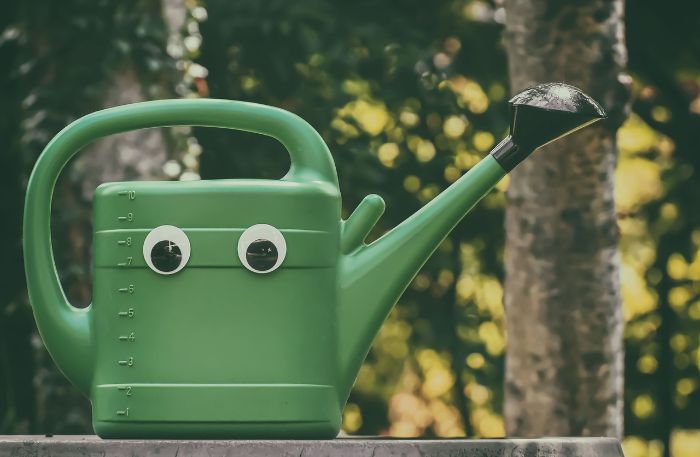
Handle placement determines where the full weight lands in your hand. Most garden cans have a single handle at the top of the body. This works, but the load swings forward as you tip the can to pour, which is where wrist strain comes from. Some cans add a secondary handle near the base of the spout – this gives you a two-point grip and distributes the weight more evenly during the pour. If you water for more than 20 minutes at a stretch, the two-handle design is worth seeking out.
One thing rarely mentioned in buying guides: pour the can out completely at the end of each session and store it upside down or on its side. Standing water left in a can – plastic or metal – is the fastest route to algae, mineral scale, and bacterial growth that eventually transfers to your plants. A quick tip-and-empty takes three seconds and extends the can’s useful life significantly.
Indoor Watering Cans – Why Your Garden Can Goes Wrong Inside
The wide rose head that works beautifully on a raised vegetable bed becomes a problem the moment you bring it indoors. When you water a potted houseplant with a standard outdoor can, you distribute water across the entire surface of the potting mix, which creates a wet surface layer that encourages you to water again sooner than the root zone actually needs it. The result is a common cycle: surface dries, you water, root zone stays saturated, roots suffocate.
Indoor watering cans are built around a narrow, long spout specifically because it forces the water to the base of the stem – directly over the rootball, where it needs to be. The narrow pour also means you can reach under leaves without disturbing the canopy, and navigate dense collections of pots without knocking things over.
Capacity for indoor cans tops out at 2 liters for most situations. A 1-liter can is easier to handle for collections on shelves and stands. If you have more than 15 indoor plants across multiple rooms, consider one can per area rather than carrying a single can around the house – it reduces the chance of water marking floors and keeps the routine faster. For longer stretches away from home, a dedicated vacation watering system handles what a can cannot.
One useful habit from professional nurseries: fill your indoor can from a bucket that has sat at room temperature overnight rather than directly from the cold tap. Cold water can temporarily shock sensitive tropical plants, and the brief wait also lets chlorine off-gas from municipal water.
Signs of a Quality Build – What Fails First and What to Check
Watering cans rarely fail all at once. They fail at specific points, and knowing which points to check before you buy saves a frustrating replacement six months in.
The first failure point is the joint where the spout connects to the body. On plastic cans, this is a molded fitting that cracks under repeated heavy-load carry. On metal cans, it is a soldered or welded seam that can corrode or open if the solder is thin. Press gently against the spout at the joint before purchasing. There should be no flex.
The second is the fill opening. A narrow top opening is harder to fill cleanly, harder to see the water level, and harder to clean algae from the inside walls. A wide, removable lid or a fill opening you can fit your hand into is worth looking for – especially on metal cans where you cannot see through the body to check for scale buildup.
Third: the rose head thread or clip mechanism. A rose that seats loosely will spin or leak under pressure, and the water pattern becomes uneven. Thread it on and shake the can – there should be no movement. If the rose comes with the can, check it in-store. If you plan to buy a replacement rose separately, verify compatibility before assuming “universal” fits everything it claims to.

Gardeners’ World, which has tested dozens of watering cans over the years, consistently highlights that the mid-price range in both plastic and galvanized steel performs as well or better than premium models on longevity – the added cost in top-tier brands often reflects finish quality and aesthetics rather than structural differences. Their watering can guide is a useful starting point if you want tested product comparisons alongside this structural checklist.
A soil moisture monitor used alongside your watering can removes the guesswork from frequency entirely – you stop watering by schedule and start watering by signal, which extends the life of both your plants and your equipment.
Your Setup, Your Can
You tend a raised vegetable bed through the growing season, 4 by 8 feet, mostly tomatoes and peppers. A 6-liter galvanized can with a removable downward-facing rose handles this reliably. Use the rose for transplants and seedlings in spring; remove it once plants are established and water at the base directly. One or two cans per session at this size, refilling as needed.
You have a collection of 20 to 30 houseplants spread across two rooms. An outdoor can will slow you down and create more mess than it solves. Two small indoor cans – one per room – with long narrow spouts keep the routine fast and precise. Fill them from a room-temperature bucket rather than cold tap. Empty them fully between sessions and set them on their sides.
You water hanging baskets along a porch or pergola. A long-spout can with a high-arc neck is the right choice here, not the largest can you can find. The reach matters more than the volume – you can refill a smaller can, but you cannot un-soak a basket that tipped over because the can was too heavy to control overhead.
Conclusion
The best watering can is the one that disappears from your attention while you are using it – the right weight, the right reach, the right pour for what you are watering. Start with your heaviest watering session and ask whether your current setup is actually serving it, or whether you have adapted your habits to work around a tool that does not quite fit. A 4-liter galvanized can with a removable rose covers the majority of situations for garden beds and borders. A separate 1-liter narrow-spout can takes care of the indoor collection without the bad habits a garden can encourages.
Once the tool fits the task, grouping plants by water needs is the next step that reduces the sessions themselves. The tools and the system work together – neither one does the whole job alone.
FAQ
What is the best material for a watering can?
For most gardeners, galvanized steel or a high-quality UV-stabilized plastic are the practical choices. Galvanized steel lasts 15 to 20 years with minimal care and does not degrade in sunlight the way plastic eventually does. Plastic is lighter and costs less, which matters if you are filling a large can repeatedly. Copper is a legitimate long-term option – it resists algae buildup naturally and outlasts both alternatives – but the cost is two to four times higher. Ceramic is purely decorative and not suitable for regular garden use.
What size watering can do I need for a vegetable garden?
A 4-to-6-liter can (roughly 1 to 1.5 gallons) is the practical range for most raised beds and border vegetable gardens. Oregon State University Extension notes that vegetables need roughly 1 inch of water per week, which for a standard 4 x 8 foot raised bed works out to about 20 liters. That is three to five trips with a mid-size can – manageable without the strain that comes with a full 10-liter load. Go smaller for seedling stages; a 2-liter is easier to control when precision matters most.
What is a rose head on a watering can and do I need one?
A rose head is the perforated disc that attaches to the end of the spout to break the flow into a fine spray. The holes are typically under 1 to 2mm in diameter, which reduces water pressure dramatically compared to a direct stream. For seedlings, germination trays, and recently transplanted plugs, a rose is not optional – direct pour pressure disrupts the root zone and can expose or damage young plants. For established shrubs, perennials, and ground-level beds, remove the rose and water directly at the base. A removable rose is always preferable to a fixed one because it gives you both options.
Can you use a garden watering can for houseplants?
Technically yes, but it works against good indoor watering practice. A standard outdoor can has a wide pour pattern designed to cover surface area in a bed or border. Applied to a pot, that pattern distributes water across the entire soil surface and creates a false signal that the rootball has been watered when much of the water sits in the top layer only. A narrow-spout indoor can directs water to the base of the stem and the rootball beneath it, which is where the roots actually absorb moisture. If overwatering your houseplants is a recurring problem, switching to a proper indoor can often resolves it without changing anything else.
What happens if you leave water sitting in your watering can?
Standing water inside a can – whether plastic or metal – will develop algae within a week or two in warm conditions, faster in direct sunlight. In plastic cans, warm standing water can also take on an unpleasant odor from off-gassing. In metal cans, standing water accelerates corrosion at any scratch or seam point. The habit worth forming is simple: empty the can completely after each watering session and store it inverted or on its side so no water pools inside. This adds no meaningful time to the routine and noticeably extends the can’s lifespan.
Is a two-handle watering can worth it?
For anyone who waters for more than 20 continuous minutes or has any wrist, elbow, or shoulder strain, yes. The standard single top-handle design concentrates the full weight of the can in one grip point, and as you tip the can to pour, that load shifts forward toward the spout, which is the most awkward position for the wrist. A secondary handle near the base of the spout lets you distribute the weight across both hands during the pour and control the angle more precisely. The difference becomes more apparent as the session goes on rather than at the start, which is why it is easy to underestimate in a brief store test.
How do I stop my watering can rose head from clogging?
Rose head clogging is almost always caused by mineral scale from hard water. The holes, which can be under 1mm on a fine rose, block progressively as calcium and magnesium deposits build up from repeated use and drying cycles. The fix is to soak the removed rose in a 1-to-1 solution of white vinegar and water for 30 minutes, then clear the holes with a toothpick or soft brush. Doing this once a month in hard water areas keeps the pattern even. A rose that cannot be removed for this cleaning is a meaningful disadvantage over time – this is a practical reason to prioritize removable rose designs when choosing a can.