
Updated April 15, 2026
Water features in healing gardens have a reputation for creating calm. Most designers add a fountain because it looks right, not because they understand why it works. The distinction matters more than it seems. Once you understand the mechanism – the specific chain of sensory and physiological responses that water sets in motion – every design decision changes: where the feature sits, how loud it runs, what you plant around it, and whether it actually reaches the person who needs it.
Understanding that sequence is the difference between a feature that photographs well and one that genuinely functions.
Note: The research cited in this article documents general physiological responses to natural stimuli in study populations. Healing garden design is a complementary environmental tool – it supports wellbeing in therapeutic settings but is not a clinical treatment and does not replace professional medical care.
Key Takeaways:
- Place water features within 8 feet of primary seating so the sound reaches the listener at a restorative volume
- Choose flowing water for cortisol reduction – the auditory effect occurs even when the feature is not visible to the listener
- Use a pond or reflection pool when visual stillness matters more than auditory masking
- Pair water with tall ornamental grasses to buffer wind noise and hold the soundscape in place
- Avoid oversizing – a feature loud enough to compete with conversation cancels the therapeutic effect it was installed to create
Table of Contents
Water Features and Stress – What the Research Actually Shows
The claim that water is calming appears in almost every garden wellness article. What rarely appears is the evidence behind it.
A 2018 study published in Frontiers in Psychology (PMC5842016) found that listening to water sounds reduced cortisol output in subjects after stress induction – with one qualification that matters. The effect was strongest in people who already carried high somatic stress loads. Water sounds help most the people healing gardens are most often built for.
Research from the University of Sussex, summarized in Smithsonian Magazine, found that participants exposed to natural sounds showed 184 percent improvement in overall health outcomes compared to artificial sound environments. Water sounds drove some of the strongest individual responses in that dataset.
EEG analysis adds a neurological layer. Water sounds enhance alpha wave power in the brain – the frequency associated with wakeful relaxation and cognitive restoration – more than wind or birdsong in controlled settings. Alpha state is precisely what sustained directed attention depletes. The people sitting in healing gardens after surgery, caregiving shifts, or prolonged illness are almost always running low on it.
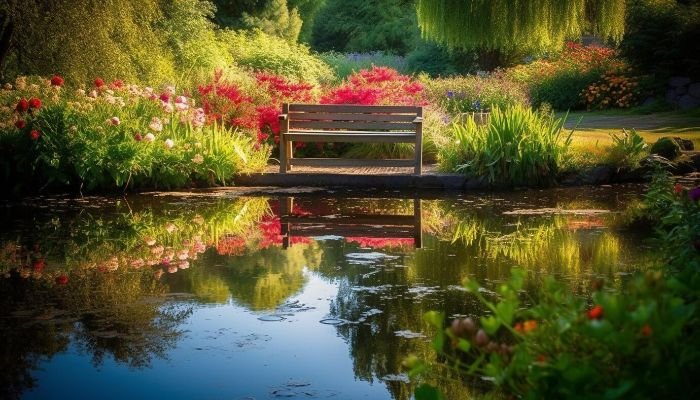
The theoretical backbone behind most healing garden design comes from landscape architect Roger Ulrich, whose Stress Recovery Theory describes how involuntary attention – the effortless noticing triggered by natural stimuli like moving water – allows directed attention to recover. UC ANR Cooperative Extension and Penn State Extension both reference this mechanism in their healing garden guidance. The Therapeutic Landscapes Network, a nonprofit focused on evidence-based design for healthcare spaces, identifies water as one of the most consistent triggers of this response in built environments.
One fact worth sitting with: the cortisol reduction effect occurs even when subjects cannot see the water source. Sound alone is sufficient. That changes where a thoughtful designer puts their budget.
The Sound Before the Sight – Why Hearing Comes First in Therapeutic Design
When a visitor to a healing garden hears water before they see it, something specific happens. Orienting attention shifts. The mind moves toward the sound, releases whatever it was holding, and briefly stays open before conscious thought steps back in. This arrival moment – sound before source – is the most restorative transition in a well-designed water garden. It is not accidental in good designs.
Flowing water generates what acousticians call broadband sound: energy spread across a wide frequency range, which masks urban noise – traffic, HVAC hum, distant voices – without introducing its own distinct rhythm the brain tries to track. It is mechanistically similar to what audio engineers call pink noise, and the effect is the same: the auditory field becomes less demanding.
The restorative frequency range for human relaxation falls roughly between 500 Hz and 4 kHz. Gentle bubblers, small cascades, and urn fountains operate in this range. Large waterfalls with greater drop heights shift energy toward lower, more percussive frequencies – the stimulating end of the auditory spectrum. A crashing waterfall and a murmuring rill trigger different physiological responses. One stimulates; the other restores.
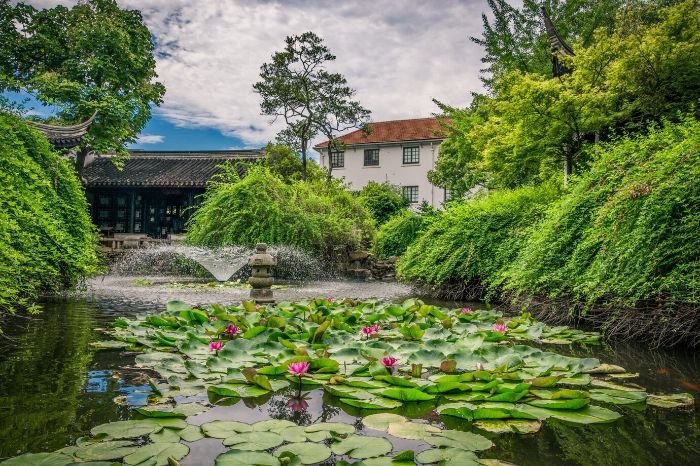
The practical threshold: a feature audible from 10-12 feet at approximately 55-65 dB is within the restorative range. Above that, conversation becomes difficult, which shifts the social dynamic of the space. Below that in any open garden setting, ambient sound competes and the masking function disappears.
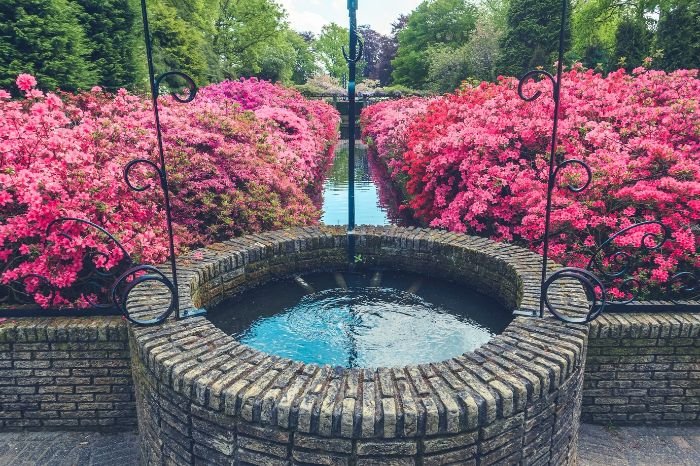
Reflection pools and still ponds work by a different mechanism entirely. Their therapeutic function is visual – what psychologists Stephen and Rachel Kaplan called soft fascination: the effortless, low-demand engagement of watching light move on a water surface, a dragonfly land, or clouds reflected below. Neither better nor worse than auditory restoration. A different tool for a different state.
How much of what gets called therapeutic garden design is really just careful acoustic design? Most of the measurable physiological benefit traces back to sound management – which implies that where you place a feature matters considerably more than which type you choose.
Pro Tip: Run recirculating fountains and bubblers at 60-70% of full pump capacity. This produces the most restorative sound profile – audible and consistent without the spray drift and misting that accelerates mineral buildup on stone surfaces and increases evaporation loss.
Matching the Feature to the Healing Context – A Practical Guide
Not every healing garden serves the same population, and the water feature that functions well in a hospital courtyard may be counterproductive in a memory care garden.
| Feature Type | Sound Level | Best For | Avoid When |
|---|---|---|---|
| Bubbler / urn fountain | Low | Memory care, intimate seating areas, indoor therapeutic spaces | Large open courtyards where sound disperses before reaching seats |
| Wall fountain / cascade | Medium | Hospital courtyards, rehabilitation gardens | Very small enclosed spaces where hard surfaces create echo |
| Recirculating rill | Low-medium | Meditation paths, sensory gardens, movement therapy routes | Settings where silence itself is the therapeutic goal |
| Pond / reflection pool | Minimal | Visual restoration, wildlife connection, contemplative gardens | Where auditory masking of urban or institutional noise is the priority |
| Waterfall | High | Screening traffic noise, large institutional outdoor spaces | Dementia care, high-anxiety settings, any small enclosed space |
The dementia care caveat deserves direct attention. Loud or irregular water sounds – unpredictable splashing, spray patterns that shift with wind – can increase agitation in people with cognitive decline, producing the opposite of the intended effect. In these settings, a gentle low-volume bubbler or a still reflection pool with tactile access at the edge is far preferable. The therapeutic value of water for this population comes through visual engagement and touch; sound masking is secondary.
Observation: In rehabilitation gardens where patients perform physiotherapy exercises outdoors, still water surfaces consistently serve as natural focus points during repetitive movement sequences. The calm, non-competing visual anchor supports concentration in a way that active sound does not.
What Separates a Therapeutic Water Feature From a Decorative One
Most garden center fountains are designed to be looked at. A therapeutic water feature is designed to be heard from a specific seat, at a specific volume, in a deliberate spatial relationship to the person using the garden. That distinction shapes every decision.
Proximity and arrival
The feature must be audible from the primary seating point without requiring the listener to raise their voice. In most garden rooms, that means within 6-10 feet of the principal bench or chair. A fountain installed as a visual centerpiece 25 feet across the lawn is decorative. Move it closer and the therapeutic function engages.
Where the site allows, route the approach path so the sound of water reaches visitors before the source comes into view – a turn in the path, a planting screen, a low hedge. This brief acoustic-before-visual moment produces the strongest orienting response, the clearest break from whatever the visitor arrived carrying.
Placement relative to walls
Features installed flush against a hard surface reflect sound back into the space, creating an echo-chamber effect that disrupts the broadband masking quality. Leave at least 18-24 inches of planted buffer between the water feature and any solid wall. Natural stone and plant material absorb sound; brick and concrete amplify it.
Scale
A 3-foot diameter urn fountain is adequate for a 12×12 foot garden room. A feature that dominates the space visually, placed 25 feet from the nearest seat, fails at its primary function. Appropriately sized and well-placed always outperforms oversized and centered.
Accessibility
In clinical and care home settings, a basin height of 18-24 inches allows wheelchair users to hear, see, and touch the water without assistance. Non-slip surfaces within 3 feet of any water edge. East-facing features catch morning light on the surface; west-facing features hold afternoon movement in the water. These are design decisions, not finishing touches.
The Therapeutic Landscapes Network maintains evidence-based design guidelines specifically for healthcare and rehabilitation garden contexts – one of the few nonprofit resources with documented design standards, not just general principles.
Plants and Materials That Strengthen the Therapeutic Effect
Water alone does not make a therapeutic space. What surrounds it determines whether the effect holds across a full visit.
Aquatic planting serves two functions at once. Water lilies (Nymphaea spp.) shade the surface – slowing algae growth and reducing maintenance – and add seasonal color without competing through scent. Japanese iris (Iris ensata) at the water’s edge provides vertical structure and marks seasonal change – both matter in therapeutic gardens where the sense of time passing and life continuing is part of the healing function itself.

At the perimeter, tall ornamental grasses – Calamagrostis x acutiflora ‘Karl Foerster’ and Miscanthus sinensis ‘Morning Light’ in particular – accomplish two things simultaneously. They baffle wind, which otherwise disrupts the even sound surface of a recirculating feature, and they create visual enclosure that makes a seating area feel sheltered. Sound wells up and holds, contained by the planting mass.
Materials at the edge matter. Natural stone and decomposed granite absorb sound. Polished concrete near a water feature creates reflective surfaces that alter the acoustic character. Use rough-textured stone or tumbled slate within 3 feet of the feature and along the approach path.
For layered sensory engagement within arm’s reach of seating: lavender and chamomile add touch and scent without overwhelming. In clinical settings, keep strongly scented plants – roses, jasmine, lilies – away from the water’s immediate edge. Scent sensitivity is common in patients on medication, and a powerful fragrance next to an otherwise calm water feature creates sensory conflict in an environment designed for the opposite. A curated selection of scent-bearing plants suited to mindfulness and relaxation gardens covers this tradeoff in detail.
Maintenance Reality – What Healing Garden Water Features Actually Need
A healing garden water feature that stops working or turns green defeats its own purpose. Plan for maintenance before installation, not after.
Weekly: Skim surface debris. Check that pump flow rate has not changed – a slowing pump often signals a clogged filter before the sound becomes noticeably different.
Monthly: Clean filter media. For ponds and larger water bodies, test pH – the target range is 7.0-7.4. Outside that range, algae accelerates and aquatic plants begin to decline.
Seasonally: Drain and store fountain elements before temperatures drop below 28°F. Submersible pumps left in water that freezes will crack. Divide aquatic plants every 2-3 years or they crowd out the open water surface. Cut back ornamental grasses at winter’s end before new growth begins.
Time budget: A recirculating urn or bubbler fountain requires roughly 30 minutes of attention per month during the growing season. A pond with aquatic plants requires 2-3 hours of seasonal work and weekly skimming.
The most common failure state: algae buildup that turns a reflective pool into an opaque, odorous surface. Preventable with the right aquatic plant coverage – water lily pads over roughly 60% of the surface area is generally adequate – and a UV clarifier on any system with fish. A neglected water feature becomes a liability faster than almost any other garden element.
Conclusion
A water feature earns its place in a healing garden when it can be heard from the primary seating point without competing with conversation. If it cannot pass that single test, the therapeutic function is not engaged – regardless of how the feature looks from across the garden.
Get placement right and the rest of the sensory sequence follows almost automatically. Sound arrives at the path’s turn, before the eye finds the source. Someone who came in carrying the particular weight that brings people to healing gardens sits down and stays longer than they expected. The light moves across the water in the afternoon. The grasses hold the wind at the edge. That is what a well-placed water feature actually does – not loudly, and not immediately – with a consistency that very few other garden elements can match.
FAQ
What type of water feature is best for a small healing garden?
A recirculating urn or bubbler fountain works best in spaces under 200 square feet. The sound output is calibrated for close-range listening – typically effective from 6-8 feet – and the footprint can be as small as 18 inches in diameter. A wall-mounted spout draining into a trough is another option for very tight spaces, requiring no ground clearance at all. What small spaces rarely benefit from is a waterfall: a feature that looks proportionate in a small garden usually produces a sound level too low to provide effective masking and too variable to maintain consistent therapeutic benefit. Small healing gardens need precision in placement more than scale in the feature itself.
Can you use a water feature in an indoor therapeutic space?
Yes, with specific adaptations. Indoor features need fully enclosed recirculating systems – no open evaporation that could push indoor humidity above 60% RH, which creates its own comfort problems. Tabletop or countertop fountains with submersible pumps and contained basins work well for rooms under 400 square feet. Sound levels indoors are amplified compared to outdoor settings, so a feature that reads as gentle in a courtyard can feel intrusive in a small room. Test the decibel level from the intended seating position before permanent installation. Most indoor therapeutic spaces do better with a smaller feature run at lower pump capacity than the same model run at full output.
What happens if a water feature is too loud in a healing garden?
It works against the therapeutic intent. When a water feature’s sound level rises above normal conversational volume – roughly 65 dB from the primary seating point – the brain shifts from parasympathetic relaxation toward alert monitoring. Visitors have to raise their voices, which creates social tension and heightened arousal. In dementia care settings, loud or irregular water sounds have been specifically linked in care home design research to increased agitation – producing the opposite of the intended effect. The fix is usually pump speed reduction or adding baffles to the outflow channel. If the sound cannot be adequately reduced at the source, relocating the seating further from the feature often resolves the problem without touching the installation itself.
How far from seating should a water feature be placed in a healing garden?
The functional range is 6-12 feet from the primary seating point. Closer than 6 feet and the sound can feel intrusive for most feature types in open-air settings. Beyond 12 feet in a typical open garden, the ambient environment competes with the water sound and the masking effect diminishes markedly. In an enclosed courtyard with reflective hard surfaces, the effective range extends somewhat. In a large open lawn, even a feature at 8 feet may need surrounding planting to hold its acoustic presence at the seat.
Do water features attract mosquitoes in healing gardens?
Moving water does not. Still water does. Any recirculating fountain with water in continuous circulation will not support mosquito larvae – they cannot establish on a moving surface. Problems arise when the pump is off for extended periods: overnight shutdown allows larvae to establish in standing water within 24-48 hours in warm weather. Ponds and reflection pools need either mosquito dunks (Bacillus thuringiensis israelensis, or Bti), a small population of mosquitofish, or a surface-agitation pump to prevent this. Installing a pond without a mosquito management plan, then shutting the whole feature down because of the insect problem that follows, is the most common and avoidable maintenance mistake in healing garden water feature planning.
What plants grow well in and around therapeutic garden water features?
At the water’s edge: Iris ensata, Lobelia cardinalis, Pontederia cordata (pickerelweed), and Acorus gramineus for shallow marginal zones. On the water’s surface: Nymphaea varieties to cover 50-60% of the surface area. For perimeter structure and wind buffering: Calamagrostis x acutiflora ‘Karl Foerster’, Miscanthus sinensis ‘Morning Light’, and Hakonechloa macra. Within arm’s reach of seating for touch and scent: lavender, chamomile, and creeping thyme. In clinical settings, avoid strongly fragrant roses and lilies directly adjacent to the water edge – scent sensitivity is common in patient populations and a heavy fragrance counteracts the calm the water creates.
Is still water or moving water better for stress reduction in a healing garden?
They produce different types of restoration. Moving water reduces cortisol through auditory masking and triggers Ulrich’s stress recovery response – measurable in hormone levels within minutes of exposure. Still water supports what Stephen and Rachel Kaplan called soft fascination: low-demand visual engagement that allows directed attention to recover without auditory input. Moving water tends to work faster; still water tends to sustain the restorative state longer once it is established. In a garden designed for short visits or high daily traffic, moving water is more immediately effective. In a contemplative space where people sit for extended periods, a reflection pool with very gentle surface movement often produces deeper and more sustained restoration than an active fountain at the same scale.