




Updated April 16, 2026
How to choose pruners comes down to one question most gardeners never think to ask: are you cutting live wood or dead? That answer drives everything – blade type, mechanism, and even how much you should spend. Get it wrong and you are not just dulling a blade faster; you are creating wounds that take weeks longer to seal and leaving a door open to fungal disease. The three main hand pruner types each solve a different problem, and knowing where they differ turns a confusing purchase into a confident one.
Key Takeaways:
- Use bypass pruners for all living wood – anvil blades compress vascular tissue and slow healing by weeks
- Stop at 3/4 inch diameter with hand pruners; forcing thicker stems bends the spring and misaligns the blade in one session
- SK5 and high-carbon steel hold a sharper edge than stainless, but require a quick wipe with oiled cloth after every use
- Ratchet pruners are worth testing if you prune more than 30 minutes at a stretch or have reduced grip strength
- Sharpen only the beveled face with a diamond whetstone – 5 to 8 strokes restores an edge that has been maintained regularly
Table of Contents
Bypass vs Anvil Pruners – The Cut That Shapes Everything
Bypass pruners work like scissors. Two curved blades slide past each other and the cutting edge passes cleanly through the stem, leaving a thin, precise wound. Anvil pruners operate differently: a single sharpened blade presses downward onto a flat metal plate, and the stem is split apart rather than sliced. Both mechanisms cut – they just do it in ways that matter differently to living plants.
On live wood, the anvil design creates a measurable problem. The flat plate compresses one side of the stem as the blade pushes through, crushing the phloem and xylem cells on that face. Research through the American Phytopathological Society has documented that compressed tissue dries and calluses significantly more slowly than a clean scissor cut, and damaged cells are more susceptible to opportunistic pathogens like Botrytis and Pseudomonas. On a rose stem, a fruit tree leader, or any plant you are trying to encourage, that matters.
On dead wood, it does not. When you are removing dried-out canes, clearing back dead shrub stems, or breaking down material for the compost pile, anvil pruners are faster and less tiring. The blade has more mechanical advantage built into the mechanism, which reduces the hand pressure required per cut on brittle or fibrous material.
The working rule: reach for bypass pruners when the wood is green. Use anvil pruners for everything dead or dried.
I often notice that gardeners who have owned only one pair of pruners have bypass models. That is the right call. If you are choosing a first or only pruner, the bypass type handles the full range of what most gardens require.
A quick reference before moving on – bypass pruners also vary in head orientation. Straight-head models suit general cutting. Curved or angled-head models help with reaching into dense growth or cutting close to a branch collar without repositioning your wrist. The mechanism is identical; the geometry changes what is comfortable in tight spaces.
Branch Diameter as a Buying Guide – Reading the 3/4-Inch Rule
Hand pruners – bypass or anvil – are designed for branches up to roughly 3/4 inch in diameter, approximately the thickness of a standard pencil. That ceiling reflects the stress tolerance of the spring, the blade geometry, and the pivot point, not a conservative spec. Push past it regularly and the spring begins to flex sideways before the blade does.
Fine Gardening’s controlled testing of 13 midsize bypass models found that forcing cuts beyond rated diameter was the most common field failure mode. The pivot pin deforms slightly under repeated overload, which creates blade misalignment. Once a bypass blade begins tracking off-center, sharpening alone cannot restore the scissor action – the pivot needs adjustment or replacement.
| Branch diameter | Right tool | Notes |
|---|---|---|
| Up to 1/4 inch | Hand pruners | Florist scissors also work for very fine stems |
| 1/4 to 3/4 inch | Hand pruners (bypass for live wood) | Core range for most residential gardens |
| 3/4 to 1.5 inches | Loppers | Two-handled, designed for the extra leverage |
| 1.5 to 3 inches | Pruning saw | Hand saw or folding saw |
| Over 3 inches | Arborist saw or chainsaw | Beyond hand tool territory |
Most residential gardens live almost entirely in that 1/4 to 3/4 inch band. Roses, perennial woody stems, shrub shaping, deadheading thick-stemmed dahlias – all of it falls comfortably within hand pruner range. Where gardeners run into trouble is with neglected shrubs. A forsythia or lilac left unpruned for five or six years will push structural branches well past 3/4 inch. Those belong to loppers, not to more force on the bypass.
If you find yourself leaning your body into a cut to get it through, the tool is wrong for the job. That posture signals a branch diameter mismatch, and the stem will usually confirm it by crushing slightly before severing – the opposite of the clean cut you want on living wood.
Blade Steel and Build Quality – Where the Price Difference Is Real
Two steel types appear in most quality hand pruners: high-carbon steel (often designated SK5 or similar) and stainless steel. They behave differently under use and under the whetstone.
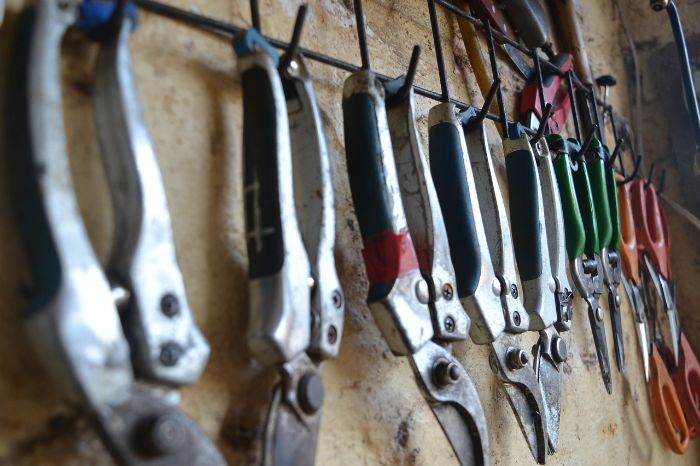
SK5 and high-carbon formulations are harder than stainless, which means they take a finer edge and hold it through more cuts before dulling. Felco, the Swiss manufacturer whose bypass pruners have been a professional standard since 1948, uses forged high-carbon steel in their blades for this reason. The tradeoff is corrosion sensitivity. A sap-covered blade left overnight in a damp shed is enough to start surface oxidation. A wipe with a lightly oiled cloth after each use is non-negotiable with high-carbon tools.
Stainless steel resists rust and requires less daily attention, but it softens faster under sharpening and does not return to the same edge geometry. For a gardener who prunes once a week and may forget to dry tools, stainless is the more forgiving material. For anyone pruning frequently or needing precision on fine stems, the edge quality of high-carbon steel is worth the maintenance discipline.
Most gardeners replace pruners because the blade dulled, never having sharpened it once – which raises the question of whether the problem was the steel or the habit. A quality high-carbon blade that is sharpened twice a season will outlast a stainless blade replaced every two years.
What the blade coating tells you
Non-stick coatings – Teflon or similar fluoropolymer – reduce friction and sap adhesion. This is genuinely useful when cutting through sticky Prunus sap or pine resin, where an uncoated blade begins to drag after a few cuts. The coating wears from the cutting edge first and does not affect sharpness, but it extends the clean-release performance on the flat blade face. Coatings appear on both budget and professional models; their presence is a functional feature, not a quality signal.
Pro Tip: Before sharpening a bypass blade, clean off all sap residue with isopropyl alcohol or a dedicated resin remover. Sap on the blade face loads the whetstone unevenly and can pull the blade off angle mid-stroke, rounding the bevel rather than restoring it.
Grip, Spring, and Hand Size – The Variable No Review Can Answer For You
Ergonomics is where pruner reviews lose their usefulness. Fine Gardening’s testing panel of 11 gardeners with varying experience levels found that latch preference was “extremely polarizing” – a mechanism one tester found intuitive was actively disruptive to another. Grip width, handle material, and spring tension interact with hand size and pruning style in ways that specs cannot predict.
Three things worth evaluating in person before committing to a model:
- Handle spread in the open position: your fingers should not stretch to grip the handles at full extension. For gardeners with small hands, a spread over three inches causes index finger fatigue within 20 minutes of continuous work.
- Spring tension: heavy-return springs build fatigue in the finger flexors over a long session. Some models have adjustable tension screws, which is worth looking for if you prune in sessions longer than 30 minutes.
- Rotating lower handle: Felco’s 12 and 14 models include a lower handle that rotates with the natural rotation of the grip, reducing forearm twist per cut. Over a two-hour pruning session on fruit trees, this reduces wrist and forearm strain in a way that is difficult to appreciate until you have used a fixed-handle model on the same task.
Where possible, borrow a model from a neighbor before buying, or purchase from a retailer with a return window. Fifteen minutes of actual cutting with a specific pruner tells you more than any product description. What you are checking for is whether the tool disappears in your hand – the sign that grip width, spring weight, and balance are working with your anatomy rather than against it.
When Ratchet Pruners Solve a Problem Standard Models Cannot
Ratchet pruners use a stepped mechanism that advances the blade incrementally with each squeeze. Instead of cutting in one stroke, the ratchet locks the blade position at each increment and lets you release and re-grip before squeezing again. The blade reaches full cut depth just as a standard bypass or anvil pruner would, but the hand force required per stroke is roughly halved.
This design solves a specific problem: branches at the upper end of hand pruner range – 5/8 to 3/4 inch on stems that are dense or fibrous – that require grip force many gardeners cannot sustain over a full pruning session. For anyone with arthritis, recovering from a wrist or hand injury, or simply pruning a large mature shrub in one go, ratchet pruners extend what is manageable without stepping up to two-handled loppers.
The honest tradeoff is speed and feel. Ratchet mechanisms are slower per cut, and the stepped action is poorly suited to detailed work. Shaping the interior of a rose, following the step-by-step decisions that rose pruning requires, or deadheading with precision – all of that becomes awkward with a ratchet. They are the right tool for removing old woody canes at the base of a shrub, not for work where placement and angle matter.
Keeping Your Pruners Sharp – The Habit That Protects Your Plants
A dull pruner does not slice through a stem. It tears. The torn tissue produces a ragged wound edge with more surface area exposed to airborne spores, and it takes longer to callus over than a clean cut. Oregon State University Extension’s pruning guidelines identify tool sharpness as a disease management factor, not just a quality-of-work consideration.

How to sharpen a bypass blade
Bypass pruner blades have a single bevel – one angled face and one flat face. Sharpen only the beveled side. Hold the blade against a diamond whetstone at the existing bevel angle, typically 10 to 15 degrees, and draw the stone from heel to tip in smooth, consistent strokes. Five to eight strokes is usually enough to restore an edge that has been maintained regularly. Follow with one light pass on the flat back of the blade to remove the wire edge that builds up from sharpening the bevel side. A ceramic pocket rod also works for field touch-ups between full sharpenings.
Sterilization between plants
When moving from one plant to the next during a pruning session – particularly from any plant showing dieback or discoloration – wipe the blade with a 70% isopropyl alcohol solution or a 1:9 bleach-to-water dilution. UC Cooperative Extension research on stone fruit disease management found that several fungal and bacterial pathogens can survive on cutting surfaces for up to 20 minutes without sterilization. A small spray bottle or alcohol-soaked cloth in a pruning apron pocket makes this a 10-second step rather than a trip back to the potting bench. This habit is particularly relevant when the common pruning mistakes most likely to spread disease come from contaminated tools rather than technique errors.
Store pruners dry, latch engaged, away from contact with other metal tools. The most common source of edge nicks is blades knocking against other blades in a tool drawer. A magnetic strip or a slotted wooden block keeps them separate and accessible without the noise of metal against metal every time you open the drawer.
The First Pruner Most Gardeners Should Own
If you are building a tool kit from scratch, start with a midsize bypass pruner in the 8 to 8.5 inch range with a high-carbon blade. That single tool handles the majority of pruning in a mixed garden: roses, perennials, small shrubs, dead-heading, light fruit tree work. The brand matters less than the mechanism fit – a well-maintained mid-range bypass pruner will consistently outperform a premium model that sits in a drawer because the grip is uncomfortable.
The second pruner most gardens eventually need is a pair of loppers for stems between 3/4 and 1.5 inches. That gap – the branch that is clearly too thick for hand pruners but not thick enough to justify a saw – is where most gardeners default to forcing the wrong tool. Loppers fill it cleanly.
An anvil pruner makes sense as a third tool if you do significant dead wood clearing: cutting back ornamental grasses in late winter, removing the dried canes of large shrub roses, or clearing storm-damaged material. The speed advantage on dead material over a full afternoon of cleanup is tangible. But as a first purchase, the bypass model gives you everything and the anvil gives you a subset.
Conclusion
Pruner choice narrows quickly once you understand what the blade mechanism actually does to plant tissue. Bypass for living stems where clean healing matters, anvil for dead material where speed matters more than wound quality, ratchet when grip strength is the limiting factor.
The details that separate good pruners from forgettable ones – blade steel, spring tension, handle spread, latch type – are worth investigating in person, because they interact with hand size and pruning style in ways no spec sheet captures. A pair of Felco bypass pruners that fits your hand correctly and gets sharpened twice a season will still be making clean cuts 15 years from now. That is the smell of sap-free steel and the satisfying resistance of a blade that meets the stem at exactly the right angle – one clean squeeze and the cut is done.
FAQ
What is the difference between bypass and anvil pruners?
Bypass pruners have two blades that slide past each other like scissors, producing a clean cut with minimal tissue damage. Anvil pruners have a single blade that presses onto a flat metal plate, splitting the stem rather than slicing it. On live wood, the anvil action compresses one side of the stem, slowing healing and increasing disease risk. On dead or dry material, anvil pruners are faster and require less hand force. Most gardeners use bypass pruners for nearly everything and reserve anvil models for dead wood cleanup.
Can you use anvil pruners on rose bushes?
It is not recommended for active pruning cuts on living canes. The flat plate crushes the soft vascular tissue on one side of the stem, which slows the callus formation that seals the wound. On rose stems, which are particularly susceptible to cane borers and fungal entry after pruning, a clean bypass cut heals noticeably faster. Anvil pruners can be used on rose bushes to remove fully dead or winter-killed canes where tissue quality no longer matters.
What happens if you prune branches that are too thick for hand pruners?
Forcing a branch beyond the rated diameter – typically 3/4 inch for most hand pruners – places lateral stress on the pivot pin. The spring absorbs some of this by flexing sideways, which is the early warning sign. Over repeated overloading, the pivot pin deforms slightly, causing the blades to track out of alignment. A misaligned bypass pruner no longer produces a clean scissor cut; it crushes the stem on one side before finishing the cut, mimicking the damage of an anvil design even though the mechanism is different. Once the pivot deforms, sharpening does not fix it.
How do I know when my pruners need sharpening?
Three signals: the blade feels like it is pushing through the stem rather than slicing, you are using noticeably more hand pressure than when the tool was new, or the cut surface looks slightly fibrous or torn rather than smooth. A quick field check is to run your thumbnail lightly across the cutting edge perpendicular to the blade – a sharp edge catches slightly; a dull edge slides without resistance. Sharp pruners should be able to slice a single sheet of paper cleanly without tearing.
Which pruner brands are worth buying?
Felco (Switzerland) has been the professional benchmark since 1948 – their models use forged high-carbon steel and most parts, including blades, springs, and screws, are sold as separate replacements, so a quality pair can be maintained indefinitely. ARS (Japan) makes precision bypass pruners favored by bonsai practitioners and orchardists for their thin blade profile and fine edge. Corona (US) offers consistent performance at lower price points, with replacement parts also available. For a first pruner, any of these in a bypass configuration will outperform budget models in cut quality and longevity.
How often should I sharpen my pruning shears?
For a home gardener using pruners weekly through the growing season, sharpening twice per season – at the start of spring pruning and at midsummer – is usually enough to maintain clean cuts. If you are pruning daily or working through dense, woody material regularly, a light touch-up with a ceramic rod every two or three sessions prevents the blade from getting dull enough to require a full sharpening. The goal is to never let the edge degrade to the point where you feel the blade dragging.
What size pruners do I need for fruit trees?
For fruit tree pruning, a midsize bypass pruner handling up to 3/4 inch covers all the spur and lateral work – the majority of cuts in a well-maintained tree. Water shoots, crossing branches, and most annual growth come in well under that threshold. For older trees with scaffold branches or structural limbs over 3/4 inch, add a pair of loppers for the 3/4 to 1.5 inch range and a folding pruning saw for anything larger. Most fruit tree pruning, once the tree is established, is 80% hand pruner work and 20% loppers.
How do I stop my pruners from getting rusty?
The practical answer is a two-step habit: wipe the blade clean of sap and debris immediately after use, then apply a thin film of oil – camellia oil, mineral oil, or a dedicated tool oil – before storing. Sap left on high-carbon blades accelerates oxidation because it retains moisture against the steel. For longer storage between seasons, a light coat of oil and storage in a dry environment is enough. If rust does appear, fine steel wool removes surface oxidation without damaging the blade bevel, followed by re-oiling before the next use.