



Last Updated June 05, 2026
A solar garden light can make a path feel safe at dusk, then disappoint by midnight. The fixture looked bright in the package photo. The stake went into the soil easily. By the third cloudy week, the light is weak, the panel is dusty, and the walkway has bright dots with dark gaps between them.
Solar garden lighting works best when the light has a clear job and the panel receives enough sun to do that job. Small path markers can guide feet along a mulch path. A solar spotlight can pick out a young tree. String lights can soften a patio edge. The same fixture becomes frustrating when it is asked to replace wired security lighting, illuminate steps through winter shade, or brighten a whole seating area after several rainy days.
The eco-friendly value comes from using less grid power, avoiding trenching, and placing light carefully. Solar lights still use batteries, plastics, metals, and LEDs. They still affect insects, neighbors, and the night sky. A good solar lighting plan uses less light, aims it better, and favors fixtures that can be maintained through more than one season.
Key Takeaways
- Solar garden lighting works best for paths, accents, borders, patios, containers, and low-risk areas with direct sun.
- Choose solar lights by job first: guidance, feature lighting, mood, safety, or motion-triggered visibility.
- Panel placement matters as much as fixture placement; shaded panels cause weak output and short run time.
- Warm, shielded, downward light is usually better for gardens than cool, exposed glare.
- Battery access, weather rating, replaceable parts, and panel size matter more than decorative style alone.
- Use low-voltage wired lighting for critical stairs, long paths, heavy shade, and dependable all-night brightness.
Table of Contents
Choose The Right Solar Garden Light For Each Job
Solar lighting fails when every fixture is treated as the same kind of glow. A path light, a spotlight, a wall light, and a string light solve different problems. Path lights guide movement. Spotlights aim at a feature. String lights create mood. Motion lights give short bursts of visibility near gates, bins, sheds, or side yards.
Garden lighting basics still shape solar fixture choice because movement, focal points, atmosphere, glare control, and shadow decide where light belongs. Solar power changes the installation method and energy source; it does not remove the need to aim light, control glare, and avoid overlighting.
Look at the garden after sunset before buying anything. Dark paths may need low markers on alternating sides. One aimed beam from the front corner may be enough for a sculpture. A patio may need warm string lights under a pergola and a separate step light near the door. The fixture type should follow that nighttime problem.
| Lighting Job | Best Solar Fixture | Useful Specs To Check | Avoid This Mistake |
|---|---|---|---|
| Mark a garden path | Low path lights or bollard-style solar lights | Warm color, shielded head, even spacing, replaceable battery | Using tiny marker lights as the only light on uneven steps |
| Highlight a shrub, tree, statue, or fountain | Adjustable solar spotlight with separate panel | Beam angle, panel cable length, aiming angle, run-time setting | Putting the panel in the shade because the feature looks best there |
| Light a patio or pergola softly | Solar string lights or lanterns | Bulb spacing, panel mounting point, wind resistance, warm color | Expecting string lights to provide task lighting for cooking or stairs |
| Add short security visibility | Motion-activated solar wall light or floodlight | Sensor range, high/low mode, panel size, winter run time | Leaving a harsh floodlight on all night near bedrooms or neighbors |
| Edge a border or container area | Small stake lights, mini lanterns, or solar deck dots | Low output, weather seal, stake strength, easy cleaning | Overfilling beds with bright dots that distract from the planting |
Solar Garden Light Lumens By Job
| Lighting Job | Useful Lumen Direction | Best Use | Main Risk |
|---|---|---|---|
| Decorative glow | Very low output | Lanterns, borders, containers, table edges | Too dim for movement or steps |
| Path guidance | Low to moderate output | Mulch paths, gravel paths, bed edges, casual routes | Bright dots with dark gaps when spacing is poor |
| Accent or feature lighting | Moderate focused output | Small trees, shrubs, statues, water features, walls | Wide beams flatten the feature and waste battery |
| Patio mood lighting | Low distributed output | String lights, lanterns, pergola edges, seating glow | Weak task visibility for cooking, steps, or serving areas |
| Motion safety or security | Higher output for short bursts | Gates, sheds, bins, side yards, driveway edges | All-night high mode drains batteries and creates glare |
Solar Panel Placement – Charge The Light Before Placing The Glow
The best-looking fixture location is often a poor charging location. A Japanese maple, pergola, fence, porch roof, or tall grass can shade the small panel at the exact hours it needs sun. The light may work during the first clear week, then fade after cloudy weather because the battery never fully recovers.
Check sun on the panel as carefully as sun on the fixture. A path light with the panel built into the top needs direct sun where the stake sits. A spotlight with a separate panel gives more freedom because the beam can aim into a shaded feature and the panel can sit in open sun. That cable length is one of the most useful specs on the box.

Season changes the calculation. A spot that charges well in June may sit in low winter shade by November. Deciduous trees let in more winter light after leaf drop. Evergreen hedges, fences, and house walls keep blocking sun all year. Solar lights near winter paths, bins, gates, or steps need the clearest charging spot, not the prettiest one.
Test before committing. Push the stake in loosely, charge the light for two sunny days, and watch it through one full evening. A useful test shows how long the light stays bright, whether the beam hits the path or a person’s eyes, and whether the fixture creates dark gaps.
Solar Panel And Battery Specs That Affect Run Time
Outdoor solar light run time depends on the solar cells receiving enough sunlight, so a shaded panel or short winter day can reduce the hours of useful light.
| Spec | Why It Matters | Weak Sign | Better Direction |
|---|---|---|---|
| Panel size | Small panels recover slowly after cloudy weather | High brightness claim with a tiny panel | Panel size should match the promised output and run time |
| Separate panel option | Lets the light serve a shaded feature and the panel charge in sun | Built-in panel forced into shade | Use separate panels for trees, walls, fountains, and shaded paths |
| Battery access | Rechargeable batteries age before most LEDs fail | Sealed case with no battery replacement path | Choose clear battery access and common rechargeable battery types |
| Brightness modes | Lower modes stretch stored energy across the evening | One high-output mode only | Use dim, timer, or motion modes where available |
| Run-time claim | Run time depends on sun hours, season, dirt, shade, and battery condition | All-night claim with no sunlight requirement | Treat run time as a best-case number and test after cloudy days |
Solar Lighting Design – Keep The Garden Dark Enough To Feel Natural
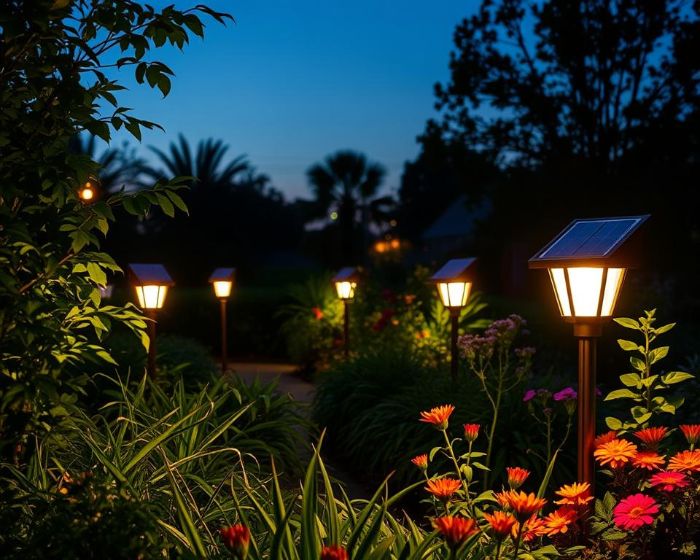
Eco-friendly lighting depends on placement as much as power source. A solar fixture can still spill glare into a neighbor’s window, wash out a planting, or confuse insects moving through the garden. A lower-impact night garden usually uses fewer lights, warmer color, lower output, and better aiming.
Responsible outdoor lighting uses light only where it is needed, only when it is needed, at the lowest useful level, with warm color and careful direction. Those principles fit solar garden lighting especially well because every extra lumen drains the battery faster.
Warm light usually fits planted spaces. A 2700K to 3000K warm-white look flatters foliage, brick, gravel, wood, and stone. Cooler blue-white light can make a small garden feel hard and commercial. It also appears harsher to the eye at night. Keep the color temperature consistent across the visible area so the garden does not look patched together.
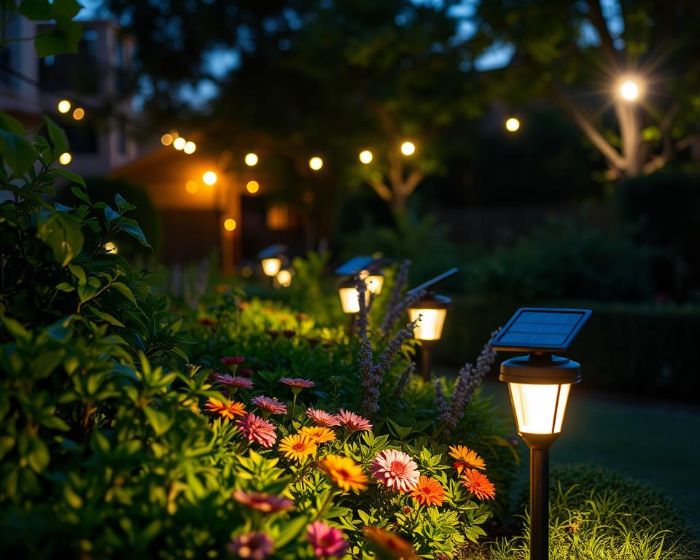
Aim solar fixtures downward or across texture. Shielded path lights reveal the walking surface and keep glare out of faces. Low spotlights can graze bark, stone, foliage, or water from a low angle. String lights work best as a glow under a structure. Dark areas between lit features give the garden depth.
Solar Vs Low-Voltage Garden Lighting – Use Each System Where It Fits
Solar lights are easiest where wiring would be disruptive. They work well along remote paths, around beds, near sheds, in container gardens, and on patios with good sun. Installation is fast, and a homeowner can move fixtures as plants grow or paths change.
Low-voltage wired lighting is better for critical visibility. Exterior stairs, long walkways, steep paths, shaded entries, and all-night security areas need dependable output through storms, winter, and cloudy stretches. In those places, solar can supplement the design, and wired lights should carry the safety load.
| Garden Condition | Solar Lighting Fit | Better Choice When | Design Note |
|---|---|---|---|
| Sunny path through beds | Good for gentle guidance | Use low-voltage for stairs, slopes, or trip hazards | Alternate fixtures and keep light low to avoid a runway effect |
| Shaded woodland path | Weak unless panels can be placed remotely | Use wired low-voltage or fewer motion lights | Separate-panel solar spotlights can work at the sunny edge |
| Patio or pergola | Good for mood lighting | Use wired lighting for cooking, steps, and task areas | String lights should support atmosphere, not safety alone |
| Specimen tree or sculpture | Good with adjustable spotlight and sunny panel | Use wired uplighting for tall trees or all-night performance | Test the beam at dusk and lower the angle before final placement |
| Gate, shed, or side yard | Good with motion activation | Use wired light when the area must stay lit every night | Motion mode saves battery and reduces light pollution |
For paths that need dependable visibility, pathway lighting design should come before the power decision. Spacing, glare, surface texture, steps, and curves decide how much light is needed. Solar becomes the power source only after the path’s safety job is clear.

Batteries, Weather Ratings, And Maintenance – Buy For The Weak Point
The weak point in a solar garden light is usually not the LED. It is the battery, the panel, the stake, the switch seal, or the cloudy plastic lens. Cheap fixtures often fail because the battery cannot be replaced, the panel yellows, or the stake cracks in hard soil.
Look for replaceable rechargeable batteries, clear battery access, a real weather rating, a sturdy stake, and a panel large enough for the promised output. A light with a replaceable battery can stay useful for years. A sealed throwaway fixture becomes waste when the battery fades.
| Outdoor Position | Weather Rating Direction | Why It Matters | Extra Check |
|---|---|---|---|
| Sheltered patio, porch, or pergola | Lower outdoor-rated splash protection may be enough | Rain exposure is limited, and humidity and dust still reach the fixture | Check battery access and cable strain |
| Open border, path, or fence line | Choose stronger rain and dust protection | Fixtures face direct rain, sprinklers, mud splash, and wind-driven moisture | Check seals, stake strength, and corrosion resistance |
| Near sprinklers or low wet ground | Use a higher water-resistance rating | Side spray and pooling water stress seals faster than normal rain | Avoid placing battery compartments where water collects |
| Pond edge or submerged use | Use only fixtures rated for pond or underwater use | Ordinary garden solar lights are not safe for immersion | Check the exact product rating and installation instructions |
| Coastal or exposed windy site | Weather rating plus corrosion-resistant materials | Salt air, wind, and grit can damage finishes, screws, switches, and panels | Favor replaceable parts over sealed throwaway fixtures |
Weather matters by location. Hot patios stress batteries. Coastal air corrodes metal finishes. Sprinklers soak low fixtures from the side. Snow buries path lights and blocks panels. Wind can twist string lights or loosen cheap stakes. A durable solar fixture should match the garden’s worst season, not the mild day when it was installed.
Maintenance is small and regular. Wipe panels with a damp cloth. Trim grass or groundcovers that shade panels. Reset leaning stakes after frost heave. Check string-light hangers after storms. Replace weak rechargeable batteries before assuming the whole fixture has failed.
Solar Garden Lighting Mistakes – Fix Dim Lights, Glare, And Short Run Time
Most solar lighting problems show up as dim output, short run time, glare, or uneven spacing. The fix is often simple: more panel sun, lower brightness mode, cleaner panel, wider spacing, a warmer fixture, or a better match between job and fixture.
| Problem At Night | Likely Cause | First Fix | When To Replace |
|---|---|---|---|
| Light fades after one or two hours | Panel receives too little sun or battery is aging | Move the panel, clean it, and test a new rechargeable battery | Replace if the battery is sealed or the panel no longer charges well |
| Path has bright dots and dark gaps | Fixtures are too far apart or too narrow in beam | Stagger lights and test spacing at dusk | Replace tiny marker lights on risky paths with stronger path fixtures |
| Light shines into eyes | Fixture is too tall, unshielded, or aimed outward | Lower the fixture, tilt it down, or move it behind foliage or stone | Replace exposed globe lights in tight paths with shielded heads |
| Spotlight misses the feature | Stake shifted, beam angle is too wide, or panel limits placement | Move the fixture 6 to 12 inches and test again after dark | Replace fixed-angle lights with adjustable spotlights |
| String lights sag or fail after storms | Weak mounting points or exposed cable run | Add hooks, guide wire, or protected attachment points | Replace fragile copper-wire lights in windy or exposed areas |
Feature lighting needs the same testing. Garden spotlights and uplighting work best when the beam catches texture without flattening the whole feature. A solar spotlight should be moved in small increments after dusk until bark, stone, water, or sculpture holds the light cleanly.
Solar Garden Lighting And The Rest Of The Landscape
Solar lights look better when they follow the garden’s existing lines. Path lights should echo the path curve, not the edge of the lawn if the path bends away. Border lights should sit where plants will not swallow them by midsummer. Patio string lights need real anchor points, not brittle stems or a fence rail already leaning under vines.

Materials change how light behaves. Pale gravel reflects more light than bark mulch. Wet stone shines. Dark soil absorbs small marker lights. Tall ornamental grasses scatter light and can create a soft edge, and they can also shade panels by late summer. A light that works in a bare spring bed may need a new position after plants fill in.
Path lighting makes the most sense after the path itself is settled. Garden pathway design affects lighting because curves, slopes, drainage edges, steps, and planting height decide where people need guidance. Lighting should reinforce that route, not fight it.
| Lighting Technique | Solar Fixture Fit | Best Garden Use | Main Limit |
|---|---|---|---|
| Path lighting | Good with low shielded path lights | Routes through beds, gravel paths, casual garden walks | Stairs and trip hazards may need wired lighting |
| Uplighting | Good with adjustable spotlights and separate panels | Small trees, shrubs, walls, sculpture, water features | Built-in panels can force poor aiming or poor charging |
| Downlighting | Limited with solar unless panel placement is open | Pergolas, sheds, fences, low wall mounts | Tree-mounted solar units may stay shaded |
| Silhouetting | Possible with a panel in open sun and light behind the plant | Bamboo, grasses, architectural shrubs, screens | Needs a wall or surface behind the plant |
| String-light glow | Good for mood when panel gets sun | Patios, pergolas, balconies, seating edges | Not enough for task lighting or step safety |
Conclusion
Solar garden lighting is eco-friendly when it uses sunlight carefully and keeps the night garden comfortable. The fixture needs a real job, the panel needs sun, the light needs warm color and good aiming, and the battery needs a path to replacement.
Use solar lights for the places where flexibility, low wiring, and gentle evening glow make sense. Use wired low-voltage lighting where safety depends on reliable brightness. A garden lit this way keeps paths readable, features visible, and the night dark enough to still feel like a garden.
FAQ
Is solar garden lighting worth it?
This type of lighting is worth it for paths, accents, patios, borders, sheds, and low-risk areas with enough sun. It is less dependable for shaded stairs, long paths, and security areas that need strong all-night light in every season.
Do solar garden lights work in shade?
Deep shade gives solar garden lights poor charging conditions unless the panel can be placed in a sunnier location. A fixture with a separate panel is better for shaded features because the light can sit in shade and the panel can charge elsewhere.
Can solar lights be too bright for a garden?
Solar lights can be too bright when they create glare, flatten planting texture, or shine into windows. Use lower output, warmer color, shielding, motion mode, or wider spacing before adding more fixtures.
Why do solar lights get dim in winter?
Solar lights get dim in winter because days are shorter, the sun angle is lower, panels may be shaded, and cold batteries store less usable energy. Clean panels, move them to stronger sun, and use lower brightness settings when available.
What shortens the life of solar garden lights?
Poor charging, sealed batteries, dirty panels, cracked stakes, weak weather seals, sprinkler spray, and winter burial can shorten fixture life. Replaceable batteries and accessible panels make maintenance easier.
Are solar lights better than wired garden lights?
Solar lights are better for easy installation, remote areas, accents, and flexible layouts. Wired low-voltage lights are better for critical paths, stairs, heavy shade, and dependable all-night output. Many gardens use both.