

Last Updated June 02, 2026
Oak tree types differ in leaf edges, acorn timing, bark texture, mature size, root behavior, and the wildlife they feed. Two young oaks in nursery pots can look nearly identical until one becomes a broad white oak with a massive crown and the other grows into a fast northern red oak with pointed leaves and deeper fall color. The wrong choice does not fail in the first week. It fails years later when the crown crowds a driveway, the soil pH turns leaves yellow, or summer pruning opens a wound during oak wilt season.
Oaks belong to the genus Quercus, a large group of trees and shrubs in the beech family. Gardeners see the diversity most clearly through red oaks, white oaks, live oaks, bur oaks, pin oaks, swamp white oaks, willow oaks, and chinkapin oaks. Leaf tips, acorn maturity, bark, site tolerance, and mature footprint give the cleanest first read.
Key Takeaways:
- Separate red and white oaks before comparing individual species
- Match mature spread first; nursery height hides the real footprint
- Use acorn timing when leaf shape gives a mixed signal
- Native oaks feed more wildlife than most ornamental shade trees
- Prune during dormant windows where oak wilt occurs locally
Table of Contents
Oak Tree Diversity – Why Quercus Splits Into Useful Groups
Quercus includes about 450 species of ornamental and timber trees and shrubs, with oaks distributed through the north temperate zone and into high tropical elevations. The number matters less than the pattern behind it. Oaks adapted to dry uplands, wet bottomlands, alkaline prairie edges, coastal heat, mountain slopes, and long-lived mixed forests. The genus spread into many jobs.
A real oak is built around an acorn. Male flowers hang as catkins in spring, female flowers sit closer to the twig, and the fertilized ovary matures into the nut held in a scaly cup. The cup, cap depth, nut shape, and maturation time carry identification clues after leaves have fallen. Pick up a fresh acorn and press a thumbnail into the cap. A shallow, saucer-like cap reads differently from the thick, shaggy bur oak cup that feels rough and corky against the skin.
Taxonomy gets messy because oaks hybridize. A tree at the edge of a woodland can carry leaves that do not match the clean drawing in a field guide. Sun leaves grow thicker and smaller than shade leaves. Young sprouts sometimes carry exaggerated lobes. The first reliable move is to place the tree in a working group, then narrow species by bark, acorn, buds, habitat, and region.
| Oak group | Common field cue | Acorn timing | Typical garden meaning | Common mistake |
|---|---|---|---|---|
| White oak group | Rounded lobes or rounded teeth, no bristle tips | One growing season | Long life, strong wood, lower oak wilt speed | Planting too close to pavement because growth starts slowly |
| Red and black oak group | Pointed lobes with small bristle tips | Two growing seasons | Faster shade, stronger red-brown fall color, higher oak wilt risk | Pruning in warm sap-feeding beetle season |
| Live and evergreen oaks | Leathery leaves that may be entire or lightly toothed | Species dependent | Warm-region canopy, coastal and southern character | Assuming evergreen habit means small size |
| Shrub and scrub oaks | Multi-stemmed form, smaller leaves, dry-site habit | Species dependent | Wildlife value where full-size canopy will not fit | Ignoring them because they do not look like classic shade trees |
The grouping turns Quercus into a usable field map. Mature size, group, acorn behavior, and site tolerance narrow the field before expensive mistakes start.
Red Oaks And White Oaks – The Field Split That Changes Care
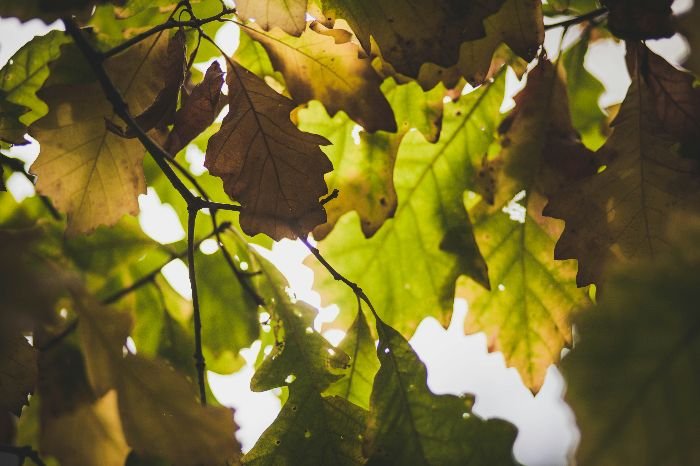
The red-oak and white-oak split changes identification, acorn timing, wood anatomy, and disease response. White oak leaves have fingerlike lobes with rounded tips and no bristles. Northern red oak leaves usually carry 7 to 11 pointed lobes with sharp tips. Those tiny bristles are easy to miss until you hold the leaf sideways and let the light catch the edge.
Run a fingertip from the base of a red oak leaf toward the end of a lobe. The bristle gives a slight prickly stop, like a hair-fine thorn. A white oak lobe feels blunt and rounded under the same motion. That touch test works better than color in midsummer, because both groups can carry deep green leaves before fall pigments separate them.
Why The Acorn Clock Matters
White oak acorns mature in one growing season, drop earlier, and germinate quickly after falling. Red oak acorns take two seasons to mature, so a branch can hold small first-year acorns and larger second-year acorns at the same time. The seed chemistry differs as well. Red oak acorns carry more tannins, which makes them bitterer and slower to break down as food. White oak acorns are less bitter and disappear faster where wildlife pressure is high.
The oak wilt difference comes from water movement inside the tree. The fungus Bretziella fagacearum blocks xylem, the water-conducting tissue. Red oaks move fast through large open vessels, and once those vessels are invaded, crown wilt can move with frightening speed. Red-oak group trees can die within weeks to six months after infection. White-oak group trees often decline more slowly over years.
| Feature | Red oak group | White oak group | Why it matters |
|---|---|---|---|
| Leaf tip | Pointed lobes with bristles | Rounded lobes or rounded teeth | Fastest first group cue in leaf season |
| Acorn maturity | Two growing seasons | One growing season | Confirms group when leaves are variable |
| Acorn taste and wildlife timing | More tannic and slower to disappear | Less bitter and eaten earlier | Changes wildlife use through fall and winter |
| Oak wilt speed | Rapid decline after infection | Slower branch-by-branch decline | Changes pruning caution and response urgency |
| Wood pores | More open vessels | Vessels plugged by tyloses in many species | Changes water resistance and lumber use |
Pro Tip: Collect one mature leaf, one fallen acorn, and one twig from the same tree before identifying it. Mixed samples from a sidewalk or park lawn create false matches because several oaks can drop leaves and acorns into the same patch.
The split also changes how a yard feels in autumn. White oak acorns disappear quickly under squirrels, jays, deer, and turkey traffic. Red oak acorns linger longer on the ground, dark and hard underfoot, and become more useful later as weather leaches tannins. A lawn under a mixed oak stand rarely has one uniform acorn season.
Common Oak Tree Types – Species That Solve Different Jobs
Species choice starts with adult shape. A slow white oak sapling looks harmless beside a driveway. Decades later, trunk flare, crown width, and roots demand park-tree space. Northern red oak fills space faster, and its disease risk changes pruning discipline in oak wilt regions.
White oak is a long-lived tree for sites where roots can remain undisturbed. Swamp white oak fits larger sunny sites where soil stays wetter and more acidic. Same broad group, different job: one needs an undisturbed root zone; the other earns space in damp acidic soil.
| Oak type | Group | Field cue | Best fit | Main caution |
|---|---|---|---|---|
| White oak, Quercus alba | White oak | Rounded lobes, pale gray blocky bark, broad crown | Large lawn, park-like setting, long-term shade | Slow start hides eventual size and root sensitivity |
| Northern red oak, Quercus rubra | Red oak | Pointed lobes, gray-white leaf underside, ski-track bark ridges | Faster shade in well-drained acidic soil | High oak wilt concern in affected regions |
| Bur oak, Quercus macrocarpa | White oak | Massive fringed acorn cups, rugged bark, stout limbs | Big spaces, tougher prairie-influenced sites | Too large for narrow lawns and small front yards |
| Pin oak, Quercus palustris | Red oak | Strong central leader, lower branches angle downward | Open acidic sites needing fast structure | Chlorosis in alkaline soil, awkward lower-limb clearance |
| Swamp white oak, Quercus bicolor | White oak | Two-toned leaves, peeling bark, tolerance of wetter ground | Moist sites, rain-garden edges, larger urban lawns | Still needs sun and enough canopy room |
| Live oak, Quercus virginiana and relatives | White oak lineage | Leathery evergreen leaves, sweeping limbs, dense shade | Warm southern landscapes and coastal character | Horizontal spread becomes the real footprint |
| Willow oak, Quercus phellos | Red oak | Narrow willow-like leaves, small acorns, fine texture | Street edges and larger lawns in suitable climates | Fast growth still needs root and canopy clearance |
| Chinkapin oak, Quercus muehlenbergii | White oak | Rounded teeth, sweet acorns, limestone tolerance | Sites with neutral to alkaline soils | Less familiar nursery stock in some regions |
| English oak, Quercus robur | White oak lineage | Rounded lobes, long-stalked acorns, broad old-age crown | Large European landscapes, parks, wildlife habitat | Too large for most small gardens and tight urban sites |
| Sessile oak, Quercus petraea | White oak lineage | Rounded lobes, nearly stalkless acorns, upright woodland habit | European woodland and upland settings | Regional fit matters more than ornamental familiarity |
| Cork oak, Quercus suber | Evergreen oak | Thick corky bark, leathery evergreen leaves | Mediterranean climates and dry warm landscapes | Poor fit for cold or wet-winter sites outside its climate range |
| Holm oak, Quercus ilex | Evergreen oak | Dense evergreen canopy, leathery leaves, dark crown | Warm coastal and dry urban landscapes where suitable | Dense shade and mature spread need early space planning |
| Gambel oak, Quercus gambelii | White oak lineage | Smaller regional oak, often multi-stemmed, western dry-site habit | Smaller native oak role in suitable western regions | Local native range should set the shortlist |
The right species depends on climate, soil, disease pressure, and the space above and below ground. Home landscapes add a stricter filter: mature footprint, root clearance, and local climate decide planting value. That same screening applies when selecting the right oak tree for your landscape.
Soil narrows the list fast. Pin oak in alkaline soil develops iron chlorosis, with new leaves turning yellow while veins stay green. Bur oak and chinkapin oak handle higher-pH conditions better in many regions. Clay that stays slick after rain points toward a different shortlist than sandy soil that runs through your fingers dry and pale by afternoon. The hand-feel tests used for soil types in gardening apply before any oak goes into the ground.
Leaves, Acorns, And Bark – Field Identification Cues That Hold Up
Leaf shape gets the first look because it sits at eye level. Oak identification improves when leaves stop carrying the whole burden. A single tree can produce sun leaves, shade leaves, juvenile sprout leaves, and late-season leaves with different depth of lobing. Hybrids add another layer. Acorns, buds, bark, and site position strengthen the read.
Use these field cues together:
- Check for bristle tips on lobes to separate red-oak group trees.
- Look for rounded lobes or rounded teeth in white-oak group trees.
- Compare acorn caps; shallow, bowl-shaped, fringed, and deep caps narrow species.
- Notice whether acorns appear in one size or two size classes on the branch.
- Read bark texture on mature trees, because young bark looks smoother.
- Inspect winter buds when leaves and acorns are absent.
- Match the tree to habitat: wet bottomland, dry slope, limestone soil, or coastal heat.
Leaf Clues Work Best When You Touch The Edge
Northern red oak leaves often run 5 to 8 inches long with seven to eleven bristle-tipped lobes. White oak leaves often run 4 to 7 inches long with seven to ten rounded lobes. Those numbers help. The hand gives the better first confirmation. A red oak lobe catches slightly at the tip. A white oak lobe rolls under the thumb with no hard point.
The underside matters too. Northern red oak leaves carry a grayish-white underside, and that pale flash shows when wind flips the leaf. White oak foliage can read blue-green above and whitish beneath. On a dry afternoon, those undersides flicker through the crown like dull silver, especially when a gust turns the whole branch at once.
Acorns And Bark Finish The Identification
Acorns are modified fruits, and their cup scales are species clues. Bur oak cups look shaggy and thick. Northern red oak acorn caps sit shallower, almost like a small beret. White oak acorns are more oblong, with a cap that covers part of the nut. When acorns crunch under shoes in early fall, note whether they are fresh and pale inside or dark, hard, and tannic.
Bark gets better with age. Young oak bark can look plain and gray. Mature white oak develops ash-gray plates and blocks. Northern red oak develops long, flat-topped ridges, the “ski track” pattern arborists use as a quick trunk cue. Chestnut oak and bur oak carry rougher, deeper texture. Which clue would still identify the tree in February, after leaves are gone and last fall’s acorns have been carried off?
I often notice that gardeners identify the leaf correctly and still choose the wrong tree because they never look at the crown. A pin oak’s lower limbs, a live oak’s horizontal spread, and a bur oak’s heavy scaffold branches change the yard more than the leaf outline does.
Oak Trees In Wildlife Habitat – Acorns, Caterpillars, And Soft Landings
Native oaks feed a yard above, inside, and below the canopy. Acorns feed mammals and birds through fall and winter. Leaves host caterpillars, and those caterpillars feed many nestlings. Cavities, bark seams, and branch structure create shelter as the tree ages. Mature canopy and rough bark add habitat that a young ornamental tree cannot replace.
Native oaks rank among the most valuable trees for wildlife in many U.S. counties where they occur, and oak trees can support hundreds of Lepidoptera species, the insect order that includes butterflies and moths. A spring oak leaf with small chewing marks is not automatically a problem. In a wildlife garden, some of that missing tissue is the food web doing its first shift.
The ground under the tree matters as much as the leaves above it. Many caterpillars drop from branches to pupate in leaf litter or soil, which makes soft landings useful under keystone trees. Weekly mowing, bare ground, and aggressive raking turn the oak into a partial habitat. Leaf litter that feels cool, papery, and slightly damp under the top dry layer gives insects a safer transition from canopy to soil.
Enter a ZIP code in the NWF Native Plant Finder when the goal is a native oak selected for your region. The local result matters because a native live oak in the Southeast, a bur oak in prairie country, and a Gambel oak in the interior West do different ecological work in different plant communities.
Acorn timing also spreads wildlife value. White oak acorns tend to be eaten first because they are less bitter. Red oak acorns persist longer and become winter food after tannins leach. That staggered food supply is one reason mixed oak stands feel alive for longer than a single-species ornamental row. The same logic sits behind choosing native plants and planning pollinator-friendly plants as connected habitat layers.
Start With The Fit Check – Space, Soil, Roots, And Disease Limits
An oak decision starts with room. A tree that reaches 60 to 80 feet with a broad crown should not be squeezed into a narrow strip because it looked tidy in a 7-gallon pot. Mark the mature canopy with a hose or flags before planting. When the marked circle crosses a driveway, roofline, utility line, or vegetable bed, the tree is already telling you the site is too tight.
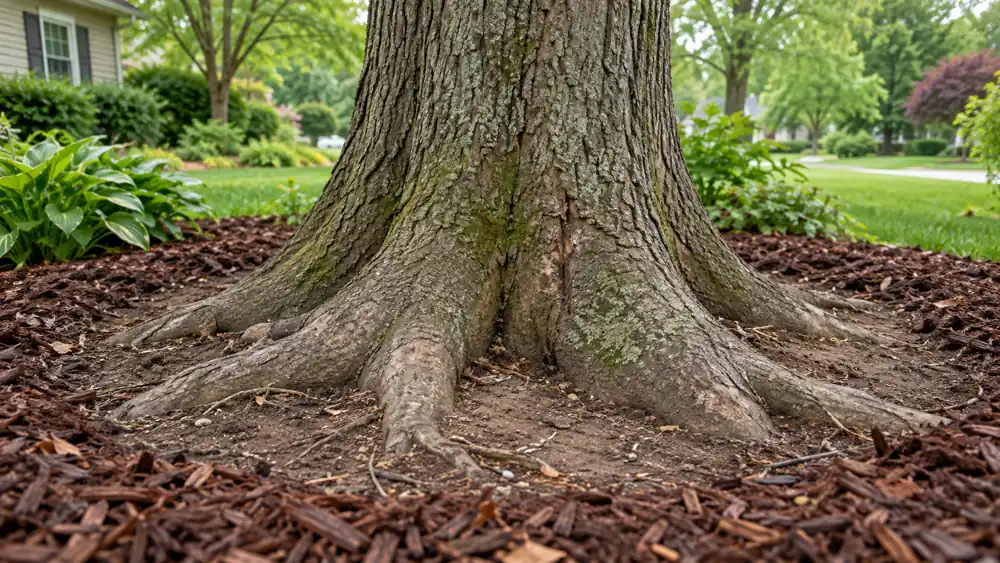
Root behavior changes the planting risk. White oak builds a deep root system early and resents disturbance. A balled-and-burlapped tree with a hidden girdling root can sit green for a season, then stall as the root collar tightens. Pull mulch and soil back from the root flare when inspecting nursery stock. The flare should spread visibly above the soil line, with firm woody roots moving outward. Circling roots feel like cord under the surface.
Urban sites need a harder filter. Compacted soil squeezes pore space, and roots need oxygen as much as water. A shovel that hits hard, gray, plate-like soil three inches down signals a root-zone problem before the species label matters. Tree choices for tight city lots should go through the same mature-size and root-clearance thinking used in selecting trees for urban gardens.
Mulch helps only when it protects the root zone without burying the trunk. Keep mulch off the bark, leave the root flare visible, and widen the ring as the canopy expands. A correct mulch layer feels cool and springy below the dry surface. A volcano mound against the trunk feels damp at the bark and invites decay, rodents, and collar problems. For young oaks, mulching to conserve soil moisture is useful because it moderates heat while roots explore outward.
Disease limits are regional. Oak wilt changes pruning season in parts of the Midwest, Northeast, and Texas. Fresh wounds attract sap-feeding beetles during high-risk periods, and red-oak group trees pay the heaviest price. Dormant pruning is the safer habit where oak wilt occurs. A red oak that drops more than half its leaves in a few summer weeks, especially from the crown downward, needs local extension diagnosis or a certified arborist.
A healthy oak in the wrong position becomes a permanent maintenance problem. It asks for clearance pruning, competes with beds, shades the wrong window, or pushes roots into hardscape. A smaller native oak or a shrub oak in the right place beats a famous giant planted where it has no adult room.
Conclusion
Start with the group, then the site. Red and white oak cues tell you how leaves, acorns, disease risk, and wildlife timing work. Soil texture, pH, mature crown width, and root clearance decide whether that tree fits the ground and air around it. When the marked adult canopy does not fit, choose a smaller regional oak before the first hole is dug.
A good oak choice looks calm years later: the root flare stays visible above a cool mulch ring, leaves hold clean color through summer, acorns fall where they feed the yard away from the walkway, and the crown has enough sky to widen without constant pruning.
FAQ
How Many Types Of Oak Trees Are There?
Botanical references place Quercus at roughly 450 species, with some scientific lists ranging higher depending on accepted species and hybrids. For home gardeners, the useful number is much smaller. Most choices narrow to regional white oaks, red oaks, live oaks, and a few smaller or tougher species that fit local soil and climate.
Are Live Oaks Red Oaks Or White Oaks?
Southern live oak and several related North American live oaks sit in the white oak lineage. Their evergreen leaves look different from classic lobed white oak leaves. Evergreen habit is a climate and leaf-retention trait. It does not automatically place a tree outside the red-white oak split.
What Is The Fastest Way To Tell A Red Oak From A White Oak?
Look at the lobe tips first. Red-oak group leaves have pointed lobes with bristles. White-oak group leaves have rounded lobes or rounded teeth without bristles. If leaves are confusing, use acorn timing: red oak acorns mature over two growing seasons, and white oak acorns mature in one.
Which Oak Tree Works Best In A Small Yard?
Small yards need region-specific oaks with honest adult size, not a young large oak kept small by pruning. Dwarf chinkapin oak, Gambel oak, scrub oak, and other smaller native oaks fit some regions better than white oak or bur oak. Local native range decides the best shortlist.
Can You Grow An Oak Tree From An Acorn?
Yes. Fresh acorns from a healthy local native oak give the best start. Remove the cap, discard acorns with holes or soft spots, and plant in a deep pot or protected bed so the first taproot can run downward without hitting a shallow container bottom. Protection from rodents and deer matters during the first year.
What Happens If You Prune Oaks In Summer?
In oak wilt regions, summer pruning creates fresh wounds during the season when sap-feeding beetles can move spores. The risk is highest for red-oak group trees. Hazardous limbs require safety pruning; routine shaping is a dormant-season job after local extension offices list the low-risk window.