





Last Updated April 29, 2026
Garden layout design is the plan that decides how a yard works before the first plant goes in. It controls where people walk, where water moves, where shade falls, which views matter, and how much maintenance the garden will ask from you after the first good weekend is over.
A beautiful garden that blocks the hose, hides the compost path, crowds the back door, or leaves no room to prune becomes tiring fast. A functional layout that ignores view, rhythm, and proportion feels like a work zone. A strong garden supports daily use, mature growth, proportion, rhythm, and a clear visual focus.
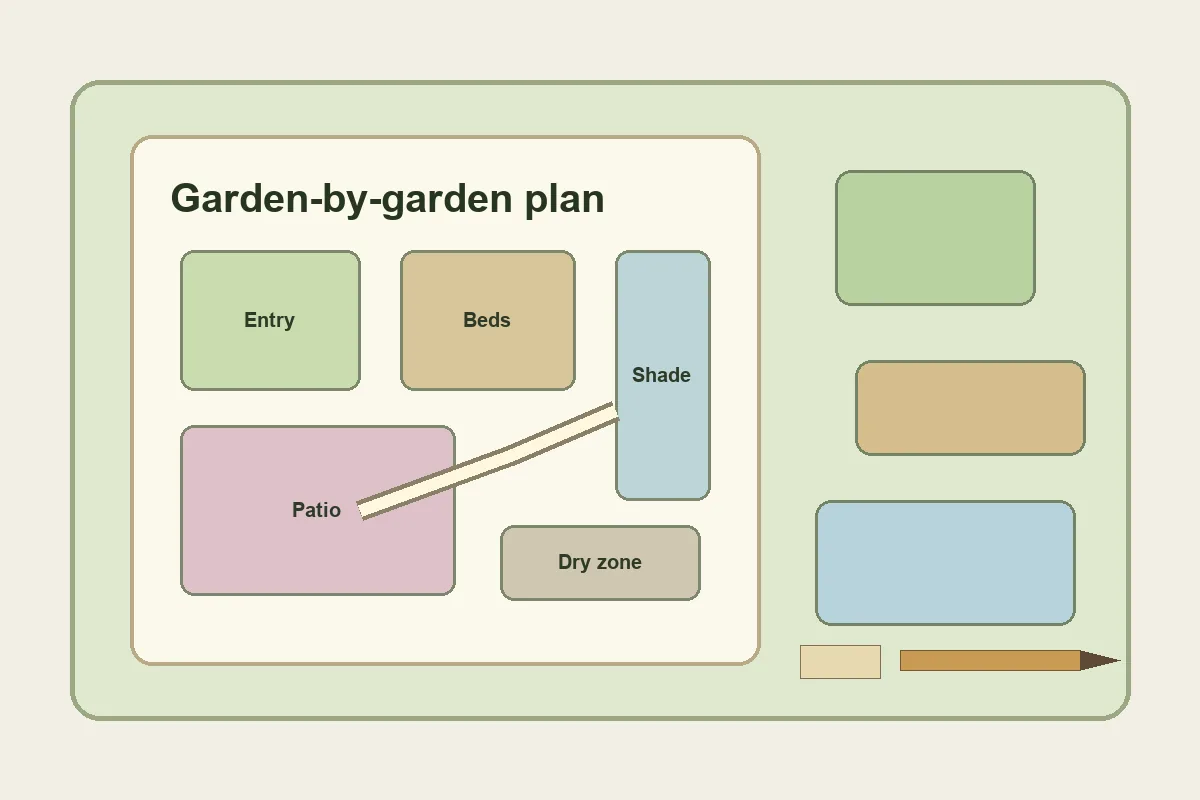
A good garden layout includes a measured base map, use zones, main paths, service access, seating views, mature plant spacing, focal points, water movement, sun exposure, and maintenance routes. Sketch the fixed features first, then place plants by mature size, daily use, and long-term form.
Key Takeaways:
- Map fixed features before choosing plants
- Plan the path you will use on wet days
- Give shrubs their mature width on paper
- Place beauty where you actually look
- Test the layout with hose lines before digging
Table of Contents
Garden Layout Design – Make Use Visible Before Beauty
A garden layout works when every important area has a job. The front entry welcomes, the side yard moves tools, the patio holds people, the vegetable bed gets sun and water, and the service corner stays reachable without stealing the main view.
A residential landscape design process organizes natural and built features into an aesthetic, functional, and environmentally sustainable landscape. Site inventory, user needs, functional diagrams, conceptual design, and final design should come before planting choices. Layout fails when looks arrive before use.
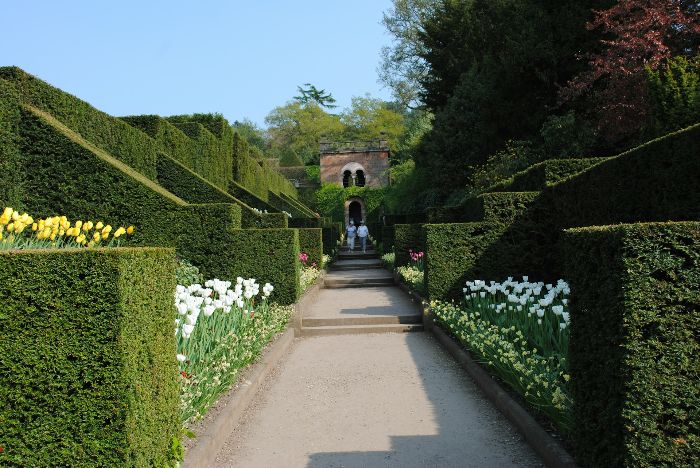
Think of the first sketch as a traffic map. Draw the routes from house to gate, house to compost, kitchen to herbs, patio to lawn, hose bib to the farthest bed, and driveway to storage. The lines that appear again and again are the bones of the layout. They deserve space.
Map the main inputs before drawing bed shapes:
- Daily routes from doors, gates, driveways, and patios
- Views from windows, seating areas, and the street
- Utility needs such as hose access, trash, compost, and storage
- Light, drainage, wind, slope, and existing trees
- Maintenance access for pruning, mowing, harvesting, and repairs
Garden Layout Planning Steps
- Measure the house, property edges, doors, windows, gates, existing trees, utilities, downspouts, slopes, and hard surfaces.
- Mark sun, shade, water movement, wind exposure, soil trouble spots, and utility access.
- Draw daily routes from the house to gates, seating, compost, storage, water, food beds, and bins.
- Place zones before bed shapes: entry, seating, food growing, service, play, privacy, or storage.
- Test main paths at full scale with hose lines, stakes, rope, or marking paint.
- Draw mature plant volumes for trees, shrubs, perennials, groundcovers, and screening plants.
- Add focal points, repeated materials, and anchor plants to connect the main views.
- Review pruning, watering, harvesting, wheelbarrow, and repair access before planting.
A working layout reduces repeated friction: tight turns, muddy shortcuts, blocked spigots, hidden tool routes, and narrow maintenance access. Each small resistance makes the garden harder to care for after the first season.
Garden planning and design should build year-round color, harvest, and seasonal structure onto a layout that already works. Layout decides where the garden can work. Seasonal planning decides how it changes through the year.
Garden Layout Site Map – Measure The Yard Before Choosing Plants
A site map turns a yard from a memory into a working document. Memory edits out the annoying details: the downspout that dumps water across the path, the fence shadow that reaches the tomato bed by late afternoon, the utility box that needs clear access, the window that sits lower than the shrub label suggested.
Site analysis matters because great landscape design cannot compensate for poor growing conditions or improper plant selection. A base map should record light, water movement, wind, utilities, existing plants, wildlife, and other site features. Those notes keep the garden from being designed for the yard you wish you had.
Walk the yard after a hard rain. The useful clues are physical: a shiny strip of runoff crossing the lawn, mulch pushed into a crescent, soil that smells sour and stays dark at the low corner, gravel that crunches dry underfoot beside a wet bed. Water marks the layout for you.
Sunlight needs the same honesty. Track where full sun, part shade, and deep shade actually fall at morning, midday, and late afternoon. A focused sunlight assessment matters more than the label “sunny backyard,” because one fence, tree, or roofline can split a small yard into several microclimates.
Use a simple scale if you can. One inch equals five feet works well for small yards; one inch equals ten feet works for larger lots. Mark the house, doors, windows, existing trees, slopes, downspouts, spigots, utilities, AC units, patios, steps, gates, and property edges. Leave plant names off the first map.
Pro Tip: Before drawing beds, place a garden hose along each proposed edge and leave it overnight. View it from the kitchen window, main door, and patio the next morning. Lines that look graceful from one angle can cut awkwardly across another.
Functional Garden Layout – Build Zones, Paths, And Access First
Functional garden layout starts with outdoor rooms and the routes between them. A room does not need walls. It needs edges, a purpose, and enough space for the body to use it without stepping into planting soil.
Sustainable landscape design should balance function, maintainability, environmental soundness, cost, and visual appeal. Those criteria prevent a common layout mistake: designing a scene with too little attention to use.
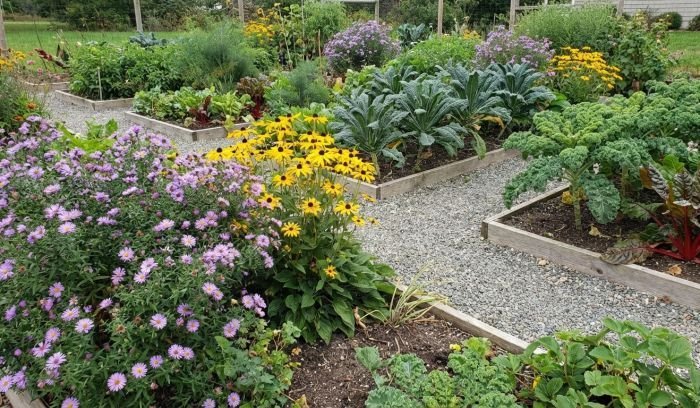
Place the hard-to-move functions first. Seating needs flat, comfortable ground and a view worth sitting in. Compost needs access that will not bother guests. Vegetable beds need sun, water, and a route wide enough to carry a basket without brushing wet foliage. A utility side yard needs clear space for trash bins, hoses, repairs, and winter storage.
| Layout Element | Functional Job | Planning Detail | Common Failure |
|---|---|---|---|
| Main path | Move people through the garden | Keep the route direct enough for daily use | A pretty curve becomes a muddy shortcut |
| Secondary path | Reach beds for care | Connect pruning, harvesting, and watering points | Beds look full and stay hard to maintain |
| Seating area | Hold people, shade, and view | Face the best view, not just the fence | The bench lands where no one wants to sit |
| Service zone | Handle compost, tools, bins, and hoses | Screen it with access kept simple | Useful work areas block the main view |
| Planting bed | Grow plants with shared needs | Size the bed for reach and mature spread | Deep beds require stepping into soil |
Path width is not only a comfort issue. Repeated foot pressure collapses soil pore spaces along bed edges, especially in clay soil after rain. Roots near compacted edges receive less oxygen, water infiltrates unevenly, and plants along the path may lag even when the planting plan looks right.
Garden pathway design decisions include slopes, drainage, materials, and base depth. At layout stage, the main decision is simpler: can you reach every bed without stepping where roots need air?
Beautiful Garden Layout – Use Scale, Rhythm, And Focal Points
Beauty in a garden layout comes from proportion, repetition, view control, and restraint from the first sketch. The eye likes a path that leads somewhere, a bed that fits the house, and a repeated material that makes separate areas feel related.
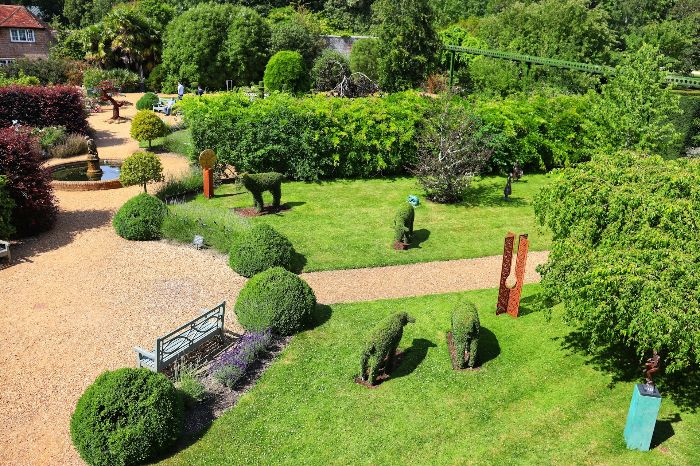
Landscape design uses scale, balance, unity, perspective, rhythm, and accent to organize outdoor space. Mature plant size must be considered before selection. That one idea does more for beauty than most color palettes.
Stand at the window or door you use most and squint. Big shapes should still read: tree canopy, shrub mass, path line, seating area, open ground, vertical accent. If everything disappears into many small pieces, the layout lacks visual hierarchy. If one object dominates every view, the layout has no balance.
Use focal points sparingly. A bench at the end of a walk, a small tree outside a window, a pot beside an entry, or a simple water bowl can lead the eye. Several equal-strength focal points in one view create visual noise, like voices talking over each other.
Example: if the main view is from the kitchen window, place the focal point about one-third into the view, with the fence or hedge as background. Repeat one shrub or grass along the path so the eye connects the window, route, and planting bed.
The deeper mechanism is visual weight. Dark foliage, coarse texture, dense evergreen mass, large leaves, and upright forms register as heavier than pale, fine, low, or airy plants. Balance does not require matching pairs; it requires enough weight in the right place for the view to feel settled.
Basic landscape design principles refine unity, balance, proportion, rhythm, and emphasis. In layout planning, keep asking one practical question: where should the eye land first?

Beginner gardens often look busiest near the nursery-season entry point, because plants are placed at the unloading spot, away from the main sightline that needs structure.
Planting Layout – Place Mature Plant Volumes, Not Nursery Pots
The nursery pot is the least useful size a plant will ever be. A one-gallon shrub may look lonely on the plan, then press against the walkway three years later. A young ornamental grass may look like a tuft in spring, then block a path after summer growth fills in.
Draw mature plant volumes as circles, ovals, or rough masses before choosing the final cultivar list. Tree canopy, shrub width, perennial spread, and groundcover coverage are spatial facts. They decide shade, airflow, access, visual weight, and pruning workload.
Plants also change the microclimate around them. A small tree casts shade, slows wind, cools surface temperature through transpiration, and changes soil moisture below its canopy. Shrub masses create enclosure and reduce wind at ground level. Dense planting can shade soil and suppress some weeds, and it can also reduce airflow enough to increase fungal leaf problems in humid climates.
| Plant Layer | Layout Role | Best Placement Question | Maintenance Risk |
|---|---|---|---|
| Trees | Canopy, shade, height, long-term structure | What will this shade in 5 to 10 years? | Too close to rooflines, wires, or small beds |
| Evergreen shrubs | Walls, screens, winter mass, rhythm | Does the mature width still leave access? | Constant pruning to hold an undersized space |
| Deciduous shrubs | Seasonal bloom, structure, loose screening | What does the bed look like after leaf drop? | Gaps in winter if all structure is deciduous |
| Perennials and grasses | Color, movement, texture, pollinator value | Will the mass still read after bloom? | Too many single plants with no rhythm |
| Groundcovers and fillers | Soil cover, edge softness, weed reduction | Will they spread into paths or crowns? | A soft edge becomes a maintenance chore |
Group plants with similar water needs before the planting plan gets pretty. A drought-tolerant lavender beside a thirsty ligularia creates an irrigation conflict that no layout line can solve. Grouping plants by water needs belongs on the garden layout map.
Texture belongs on the plan too. Run your fingers through a fine ornamental grass and it gives a dry, whispery resistance; brush a broad hosta leaf and the surface feels cool, waxy, and heavy. Those tactile differences read visually from a distance. Coarse texture comes forward. Fine texture recedes.
Garden Layout Planning Matrix – Match Choices To Real Constraints
Garden layout should not become a collection of wishes. Every yard has constraints: shade, slope, privacy, soil, budget, pets, children, storage, water access, or a limited maintenance window. Good design converts the constraint into a shape decision.
| Constraint | Layout Move | Beauty Move | Watch Before Building |
|---|---|---|---|
| Small yard | Use fewer zones and cleaner routes | Repeat one material and one anchor plant | Too many tiny features shrink the space |
| Deep shade | Put seating and paths where plants are limited | Use foliage shape, texture, and pale surfaces | Forcing sun plants creates thin growth |
| Wet low spot | Direct paths away from standing water | Turn the low area into a planted basin | Ignoring drainage damages paths and roots |
| Exposed wind | Place seating behind structure or planting mass | Use flexible grasses and sturdy shrubs | Tall brittle plants become seasonal cleanup |
| Edible garden goal | Place beds near water and daily routes | Frame vegetables with paths, herbs, or flowers | Hidden beds get harvested and weeded less |
| Low maintenance need | Reduce edge length and simplify bed shapes | Use massed shrubs and long-lived perennials | Many narrow curves increase trimming time |
Soil constraints can decide whether a layout works. A layout that places the most demanding bed on compacted subsoil or a wet clay pocket will keep asking for repairs. Before permanent beds, use a soil management check to decide whether the site needs drainage correction, organic matter, raised beds, or a different plant palette.
A layout can look balanced on paper and still fail because the best line crosses the worst ground. When water, compaction, or utility access says no, believe the site.

Garden Layout Review – Test The Plan Before You Build
The cheapest mistake to fix is the one still drawn in pencil. Before digging, test the layout at full scale with hThe cheapest mistake to fix is the one still drawn in pencil. Before digging, test the layout at full scale with hose lines, marking paint, stakes, cardboard, nursery pots, or rope. Walk it with a full watering can, a wheelbarrow, and a harvest basket if those are part of real life.
View the layout from three places: the main door, the main window, and the place where you will sit. A plan that only works from overhead belongs on paper. A garden is experienced at eye level, shoulder height, and footstep speed.
Test timing too. Morning light might make one border glow; late afternoon glare might turn the same seating area unusable. In summer, the air may feel still and hot beside a solid fence. In fall, wet leaves may collect exactly where the path narrows. Layout is physical.
Before digging, check the layout against real use:
- Walk every daily route without stepping into future beds
- Confirm hose, tool, compost, trash, and pruning access
- View focal points from doors, windows, paths, and seats
- Check mature plant widths against paths, walls, and utilities
- Mark wet, dry, windy, shaded, and hot areas on the plan
- Remove one feature if the layout feels crowded
Removing one feature is often the hardest correction. Many home layouts improve when one feature leaves: one extra curve, one decorative object, one small bed, one isolated shrub, one path that no one will use. Space is a design material too.
A good finished plan should feel clear. Routes are legible, views have leaders, service areas stay reachable, and plant masses have room to mature.
Conclusion
Designing a garden layout starts with the ground, the house, the people, and the routes that will be used every week. Beauty follows when those practical lines are given scale, rhythm, focal points, and mature plant spacing.
Sketch first, test at full size, then plant. The garden that lasts is the one that lets you move, prune, water, harvest, sit, and look without fighting the plan.
FAQ
How do I plan a garden layout?
Start with a measured base map that shows the house, doors, windows, paths, utilities, existing trees, slopes, wet spots, and sunny areas. Add use zones next: entry, seating, planting, service, storage, play, or food growing. Draw movement routes before plant beds. Then place plants by mature size, water needs, and the view from the places you use most.
What makes a garden layout functional?
A functional garden layout lets people move, maintain, water, harvest, and sit without fighting the space. Paths reach every bed. Service areas stay accessible. Plants have room to mature. The layout also respects sun, drainage, wind, and soil because those site conditions decide how hard the garden will be to keep healthy.
How do I make a garden layout look beautiful?
Use fewer ideas with stronger repetition. Repeat one or two plants, echo a material from the house, create one clear focal point per main view, and size beds in proportion to the house and path system. Beauty comes from scale and rhythm before flower color. A simple layout with mature plant masses usually reads better than many small disconnected features.
Should I plan garden paths or plants first?
Plan the main paths first because they lock in movement, access, and maintenance. Plants soften the path edges later. If plants come first, the layout often leaves no clear route for pruning, watering, harvesting, or carrying tools. Once the routes are settled, plant spacing and bed shape become much easier to judge.
How wide should garden paths be?
Main paths need enough width for the way they are used. A route used with a wheelbarrow, stroller, trash bin, or two people walking together needs more room than a quiet stepping-stone path through a flower bed. Test the path with the actual object you will carry or push. If your elbow, basket, or wheel catches foliage, widen the route before building.
How do I design a small garden layout?
Small garden layouts work best with fewer zones, clearer edges, and repeated materials. Keep the main route simple, place the strongest view where you see it from indoors, and choose plants by mature width. Vertical elements, containers, mirrors of repeated shapes, and one strong focal point can make a small yard feel organized without filling every inch.
What is the biggest mistake in garden layout design?
The biggest mistake is buying plants before the layout is settled. Nursery plants are small, colorful, and easy to overplace. Mature plants need width, airflow, water access, and maintenance room. A layout that starts with impulse plants often ends with crowded shrubs, blocked paths, and pruning work that never stops.
How do I connect a garden layout to year-round planning?
Use the layout to set the permanent structure, then use year-round planning to fill seasonal behavior. Trees, paths, evergreen masses, seating, utility access, and major beds belong in the layout. Bloom sequence, harvest timing, foliage color, winter structure, and succession planting belong in the seasonal plan. The two plans should reinforce each other, not compete.