




Updated April 20, 2026
Choosing the right wheelbarrow comes down to three things most buying guides skip: what you carry, where you carry it, and how far. Most buyers settle on price first, then discover why the barrow fights them through every narrow path and every trip up a slope. The right one disappears into your routine. You load it, push it, tip it, and move on. The wrong one adds friction to every trip.
Wheelbarrows are not all built for the same garden. A flat suburban lot with raised beds needs something fundamentally different from a sloped half-acre where the compost pile sits 80 feet from the vegetable garden. The decisions that matter – wheel count, tray shape, handle height, tire type – only make sense when you start from your terrain and your tasks rather than from a price tag.
Key Takeaways:
- Slopes over 10 degrees require two wheels to prevent active load-correction on every trip
- Poly outlasts steel for compost; steel handles gravel and stone loads better
- Check pneumatic tire pressure monthly; soft tires add 30-40 percent push resistance
- Four cubic feet of wet compost weighs 180-220 pounds – calculate before loading
- Hip-level handles keep the spine neutral on inclines and heavy pushes
Table of Contents
What You’re Carrying – Where Every Garden Wheelbarrow Decision Should Start
The most useful question before any other: what are you moving, and how often?
Loose organic materials – compost, mulch, topsoil, leaf litter – behave differently from dense, sharp loads like gravel, crushed stone, or bricks. The distinction is not just volume. It involves surface wear, chemical exposure, and how the material shifts during transport. Compost and wet soil are mildly acidic, retain moisture, and press against the tray surface for long stretches. Stone and masonry are abrasive and dry, but apply hard point pressure at every contact.
For anyone primarily moving compost materials and mulch, a poly tray in the 4-5 cubic foot range covers nearly every task without the corrosion risks that come with steel. For mixed use – organic loads most of the season with occasional stone or paving work – a powder-coated poly is the practical middle ground. Construction or masonry work calls for steel.
How Often You Use It Changes What You Need
Someone who moves mulch twice a year can forgive an awkward handle or a slightly heavy tray. Someone running weekly compost from the compost bin to beds from March through October cannot. Frequent use amplifies every ergonomic flaw – handle height, grip material, turning radius. If the barrow sees more than 20 uses per growing season, treat ergonomics as a primary filter, not a secondary feature to consider after tray size.
| Load Type | Recommended Tray | Minimum Capacity |
|---|---|---|
| Compost, wet soil, amendments | Poly | 4 cu ft |
| Dry mulch, bark chips, leaves | Poly | 4-5 cu ft |
| Gravel, crushed stone | Steel | 4 cu ft |
| Garden debris, transplants | Poly | 4 cu ft |
| Bricks, pavers, flagstone | Steel | 3-4 cu ft |
| Mixed use across seasons | Powder-coated poly | 4-5 cu ft |
Single Wheel or Two – The Terrain Call Most Buyers Miss
Single-wheel designs outsell dual-wheel models in residential gardens, and the reason is practical: most garden paths and gate openings measure 28-32 inches across, and single-wheel barrows thread through them cleanly. Two-wheel designs typically run 32-36 inches at their widest point. If your garden has a gate or path under 34 inches, a two-wheel model becomes a negotiation on every trip.
Beyond the path question, the real difference is in what each design demands from you physically.
When Single Wheel Makes Sense
A single wheel sits directly under the load’s center of gravity, which makes the barrow easy to tip and quick to pivot. On flat or gently sloping ground, the primary effort is forward. The balance is natural. For gardens with firm, level paths – compacted gravel, flagstone, concrete – and loads under 150 lbs, a single-wheel handles every task without compromise.
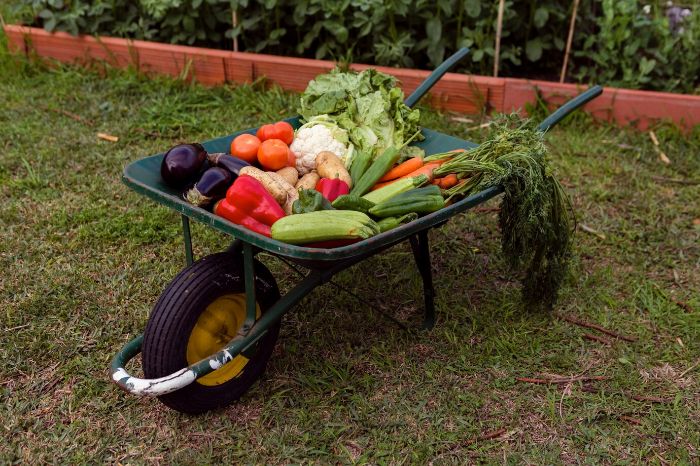
Where single-wheel struggles is on lateral slopes: surfaces where the ground tilts sideways relative to your direction of travel. That tilt forces continuous corrective pressure on the handles to keep the tray from swinging off-line. Over a 30-minute session on a consistent cross-slope, the physical cost adds up in a way a flat-ground test push never reveals.
The Case for Two Wheels
Two wheels distribute load sideways across a wider base, which means the barrow stabilizes without active correction on uneven and sloping terrain. You push forward; the frame holds level on its own. For properties with slopes over 10-12 degrees, soft ground that shifts under load, or loads exceeding 200 lbs, two wheels reduce both the physical effort and the tipping risk.
The trade-off is turning radius. Two-wheel models require a wider arc to change direction. Dumping into a tight raised bed corner takes an extra step compared to a single-wheel that pivots on its tire.
Pro Tip: If your garden has slopes but also narrow paths, a single-wheel is the more practical choice. Widen one or two key paths by four inches with a flat spade rather than fighting a loaded two-wheel barrow through a 28-inch gate opening on a grade – that maneuver adds a minute to every trip.
Steel or Poly – When the Conventional Wisdom Gets It Backwards
The standard advice: steel for heavy loads, poly for light. That framing is useful as far as it goes, but for everyday gardening it often sends buyers toward the wrong choice.
Steel feels more durable. It is, in one specific way: abrasion resistance. Load it with rough gravel week after week and steel holds up where poly would show surface cratering over time. For organic gardening loads – compost, soil, fertilizer mixes – poly actually outlasts basic steel. Compost sits at a pH of roughly 6.0-7.5, and when wet organic material stays in contact with a scratched steel surface, oxidation begins almost immediately. Washington State University Extension documents how mildly acidic organic material accelerates corrosion on ferrous metals in the presence of persistent moisture. A standard painted-steel tray used for regular compost work shows rust through the tray bed at the weld seams within two to three seasons.
Epoxy powder-coated steel is a different matter. The coating bonds mechanically to the steel surface, runs thicker than spray finishes, and resists the chemical action of organic loads for years. Budget steel trays with basic spray paint coatings chip within the first season of hard use – and once they chip, corrosion starts at every exposed point.

Tray shape adds a practical dimension most buyers overlook. Rounded-nose trays tip at any angle – forward, sideways, or diagonal into a bed corner. Flat-bottom trays tip forward only. For anyone dumping mulch into the corner of a raised bed or tipping sideways along a border edge, a rounded nose is the more flexible option. Bryan Clayton, CEO of the lawn care marketplace GreenPal, notes that professional landscapers moving organic material daily default almost universally to poly trays with rounded noses specifically because of this multi-directional dumping flexibility.
I often notice that gardeners who replace their wheelbarrow within three years did not wear out the frame or the handles – they lost the tray to rust through the weld line at the nose, almost always the spot where wet organic material pools after tipping.
Tray Capacity and Real Load Weight – The Spec That Misleads Most Buyers
The cubic foot rating tells you how much volume the tray holds. It says nothing about how much the load weighs once you fill it.
Most home gardeners do well with a 4-5 cubic foot wheelbarrow, and the reasoning has nothing to do with the barrow’s limits – it has to do with yours. Mark Wolfe, who spent 20 years in professional landscaping before leading equipment testing at Bob Vila, recommends 4-6 cubic feet for residential use specifically because loads in that range stay within manageable push weight across the most common materials.
Here is the part most buyers don’t work out until after the first heavy load:
| Material | Weight per Cu Ft | Weight in a 4 Cu Ft Load |
|---|---|---|
| Dry mulch | 15-20 lbs | 60-80 lbs |
| Dry compost | 30-35 lbs | 120-140 lbs |
| Wet compost | 45-55 lbs | 180-220 lbs |
| Dry topsoil | 45-50 lbs | 180-200 lbs |
| Wet topsoil | 80-100 lbs | 320-400 lbs |
| Loose gravel | 90-110 lbs | 360-440 lbs |
The National Institute for Occupational Safety and Health sets the recommended action limit for sustained push and pull force at roughly 51 lbs for most adults under standard conditions. A fully loaded wheelbarrow on flat ground transmits approximately 15-20 percent of its total weight as push force at the handles. On a 10-degree incline, that percentage roughly doubles.
A 4 cubic foot load of wet compost at 180-220 lbs generates around 27-44 lbs of push force on flat ground – within the NIOSH limit. That same load on a 10-degree slope generates 54-88 lbs – above it for most adults. The barrow’s weight rating becomes irrelevant at that point. Your body is the limiting factor, and capacity decisions should account for material density and terrain before they account for tray volume.
Handle Height and Grip – What Back Pain Teaches Professional Landscapers
Handle ergonomics appear in almost no wheelbarrow buying guides. They drive more garden-related lower back strain than most gardeners attribute to tool fit.
The ideal grip height puts your wrists at or just below hip level when you’re walking in a normal push position. This keeps your arms angled slightly downward, your core engaged, and your lumbar spine in a neutral position. Handles set too low force you to round your back to reach them – especially on inclines where the rear of the barrow drops and you lean forward to maintain balance. OSHA’s ergonomics guidelines specifically identify handle heights below the neutral spine zone as a key risk factor for cumulative lower back strain in repetitive pushing tasks.
Two-Handle vs. Loop Handle
Bifurcated handles – two separate grips – give you independent leverage on each side. You can lean into a slope or guide around an obstacle without sending the corrective force through your wrists. Loop handles, a single continuous curved bar, distribute force more broadly and can feel gentler for users with hand or wrist conditions. Most residential wheelbarrows use bifurcated handles. Loop handles appear more often on construction-grade models built for two-person carry.
Grip Material and Extended Use
Untreated metal handles create two specific problems. In direct summer sun, bare steel or aluminum surfaces reach temperatures above 120°F within 20-30 minutes – hot enough to make bare-hand gripping uncomfortable through a full session. In rain or morning dew, the surface becomes slick under load. Foam grip inserts address both issues: they insulate against heat, improve grip in wet conditions, and reduce hand fatigue over long sessions.
If you wear padded gardening gloves consistently, bare handles are manageable. Grip inserts earn their price on any barrow used for more than 20 minutes at a stretch.
For anyone running regular soil amendments and heavy bed preparation through spring and fall, back strain from a tool that fits poorly builds across a season in ways that a single afternoon won’t reveal.
Why does back fatigue after 20 minutes of wheelbarrowing on flat ground almost always trace back to handle height rather than the load itself?
Tires, Coating, and the One Upgrade Worth Every Dollar
Pneumatic tires are the default on most quality wheelbarrows in the 4-6 cubic foot range. They absorb vibration, conform to uneven ground, and make the push feel lighter on rough terrain – the slight give of a properly inflated tire on wet lawn is immediate and noticeable. The downside is maintenance: monthly pressure checks, the occasional flat, and the risk of pushing on a soft tire without realizing it. A tire at 20 PSI instead of the correct 35-40 PSI increases rolling resistance by 30-40 percent and puts uneven stress on the wheel axle over time.
Flat-free tires – foam-filled – eliminate all of that. The ride is slightly firmer on very rough ground and they add 1-2 lbs to the wheel weight, but for most home gardeners the maintenance-free aspect outweighs the small comfort difference. Flat-free tires are the better choice for anyone who stores the barrow seasonally, works primarily on maintained paths and lawn, or prefers not to add tire pressure to the spring setup list.
Solid rubber tires belong on concrete and paving only. They transmit every surface irregularity directly to the handles and bounce noticeably on soft or uneven ground. They are not a value option for garden use.
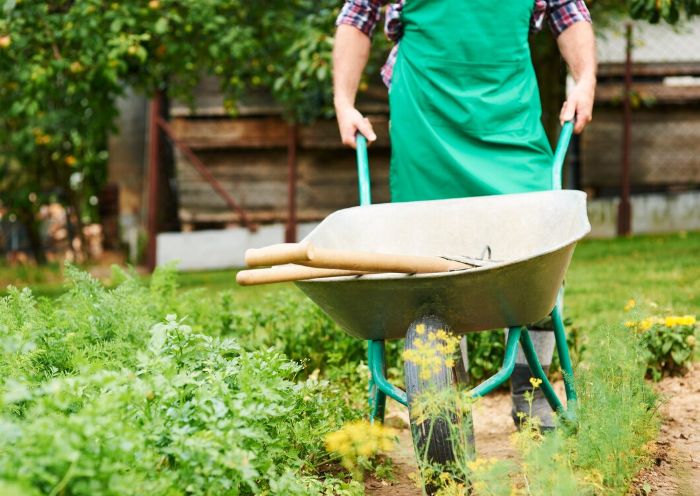
On coating: if a steel tray’s description reads “painted” without further specification, the coating will chip under hard use within one season. Epoxy powder coat is the standard worth paying for – it bonds mechanically to the steel, runs thicker than spray finishes, and resists the point impacts that chip paint. If the spec sheet does not mention epoxy or powder coat, factor in a shorter tray lifespan accordingly.
One upgrade worth taking at purchase: if the base model comes with pneumatic tires and a flat-free option is available, it typically adds $15-25 to the base price. Replacing a pneumatic tire after the first significant flat runs $40-60 including the tube, and most barrows that see regular use will have one within the first few seasons. The math favors upgrading at the register.
How to Test One Before You Buy
Most of the variables that determine whether a wheelbarrow suits your garden cannot be assessed from a product page. These four checks take under three minutes and catch the problems that photo reviews miss.
The balance test. Lift the handles to your natural push height with the barrow empty and level. The nose should sit lower than the tray edge but should not dive aggressively toward the ground. A heavily forward-biased center of gravity means the wheel placement puts continuous lifting load on your wrists the moment you add weight toward the front of the tray.
The handle height check. Stand behind the barrow in your normal push posture. Your wrists should land at or just below hip height when your arms extend naturally forward. If your wrists drop to mid-thigh to reach the grips, your back will compensate on every incline – not because the load is heavy, but because the geometry is wrong.
The tray flex test. Apply firm downward pressure to the front edge of the tray with both thumbs. Steel should show no flex at all. Poly should deflect slightly and spring back cleanly without surface whitening or stress marks at the edges. Visible stress marks under moderate thumb pressure on a new barrow mean the wall thickness is too thin for regular soil and compost loads.
The tire firmness check. Press your thumb firmly into the sidewall of a pneumatic tire. It should resist clearly and firmly. Wheelbarrows often ship at 20-25 PSI from the warehouse; correct inflation is 35-40 PSI. A tire that gives easily on a brand-new product signals quality control issues that typically extend across the rest of the assembly.
Conclusion
The wheelbarrow does not need to impress – it needs to disappear into your routine. The right one becomes background noise in a gardening session: load it, push it, tip it, move on. When you match the tray material to your actual loads, set the handle height once at setup, and pick a wheel configuration that suits your terrain, you will push through a full growing season without giving the tool a second thought.
When any of those three things are wrong, the feedback arrives quickly. The handles strain on every slope. The tray starts rusting through the weld line by September. The two-wheel model stops clearing the gate post. Capacity and coating specs on a product tag never tell you that. A three-minute test before the first loaded trip does.
FAQ
What size wheelbarrow for a home garden?
A 4-5 cubic foot tray handles every common home garden load including mulch delivery, compost transfer, and soil amendments. Going to 6 cubic feet is reasonable for larger properties, but a fully filled 6 cu ft tray of wet compost or soil regularly exceeds what most adults can push safely on any slope. Most gardeners who buy the largest available model end up using it at 60-65 percent capacity by their third season. Match the size to your most frequent load, and you will never feel the barrow working against you.
Single wheel vs two wheel wheelbarrow – which is better?
Two wheels do not automatically mean a better wheelbarrow for garden use. Single-wheel designs outsell dual-wheel models in suburban gardens specifically because they fit through standard gate and path openings of 28-32 inches that most two-wheel models cannot navigate without repositioning. The deciding factor is terrain. On slopes over 10-12 degrees or on consistently soft, uneven ground, two wheels reduce the active correction required to keep a loaded tray upright. On flat or gently sloping ground with standard path widths, a single-wheel design handles every task with less turning difficulty and more natural pivot.
Steel vs poly wheelbarrow tray – what is the difference?
Steel resists abrasion better; poly resists corrosion better. For organic gardening loads like compost, soil, and mulch, poly trays regularly outlast basic steel by several seasons because the mild acidity and persistent moisture in these materials accelerates corrosion at any scratched point on a steel surface. Steel earns its place for sharp, abrasive loads – gravel, broken stone, masonry debris – where the harder surface holds up longer against point contact. If the steel tray you are considering uses epoxy powder coat rather than basic spray paint, its corrosion resistance improves significantly for organic use as well.
Can you mix concrete in a wheelbarrow?
Yes, but only in a steel tray, and only if you clean it thoroughly within 30 minutes of finishing the mix. Concrete is highly alkaline, running at pH 12-13, and damages poly trays during a single mixing session by etching the surface and making the material brittle over time. Steel handles the alkalinity without immediate damage. The risk with steel is concrete that dries in the weld seams – it cracks the coating at the joint lines and corrosion follows within a season. For anyone mixing more than a few bags on a regular basis, a dedicated mixing tub is the more practical tool; a steel wheelbarrow works fine for occasional small batches provided the cleanup is immediate.
What happens if you overfill a wheelbarrow?
Overfilling creates two separate problems. The obvious one is spillage on bumps and direction changes, especially with loose materials. The less obvious one involves the handles: when a tray carries more weight than the user can balance in motion, the rear handles rise to compensate, shifting push force from the legs and core to the lower back and shoulders. Frame stress concentrates at the leg and tray mounting welds – the first point of structural failure on most budget models. A barrow that is consistently loaded past its practical carry weight will show metal fatigue at the leg attachment points within one to two seasons of regular use.
Best tire type for garden wheelbarrow?
Flat-free foam-filled tires offer the best practical balance for most home gardens. They require no inflation maintenance, never puncture, and handle the range of surfaces most gardeners work on – lawn, gravel paths, soft soil – without meaningful comfort loss compared to pneumatic. Pneumatic tires ride noticeably smoother on very rough or rocky terrain and feel lighter on soft ground, but they require monthly pressure checks and will eventually go flat. Solid rubber tires work on concrete or compacted gravel but bounce noticeably on soft or uneven ground. For seasonal storage and low-maintenance use, flat-free is the reliable default.
How to prevent wheelbarrow from rusting?
Clean the tray after every use involving organic material, wet soil, or any load that leaves residue in the weld seams. A 60-second rinse and wipe extends tray life by years. For steel trays, store the barrow nose-down or tilted slightly so water drains rather than pooling at the front weld line – standing water at that joint is where corrosion starts on almost every steel barrow that rusts through prematurely. Touch up paint chips and scratches with a rust-inhibiting primer within the same season they appear. Once rust reaches the underside of a weld seam, the structural damage progresses faster than surface treatment can slow it.