



Last Updated May 29, 2026
A tired garden bed usually gives warnings before it fails outright. Water sits on the surface after rain. The top inch turns pale and hard between waterings. Seedlings grow for two weeks, then stall. A tomato plant gets fed again and still curls by afternoon because the roots are working inside tight, airless soil.
Soil health improvement begins when those signs are separated from the product shelf. Compost, fertilizer, lime, mulch, cover crops, drainage work, and soil testing can all be useful. They cause problems when they are used in the wrong order. A compacted bed needs air and pore space before another quick feeding. An over-rich bed needs restraint before a thicker compost layer. Yellow leaves need context before pH correction enters the picture.
The soil has to show which job is failing first. Healthy garden soil lets water enter, holds some moisture without staying saturated, keeps enough pore space for oxygen, supports roots below the surface layer, and releases nutrients at the pace crops can use them. The first repair should make one of those jobs easier.
Key takeaways:
- Read water movement, surface crusting, root depth, and plant response before adding inputs.
- Compost improves soil behavior when the bed needs organic matter, moisture buffering, and better aggregation.
- Compaction and drainage problems need physical correction before fertilizer can help much.
- Soil tests matter before pH changes, repeated fertilizer, manure-heavy compost, or nutrient corrections.
- Healthy soil is maintained through smaller seasonal habits, not repeated rescue work.
Table of Contents
Quick Soil Health Diagnosis
Soil repairs become clearer when the bed is treated like a living root zone instead of a container for products. Start with the visible failure, then choose the first check that proves which system is weak: structure, organic matter, drainage, pH, nutrients, or maintenance.
| What the bed does | Likely soil problem | First check | First move | Mistake to avoid |
|---|---|---|---|---|
| Water runs sideways or sits after rain | Compaction, sealed surface, poor grade, or drainage restriction | Press a trowel into the wet zone and check whether the lower layer is dense. | Open structure only when workable, keep traffic off wet soil, and correct the water path. | Adding fertilizer while roots still lack oxygen. |
| Surface crusts and seedlings struggle to emerge | Weak aggregation, bare soil, splash sealing, or low organic matter behavior | Water gently and watch whether the top seals again as it dries. | Add finished compost or leaf-based organic matter, then protect the surface. | Breaking the crust repeatedly without changing the surface condition. |
| Soil dries quickly below the top inch | Sandy texture, low moisture buffer, shallow watering, or exposed surface | Dig after watering and see whether moisture reached the active root zone. | Use compost, leaf mold, mulch, and deeper watering rhythm. | Watering the surface more often while the lower root zone stays dry. |
| Plants stay pale after feeding | pH, nutrient imbalance, salt stress, wet roots, or weak uptake | Compare leaf pattern with moisture, root condition, and soil test history. | Test before adding lime, sulfur, phosphorus, potassium, or repeated fertilizer. | Assuming all yellowing means nitrogen shortage. |
| Dark soil grows soft plants with burned edges | Over-enrichment, excess salts, or repeated rich inputs | Review compost, manure, and fertilizer history before adding anything else. | Pause rich materials and check whether the bed needs restraint. | Treating dark color as proof of balanced soil. |
| Roots stay shallow or turn sideways | Dense layer, wet lower zone, dry lower zone, or compacted bed base | Pull a spent crop and inspect the root shape and stopping depth. | Fix root access before chasing nutrient symptoms. | Improving only the top inch while the restriction remains below. |
Read the Bed Before You Amend It
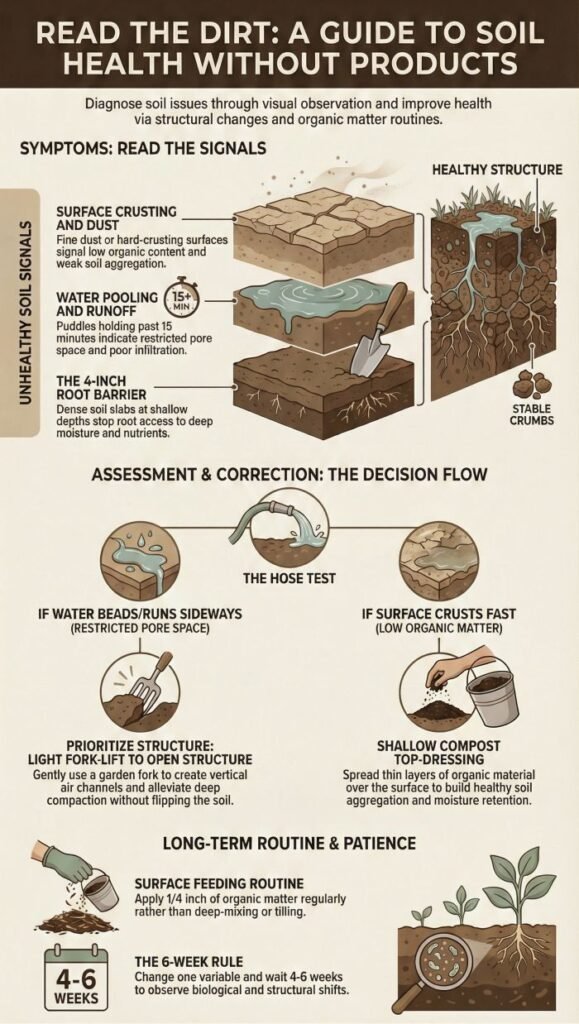
The first soil check should happen with your hands and water. A damp handful that smears into a ribbon points toward clay behavior and compaction risk. A handful that falls apart while the bed dries by midday points toward low moisture reserve. A sour smell after rain usually means oxygen has been pushed out of the root zone.
Water movement shows pore space
Water entry is the fastest read on soil function. A healthy bed accepts a normal soak without turning glossy, then holds enough moisture for roots after the surface begins to dry. When water beads and moves sideways, the surface is sealed or the profile below it is too tight. When water vanishes fast and the soil below stays dry, the bed may need organic matter, mulch, and slower irrigation rather than more frequent splashing.
Water also shows whether the next input will work. Compost mixed into a sealed bed may improve the top layer while the lower restriction keeps roots shallow. Fertilizer applied to wet, airless soil can sit near roots that are already stressed. A soil test can report nutrients, yet roots still need air and moisture balance to use them.
Root depth shows whether the repair is reaching the crop
Pull one finished plant before clearing the bed. Roots that branch downward through crumbly soil usually show a working profile. Roots that mat near the surface, flatten at one depth, or circle in a shallow layer show a bed that is physically limiting the crop. That root pattern matters more than the surface color.
A shallow root system raises every other problem. The crop dries faster in heat, takes up nutrients unevenly, and wilts sooner under wind or sun. Soil health improvement should push roots into a larger, better-aerated volume of soil. When that happens, watering and feeding become less frantic.
When Soil Structure Is the Real Limit
Structure is the arrangement of soil particles into crumbs, plates, blocks, or dense clods. Texture changes slowly, but structure changes with traffic, moisture timing, roots, organic matter, and disturbance. A clay bed can have workable structure. A raised bed filled with rich material can still collapse into a dense, air-poor mass if it is overworked or walked on wet.
Compaction makes nutrients less useful
Compacted soil restricts the channels that carry oxygen and water. Roots slow down, nutrient uptake drops, and the plant may look hungry even when nutrients are present. Repeated feeding often disappoints in a tight bed because the root system occupies too little soil to use the input well.
Structure work should lead when tools hit resistance at the same depth, footprints stay glossy, water sits after rain, or roots flatten against a dense layer. The correction is usually a sequence: stop traffic, wait for a workable moisture window, open the restriction without pulverizing the bed, add organic matter in moderate layers, and keep the surface covered.
Surface cover protects the improvement
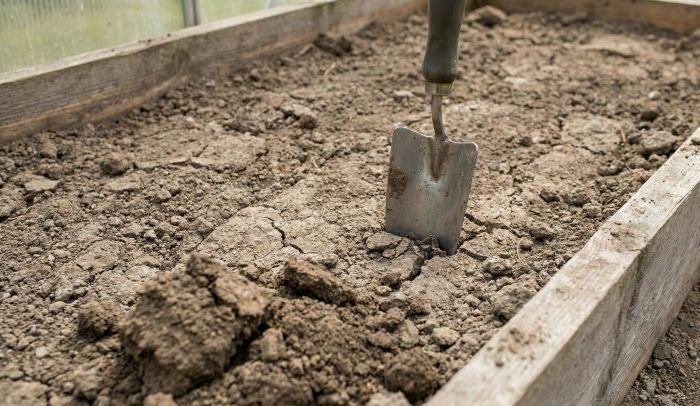
A repaired bed can slide backward when the surface sits bare. Rain impact breaks aggregates. Sun bakes the top layer. Foot traffic closes the channels that roots and soil life built. Mulch, cover crop residue, and living roots protect the first inch where crusting often begins.
Soil with hard layers, puddling, crusting, or shallow root stops needs the deeper structure path in improving garden soil structure. That work should happen before compost amount, fertilizer choice, or pH correction becomes the main concern.
When Compost and Organic Matter Should Lead
Compost is often the right first material when soil needs better crumb structure, more moisture buffer, and more biological activity. Finished compost helps mineral particles hold together in small aggregates, which improves the balance between air and water. In sandy soil, that added organic matter slows dry-down. In clay, it helps the bed break apart more easily when the soil is worked at the right moisture.
Compost is one form of organic matter
Compost is finished decomposed material. Organic matter is the wider soil-building category: leaf mold, aged plant residues, cover crop roots, mulch as it breaks down, and other once-living materials. The form matters. Finished compost is easier to blend before planting. Leaf mold is useful where water disappears too fast. Surface mulch protects aggregates and slows evaporation. Fresh residues need timing so they do not cool the bed or tie up nitrogen around young crops.
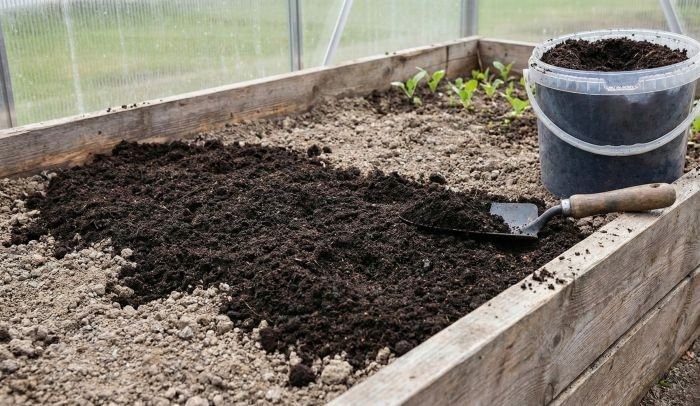
Compost should lead when the bed has weak surface structure, low moisture reserve, or a tired planting layer that still drains and lets roots move. Compost should slow down when the bed is already dark and rich, has a history of manure, grows lush soft leaves, or shows nutrient burn. More organic material can become another imbalance when the soil already has enough.
Amount matters because soil can be over-enriched
A measured compost layer is usually safer than a dramatic reset. Thick rich additions can push phosphorus, salts, and nitrogen beyond what the crop needs, especially when manure-based compost is used every season. The bed may look darker while plant response becomes softer, weaker, or less predictable.
Compost amount, organic matter selection, clay and sandy soil response, and bed preparation are handled in improving garden soil with compost and organic matter. Use that path when the diagnosis points toward organic matter and preparation rather than pH correction or drainage repair.
When Soil Testing Should Lead
Soil testing should lead when the next decision changes chemistry. Lime, sulfur, phosphorus, potassium, micronutrients, repeated fertilizer, and manure-heavy compost can build up or shift pH. Those inputs deserve more evidence than leaf color, plant size, or a habit from last season.
Symptoms are clues, not proof
Yellowing leaves can follow nitrogen shortage, wet roots, high pH, low pH, compacted soil, cold weather, disease, or transplant stress. Purple leaves can point toward phosphorus stress, but cold soil and root restriction can produce similar behavior. A leaf symptom can start the investigation; it should not choose the amendment by itself.
Testing becomes especially useful when the same bed fails across several crops, when pH-sensitive crops struggle, when fertilizer has been used repeatedly, or when compost and manure have been added for years. A report can show whether the bed needs correction, restraint, or a physical soil fix first.
pH changes need evidence
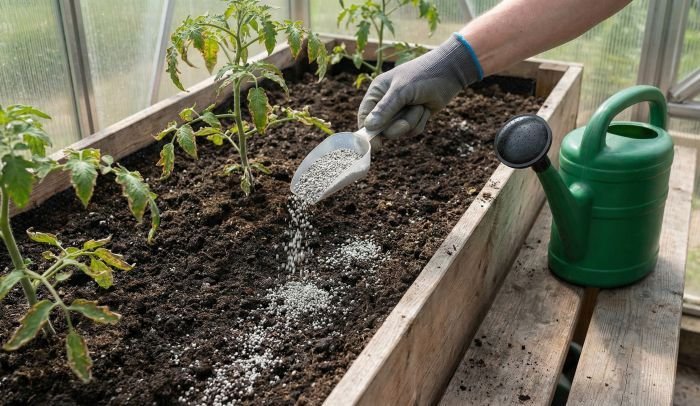
pH controls nutrient availability, so a crop can act deficient while the soil still contains the nutrient. Lime and sulfur should follow a report because they change the soil environment beyond the current crop. A wrong pH correction can make the next season harder to manage.
Use test garden soil before adding amendments when the choice involves pH, lime, sulfur, fertilizer, phosphorus, potassium, micronutrients, repeated crop failure, or unclear symptoms.
When Drainage and Water Movement Come First
Drainage problems can disguise themselves as fertility problems. A plant with wet roots may yellow, stall, drop leaves, or grow soft tissue. Feeding that plant can make the root zone saltier while oxygen remains low. Compost can help structure over time; water routed into the bed from a path, downspout, compacted edge, or sealed lower layer needs a cause fix.
Wet soil changes the order of work
Soil that stays glossy after rain should be left alone until it can crumble. Working wet soil squeezes out pore space and turns a short-term water problem into a structural problem. The better correction is patient: keep feet off the bed, redirect surface water where needed, loosen only during a workable window, and protect the surface after the bed opens.
The same logic applies in containers and raised beds. If water stays trapped in the root zone, roots lose oxygen before nutrients become the main issue. Container problems should be checked against proper pot drainage before fertilizer or rich compost is used as the correction.
Overfeeding can look like poor soil health
A bed can become too rich to behave well. Repeated fertilizer, manure, or heavy compost can leave salts and excess nutrients that show up as burned edges, lush weak growth, or poor fruiting. In that case, the soil needs restraint and evidence before more input. Recovery starts by stopping the excess source and reading the crop response under normal watering.
When recent feeding history points toward excess, compare the symptoms with overfertilized garden soil before adding another amendment.
Build a Soil Health Routine That Does Not Overcorrect
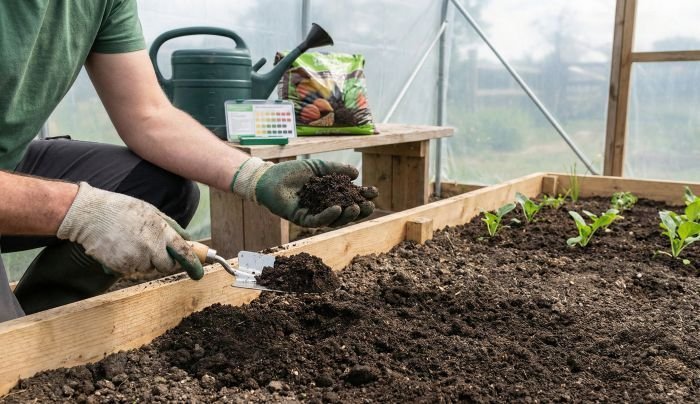
The best soil routine is small enough to repeat and slow enough to read. Soil changes through wet-dry cycles, roots, residues, microbes, and weather. When three corrections happen at once, the next plant response becomes hard to interpret. One change at a time keeps the bed readable.
| Seasonal check | What to look for | Useful move | Pause when |
|---|---|---|---|
| Early spring | Surface crust, winter compaction, wet zones, and leftover mulch behavior | Clear debris, wait for workable moisture, add light compost only where soil behavior calls for it. | The bed smears, sticks, or stays glossy under foot pressure. |
| Before planting | Root-zone looseness, seedbed contact, compost maturity, and drainage | Prepare the planting layer without pulverizing the profile. | The soil still smells sour or holds water in the planting zone. |
| Midseason | Wilting pattern, leaf color, watering depth, mulch cover, and heat stress | Adjust water depth, mulch, or targeted feeding after roots and moisture check out. | Heat, drought, or wet roots explain the symptom better than nutrients. |
| After harvest | Root depth, clods, compaction lines, and crop residue condition | Leave healthy roots, add cover, or start structure repair before the bed rests. | The bed already received several rich inputs that season. |
| Fall | Repeat failures, pH-sensitive crop issues, and amendment history | Test soil when chemistry decisions may need time before spring. | The only problem was a short weather event or one crop-specific stress. |
Maintenance is also where restraint matters. A productive bed may need only surface protection, modest compost, crop rotation, and targeted feeding when a crop actually asks for it. The bed that receives fewer corrections often becomes easier to manage because each signal stays clearer.
Nutrient additions still have a place. Use fertilizer basics for gardeners when root access, drainage, and moisture are already functioning and the crop needs a targeted nutrient push.
Conclusion
Soil health improvement works when the first repair follows the bed’s actual failure. Puddling asks for water movement and pore space. Crusting asks for aggregation and surface protection. Pale growth asks for context before feeding. A rich bed with burned edges asks for restraint. Shallow roots ask for a better physical profile.
Compost, soil testing, structure work, drainage correction, and fertilizer each have a place. The order decides whether they help. Read the bed, change one thing, give the soil time to respond, then maintain the improvement with smaller seasonal habits. That is how garden soil becomes easier to work, easier to water, and more reliable for the next crop.
FAQ
What is the first step in improving soil health?
Start with water movement, surface condition, and root depth. If water enters and roots move down, compost or targeted feeding may help. If water sits, roots stay shallow, or the surface seals, fix structure and drainage before adding rich inputs.
Is compost always the best way to improve soil?
Compost is often useful when the bed shows low organic matter behavior, weak aggregation, or a need for seasonal renewal. Slow it down when the bed is over-rich, poorly drained, or showing symptoms that need a soil test.
How can I tell if soil structure is poor?
Poor structure often shows as crusting, puddling, hard clods, smeared wet soil, roots stopping at one depth, or water running sideways. Those signs point toward pore-space and root-access problems rather than a simple nutrient shortage.
When should I test garden soil?
Test when symptoms repeat, pH-sensitive crops struggle, fertilizer has not helped, or the next decision involves lime, sulfur, phosphorus, potassium, micronutrients, or repeated manure-based compost.
Can fertilizer improve soil health?
Fertilizer can correct a nutrient shortage after the root zone is working. Pore space, drainage, organic matter, and root access need separate soil work before nutrients can move reliably into the crop.
How often should I add organic matter to garden soil?
Add organic matter according to soil behavior and crop demand, not by habit alone. Many established beds do well with modest seasonal inputs and surface cover. Beds with years of compost, manure, or fertilizer should be tested before more rich material is added.
Can soil health get worse from too many improvements?
Yes. Too much compost, repeated fertilizer, unnecessary pH correction, and working soil while wet can all create new problems. Change one factor at a time so the bed’s response stays readable.