




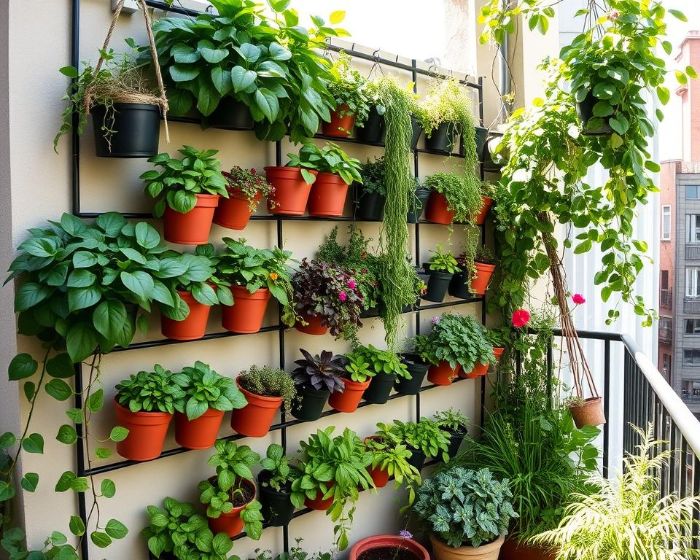
Vertical gardening for small spaces can turn a bare rail into meals when choices match the site. Get it wrong and you stain siding, stress anchors, and scorch leaves; get it right and you harvest within reach with clean runoff and a frame that holds shape.
The win comes from reading heat on the wall, tracing where water really goes, and picking modules you can lift wet without strain. Follow the signals, and a tight balcony turns productive without drama.
Key Takeaways
- Spot the midday tell that scorches leaves, then place smarter
- Choose hardware that stays firm under a simple push test
- Prove the drain path first to avoid stains and neighbor issues
- Commission light and short, then lock placements after a warm spell
- Keep crops at hand height for fast cuts and quick turnover
Table of Contents
Read Your Space for Vertical Gardening – Sun, Wind, Weight, and Water Paths
Before any hardware or plants, measure the site so choices match the limits of the structure. A quick survey saves rework and keeps neighbors happy.
Map sun and wind with simple checks
Record light and airflow at three times a day for one week. If a face gets 6-8 hours of direct sun, treat it as high exposure; 3-5 hours is moderate; less than 3 hours is low. Note reflected heat from light-colored walls by touching the surface at midafternoon; if it feels hot to the palm, plan extra spacing and heat-tolerant foliage in that area later.
Tie a ribbon to the rail to read wind. Constant flutter means a breezy corridor that dries pots fast; a limp ribbon with occasional gusts means sheltered but gust-prone. If wind routinely pushes the ribbon sideways for more than 10 seconds, reserve that face for sturdy trellised climbers and avoid tall freestanding towers there.
Load and fixings – verify railing and wall limits before drilling
Check lease rules and manufacturer specs for the rail or wall material. Wood-framed walls usually carry loads best at studs set 16 inches on center; masonry needs rated anchors; metal rails need clamp-on brackets with rubber pads. Keep any single module under 10 lb wet weight and use at least two attachment points per panel or tower.
Always check your building’s load limits before mounting any structure.
Pull-test each anchor before hanging anything. A firm hand tug should not shift the fixing or creak the substrate. If movement appears, upsize the anchor or relocate to a solid point. For small balcony vertical garden plans, avoid cantilevered arms that extend far from the face, since torque multiplies fast on light rails.
Route water safely to a catch point
Plan where every drop goes before the first plant goes up. Place a shallow tray or gutter directly beneath the lowest tier and give it a slight tilt toward a drain bucket.
Do a dry-run with 1 liter of water poured at the topmost point. Watch the path. Water should reach the catch in under 30 seconds without streaking walls or crossing property lines. If you see splashes on siding, add splash guards or reposition emitters inward. If the stream hugs the wall, space the frame 0.5-1 inch off the surface with spacers to break capillary cling.
Pro tip – Mark the intended footprint with painter’s tape and swing doors, chairs, and window panels through their full arc; if anything hits the tape, shrink the plan now instead of after holes are drilled.
A clean site read sets the whole build up for fewer failures and faster maintenance later.
Choose Compact Vertical Gardening Systems That Fit
Pick hardware that matches depth, load limits, and how you plan to water. The right choice saves wall repairs and keeps maintenance short.
Slim trellises and mesh panels – zero-depth solutions for climbers
Use flat panels where walkway space is tight. Powder-coated steel or aluminum frames hold shape through summer heat and winter cold. Mount at two or more anchor points on studs or a solid rail. Keep the face 0.5-1 inch off the wall with spacers to reduce heat transfer and streaking.
Plant choices are lean climbers with thin stems. If vines start to pull the panel out of plane, add a mid-span tie back to stop bowing. Rust at welds or loose fasteners are early failure signals. Replace hardware at the first sign of orange bleed to avoid staining the wall.
Pocket panels and stackable planters – fast setups for herbs and greens
Pocket panels work for shallow roots and frequent harvesting. Choose UV-stable felt or HDPE pockets with rigid backing so the panel does not sag when wet. Keep each panel within the rail or wall weight limit by capping soil volume per pocket and avoiding saturated mixes.
Stackable planters give more media depth than felt. Lock tiers securely and place the center of mass close to the wall. If tiers drip on the face, add a thin gutter at the base and leave irrigation adjustments for the watering section.
Towers and rail-mounted modules – maximum plants per square foot
Towers concentrate weight in a small footprint. Use a wide base or rail clamp and check that the assembly does not sway when pushed. Rotate the tower a quarter turn weekly so all sides see similar light, unless the location gets even exposure.
Rail-mounted boxes spread load along the rail. Use non marring pads under clamps and retighten fixings at the start of each warm month. Salt crust on the outer lip suggests runoff concentration at one point. Fit a small diverter to carry drips into a catch.
How to setup a vertical garden
Start dry. Assemble the frame, pull test every anchor, level the structure, then load empty modules before soil or plants. Run a short water cycle and trace where drips go to confirm the catch point. Only then fill media and plant.
| System type | Depth clr | Wet weight per module | Irrigation compat | Best uses | Renter friendly | Cost range |
|---|---|---|---|---|---|---|
| Trellis panel | 1-2 in | 3-6 lb | Drip clip on top rail | Beans, peas, cucumbers | Yes with clamps | Low |
| Pocket felt panel | 3-4 in | 8-12 lb | Drip header or hand water | Lettuce, basil, strawberries | Often removable | Low-mid |
| Stackable planters | 8-12 in | 12-18 lb | Drip riser or hand water | Herbs, salad mixes | Yes if free standing | Mid |
| Vertical tower | 12-18 in | 20-35 lb | Internal or ring drip | Leafy greens, small fruit | Sometimes, check rail | Mid-high |
| Rail mounted boxes | 6-10 in | 10-16 lb | Drip line along back | Compact herbs and flowers | Yes with pads | Low-mid |
Use depth clearance and wet weight as hard gates first. If two formats pass, choose the one you can lift and clean without help.
A tight fit between system and site avoids later rework and keeps the structure within safe limits. Install once, then focus on plants and irrigation tuning later.
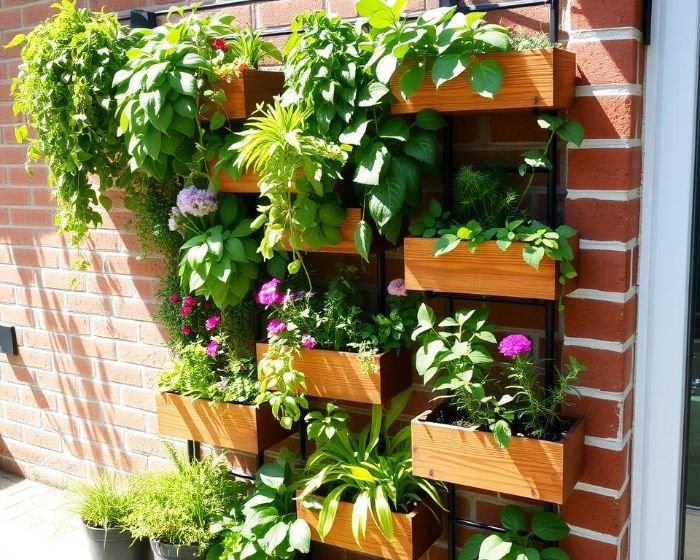
Plants and Layout for a Small Balcony Vertical Garden
Choose crops that match shallow media and tight spacing, then place them by heat and light. Fast harvests on the middle tiers keep maintenance short and food coming.
Herbs and leafy greens for pockets
Pockets shine with shallow-rooted plants that recover fast after cuts. Aim for compact cultivars that top out under 12 inches and rebound in 7-14 days.
Use basil, chives, thyme, oregano, cilantro, parsley, arugula, loose-leaf lettuces, Asian greens, and compact strawberries. Pack roots firmly but do not compress the mix. If leaves feel warm to the touch at midafternoon, shift that pocket one row lower or add a light shade strip. Tip burn on lettuce edges is the first sign of excess heat.
Vining vegetables and fruits for trellises
Climbers need secure tie points and consistent pruning so weight stays close to the wall. Pick restrained types that branch less and set fruit at shorter internodes.
Choose dwarf or determinate tomatoes, bush beans with light training, cucumbers listed as compact, and mini peppers. Tie stems every 8-12 inches of rise with soft ties. If a stem leans out from the face, add a secondary tie back to prevent bowing. Missed pruning shows as dense leaf mats and powdery mildew on the interior leaves.
Light and heat zoning by tier
Place plants by exposure, not by habit alone. Top rows get the most heat and wind, middle rows are stable, and lower rows hold more moisture.
- Top tier – heat-tolerant herbs and compact peppers; fruiting crops that handle 5-7 hours of sun.
- Middle tier – lettuces, basil, cilantro, and strawberries that prefer moderated light and easy access for harvest.
- Bottom tier – moisture-friendly greens such as chard and mizuna; reserve this zone for higher thirst.
If leaf undersides feel cool but growth stretches toward the light, promote that crop to a higher tier. If tips crisp or fruit skins feel hot by midafternoon, demote one tier or add a short shade curtain.
A clear plant plan prevents constant reshuffling later. Lock placements after the first warm week, then focus on training and harvesting cadence.
Watering, Feeding, and Root Health in Tight Setups
Tight builds need controlled moisture and light nutrition so roots breathe between cycles. Tune vertical garden irrigation for short pulses, then feed lightly to match small media volumes.
Apartment-friendly irrigation options
Compact systems like pockets and towers respond best to low-flow emitters and short runs. Use 0.5-1 gph drippers or micro-sprays with anti-siphon check valves so lines do not drain after shutoff. Run two to four short cycles during hot spells instead of one long soak. If the lowest tier drips for more than 60 seconds after shutoff, reduce run time or emitter size.
Timer logic stays simple. Start with dawn watering, then add a second cycle 10-12 hours later during heat. After rain or cool snaps, cut back to one run. Confirm coverage by touching media at the back edge of mid-tier pockets; it should feel cool and lightly damp within 2 minutes of a cycle, not soggy.
Potting mix and weight management
Use a light, open blend that drains fast yet keeps a thin moisture film on roots. A practical target is a coir-forward mix with coarse perlite or pumice in the 3-5 mm range and a modest compost fraction. The feel test is clean – squeeze a handful, and it should hold shape briefly, then fall apart with a tap. If it stays clumped, add more coarse aggregate. If it runs through fingers dry, add more coir.
Feed modestly in verticals. Aim for a diluted liquid feed every 10-14 days for greens and herbs, with a lighter rate for lower tiers that stay moist longer. If leaf tips bronze or salts crust on the lip of pockets, flush with clear water for 1-2 minutes and skip the next feed. Keep mix depth consistent across modules so irrigation and nutrition behave predictably.
How do I prevent root rot in a vertical garden
Prevent rot by keeping roots moist, not wet, and by moving air through foliage. Leave 1-2 inches between tiers so airflow clears leaf surfaces. Trim dense interior growth weekly on vines so stems dry after watering. If plants wilt while media feels wet, lift a module and check drain holes for brown mush or anaerobic slime; open clogged holes and shorten cycles.
Hygiene matters. Rinse catch trays weekly and wipe algae film before it thickens. If water trails along the wall and reenters lower pockets, add a thin spacer so frames sit 0.5-1 inch off the surface and break capillary cling. Replace any sour-smelling, waterlogged mix rather than trying to dry it in place; compacted media rarely recovers evenly in vertical formats.
Pro tip – During heat waves, split irrigation into two short cycles at dawn and dusk; leaves take up water without the midday heat spike, and trays dry by night.
Done right, watering and feeding become quiet background tasks. That leaves time for training vines and harvesting, which is where the best vertical garden ideas pay off.
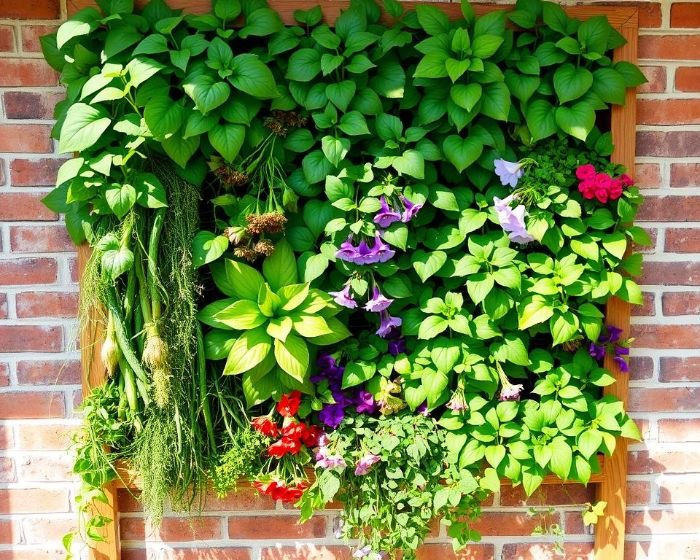
Fast Setup and a 10-Minute Weekly Routine
Install in a dry run, verify anchors, prove the water path, then load plants. A tight sequence avoids patch jobs later and keeps neighbors comfortable.
Quick install sequence
Work clean and confirm structure before adding weight. Mount the frame on solid points, level the assembly, and pull test each fixing with firm hand pressure. Hang empty modules to check alignment and door or window clearance.
Run a short water cycle with empty modules and trace every drip to the catch. If any drop reaches the siding or a shared walkway, adjust angle or add a small diverter. Only when the route is controlled should media and plants go in.
Safety and neighbor care
Protect shared surfaces and minimize noise. Fit non marring pads under clamps, add a narrow splash guard behind the lowest tier, and set the timer to early morning when foot traffic is light.
I often notice that slack cable ties allow a slight slump after the first storm; cinch ties snug and add a secondary strap at mid span where weight concentrates.
Weekly checks
A short, repeatable routine keeps growth tidy and hardware sound. Do it the same day each week.
- Tighten brackets and ties, then confirm level on the top rail.
- Trim interior shoots to open airflow and remove leaf contact with walls.
- Pinch fruiting vines to two or three leaders to keep weight close to the face.
- Rotate towers a quarter turn unless exposure is already even.
- Rinse salt crust from lips and let surfaces dry before the next feed.
- Empty and rinse the catch, then confirm the drain path with a small pour.
- Inspect emitters for uneven flow and replace any clogged pieces.
- Swap tired plants with fresh starts to keep harvests rolling.
A consistent cadence turns the build into low-friction work. Small checks prevent slumps, stains, and neighbor complaints, so the structure stays safe and presentable.
Practical Wrap-Up
Treat the first two weeks like commissioning. Start light, record a few numbers, and lock the build only after you see how the site behaves. If sun hits a face for more than 5 hours, place heat-tolerant crops high and move tender greens one tier down. If a module flexes more than 0.25 inch when you push at mid span, add a secondary tie or shift weight to adjacent anchors. Keep irrigation in short cycles. If lower tiers stay wet past 40 seconds after shutoff, reduce run time or swap to smaller emitters.
Use a simple cadence to keep performance tight. Do a dawn check twice a week for moisture and fast leaf recovery, then a dusk pass once a week for tie tension and airflow. Retorque clamps on the first day of each warm month. Rebalance plant positions at seasonal light changes around late March and late September. If you see pale new growth with dark veins, feed lightly at the next watering and reassess leaf color within 72 hours.
A compact starter blueprint keeps work predictable. Dry-fit the frame on day 0, hang empty hardware, and prove the drain path with a measured pour. Load only half the planned plants on day 2, run two short cycles, and check for even moisture on mid-tier modules. Fill the remaining pockets on day 5, prune to two or three leaders on climbers by day 7, and retie any outward lean. On day 14, confirm anchors, trim again, and set the weekly routine. Done right, vertical gardening turns small urban space into productive wall area without strain on structure or schedule.
- Rebalance tiers at spring and fall light shifts
- Run two brief water cycles, aim for quick uptake
- Push-test panels; add a mid-span tie if flexing
- Prune leaders weekly to keep weight near the face
- Retorque clamps monthly during warm weather
FAQ
How can I set up a rental-safe vertical garden without drilling into walls or rails?
Use clamp-on brackets with non marring pads, free-standing towers with a weighted base, or rail-hung boxes rated for your rail type. Lay a waterproof mat under the footprint, tighten clamps to firm hand pressure, and do a push test at mid height. If the frame shifts more than 0.25 inch, add a second clamp or reduce load.
What plants are poor choices for a small balcony vertical garden?
Skip heavy, sprawling crops that pull away from the face, like large squash, full-size melons, and indeterminate tomatoes without a rigid trellis. Deep-rooted perennials and woody shrubs struggle in shallow media. If a plant needs more than 12 inches of root depth or regular hard staking, place it in a floor pot, not a pocket.
How often should I water a vertical garden in hot weather?
Use short cycles tied to temperature and wind. At 85-95°F with regular breeze, run two or three brief cycles, morning and late day. Media on mid tiers should feel cool and lightly damp within 2 minutes after a run, then lose surface sheen within 30-40 minutes. If lower tiers stay wet beyond that window, shorten runtime or use smaller emitters.
How do I stop leaks onto neighbors below my balcony?
Install a catch under the lowest tier with capacity for at least 1 liter per 10 minutes of irrigation, fit anti-siphon check valves so lines do not drain after shutoff, and tilt the catch toward a drain bucket. Test with a measured pour from the top and watch the path. If water touches siding, add a slim splash guard or pull the frame 0.5-1 inch off the wall with spacers.
What is a simple feeding plan for vertical gardening without salt buildup?
Fertigate at a light rate every 10-14 days for greens and herbs, then flush with clear water the following cycle. If leaf tips bronze or you see white crust on pocket lips, skip the next feed and run a longer rinse. Recheck color on new growth after 72 hours before resuming.
How do I anchor vertical gardening systems for wind on high floors?
Add a mid-span tie back every 18-24 inches of rise, keep the center of mass close to the wall, and limit panel overhangs. If the frame sways more than 1 inch in a firm hand push, increase anchor size or add a second attachment point. Soft ties on vines every 8-12 inches keep weight from levering the structure.
Can root crops work in a vertical setup?
Use short-season types in deeper stackable modules. Radishes and mini carrots do fine in 8-10 inches of media; full-size carrots and beets are unreliable in pockets. If roots fork or stay small, lighten the mix with coarse perlite and water in shorter pulses.
How should I winterize a small vertical garden on a balcony?
Drain lines, remove timers, and store them indoors. Drop irrigation to manual hand watering during cold snaps, cut foliage back to reduce wind sail, and bring tender perennials inside. If freeze is forecast, empty catches and tilt panels slightly so trapped water cannot expand and crack fittings.