




Updated October 19, 2025
Soil moisture sets the stage for roots to work and new leaves to form. Read two visible cues before you touch the hose: a pale crust with midday leaf droop points to a dry profile, while a glossy surface film hints at low air in the root zone. Use that pairing to decide when to water and when to wait, then check at the same hour so patterns are clear.
The payoff is real – stronger flushes, fewer rescue irrigations, and mixes that keep their structure. Miss the signals and stress compounds fast into dull foliage and short new growth. This piece shows how to turn surface look and one simple instrument into reliable timing you can repeat through heat, wind, and cool spells.
Key Takeaways:
- Even moisture supports nutrient uptake and sustains daily growth.
- Check two to three inches below the surface.
- Water deeply, then allow partial drying between cycles.
- Use mulch and compost to boost water retention.
- Track with a moisture meter for consistent results.
Table of Contents
Why Soil Moisture Drives Plant Health
Water in the root zone moves nutrients, powers cell expansion, and keeps leaves firm. When soil moisture fits the crop’s demand, roots respire, xylem flow stays active, and growth stays smooth.
Water Transport And Nutrients
Moist pores create a film around particles that carries dissolved minerals toward root hairs. As that film thins, diffusion slows and uptake drops, even if fertilizer sits nearby.
Too much water fills pores that normally hold air. Oxygen falls, root respiration stalls, and nutrient uptake lags despite a wet profile. Expect paling growth and short internodes when roots sit in low oxygen for several days.
Turgor And Stomata
Cells need internal pressure to expand new tissue. Adequate moisture lets xylem replace transpired water quickly, so leaves keep form and new growth elongates.
When replacement lags, guard cells close stomata to limit loss. You’ll see dull leaf surfaces and a slight midday droop on tender tips long before leaves crisp. I check leaf angle around noon on hot days to spot this early throttle of gas exchange.
Stress Thresholds
Two tipping points matter in practice. On the dry side, once the surface dries and the upper root zone loses its water film, growth rate drops within hours on shallow-rooted plants. On the wet side, if drainage cannot clear free water within 24-48 hours after irrigation or rain, oxygen dips and fine roots begin to die back.
Brief dips past either threshold recoverable within a day usually leave minor marks. Repeated dips compound – fewer active root tips, slower uptake, and smaller leaves across the next flush. The job is to keep roots away from those extremes long enough for each new set of leaves to form at full size.
Target Soil Moisture By Plant Type And Texture
Give plants clear moisture targets by reading texture cues and aiming for practical bands. Match plant group with soil feel, then translate that to a simple meter or pot-weight trigger.

Texture Cues You Can Trust
Sandy mixes release water fast and feel gritty. A squeezed handful barely holds shape and breaks apart with a light tap.
Loam binds briefly, then crumbles in medium chunks. A rolled strand breaks cleanly when bent.
Clay-rich soil forms a smooth ribbon that bends without cracking. If the ribbon smears and shines, pause watering and let air back into the profile.
Targets For Common Plant Groups
Leafy greens and young seedlings prefer a consistently damp zone that never dries at the surface for long. Fruiting vegetables and shrubs tolerate short surface drying if the mid-layer still holds a cool, faintly dark cast.
Mediterranean herbs and succulents want quick surface drying and a drier mid-layer between irrigations. Houseplants in peat-heavy mixes like a moist middle with a dry top half-inch to limit gnats and root stress.
Meter And Pot-Weight Equivalents
Generic moisture meters use relative bands. For leafy greens, aim mid-scale. For tomatoes, peppers, and shrubs, let the reading drop a step lower before watering. Herbs and cacti stay another step drier without penalty.
Container weight is repeatable. Weigh or hand-calibrate after a full drink, then water again when the pot feels roughly 10-15 percent lighter for greens, 15-25 percent lighter for fruiting crops, and 25-35 percent lighter for herbs and cacti.
Pro tip – Mark a discrete line on the inside of a nursery pot and refill only when the pot reaches a known hand-feel or scale weight tied to that line, then recheck the line seasonally as mixes age and soil water retention shifts.
| Plant group | Soil texture | Feel cue | Meter/weight cue | Watering trigger |
|---|---|---|---|---|
| Leafy greens, seedlings | Sandy | Holds shape briefly, drops on tap | Meter mid-scale or 10-15% lighter | When top looks matte and cool fades |
| Leafy greens, seedlings | Loam | Crumbles in medium chunks | Meter mid-scale or 10-15% lighter | When top dulls and mid stays cool |
| Fruiting veg, berries | Loam | Brief bind, clean break | One step below mid or 15-25% lighter | When mid loses cool feel |
| Fruiting veg, berries | Clay loam | Short ribbon, slight bend | Mid-minus on meter | When ribbon stops forming |
| Mediterranean herbs | Sandy | Gritty, falls apart quickly | Low-mid or 25-35% lighter | When top is dry and mid is just cool |
| Succulents, cacti | Gritty mix | Won’t bind, dry touch | Low band or 25-35% lighter | When pot feels notably lighter |
| Shrubs, perennials | Loam | Crumble with firm squeeze | Mid-minus or 15-25% lighter | When mid loses cool touch |
| Houseplants | Peat-heavy | Soft bind, breaks with touch | Mid band, dry top half-inch | When top dries, mid still moist |
Meters vary by brand, so use bands as relative steps, not absolutes. Weight cues stay stable across seasons once you set them for each container and mix.
Closing this section, you now have targets you can aim for by feel, plant group, and simple instruments without drifting into device lists or watering how-tos.
How To Measure Soil Moisture Accurately At Home
Accurate readings come from consistent methods, clean tools, and sampling the right layer. Use one quick routine, then repeat it the same way each time so the numbers actually mean something.

Core Methods That Work
Start with feel-by-texture as a baseline. Scoop a plug from the root zone and press it between thumb and forefinger. Gritty mix falls apart with light pressure, loam holds briefly then breaks, and clay-rich soil forms a short ribbon before cracking. Pair that observation with a simple probe test.
A clean screwdriver or soil probe should slide with firm resistance through a moist band and slow sharply in dry zones. In containers, learn pot weight by lifting with one hand after a full drink. Record that wet feel once, then note how much lighter it feels right before plants start to flag on hot days.
Using A Soil Moisture Meter
Treat any soil moisture meter as a relative tool. Calibrate it with two references: a fully saturated sample that has drained for 30-60 minutes and an air-dry sample of the same mix. Note the two readings and use the mid-point for that potting mix as your control band.
Insert the probe vertically, away from pot walls and fertilizer pellets, and wipe the tip between tests. If readings jump around more than two scale points between spots in the same container, salts or poor contact are likely. Replace weak batteries and avoid readings within 24 hours of fertilizing to prevent false highs.
Pro tip – Push the probe to the same depth mark each time and log that exact depth on your tag so later readings line up with the first calibration.
Sampling Depth And Frequency
Depth depends on the crop. Shallow-rooted greens and bedding plants respond to the top 3-4 inches, so sample there. Woody shrubs and tomatoes pull from deeper layers; sample 5-7 inches where feasible. In raised beds, test halfway down the profile if the bed is under 12 inches tall.
Cadence matters. In-ground beds during mild weather can be checked twice weekly; bump to every other day during wind or heat waves. Containers warm and dry faster, so check daily in summer and every 2-3 days in spring and fall. I run spot checks in the morning so decisions guide the day’s irrigation, then verify one pot at dusk after extreme heat.
Quick-check routine – pick representative spots, clear mulch, test at the target depth, cross-check feel with probe or meter, and jot time plus weather in a small log.
Consistent technique turns mixed signals into a clear pattern. Once the pattern is visible, you can water with confidence and adjust timing before stress shows up above ground.
Keeping Soil Moisture Stable Through Weather Swings
Weather pushes water out of the profile faster than roots can use it. Hold the line with timing, surface cover, and smarter container setup so the root zone keeps an even supply.
Schedule Deep Watering
Deep cycles push moisture into the working root band and buy longer gaps between irrigations. Water in pulses until the surface stays dark for 20-30 minutes after you finish; if it turns light in under 10 minutes, volume was short or infiltration is poor.
Early morning beats late day because less evaporates and foliage dries by noon. In cool spells, run one deep cycle and recheck midweek. In hot, windy periods, split the same weekly total into two or three smaller passes to avoid runoff and keep the profile supplied.
Pro tip – If water pools for more than 5 seconds, pause for 2-3 minutes, then resume. Short pauses open pore space and pull the next pass deeper.
Mulch And Organic Matter
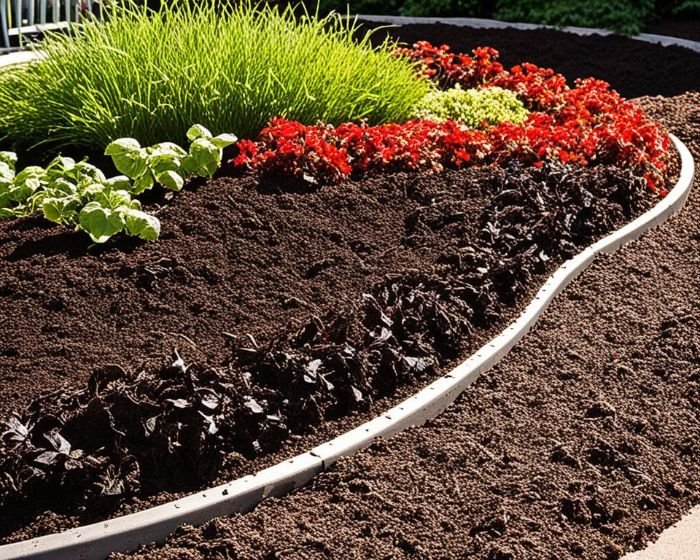
A good cover slows evaporation and prevents surface crusting. Apply a uniform 2-3 inch layer of shredded leaves, pine bark, or clean straw, keeping a finger’s width clear around stems. Dark materials warm faster in spring; pale materials reflect heat in midsummer.
Top-dress beds with 0.5-1 inch of finished compost each season. Organic particles improve pore structure, so the same irrigation penetrates farther. Renew mulch when you can see bare patches or when the layer compresses to under 1 inch after storms.
Pro tip – If peat-heavy mixes start to repel water, wet a small area first, wait 5 minutes, then water the whole surface. That priming step breaks hydrophobic behavior.
Container Control
Containers swing faster than ground beds, so manage volume and exposure. Use a pot only 2-3 inches wider than the root mass to reduce unused mix that bakes dry. A gritty, bark-based mix drains quickly but needs closer monitoring; a finer peat blend holds longer yet risks soggy bottoms in cool weather.
Placement trims losses without extra water. Shift pots where they get 2-3 fewer hours of direct sun during heat waves, or add a light shade cloth for the afternoon window. Wind strips moisture fast, so tuck pots behind a bench or low screen. Light-colored containers run cooler than dark ones on exposed patios.
Pro tip – Nest a nursery pot inside a decorative cache pot with spacers under the inner pot. You get insulation and airflow without trapping runoff in a saucer.
Seasonal tweaks – in heat, water at dawn and split cycles; in wind, shield pots and raise mulch to a full 3 inches; in low humidity, cluster containers to raise local moisture; after cool fronts, extend the gap between cycles 1-2 days.
Small adjustments here hold moisture where roots work best and cut wasted water. With the surface protected and containers set up right, irrigation schedules become simpler to keep on target.
Course-Correct When Soil Moisture Trends Too Dry Or Too Wet
Readings that drift for days point to a system issue, not a one-off. Correct the trend with targeted moves, then verify the change with the next cycle.
When Trend Is Low
Dry trends show up as falling meter bands, pots that feel unusually light by midafternoon, and a probe that slows early in the profile. Rehydrate without flooding by using short pulses that soak, pause, then soak again so water reaches the working roots.
Bottom-water containers for 10-20 minutes when the surface sheds water. Lift out and drain before returning to saucers. In beds, apply a slow trickle along a shallow furrow so water runs toward roots instead of skating across a crusted surface.
Pro tip – Shade crops for 48 hours after a deep rehydration during heat waves. Leaf temperature drops and the next reading holds longer.
When Trend Is High
Wet trends appear as meter values that sit near the top band for 24-48 hours and a probe that comes up slick in the same spots. Restore air first, then adjust inputs.
For containers, drain any standing water immediately, then raise pots on spacers so bases breathe. Vent the profile by pushing a thin stake down several channels near the rim. In beds, stop irrigation and open the surface with a narrow rake to break the seal that traps water. If water still pools after a short test, divert with a shallow relief trench until the profile lightens.
Pro tip – If meter readings barely drop after 24 hours without irrigation, skip the next cycle and recheck at the same hour the following day before making any new application.
Build A Feedback Loop
Lock in the fix with a small log. Note date, time, weather, action taken, and the next two readings. Keep timing consistent so changes reflect the action, not a different sampling hour.
Use simple triggers to drive the next move. If a dry correction raises the reading into the target band and holds there for a full day, resume the normal interval. If a wet correction still reads high after a day, extend the gap or shorten volume on the next cycle and recheck at the same depth.
Firm trend control comes from one change at a time and quick verification. Small, repeatable adjustments prevent swings and keep roots productive.
Practical Wrap-Up
Run a short calibration sprint and lock in repeatable cues. For 10 days, take morning readings at the same hour and adjust one variable at a time. If a container drops 15-25 percent from its wet weight in under 24 hours, add shade for the hottest window or increase mulch; if a meter sits near the top band 24-36 hours after watering, skip the next cycle and open the surface for air before rechecking. Soil moisture becomes manageable when measurements, triggers, and actions stay in sync.
Refresh the system on a simple cadence. Recalibrate meters monthly using one fully wetted sample that has drained 30-60 minutes and one air-dry sample of the same mix. Re-mark pot weight baselines each season or after repotting. During heat or wind, add a dawn check and verify one container at dusk; after cool fronts or heavy rain, extend intervals by 1-2 days and confirm with a probe before resuming normal timing.
- Set one reading time and keep it.
- Change one variable per cycle.
- Log date, reading, action, outcome.
- Recalibrate meter monthly, same mix.
- Update pot weights at each season change.
FAQ
How do I calibrate a low-cost soil moisture meter so readings mean something?
Set two references in the same mix: one sample fully drenched then drained 20-40 minutes, and one bone-dry sample. Note both values, mark the midpoint on a plant tag, and replace the battery every 2-3 months to keep the scale consistent.
When should I measure soil moisture on hot, windy days for the best signal?
Take a baseline 1-2 hours after sunrise, then spot-check the same plant midafternoon; if the midafternoon value drops two scale steps or more, shorten the interval or split the volume into two passes that day.
My potting mix turns water-repellent after drying out. What fixes it fast without repotting?
Bottom-water for 15-25 minutes, then apply one irrigation with a labeled wetting agent or 1 teaspoon unscented dish soap per 2 gallons of water, followed by a clear-water rinse within 10 minutes.
Do fertilizers or hard water skew moisture readings, and how do I correct for that?
Salts can make probes read wetter than reality for 12-24 hours after feeding; take readings before fertilizing and flush containers with clear water every 4-6 weeks to reset the profile.
How can I measure soil moisture in a mixed raised bed without checking every plant?
Pick one thirstiest crop in the bed as the indicator and log its readings at the same hour; when that crop reaches its trigger band, water the entire bed and verify with one post-watering spot-check.
What is a quick field test to tell if poor drainage is the problem rather than low watering frequency?
Dig a hole about a quart in volume, fill it with water, and time the drop; if water still stands after 15-20 minutes in typical loam, improve drainage or reduce volume per pass and retest.
How can I keep houseplant soil moist enough without inviting fungus gnats?
Water from the bottom when possible and cap the surface with a 0.25-inch layer of coarse grit or small bark; that top layer dries fast, blocks egg laying, and the mid-layer stays moist longer.
Is there a fast way to measure soil moisture in a large container without a meter?
Weigh the pot after a full drink and write the number under the saucer; water again when the weight drops 15-30 percent depending on the plant’s preference, then adjust by 5 percent if foliage flags early.