Knowing how to plant garlic in fall starts with matching your local planting window to soil that still drains and crumbles, then setting healthy cloves pointed end up. A frost on the lawn does not tell you whether the ground underneath is ready to freeze. In northern gardens, roots need time to establish before deep winter; in mild Southern climates, green leaves before winter are part of normal growth. Squeeze a handful from the planting bed. A shiny, sticky lump signals a different problem from cool soil that breaks apart under your thumb. The calendar alone cannot correct that difference. Choose garlic suited to your region, keep the papery skin and root plate intact, and adjust water and mulch to the bed. Those decisions give each clove a better start without relying on a nationwide frost countdown.
Plant This Week, Fix the Bed, or Wait?
- Local window open, bed workable, stock sound
- Separate the bulb, place individual cloves upright at your region’s recommended depth and spacing, cover, and settle the soil.
- Water standing or soil smearing on tools
- Delay planting in that spot. Improve drainage or choose a better bed before adding cloves.
- Ground frozen solid or timing uncertain
- Keep bulbs intact and consult nearby county Extension guidance for the remaining planting opportunity.
After planting: moisten a dry bed; skip extra irrigation in wet ground. Use winter mulch suited to local cold and rainfall.
Key Takeaways
- Label varieties now so spring growth stays easy to identify.
- Measure planting depth from the clove part your source specifies.
- Avoid peeling cloves or cutting away their root-forming base.
- Inspect mulch after heavy rain for matting and trapped moisture.
- Keep healthy early shoots intact while monitoring winter conditions.
Table of Contents
How to Plant Garlic in Fall Around Local Conditions
October is a planting month in several US regions, including Iowa and Wisconsin. Whether it is too late depends on your local climate and the bed’s condition. Air frost arrives before the soil necessarily freezes solid, so a frosty morning still leaves a usable planting window in many northern gardens. Roots emerge from the clove’s basal plate, often before much growth is visible above ground.
Cold Northern and Upper Midwest gardens
Planting about one or two weeks after the first killing frost is the Minnesota and general Wisconsin Extension approach. The soil must remain workable. A killing frost damages tender vegetation; the later hard freeze and eventual frozen ground are separate events. Keep those cues distinct when comparing dates. Waiting for a frost is useful only where that particular regional recommendation applies.
Local guidance also varies within a state. October through early November is the southern Wisconsin window described by Dane County Extension, and northern Wisconsin typically starts earlier in October. The county’s newer guidance allows earlier establishment and explains that autumn sprouting does not automatically reduce the following crop. A county recommendation and the actual bed are better starting points than a hardiness-zone calendar alone.
Mild Southern climates and regional exceptions
Late September through November is the Georgia planting period. Fall planting gives garlic time to build leaves during cool weather before spring bulb development, as described by University of Georgia Cooperative Extension. Waiting for the same killing-frost cue used in Minnesota would miss the logic of this longer growing season. Tops showing by November fit Georgia’s normal pattern.
Elevation changes the timetable again. A Western Colorado Extension example recommends planting before October 15 in many local sites so roots establish before the ground freezes. That date belongs to those conditions. Ask your nearest Extension office for a local window when your garden sits at a different elevation or has an unusually exposed location.
Does your bed still crumble when worked, and is your regional planting window open? Use both answers. Weather-driven vegetable planting decisions also depend on the time a crop needs to establish. A rigid number of weeks before the first frost leaves too much of that decision unresolved.
Choose Seed Garlic Before You Separate the Bulb
A large clove with a soft patch is poor planting stock. Garlic is propagated from living cloves, so diseases travel with the material you put into the bed. Firmness, sound wrappers and a reputable source matter before size. Buying garlic intended for planting also gives you a cultivar name and a better chance of matching it to local winters.
Hardneck types generally fit colder conditions; many softnecks suit milder winters. Cultivar choice still matters. Some softneck varieties are adapted to Iowa’s cold, according to Iowa State University Extension, so treating every softneck as a Southern-only plant would exclude useful options. Choose a cultivar with a record of suitability for your area.
Supermarket garlic is a less predictable choice because its origin and climate adaptation are uncertain. Minnesota’s caution centers on grocery softneck garlic performing poorly under local conditions. A supermarket bulb is not automatically unable to sprout, and there is no reason to assume every bulb received a sprout inhibitor. Reliable planting stock removes some of those uncertainties.
Preserve the wrapper and basal plate
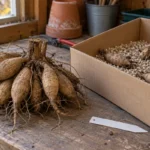
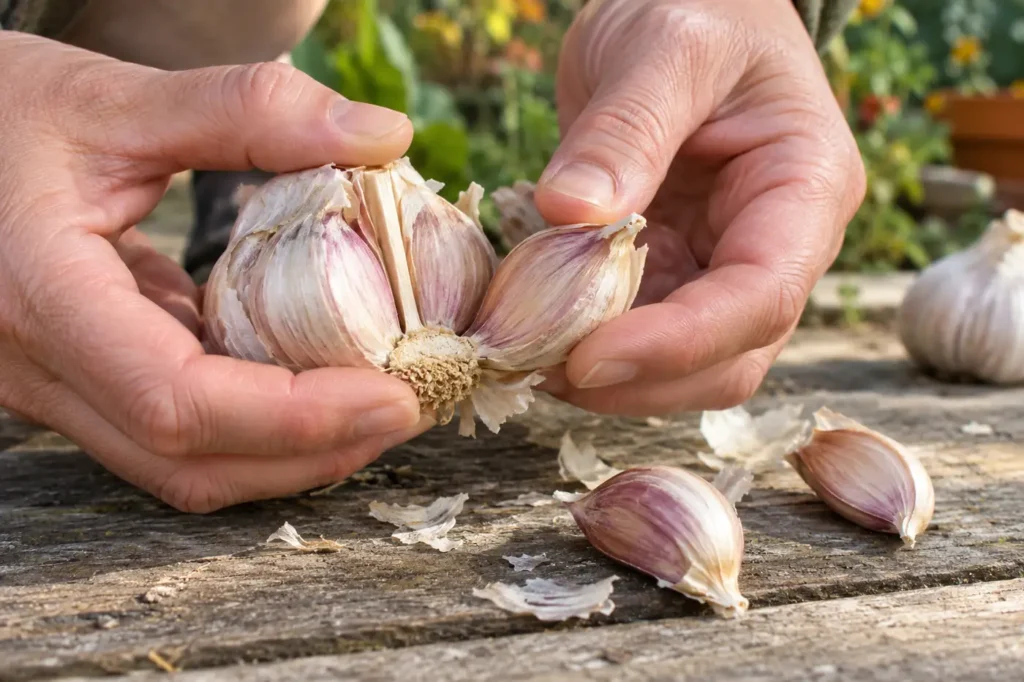
Keep bulbs whole until close to planting. Separate cloves gently a day or two beforehand, following Minnesota’s guidance, or immediately before setting them out. Whole bulbs protect the individual cloves from drying. Room-temperature storage until planting is the Wisconsin Extension recommendation for seed bulbs; cold storage advice for cured eating garlic serves a different purpose.
Run a thumb lightly along a clove. The wrapper should feel dry and papery around firm tissue; the flat bottom should remain attached. That basal plate produces roots. Cut or scrape it away and you damage the part needed for establishment. Leave the skin on, and reject soft, moldy or decaying cloves. Save small sound cloves for cooking if you have enough larger healthy ones to fill the bed.
Healthy appearance cannot rule out every infection. Diseases carried on allium planting stock, including white rot, make sourcing especially important. White rot persists in infested soil for many years, as described by Oregon State University Extension. A home soak cannot turn questionable cloves into reliably clean stock. Seek diagnostic advice when a previous crop developed suspicious rot.
Prepare a Bed Where Roots Have Air and Moisture
Soil that smears across a spade after rain is not ready to cultivate. Water fills spaces that roots need for oxygen, and working wet clay damages the structure further. Wait until it is workable or move to a better-draining location. Garlic needs full sun and a loose bed where roots spread and later bulbs expand.
Probe beneath the dry surface before deciding a bed is ready. A pale crust over dark, sticky soil reveals moisture that has not drained away. An elevated planting area improves drainage only when excess water has somewhere to go. Raising the surface also exposes soil to more cold, a tradeoff noted by Oregon State for winter vegetables west of the Cascades.
A raised-bed soil mix needs drainage throughout the rooting area. Adding loose material on top of a persistently waterlogged site does not remove the problem below. Select the site before splitting your bulbs, while there is still time to prepare the bed under suitable conditions.
Use a soil test to decide on lime or fertilizer. Garlic grows in a broadly near-neutral range in several Extension recommendations. Your soil’s existing fertility determines what to add. Repeated phosphorus-rich fertilizer builds up phosphorus when a garden already has plenty, a problem identified by Minnesota Extension. Comparing a soil test kit and lab test helps separate a quick screening from an amendment recommendation.
Review the bed’s crop history too. Onions, shallots and garlic share allium disease risks. Rotate away from previous allium crops and avoid deliberately planting into a bed with unresolved rot. If old bulbs developed soft decay or white fungal growth, obtain a diagnosis before choosing a treatment or another crop.
Set Cloves Upright and Define the Planting Depth
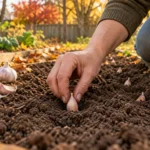
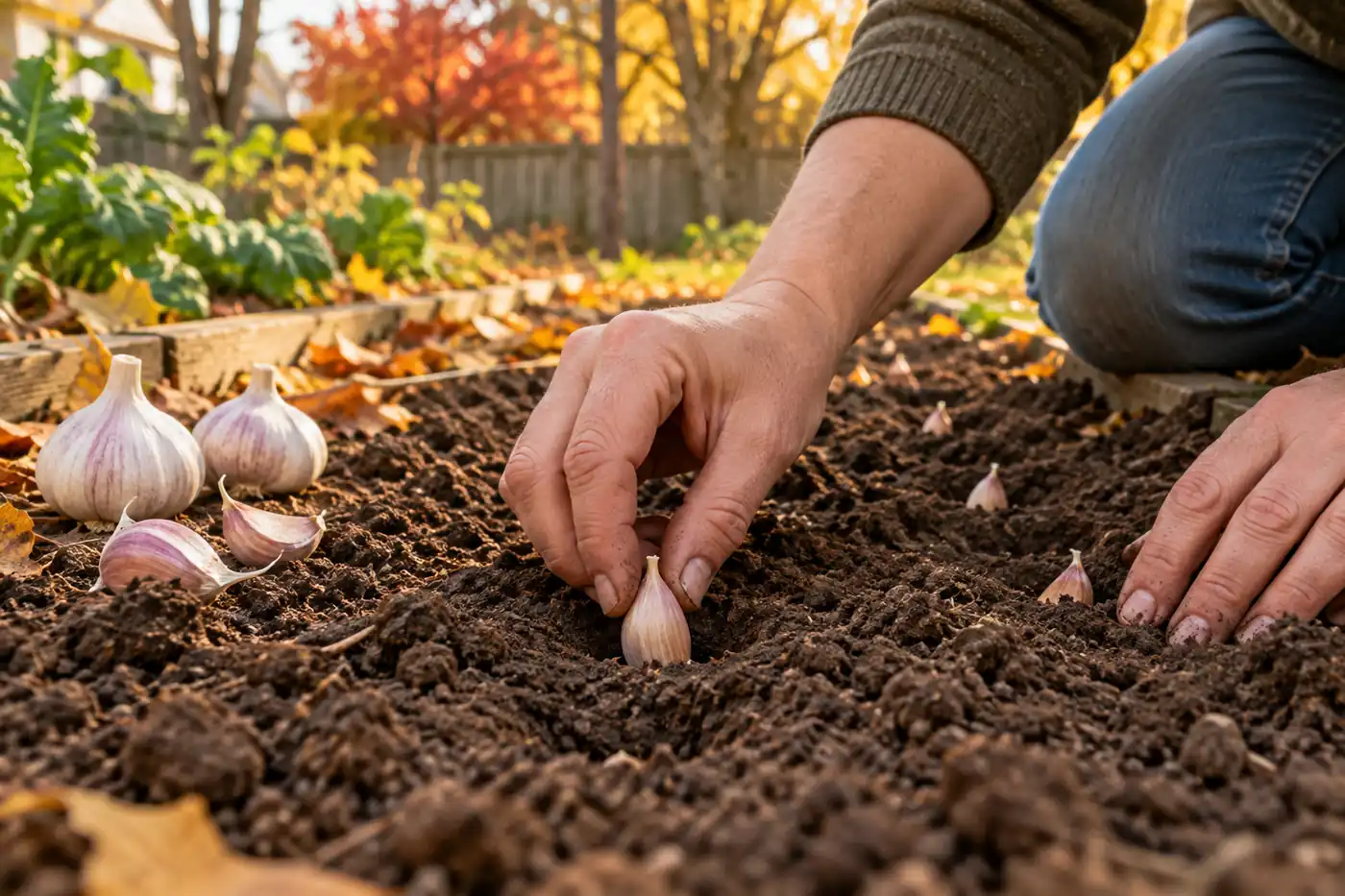
Plant one separated clove in each position, with the pointed tip up and flat basal plate down. The shoot emerges toward the point; roots form at the base. Make a hole or trench in the prepared bed, set the clove gently, and return loose soil around it. Press lightly to settle the surface without packing wet soil into a hard cap.
Choose depth and spacing from regional advice. The word deep is not always measured from the same part of a clove. Minnesota specifies the base two to three inches below the soil surface; another instruction might give a clove depth without naming the reference point. Soil above the pointed tip is therefore not automatically the same measurement.
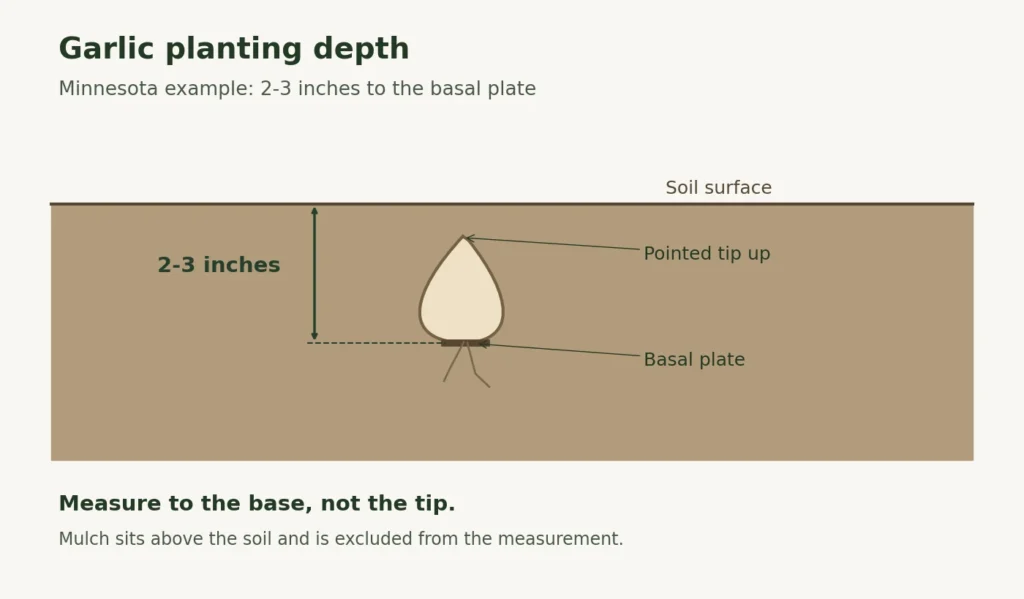
A practical Minnesota bed layout
Set sound cloves six inches apart and place each base two to three inches below the surface, following University of Minnesota Extension’s recommendation. Measure the hole before covering. A ruler makes the reference point visible; counting the straw layer as part of planting depth leaves the clove shallower in actual soil.
For multiple rows, use the row arrangement in the same regional recommendation. Keep enough access to tend the bed without stepping on the planted area. Foot pressure compacts moist soil around the root zone. Crowding increases competition between developing plants. Mark the row ends so an apparently empty autumn bed stays undisturbed.
Adjust the example to your local instructions
One to three inches deep with six-inch clove spacing is the Georgia planting recommendation. Iowa State gives one to one-and-a-half inches deep and three to five inches apart. Read the measuring instructions for your region carefully. Averaging those different recommendations obscures the method each one describes. Use the advice for your location and retain its row spacing and soil conditions.
Check the first few cloves before finishing the bed. Wrappers should remain attached and each tip should face upward. If the prepared hole collapses into slick mud, return to the drainage decision before continuing. Large cloves have more stored material to start growth. Sound stock, suitable soil and local timing still determine whether that growth gets established.
Water and Mulch According to Rain and Winter Cold
Water a dry planting bed after covering the cloves. Skip additional irrigation when rainfall has already moistened the rooting area or the bed is saturated. Garlic needs moisture for establishment and oxygen around its roots; standing water defeats the benefit of another watering. A fixed weekly appointment is a poor match for dormant cloves in winter-wet soil.
Push aside surface debris and examine the soil. Dry crumbs that fall apart with a dusty surface call for a different response from a cool, damp handful. In Georgia’s frequently dry fall planting period, thorough initial irrigation is part of the Extension method. After rain, judge the bed again before adding more. Persistent ponding requires a drainage correction.
Winter insulation changes by region
Three to four inches of leaf or straw mulch is Minnesota’s recommendation to buffer winter and early-spring temperature fluctuations. General Wisconsin guidance also uses three to four inches of clean straw after planting. Straw with weed seed introduces competition into a crop that shades the soil poorly. Spread a loose layer that lets water pass through to the row.
Four to six inches of weed-seed-free straw applied in November is the Iowa State approach. The difference includes both thickness and timing. Mild, humid Southern beds need their own winter-protection decision; Georgia’s two-to-three-inch mulch advice after emergence serves weed suppression and moisture conservation. That is a different job from northern winter insulation.
After heavy rain, inspect the cover and soil together. A flattened leaf layer that sheds water or keeps the bed persistently wet needs loosening or adjustment. Garlic mulch should moderate temperature and allow water movement. In spring, follow the local recommendation for moving or thinning the layer as shoots emerge; deeply buried leaves should not have to push through a compacted blanket.
Correct Fall Planting Mistakes Without Digging Blindly
Green shoots before winter do not automatically mean you planted too early. Georgia expects some fall foliage, and Dane County Extension’s updated advice reports that autumn sprouting need not reduce the next crop. Leave healthy leaves attached. They supply photosynthetic tissue; cutting them solely because winter is approaching adds an injury without resolving a planting problem.
Distinguish exposed leaves from the buried clove and roots. Cold injury to a leaf does not by itself reveal that the clove has died. Pulling plants repeatedly to inspect them disturbs establishment. Monitor the surface, drainage and mulch, and investigate continuing collapse or rot with local diagnostic help.
| Situation | First check | Next move |
|---|---|---|
| October is nearly over | Your regional window and actual soil workability | Plant only within a locally suitable opportunity; ask county Extension when the window is uncertain. |
| Short green shoots appear | Healthy leaves, drainage and local cold forecast | Keep leaves intact and adjust winter protection to your region. |
| Water collects over the row | Runoff, irrigation and blocked drainage | Stop adding water and address the site; fertilizer will not correct saturation. |
| Cloves are soft before planting | Stock condition and previous disease history | Reject damaged stock and obtain sound replacement bulbs. |
| Ground is frozen solid | Whether a locally suitable workable window remains | Keep seed bulbs intact and get regional advice; avoid forcing a frozen-ground planting. |
Late planting carries a real limit: less time for establishment, with no promise of full-size bulbs next summer. Frozen or waterlogged ground is a reason to stop. If a warm spell opens the bed again, the decision still depends on local conditions and cultivar suitability. A nationally fixed last date would give false confidence.
Once the bed is planted and marked, garlic growth stages progress from rooting toward spring leaves and later bulb development. Fall checks stay focused on the conditions around that buried clove. Avoid uncovering it to demand visible proof of roots, and avoid feeding solely to force a green shoot before winter.
Conclusion
Put a durable label at each row end before the bed disappears under mulch, especially when planting more than one cultivar. Record the planting date and the regional method you used. If water collects after the next rain, address that condition before adding more irrigation or cover. In spring, those labels will still identify the planted rows as fresh green blades rise through loose straw.
Frequently Asked Questions
Can I plant garlic in spring if I miss fall?
Spring planting is possible in some regions, with cultivar and cold exposure affecting bulb development. In Iowa, planting starts when the ground is workable, and fall planting produces the highest yields in the Extension guidance. Obtain a local recommendation before substituting spring planting or refrigerating cloves on an arbitrary schedule.
What should I do with a fused double clove?
Some hardneck cloves are two cloves fused together. Fused cloves produce two bulbs that flatten against each other, as described by Wisconsin Extension. Select ordinary single cloves when uniform bulbs are the priority, and use sound doubles for cooking. Cutting through a fused clove injures the tissue you would plant.
Is elephant garlic planted the same way?
Elephant garlic is a type of leek, Allium ampeloprasum, rather than common garlic. It grows under similar conditions in Georgia Extension’s guidance. Its larger planting material needs appropriate instructions. Do not assume a layout measured for ordinary garlic cloves applies unchanged to elephant garlic.