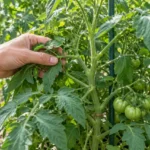


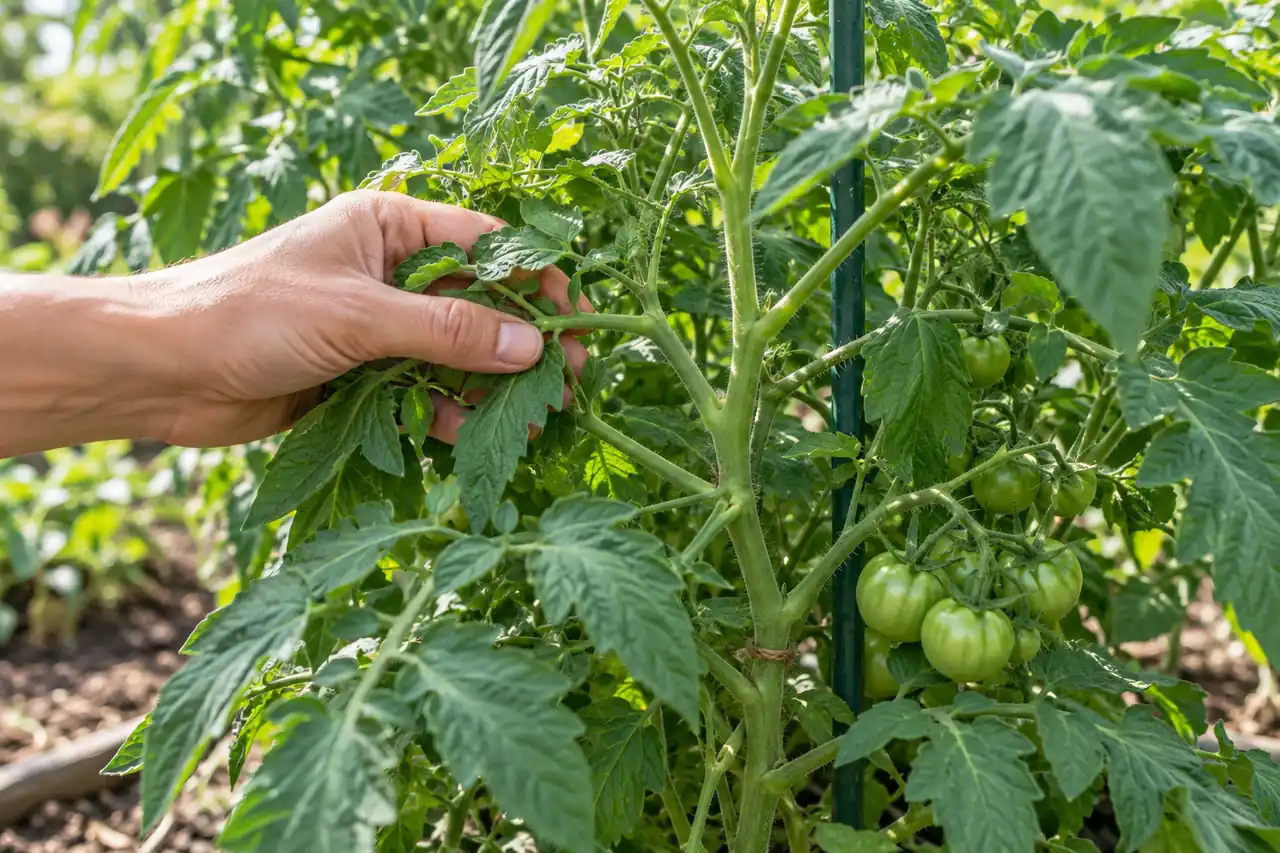
How to prune tomato plants depends on their growth habit, the support holding them, and which shoots are already carrying fruit. On an indeterminate plant trained up a string, removing selected side shoots keeps the chosen stems manageable. On a bushy determinate tomato, the same cuts can remove much of the coming harvest.
Before cutting, trace a leaf back to the main stem. A small leafy shoot growing in the angle between them is a sucker; the leaf itself and the flower cluster are different structures. That distinction matters more than making the plant look tidy. Keep healthy foliage around developing tomatoes, work when leaves are dry, and choose the stems to keep before removing any. A crowded vine, a young transplant and a fruiting patio tomato need different amounts of pruning.
What should you cut?
Determinate or unknown variety: keep upper fruiting shoots. Limit trimming to a clearly justified lower-leaf problem until the cultivar is confirmed.
Indeterminate on a stake or overhead string: choose one or two supported leaders, then remove unwanted young shoots from the leaf axils.
Cage or basket-weave row: retain the branches that the support is meant to hold. Do not copy a single-stem pruning pattern onto a bushy plant.
Before each cut: confirm the shoot, dry the foliage, clean the tool, and preserve shade over fruit.
Key Takeaways
- Check the cultivar label before removing productive side shoots.
- Trace each compound leaf to identify its separate axillary sucker.
- Match retained stems to the support already holding your plant.
- Shorten neglected shoots selectively, preserving leaves around developing fruit clusters.
- Separate late-season topping from routine lower-leaf and sucker removal.
Table of Contents
How to Prune Tomato Plants by Growth Habit
Determinate tomatoes finish their main shoots in flower clusters and produce much of their crop over a concentrated period. Their side branches are part of that crop-bearing structure. Indeterminate tomatoes continue extending stems and making new flower clusters through the season, giving you more choices about which stems to train.
Check the seed packet, nursery tag or supplier’s cultivar description. A short plant may simply be young, and cherry-sized fruit does not identify the growth habit. Semi-determinate varieties need their own cultivar guidance; treating every intermediate plant as a single-stem vine can remove productive laterals.
The overlapping tomato growth stages also matter. An established plant with several fruit clusters has more foliage and different pruning risks than a transplant still rebuilding roots.
Choose the stems your support can hold
A string trellis carries selected vertical stems. A roomy cage holds a branching plant. Those shapes require different cuts. The basket-weave and overhead-trellis pruning methods from University of New Hampshire Extension explicitly retain different numbers of shoots.
| Plant and support | Keep | Remove selectively |
|---|---|---|
| Determinate in a cage | Productive upper branches and fruit-shading leaves | Problematic low foliage; lower suckers only when the chosen method calls for it |
| Indeterminate, one supported leader | Main growing stem, its leaves and flower clusters | Young axillary shoots that would become extra leaders |
| Indeterminate, two supported leaders | Main stem plus the selected sucker below the first flower cluster | Other unwanted young suckers; preserve functioning leaves |
| Basket-weave row | Upper laterals permitted by the row-training method | Low shoots below the retained first-truss branch in the UNH method |
| Unknown or semi-determinate cultivar | Potentially productive stems until the habit is confirmed | Only clearly problematic tissue; postpone major reshaping |
For a healthy determinate plant, routine sucker removal may be unnecessary. Wisconsin Extension takes that conservative approach; Iowa State permits limited removal below the first flower cluster. Neither approach justifies stripping the upper branches.
For two-leader training, locate the lowest flower cluster and preserve the sucker immediately below it. Give that second stem its own secure support. In a one-leader system, remove that sucker too. Decide before it becomes a thick, flowering branch.
Find the Sucker at the Leaf Axil
A tomato leaf is compound: one leaf stalk carries several serrated leaflets. What looks like a small side branch may therefore be a single leaf. Follow its stalk inward until it joins the hairy main stem. The angle at that junction is the leaf axil.
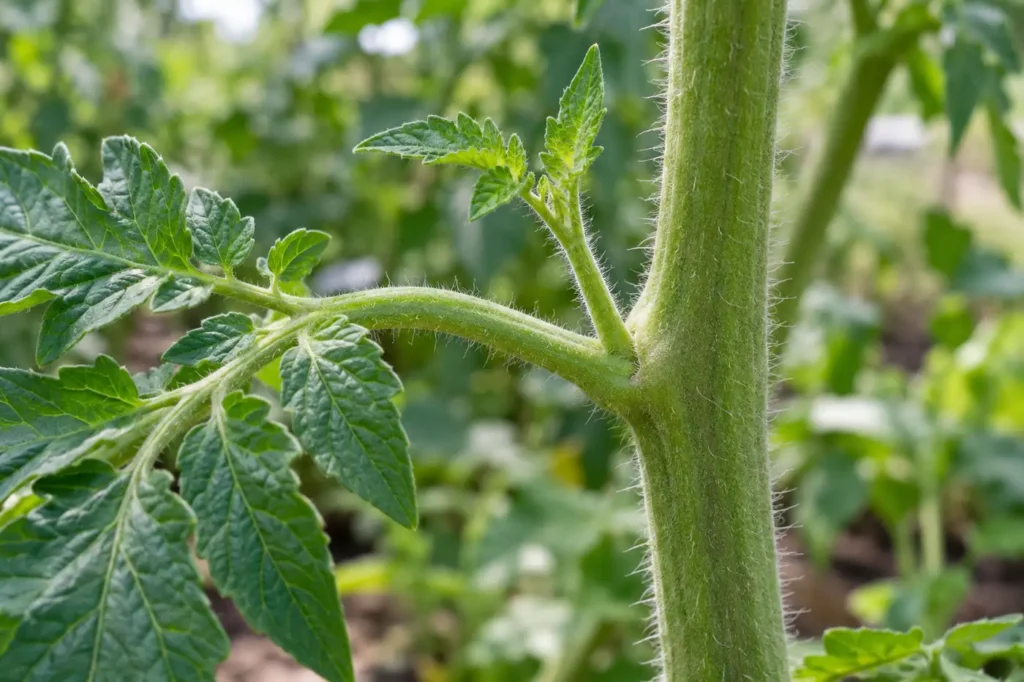
A sucker begins as a separate growing point in that angle, often with tiny folded leaves. As it lengthens, it develops more leaves and can eventually carry flowers and tomatoes. It is not a permanently sterile shoot stealing everything from the main stem.
Compare three structures before pinching: a compound leaf carries leaflets along its stalk; a flower truss carries flowers or fruit; a sucker has a leafy growing tip and can develop into another stem. Keep the main leader’s own tip intact during routine sucker removal.
Do not rely on a fixed branch angle. Supports, weight and earlier growth can bend shoots into confusing positions. Trace the attachment back to its origin. If two mature stems have become entangled, separate them gently and identify their origins before deciding which to remove.
A sucker already bearing tomatoes is still a sucker by origin, but it is also a fruiting stem. Cutting it removes those tomatoes. If the plant has room and suitable support, retaining that branch may be more useful than forcing an older plant into a newly chosen shape.
Make Small Cuts Without Tearing the Main Stem
Begin on an established plant whose growth habit and intended leaders you have identified. Have clean hands, sharp bypass hand pruners and a soft plant tie ready. Dry leaves let you handle the plant without spreading moisture and sap across the canopy as readily as wet foliage does.
- Trace the main stem upward and locate the first flower cluster. Identify any side shoot you are deliberately keeping as a second leader.
- Find an unwanted young sucker in a leaf axil. Check that neither the leaf stalk nor a flower truss is caught behind it.
- Pinch the small flexible shoot at its base with a controlled motion. If it resists or starts pulling a strip of tissue from the main stem, stop and use clean pruners.
- For a shoot that needs a tool, position the blades around that shoot alone. Cut without gouging the parent stem or dragging the blades through adjacent growth.
- Support the retained leader with a loose tie that leaves room for thickening. Keep pressure away from flower and fruit clusters.
- Step back and check the remaining canopy. Fruit should still have leaf cover, and the chosen stems should rest on their supports without tension on the trusses.
Small shoots are easier to control than thick ones. New Hampshire’s overhead system removes suckers under about 2 inches long; that is a useful working size for that system, not a biological deadline for every tomato. Inspect often enough to catch new shoots before they harden.
Fresh tomato foliage has a sharp green scent when disturbed, and its fine hairs can leave sticky residue on fingers. Wash the sticky residue from your hands before moving between plants.
Clean before disinfecting
Remove sap and visible debris from the blades first. Clean, sharp edges are part of sound pruning tool care; disinfectant cannot replace that cleaning step.
For small hand pruners, University of Minnesota Extension lists isopropyl rubbing alcohol at 70% concentration or higher, used between plants. Wisconsin’s tomato-pruning protocol specifies at least 30 seconds of alcohol treatment before pruning and between plants. Follow the product precautions, keep alcohol away from flame, and never mix disinfectants.
Manage Thick Shoots Without Stripping the Canopy
A missed sucker can feel firm and fibrous, with a thickened base that resists pinching. Bending it until it breaks may peel tissue down the main stem. A strong sideways pull is especially risky where the junction already supports flowers or a heavy fruit cluster.
First decide whether that branch actually needs removal. If it has become a useful fruiting leader, make room and support it where practical. A mature plant does not need to resemble a newly trained transplant.
For long, neglected side shoots, Oregon State Extension describes Missouri pruning: shorten the shoot beyond its first one or two sets of leaves, leaving that leafy section attached. This limits further extension without removing the whole shoot’s leaf area at once.
Trace the branch outward from its origin before cutting. Keep the intended leaf sets, then cut off the extension beyond them. Anything farther along the removed piece, including flowers or fruit, is lost. If useful fruit is beyond the proposed cut, reconsider the position or keep and support the branch.
Do not combine removal of several large leaders with a heavy lower-leaf cleanup in one session. That can suddenly expose fruit and leave little functioning canopy. Make only the cuts with a clear purpose, then reassess what remains.
Remove Lower Leaves Without Exposing the Fruit
Start with leaves resting on soil or dragging through damp mulch. Rain and watering can splash contaminated material onto low foliage. Removing selected contact leaves can help, but mulch, watering at the soil surface and adequate spacing still matter.
On an established plant, the lower-leaf pruning guidance from Iowa State describes roughly 6 to 12 inches of clearance and cautions against removing more than one-third of the foliage at once. Treat that as a limit within its home-garden guidance, not an amount to remove.
A 14-inch transplant should not lose 12 inches of foliage. Remove a truly problematic leaf if needed and let the plant establish more canopy. On a larger vine, inspect each low leaf and stop once the problematic contact leaves are gone.
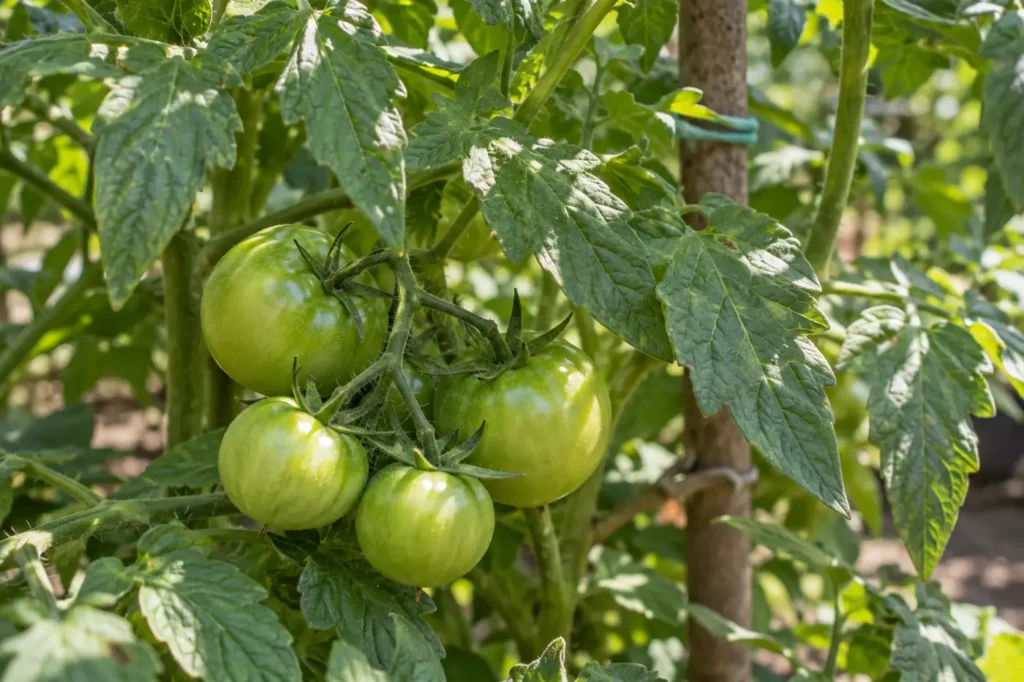
Healthy upper leaves produce sugars and shade the fruit. Tomatoes that suddenly sit in intense direct sun can develop sunscald; University of California IPM describes brown, leathery damage on the exposed side. Removing more leaves will not repair that injury.
Before trimming, look through the plant from the sun-facing side. If a fruit cluster will be fully exposed after a cut, preserve another source of leaf shade or reconsider the cut. A thin canopy on a hot patio calls for more restraint than vigorous, crowded foliage in a humid bed.
Spots and yellowing need a separate check. Removing a few affected lower leaves may fit disease management, but pruning is not a cure for every wilt, spot or curled leaf. The pattern of tomato leaves curling can point toward stress or other causes that extra cutting will not solve.
Control Height With Support or Late-Season Topping
Topping removes the growing tip of a selected leader. Sucker removal manages extra side stems and preserves the chosen leader’s extension. Confusing the two can stop a stem’s future growth when you meant only to tidy a leaf junction.
A tall plant in midseason
When an indeterminate vine reaches the top of its stake with months of growing weather remaining, assess the support first. A stronger or taller support may preserve future flower clusters. With suitable equipment and room, trained vines on a purpose-built overhead system may be lowered. Do not pull a loaded plant down an ordinary stake.
If the support has a firm height limit and topping is necessary, accept the tradeoff: the removed extension cannot produce its future trusses. Keep existing fruit clusters and healthy leaves below the cut. A plant’s height alone is not a reason to remove its tip.
An indeterminate plant approaching fall frost
Late-season topping has a different purpose: stop adding new extension when the remaining season is too short to finish another crop of fruit. Iowa State suggests about four to six weeks before the average first fall frost; Oregon’s short-season guidance uses about a month before expected frost.
Use your local frost pattern, the forecast and the fruit already present. Those regional windows are not nationwide dates or promises that every green tomato will ripen. Cut above a retained leaf or fruit cluster, preserving useful foliage. Do not top a determinate plant as though it were an endlessly extending vine.
Stopping routine sucker pruning before the first harvest is a separate choice. Wisconsin’s training method pauses it one to two weeks before the expected first picking to allow protective canopy growth. That early-harvest pause does not mean cutting the main tip, and it is not the same clock as fall frost.
Stop Pruning When Stress Changes the Decision
Postpone structural pruning when leaves are wet, the plant is wilted from heat or moisture stress, or the cultivar is still unknown. A sparse canopy and newly exposed fruit are reasons to keep leaves, even if the plant has a few unwanted shoots.
- If a thick shoot starts tearing the main stem, stop pulling. Support the remaining growth and use a controlled tool cut for any later planned removal.
- If you cut a flower truss by mistake, leave the other trusses intact. More pruning cannot replace the flowers you removed.
- If a determinate plant has already lost several upper branches, stop reshaping it. Protect its remaining leaves and fruiting stems.
- If lower spots keep spreading after cleanup, investigate the disease and moisture conditions. Repeated stripping may reduce leaf area without controlling the cause.
- If a leafy plant is setting few tomatoes, check weather, growth stage and care before cutting more. Pruning cannot correct every fruit-set problem.
After a pruning pass, inspect the plant from both sides. Confirm that the intended leaders remain, ties are loose, flower clusters are undamaged and fruit still has shade. The amount of foliage on the ground is not a measure of a successful job.
Conclusion
Keep the cultivar label beside your pruning decisions. Preserve productive branches on determinate plants, select supported leaders on trained indeterminates, and recognize the difference between a leaf and a sucker before making a cut. When a branch is already thick or fruiting, reconsider what removal would cost.
Finish with a canopy check: dry, supported growth; fewer problematic soil-contact leaves; healthy foliage shading tomatoes. Inspect again when new growth warrants attention. Leave a healthy, well-supported canopy alone if no further cuts are needed.