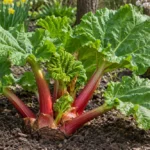
How to grow rhubarb starts with giving a perennial crown enough time and space to build a strong root system. A few tempting stalks on a new plant are working leaves, feeding the underground parts that must support next spring’s growth. Leave that first crop attached and make establishment your immediate goal.
Choose culinary rhubarb from a known source, then check the climate, drainage and mature footprint before planting. A dormant bare-root crown, a leafy potted plant and a seedling need different handling. They also may reach harvestable size at different times. In a cool-winter garden, a well-placed crown can become a long-lived crop; repeated heat stress or saturated soil can prevent that progress. Plant at the depth recommended for your stock, keep the growing crown clear of mulch and judge harvest readiness by completed growing seasons and plant vigor.
Choose the starting plant and harvest plan
Bare-root crown: identify living buds and substantial roots. Iowa places the buds 1-2 inches below finished soil; Minnesota places the crown level. Follow the applicable nursery and local instructions.
Potted plant: retain its original growing level. Do not add the bare-root burial measurement on top of an existing root ball.
Seed: expect variable plants and a longer establishment period. Named crowns or divisions give more predictable cultivar identity.
First harvest: leave year one untouched. A conservative plan also leaves year two, then takes a short harvest from a vigorous plant in year three. The year-by-year table explains the limited second-season alternatives.
Key Takeaways
- Choose identified culinary rhubarb and leave its leaves uneaten.
- Reserve a drained bed with room for mature foliage.
- Match planting depth to the stock and local recommendation.
- Keep young plants’ stalks attached to build root reserves.
- Check crown vigor and freeze damage before harvesting stalks.
Table of Contents
Check Winter Chill, Summer Heat and Culinary Plant Identity
Rhubarb grows best as a perennial in a climate that gives it a winter rest and a reasonably cool growing season. Cold hardiness alone does not describe that fit. A plant may survive winter and still struggle to make vigorous leaves through a long hot summer.
Winter chilling followed by moderate summer temperatures favors vigorous rhubarb. Growing criteria published by Oregon State University include at least 500 winter hours between 28 and 40 degrees Fahrenheit and summer temperatures averaging below 75 degrees. These figures describe its cool-temperate preference, not a tested promise for every cultivar in every US garden.
In a hot region, ask your local extension office or a nursery with actual local rhubarb experience about performance over several years. Afternoon shade can reduce heat exposure in some warm, dry sites. It cannot supply missing winter conditions or repair a rotting crown. Avoid committing a permanent bed on the strength of a national hardiness label alone.
Buy a crown for cultivar identity and a shorter wait
A named division or healthy potted plant usually gives a more predictable start than seed. Seedlings vary in color, vigor and other traits and take longer to establish. A healthy division carries living buds attached to a useful portion of the root system; a dried sliver with a damaged bud is a much less promising start.
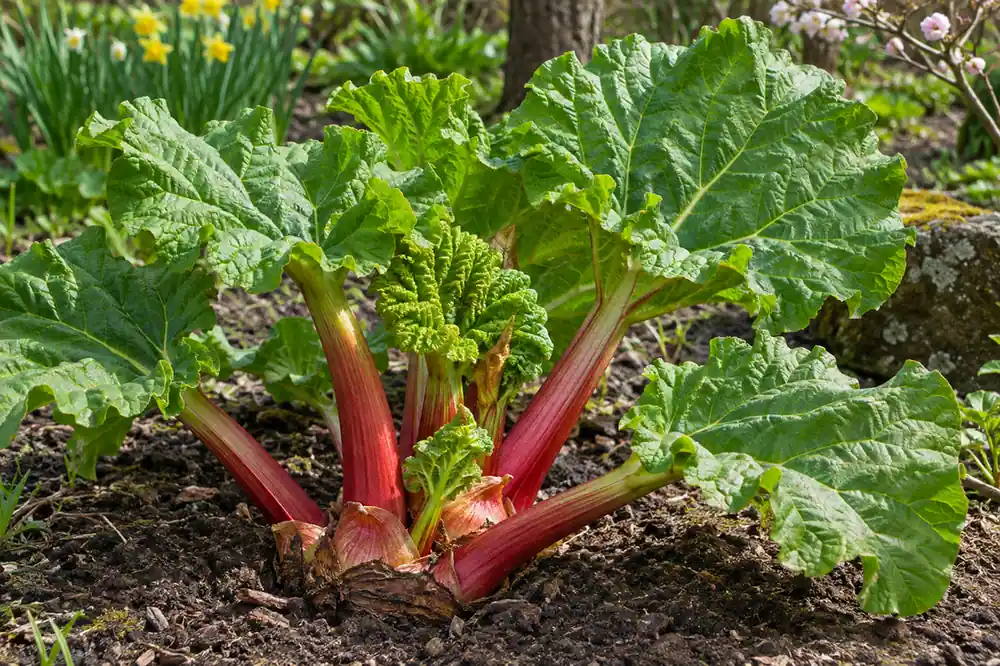
Check that the plant is culinary rhubarb. Ornamental Rheum species are not interchangeable with a food cultivar simply because they have red foliage. The harvested part of culinary rhubarb is the leaf stalk, or petiole. Remove the leaf blade and keep it out of food preparation; rhubarb leaves must not be eaten, raw or cooked.
Give the Crown Drained Soil and Space for Broad Leaves
Choose a position you can leave undisturbed for several years, with access for watering, weeding and picking. Reserve roughly 3-4 feet between crown centers, then leave a usable path outside the foliage. Regional row layouts differ, so a center-to-center plant interval is not a universal aisle width.
One small shipping crown can develop a broad leaf canopy. Two crowns squeezed into the middle of a 4-foot bed may quickly overlap. Plan access around permanent edible plants before neighboring roots and foliage make the space difficult to change.
A sunny position suits the crop in cool-temperate gardens. Iowa’s guidance uses 6-8 hours of direct sun. In warmer, dry climates, some afternoon protection may help with heat, provided it does not put rhubarb into heavy shade and competition from tree roots.
Inspect the soil after rain. Water that remains around the crown deprives roots of air and favors destructive root and crown disease. An isolated hole filled with rich compost can remain a wet pocket inside clay. Improve the rooting area and the route water can take away from it; correcting a waterlogged bed comes before planting a replacement crown.
Prepare the wider rooting area before planting
Remove perennial weeds and incorporate appropriate mature compost during preplant soil preparation. Work only when the soil is crumbly enough to handle. Wet clay that smears against the spade is easy to compact and difficult for new roots to explore.
Soil-test results help guide amendments. Oregon State gives an ideal pH range of 6.0-6.8; Minnesota describes tolerance of a much broader range in ordinary Minnesota garden soils. Neither is a reason to add lime blindly. Sample the actual rhubarb bed and request a laboratory test with crop-specific interpretation before changing pH or repeating fertilizer applications.
How to Grow Rhubarb From Bare-Root Crowns or Potted Plants
Early spring, with dormant plants and workable ground, is a common planting window in cold-winter regions. Fall planting or division can work where roots have time to establish before the soil freezes. Follow the local window for the stock you have; a calendar month copied from another state cannot tell you whether your ground is ready.
Keep exposed roots from drying during storage and planting. Inspect the crown for firm tissue, intact buds and attached roots. A soft, collapsing or badly decayed piece is not sound propagation material. Do not carry a diseased piece into a newly prepared bed.
Locate the bud before measuring depth
For a dormant bare-root plant, the Iowa rhubarb planting instructions place the buds 1-2 inches below the final soil surface. Oregon State measures a similar interval from the top of the crown, and Illinois specifies a crown bud 2 inches below. University of Minnesota guidance differs: a mail-order bare-root crown is set level with the soil. That published difference should be resolved for your nursery stock and local conditions before planting.
Bare-root depth: identify the measured tissue
Iowa measures 1-2 inches from finished soil to the buds of a bare-root plant.
Minnesota sets the mail-order bare-root crown level with the soil.
These are different published methods, not two steps to combine. Drawings are not to scale. Potted plants retain their previous growing level under both Iowa and Minnesota guidance.
- Prepare a hole wide enough for the attached roots, without bending them upward or forcing the crown into a narrow slot.
- Hold the crown at the chosen source-supported depth. Measure from undisturbed surrounding ground to the named bud or crown point.
- Return soil among the roots and firm gently. Avoid pressing down on the buds.
- Water thoroughly, allow the soil to settle, then check the finished level again. Correct exposed roots or excessive settling before mulching.
- Label the cultivar and planting season so that you can count complete establishment seasons later.
Keep a potted plant at its previous growing level
Remove the container carefully, inspect the roots and keep the existing growing level visible. Iowa and Minnesota place established potted plants at the level at which they were growing. Do not bury green stalk bases under an extra 2 inches of soil by transferring a bare-root rule to a pot.
Seed-grown plants need hardening before outdoor planting and more patience before picking. Starting from seed can be worthwhile when you accept variation. It is a poor shortcut when your main goal is a named cultivar and the earliest reasonable harvest.
Preserve Leaves and Maintain Moisture Through the First Two Seasons
Leave the first season’s stalks attached. Each healthy leaf captures energy that can be stored in the crown and roots. Taking those leaves from a small transplant removes part of the equipment it needs to establish.
Keep weeds under control near the crown. Hand-pull small weeds and cultivate shallowly; deep hoeing close to the plant can injure roots and buds. Young rhubarb cannot shade out established weeds just because a mature plant eventually develops large leaves.
Water so that moisture reaches the rooting zone, then check below the surface before watering again. New transplants occupy a smaller soil volume than an established crown. They may dry quickly in warm wind even when a mature plant nearby looks fine. In clay, a dry surface can also cover wet ground underneath.
A mulch layer around the plant helps reduce drying and weed germination. Iowa uses about 2-3 inches. Keep it off the growing crown, where a damp pile can hide emerging shoots and hold moisture against vulnerable tissue. Pull back enough material to inspect the soil without damaging the buds.
Feed according to the bed, not a copied dose
Rhubarb needs nutrients to build its large leaves, and poor fertility can contribute to weak stalks. Check growth, site conditions and a sample from the actual planting area before choosing fertilizer. Leaf size alone cannot tell you how much nitrogen, phosphorus or lime is needed.
Repeated balanced fertilizer or manure applications can build phosphorus in soil already rich in it, a problem highlighted in Minnesota guidance. Use the laboratory recommendation and previous amendment history to choose a suitable product. Keep fertilizer off the crown and avoid fresh manure near a crop harvested early in the season.
Take the First Harvest According to Completed Seasons and Crown Vigor
Count full growing seasons after planting. A crown set in fall has not completed a full establishment season by the following spring. A weak plant also does not become ready simply because its label says year three.
| Source and route | Season 1 | Season 2 | Season 3 | Season 4 and later |
|---|---|---|---|---|
| Iowa and Purdue conservative establishment plan | No harvest | No harvest | Short harvest, about 4 weeks, from vigorous plants | A mature regional season, commonly up to 8-10 weeks, with foliage retained. |
| Oregon State limited early option | No harvest | Only 3-4 stalks from a healthy plant | Established care; retain stalks and healthy foliage | Keep roughly six stalks on a mature plant under its guidance. |
| Illinois limited early option | No harvest | Only 1-2 weeks from healthy plants | A mature regional season if vigorous | Limit the share picked and preserve leaf growth. |
For a small new crown, the first row gives a cautious plan: protect two full seasons, then take a shortened first harvest. The second-season options are published alternatives for strong plants, not a requirement to pick. Seedlings may need additional establishment time. Avoid mixing the earliest start from one source with the largest harvest allowance from another.
Grip the leaf stalk low without pulling up the crown
Choose a firm stalk that has reached its cultivar’s normal full size. Many Iowa and Purdue examples use about 10-15 inches, and some cultivars grow longer. A crisp stalk with a developed leaf is a better cue than redness alone; healthy culinary rhubarb can have green stalks.
Grip low near the base and use a firm sideways pull with a slight twist to detach the stalk without tearing the crown or injuring emerging buds. Stop if the movement starts lifting the plant. Remove the toxic leaf blade from the detached stalk before bringing the crop into food preparation.
Leave most leaves growing. Illinois recommends removing only about one-third at a time, a conservative starting rule for a healthy mature plant. Iowa allows up to half and Purdue up to two-thirds under their guidance. Those different ceilings do not justify stripping a weak crown. Choose a bounded local method and stop earlier when growth is thin or stressed.
Keep Summer Foliage Working and Remove Developing Flower Stalks
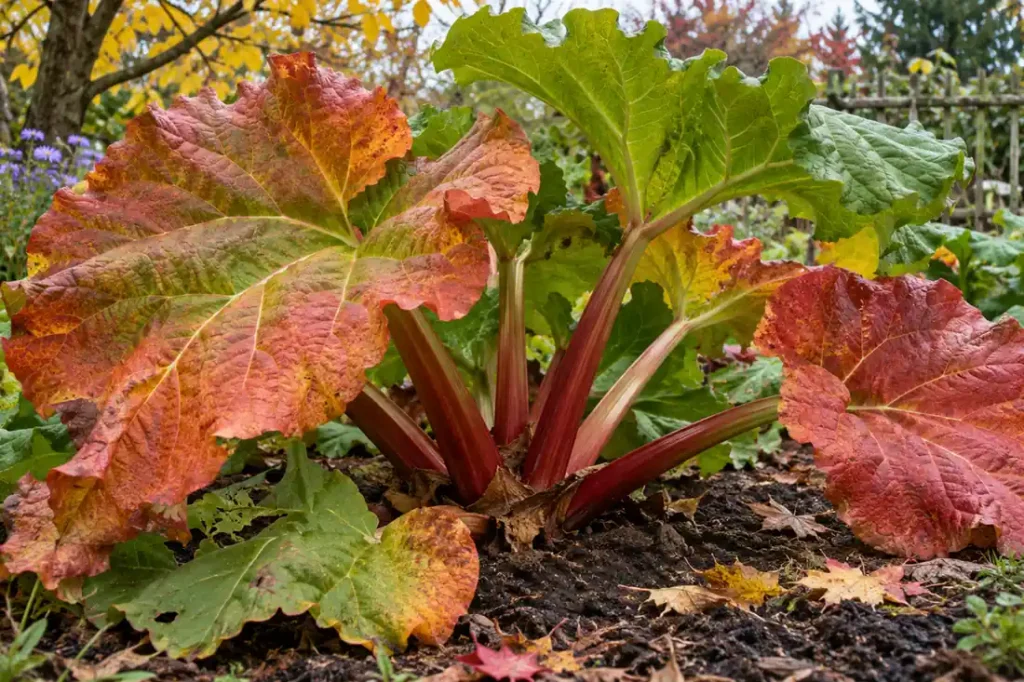
After the normal harvest, keep watering and weeding as needed. Do not cut the plant down for tidiness. Healthy leaves continue supplying the roots with reserves for the next spring. In cold-winter gardens, remove dead foliage after a killing freeze rather than removing useful green leaves in midsummer.
A tall flower stalk emerging from the center is different from a leaf stalk. Flowering can reflect cultivar habit, age or stresses such as heat and drought. Remove the developing flower stalk near its base when growing rhubarb for petioles, taking care around the crown. Repeated flowering deserves a check of growing conditions and plant age.
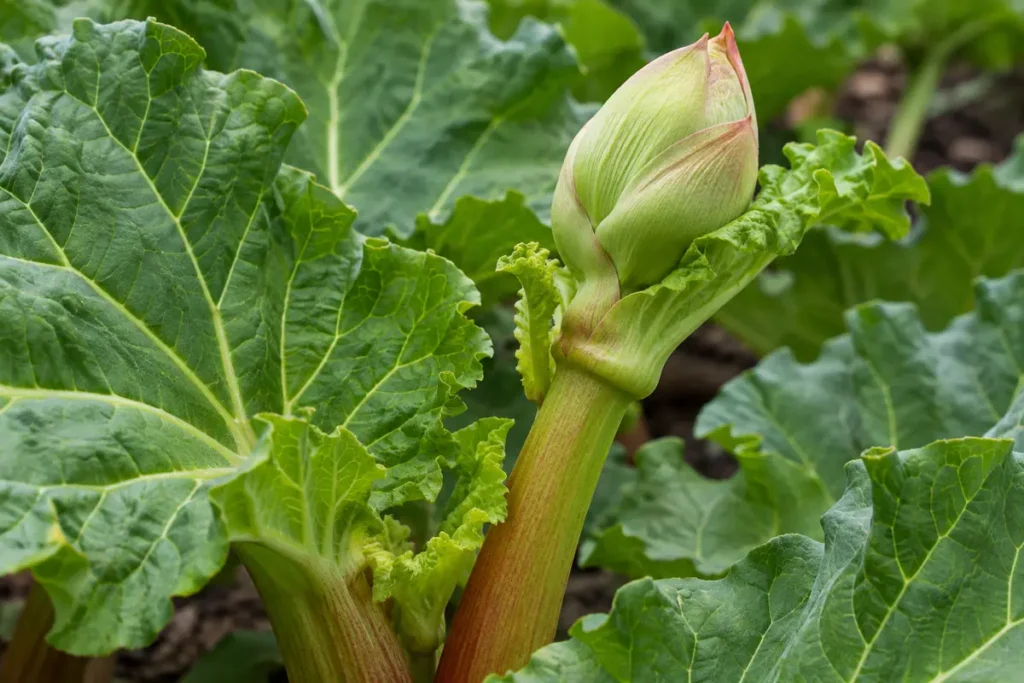
Flowering does not make healthy culinary leaf stalks suddenly poisonous. Nor do they become poisonous because the calendar reaches summer. Limiting continued picking protects plant vigor and next year’s crop. Leaf blades remain unsuitable for eating throughout the year.
Check Plant Age, Wet Soil and Freeze Damage Before Taking More Stalks
| Visible sign | Check first | Next action |
|---|---|---|
| Thin stalks on a recently planted crown | Age, original division size and establishment progress | Leave foliage; keep moisture and weeds managed without forcing a harvest. |
| Many narrow stalks on an older crowded plant | Crown crowding, past harvest pressure and soil fertility | Reduce picking; plan division if the crown is healthy and crowded. |
| Limp growth with wet soil and soft bases | Drainage and possible crown/root disease | Do not keep watering saturated ground; seek a local diagnosis. |
| Blackened leaves and soft limp stalks after a freeze | Actual tissue damage, not temperature alone | Discard damaged stalks; assess undamaged growth separately. |
| Flower stalks recur despite weak leaf growth | Cultivar, crown age, heat, water and fertility | Remove the flower stems and correct identified stress before feeding. |
Crowded crowns can need division when formerly thick stalks become numerous and thin. Suggested ages vary from around five or six years in Oregon guidance to eight or ten in Iowa and Purdue. Use the plant’s condition, not its birthday. Divide healthy material during a suitable dormant or early-spring window, retaining living buds and substantial roots, then allow it to reestablish.
Do not treat a rotting crown as healthy division material. Soft, decaying tissue and persistent wetness call for diagnosis and a better site. Splitting it into pieces and replanting in the same saturated bed leaves the main problem in place.
After a freeze, inspect damaged stalks before harvesting
The Iowa guidance on frozen rhubarb uses blackened, shriveled foliage and soft, limp stalks as discard signs. Check the plant two or three days after the event if damage is uncertain. A cold night alone does not condemn an undamaged plant; new healthy stalks are assessed according to their growth and the crown’s readiness for harvest.
Conclusion
Give rhubarb a suitable climate, drained soil and time to build its crown. Identify the planting stock before measuring depth, keep useful foliage through establishment and take a limited first harvest only from a vigorous plant. Protecting those roots and leaves is what makes repeated spring harvests possible.