




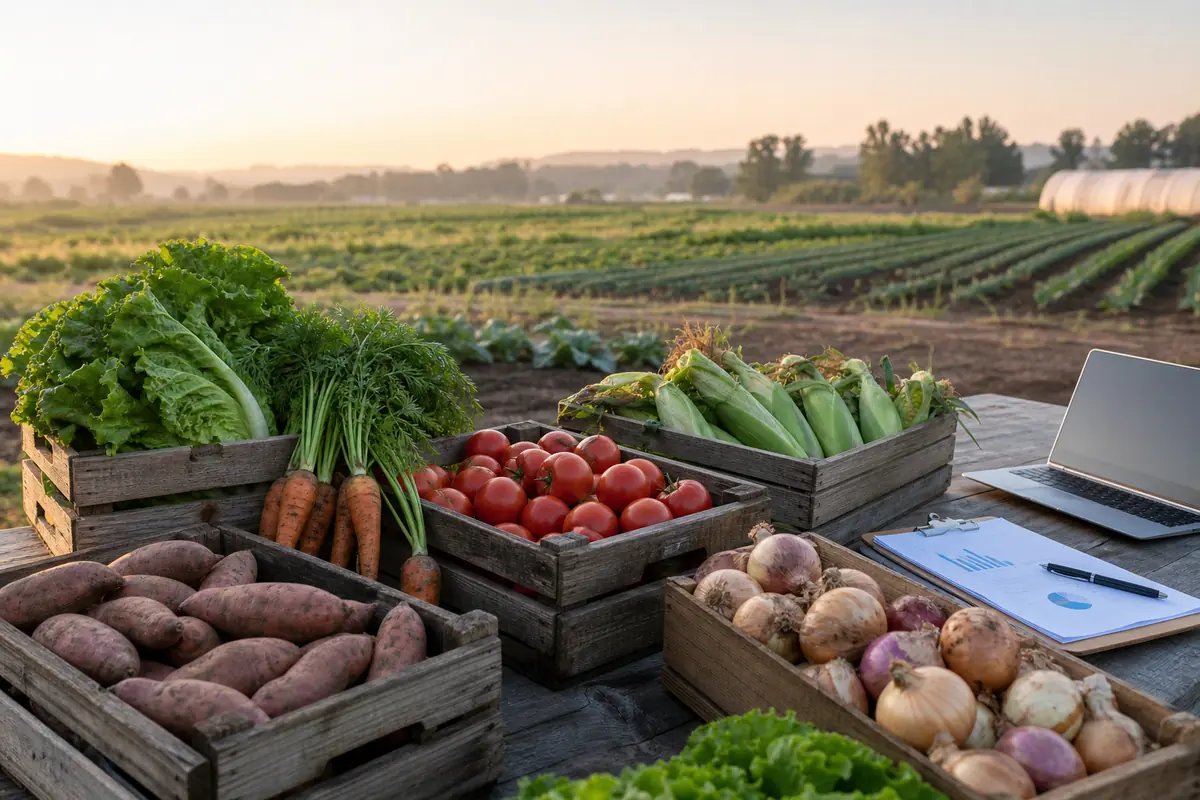
Vegetable production statistics for 2026 should start with the latest official crop year, and the newest USDA NASS annual release is the Vegetables 2025 Summary, published in February 2026. Across the 28 vegetable and melon crops estimated in that report, U.S. production reached 735.8 million cwt in 2025 on 2.23 million harvested acres, with utilized production valued at about $19.0 billion.
The numbers are easy to misread unless the unit stays attached. NASS reports total production in thousand cwt, where one cwt equals 100 pounds. Processing vegetables often use tons. Value is reported in thousand dollars. A tomato number can look huge because processing tomatoes move by the truckload; a lettuce number can look smaller by weight and still carry more crop value.
Key Takeaways
- Count 735.8 million cwt across 28 crops in 2025.
- Value utilized production at about $19.0 billion.
- Rank tomatoes first by volume at 248.3 million cwt.
- Rank romaine lettuce first by value at $2.78 billion.
- Track sweet corn as the acreage leader at 368,500 acres.
- Separate fresh-market cwt from processing tons before quoting.
Table of Contents
Latest U.S. Vegetable Production Data Snapshot
Source basis: USDA NASS Vegetables 2025 Summary, 2025 crop year. Cwt means hundredweight, or 100 pounds.
Vegetable Production Statistics Snapshot – Latest USDA Benchmarks
The latest annual benchmark comes from the USDA NASS Vegetables 2025 Summary. The release covers 28 vegetable and melon crops for 2023-2025 and states that the two largest vegetables by harvested area in 2025 were sweet corn and tomatoes. Tomatoes were the largest crop by total production.
| Metric | 2025 Figure | Unit | What It Means |
|---|---|---|---|
| Crops estimated | 28 | vegetable and melon crops | NASS scope for the annual vegetable summary. |
| Total production | 735.8 million | cwt | All 28 crops before subtracting harvested-not-sold volume. |
| Utilized production | 732.2 million | cwt | Production sold fresh, sold for processing, used for processing at home, or held in storage. |
| Harvested acreage | 2.23 million | acres | Open-field harvested area across the 28 crops. |
| Planted acreage | 2.29 million | acres | Open-field planted area across the same crops. |
| Value of utilized production | $19.0 billion | dollars | Summed crop-year value across the 28 crop rows. |
| Harvested-not-sold share | 0.49% | share of total cwt | About 3.63 million cwt was reported as harvested and not sold. |
| Largest crop by production | Tomatoes | 248.3 million cwt | Tomatoes represented about one-third of total production volume. |
| Largest crop by harvested area | Sweet corn | 368,500 acres | Sweet corn used the most harvested acres in the annual report. |
| Highest-value crop | Romaine lettuce | $2.78 billion | Romaine led 2025 crop value with less field weight than tomatoes. |
These figures describe open-field production in the crops NASS estimates for the annual vegetable report. They do not include every greenhouse tomato, every small garden, or every vegetable form in the food system. That boundary keeps the data clean enough to cite.
Vegetable Production By Crop – Tomatoes Dominate The Weight
Tomatoes carried 248.3 million cwt in 2025, about 33.7% of total production across the 28 crops. The scale comes from processing tomatoes as much as fresh market tomatoes. The fruit may end up in cans, paste, sauce, institutional kitchens, and food manufacturing long before a shopper sees a fresh tomato display.
| Rank | Crop | Total Production | Share Of 28-Crop Total | Harvested Acres | Utilized Value |
|---|---|---|---|---|---|
| 1 | Tomatoes | 248.3 million cwt | 33.7% | 246,700 acres | $2.02B |
| 2 | Onions | 82.1 million cwt | 11.2% | 137,000 acres | $1.60B |
| 3 | Sweet corn | 58.2 million cwt | 7.9% | 368,500 acres | $747.7M |
| 4 | Romaine lettuce | 46.7 million cwt | 6.3% | 129,200 acres | $2.78B |
| 5 | Watermelons | 38.7 million cwt | 5.3% | 98,900 acres | $740.7M |
| 6 | Head lettuce | 38.3 million cwt | 5.2% | 111,600 acres | $1.68B |
| 7 | Sweet potatoes | 32.5 million cwt | 4.4% | 155,700 acres | $799.4M |
| 8 | Carrots | 26.7 million cwt | 3.6% | 61,100 acres | $2.02B |
| 9 | Cabbage | 22.0 million cwt | 3.0% | 49,600 acres | $538.3M |
| 10 | Leaf lettuce | 16.1 million cwt | 2.2% | 67,000 acres | $1.38B |
| 11 | Celery | 15.0 million cwt | 2.0% | 27,700 acres | $483.6M |
| 12 | Pumpkins | 14.7 million cwt | 2.0% | 68,100 acres | $258.5M |
The crop order changes when the measure changes. Tomatoes lead by weight. Sweet corn leads by acreage. Romaine lettuce leads by value. Those three facts can all be true in the same crop year because vegetables move through different markets, storage systems, and pricing structures.
Vegetable Production Value – Lettuce And Carrots Lead Dollars
Production value does not follow production weight. Romaine lettuce led the 2025 value table at $2.78 billion, followed by carrots and tomatoes at about $2.02 billion each. Leaf lettuce also ranked high by value, even though it was tenth by production volume.
Top Crops By 2025 Production Value
| Rank | Crop | Utilized Production Value | Total Production | Average Price |
|---|---|---|---|---|
| 1 | Romaine lettuce | $2.78B | 46.7 million cwt | $59.70/cwt |
| 2 | Carrots | $2.02B | 26.7 million cwt | $75.50/cwt |
| 3 | Tomatoes | $2.02B | 248.3 million cwt | $8.17/cwt |
| 4 | Head lettuce | $1.68B | 38.3 million cwt | $43.70/cwt |
| 5 | Onions | $1.60B | 82.1 million cwt | $19.60/cwt |
| 6 | Leaf lettuce | $1.38B | 16.1 million cwt | $85.70/cwt |
| 7 | Sweet potatoes | $799.4M | 32.5 million cwt | $24.70/cwt |
| 8 | Broccoli | $768.7M | 11.1 million cwt | $69.20/cwt |
| 9 | Sweet corn | $747.7M | 58.2 million cwt | $12.90/cwt |
| 10 | Watermelons | $740.7M | 38.7 million cwt | $19.30/cwt |
| 11 | Cabbage | $538.3M | 22.0 million cwt | $24.40/cwt |
| 12 | Cauliflower | $487.1M | 7.5 million cwt | $64.60/cwt |
Value is the cleaner measure for market weight. Production volume favors dense, processing-heavy crops. Value pulls high-price fresh crops forward. A cold chain, labor, field loss, pack-out quality, and short shelf life can all push a crop higher in dollar terms.
Vegetable Acreage Statistics – Sweet Corn Uses The Most Ground
Sweet corn led harvested acreage in 2025 with 368,500 acres, even though it ranked third by total production and ninth by value. Tomatoes used 246,700 harvested acres. Sweet potatoes used 155,700 acres and moved into the top three for acreage.
| Rank | Crop | Harvested Acres | Share Of 28-Crop Harvested Area | Yield |
|---|---|---|---|---|
| 1 | Sweet corn | 368,500 acres | 16.5% | 158.1 cwt/acre |
| 2 | Tomatoes | 246,700 acres | 11.0% | 1006.6 cwt/acre |
| 3 | Sweet potatoes | 155,700 acres | 7.0% | 208.8 cwt/acre |
| 4 | Snap beans | 139,100 acres | 6.2% | 83.7 cwt/acre |
| 5 | Onions | 137,000 acres | 6.1% | 599.6 cwt/acre |
| 6 | Romaine lettuce | 129,200 acres | 5.8% | 361.2 cwt/acre |
| 7 | Head lettuce | 111,600 acres | 5.0% | 343.3 cwt/acre |
| 8 | Green peas | 104,000 acres | 4.7% | 45.1 cwt/acre |
| 9 | Broccoli | 101,000 acres | 4.5% | 110.0 cwt/acre |
| 10 | Watermelons | 98,900 acres | 4.4% | 391.4 cwt/acre |
| 11 | Cucumbers | 84,300 acres | 3.8% | 170.2 cwt/acre |
| 12 | Pumpkins | 68,100 acres | 3.0% | 215.2 cwt/acre |
Acreage is the best measure for land footprint. It can also explain why a crop feels more visible in farm regions than it looks in the value table. A broad field of sweet corn can cover far more acreage than a smaller high-value block of lettuce or carrots.
Fresh Market Versus Processing Vegetables – The Unit Changes The Story
Fresh-market production and processing production should stay separate. NASS reports fresh-market utilized production in thousand cwt, while processing production is often reported in tons. Mixing those units produces bad rankings. The 2025 vegetable report PDF defines fresh market as utilized production that is not processed, and utilized production as crop volume sold fresh, sold for processing, processed at home, or held in storage.
| Rank | Crop | Fresh-Market Production | Reported Unit |
|---|---|---|---|
| 1 | Onions | 58.4 million cwt | 1,000 cwt |
| 2 | Romaine lettuce | 46.7 million cwt | 1,000 cwt |
| 3 | Watermelons | 38.4 million cwt | 1,000 cwt |
| 4 | Head lettuce | 38.3 million cwt | 1,000 cwt |
| 5 | Sweet potatoes | 25.0 million cwt | 1,000 cwt |
| 6 | Carrots | 21.3 million cwt | 1,000 cwt |
| 7 | Cabbage | 17.4 million cwt | 1,000 cwt |
| 8 | Leaf lettuce | 16.1 million cwt | 1,000 cwt |
| 9 | Sweet corn | 15.1 million cwt | 1,000 cwt |
| 10 | Celery | 15.0 million cwt | 1,000 cwt |
| 11 | Tomatoes | 13.9 million cwt | 1,000 cwt |
| 12 | Broccoli | 10.8 million cwt | 1,000 cwt |
| Rank | Crop | Processing Production | Reported Unit |
|---|---|---|---|
| 1 | Tomatoes | 11.64 million tons | tons |
| 2 | Sweet corn | 2.13 million tons | tons |
| 3 | Onions | 1.16 million tons | tons |
| 4 | Cucumbers | 0.54 million tons | tons |
| 5 | Snap beans | 0.46 million tons | tons |
| 6 | Sweet potatoes | 0.37 million tons | tons |
| 7 | Carrots | 0.27 million tons | tons |
| 8 | Pumpkins | 0.24 million tons | tons |
| 9 | Green peas | 0.23 million tons | tons |
| 10 | Cabbage | 0.23 million tons | tons |
| 11 | Bell peppers | 0.12 million tons | tons |
| 12 | Garlic | 0.12 million tons | tons |
The processing table explains why tomatoes dominate total production. Most tomato volume is harvested for processing, not for the fresh tomato bin. Sweet corn also has a large processing side, which is why acreage and processing volume both matter when reading the crop.
Vegetable Production By State – Crop Concentration Matters More Than A Single State Total
State production is best read crop by crop because some NASS state cells are withheld to protect individual operations. A single rolled-up state table would hide those confidentiality gaps. Clear crop-state rows are still useful: they show where production concentrates and which regions carry the main supply.
| Crop | State | 2025 Production | 2025 Value | Why It Matters |
|---|---|---|---|---|
| Tomatoes | California | 239.7 million cwt | $1.48B | California carried nearly all reported tomato volume. |
| Tomatoes | Florida | 8.6 million cwt | $532.3M | Florida’s smaller volume had high fresh-market value. |
| Romaine lettuce | California | 38.1 million cwt | $2.26B | California led romaine production and value. |
| Romaine lettuce | Arizona | 8.5 million cwt | $525.8M | Arizona supplied the other major romaine row. |
| Head lettuce | California | 27.9 million cwt | $1.24B | California led head lettuce production. |
| Head lettuce | Arizona | 10.4 million cwt | $433.5M | Arizona was the second major head lettuce state. |
| Sweet potatoes | North Carolina | 18.9 million cwt | $391.8M | North Carolina was the largest sweet potato row. |
| Sweet corn | Washington | 16.4 million cwt | $83.4M | Washington led reported sweet corn production. |
| Watermelons | Georgia | 8.1 million cwt | $141.4M | Georgia narrowly led reported watermelon production. |
| Bell peppers | California | 4.3 million cwt | $211.9M | California led reported bell pepper volume. |
Use this state table as selected evidence, not a complete state league table. If a state or crop cell is marked confidential in the source, the missing value should stay missing. That is better than filling the gap with a guess.
Vegetable Yield Statistics – Tomatoes Produce The Most Weight Per Acre
Yield measures weight per harvested acre. Among crops with at least 10,000 harvested acres in the 2025 summary, tomatoes had the highest yield at 1,006.6 cwt per acre. Onions followed at 599.6 cwt per acre. Celery, cabbage, carrots, and watermelons also ranked high by field weight.
| Rank | Crop | Yield | Total Production | Harvested Acres |
|---|---|---|---|---|
| 1 | Tomatoes | 1006.6 cwt/acre | 248.3 million cwt | 246,700 acres |
| 2 | Onions | 599.6 cwt/acre | 82.1 million cwt | 137,000 acres |
| 3 | Celery | 540.0 cwt/acre | 15.0 million cwt | 27,700 acres |
| 4 | Cabbage | 444.4 cwt/acre | 22.0 million cwt | 49,600 acres |
| 5 | Carrots | 437.7 cwt/acre | 26.7 million cwt | 61,100 acres |
| 6 | Watermelons | 391.4 cwt/acre | 38.7 million cwt | 98,900 acres |
| 7 | Romaine lettuce | 361.2 cwt/acre | 46.7 million cwt | 129,200 acres |
| 8 | Head lettuce | 343.3 cwt/acre | 38.3 million cwt | 111,600 acres |
| 9 | Bell peppers | 327.5 cwt/acre | 10.6 million cwt | 32,300 acres |
| 10 | Cantaloupes | 245.6 cwt/acre | 10.6 million cwt | 43,200 acres |
Yield rankings should not be treated as crop quality rankings. Dense fruit and root crops naturally produce more field weight than leafy or pod crops. A high cwt-per-acre number says weight moved off the field; it does not say the crop is easier to grow, more profitable, or more useful in a home garden.
Vegetable Production Trends – 2025 Changed Several Major Crops
The annual summary also reports year-over-year movement. Tomatoes increased 5% from 2024 to 2025, while harvested tomato area decreased 6%. Sweet corn production rose 9%. Onions rose 8%. Carrots rose 8% in value, and sweet potatoes moved sharply higher in production after expanded harvested acreage.
| Crop | 2025 Signal | Reported Detail | Why It Matters |
|---|---|---|---|
| Tomatoes | Production up | 248 million cwt, up 5% from 2024 | Higher yield offset lower harvested area. |
| Sweet corn | Production up | 58.2 million cwt, up 9% from 2024 | Sweet corn remained the harvested-acre leader. |
| Onions | Production up | 82.1 million cwt, up 8% from 2024 | Onions ranked second by total production. |
| Snap beans | Production up | 11.6 million cwt, up 9% from 2024 | Processing and fresh-market uses both matter. |
| Spinach | Production down | 5.36 million cwt, down 13% from 2024 | Spinach continued lower after a large 2024 decline. |
| Garlic | Production down | 3.49 million cwt, down 5% from 2024 | Smaller acreage and yield reduced volume. |
One-year changes are useful, yet they need crop context. A percentage gain in a small crop does not move the national total the same way a tomato, onion, or sweet corn change does. For broader background across production, prices, and intake, vegetable statistics 2026 for production, prices, and intake keeps the wider category view separate from this production-only data sheet.
How To Cite Vegetable Production Data – Keep Year, Unit, And Scope Together
The safest citation has four parts: source, crop year, unit, and scope. Use “2025 USDA NASS vegetable and melon crops” when working from the 28-crop annual summary. Keep “million cwt” with total production and “tons” with processing. Reserve “value of utilized production” for dollars.
| Data Type | Use It For | Avoid Claiming | Safer Wording |
|---|---|---|---|
| Total production | Crop volume across harvested fields | Sales volume or fresh-market volume | “U.S. tomato production totaled 248.3 million cwt in 2025.” |
| Utilized production | Sold, processed, stored, or otherwise used crop volume | Total field production before harvested-not-sold volume | “Utilized production across 28 crops was 732.2 million cwt.” |
| Fresh-market production | Unprocessed market volume | Processing supply | “Onions led fresh-market volume at 58.4 million cwt.” |
| Processing production | Crops sent to processing channels | Fresh-market sales | “Tomatoes led processing volume at 11.64 million tons.” |
| Harvested acreage | Land footprint | Profitability or production value | “Sweet corn had 368,500 harvested acres in 2025.” |
| Value of utilized production | Crop value comparison | Weight or acreage list | “Romaine lettuce led value at $2.78 billion.” |
Vegetable consumption statistics 2026 by intake, age, state, and supply measure intake and food availability. Production tracks what farms harvest and sell. Consumption tracks what people eat or what the food supply makes available. Keeping those data layers separate prevents one of the most common vegetable-data errors.
Where To Start
Researchers who need one production benchmark should start with 735.8 million cwt in 2025 across 28 USDA NASS vegetable and melon crops. Add the scope every time, because the figure is tied to that annual report.
Market-size comparisons should use value, not production volume. Romaine lettuce, carrots, tomatoes, head lettuce, onions, and leaf lettuce tell the dollar story better than a weight list alone.
Crop supply comparisons should split fresh-market cwt from processing tons. Tomatoes are the clean example: 13.9 million cwt fresh-market production and 11.64 million tons for processing describe two very different channels.
Home gardeners and small growers should use the national numbers as scale context only. National acreage does not decide whether a crop fits a raised bed, container, or backyard schedule. For small-space crop decisions, container pot size by crop for stronger vegetable growth and container depth by vegetable root type are closer to the practical decision.
Conclusion
The latest vegetable production statistics show a 2025 U.S. crop year shaped by tomato volume, sweet corn acreage, and high-value lettuce and carrot production. The strongest benchmark is 735.8 million cwt across 28 estimated vegetable and melon crops, with utilized production valued at about $19.0 billion.
Use 2025 as the current official annual benchmark until USDA NASS releases the next annual vegetable summary. Keep the unit beside every number, separate fresh-market cwt from processing tons, and treat state rows carefully when confidentiality cells appear. The cleanest citation is the one a reader can trace back to crop, year, unit, and source without sorting through a full PDF table.