




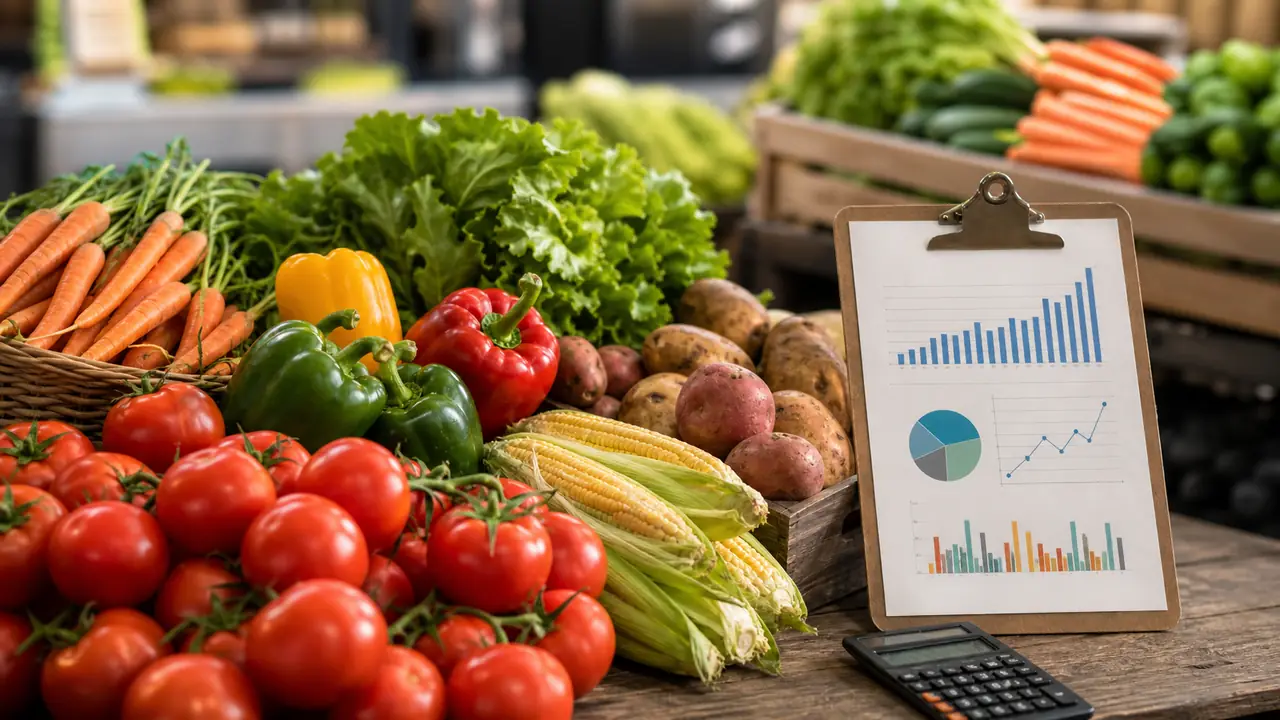
Vegetable price statistics in 2026 show a sharp split between grocery-level inflation and farm-level price pressure. USDA ERS reported fresh vegetable prices up 11.5% year over year in April 2026; farm-level vegetable prices were up 56.3% over the same April-to-April period.
Those two numbers should not be treated as the same kind of price. CPI tracks what consumers pay. PPI tracks producer prices before the retail shelf. Weekly USDA AMS grocery-ad data adds a third view: what stores were actively promoting in a specific week. Together, the three sources show where vegetable prices are rising, where shoppers are likely to feel it, and which crop rows deserve a fresh check before quoting.
Key Takeaways
- Use April 2026 as the latest ERS CPI benchmark.
- Quote fresh vegetables up 11.5% year over year.
- Track farm-level vegetables up 56.3% year over year.
- Expect 2026 fresh vegetable CPI near 7.8% midpoint.
- Separate grocery CPI from farm PPI before comparing prices.
- Check weekly AMS ads before citing current shelf examples.
Table of Contents
Latest Vegetable Price Snapshot For 2026
Source basis: USDA ERS Food Price Outlook, CPI and PPI data through April 2026; USDA AMS National Retail Report – Specialty Crops, June 6-18, 2026.
Vegetable Price Statistics Snapshot – Latest 2026 Benchmarks
The cleanest 2026 snapshot comes from two USDA data streams. The USDA ERS Food Price Outlook gives CPI, PPI, and forecast data through April 2026. The USDA AMS National Retail Report – Specialty Crops gives current advertised retail prices for the June 6-18, 2026 report period.
| Measure | Latest Period | 2026 Figure | What It Measures |
|---|---|---|---|
| Consumer CPI – fresh vegetables, month to month | March 2026 to April 2026 | +3.1% | Consumer price change for fresh vegetables. |
| Consumer CPI – fresh vegetables, year over year | April 2025 to April 2026 | +11.5% | Consumer price change versus the same month one year earlier. |
| Consumer CPI – fresh vegetables, year to date | Average 2026 to average 2025 | +4.8% | Average consumer price change so far in the calendar year. |
| ERS forecast – fresh vegetable CPI | Calendar year 2026 | +7.8% midpoint | USDA ERS forecast midpoint, with a +3.9% to +11.9% interval. |
| Farm-level vegetable PPI, year over year | April 2025 to April 2026 | +56.3% | Producer price change before grocery retailing. |
| Farm-level vegetable PPI forecast | Calendar year 2026 | +20.5% midpoint | USDA ERS forecast midpoint, with a +3.6% to +42.7% interval. |
| Vegetable grocery ads | June 6-18, 2026 | 95,388 ads | Advertised retail promotions counted by USDA AMS. |
| Onion and potato grocery ads | June 6-18, 2026 | 20,031 ads | Separate AMS ad group for onions and potatoes. |
April 2026 is the latest ERS monthly benchmark in the downloaded 2026 data, so the CPI and PPI rows should be cited as April 2026 data. The retail-ad rows are newer and narrower: they describe advertised specials for one USDA AMS report window rather than every price paid at checkout.
Fresh Vegetable Price Inflation – CPI Rose Faster Than Food At Home
Fresh vegetables were the outlier in the grocery basket in April 2026. ERS reported food-at-home prices up 2.9% year over year; fresh vegetables rose 11.5%. That gap matters because a household can feel fresh produce inflation even when the wider grocery index looks more modest.
| ERS CPI Category | Relative Importance | Month To Month | Year Over Year | Year To Date | 2026 Forecast Midpoint |
|---|---|---|---|---|---|
| All food | 100.0% | +0.5% | +3.2% | +2.0% | +3.4% |
| Food at home | 60.8% | +0.7% | +2.9% | +1.7% | +3.2% |
| Fruits and vegetables | 9.4% | +1.7% | +6.1% | +2.9% | +4.6% |
| Fresh fruits and vegetables | 7.5% | +2.1% | +6.5% | +2.9% | +5.0% |
| Fresh vegetables | 3.6% | +3.1% | +11.5% | +4.8% | +7.8% |
| Processed fruits and vegetables | 2.0% | +0.2% | +4.1% | +2.5% | +3.6% |
The fresh vegetable index moved about 5.6 times as fast as the broader food-at-home index from March to April 2026. On a store table, that difference shows up as smaller sale signs, fewer deep discounts, and a sharper jump in the bright, perishable items that have to move quickly.
Fresh Versus Processed Vegetable Prices – The Shelf Life Gap Shows Up
Fresh vegetables outpaced processed fruits and vegetables across every 2026 ERS measure in the table below. Fresh items carry more exposure to weather, harvest timing, transportation, cold storage, and shrink. Processed products can smooth some of that pressure through contracts, inventories, packaging dates, and blended inputs.
| Measure | Fresh Vegetables | Processed Fruits And Vegetables | Fresh Premium |
|---|---|---|---|
| Month-to-month change | +3.1% | +0.2% | +2.9 percentage points |
| Year-over-year change | +11.5% | +4.1% | +7.4 percentage points |
| Year-to-date change | +4.8% | +2.5% | +2.3 percentage points |
| 2026 forecast midpoint | +7.8% | +3.6% | +4.2 percentage points |
| 2026 forecast interval | +3.9% to +11.9% | +1.5% to +5.8% | Fresh range sits higher |
| 20-year historical average | +1.7% | +2.8% | 2026 reverses the usual pattern |
The reversal against the 20-year average is the useful part. Processed fruits and vegetables have historically averaged higher inflation than fresh vegetables in the ERS file. In 2026, fresh vegetable pressure is running above that long-run pattern.
Farm-Level Vegetable Prices – Producer Pressure Is Much Larger
Farm-level vegetable prices sit apart from retail prices. They sit earlier in the chain, closer to the field and shipping point, before store labor, shrink, packaging, merchandising, and promotion decisions. In April 2026, that earlier price layer moved far above the consumer index.
| PPI Measure | Farm-Level Vegetables | Context |
|---|---|---|
| Month-to-month change | +5.7% | March 2026 to April 2026. |
| Year-over-year change | +56.3% | April 2025 to April 2026. |
| Year-to-date change | +25.8% | Average 2026 to average 2025. |
| Annual 2025 | -9.0% | Farm-level vegetable prices fell in the prior calendar year. |
| 20-year historical average | +4.3% | Long-run average annual change in the ERS file. |
| 2026 forecast midpoint | +20.5% | ERS midpoint forecast for calendar year 2026. |
| 2026 forecast interval | +3.6% to +42.7% | Wide forecast interval signals high uncertainty. |
The 56.3% year-over-year PPI figure is the sharpest number in the current dataset and needs care. It compares one April with the prior April, and it follows a 2025 year in which farm-level vegetable prices averaged 9.0% lower. A low base can make the next year look especially steep.
Grocery Vegetable Ads – What Stores Promoted In June 2026
USDA AMS counted 314,027 total produce ads in the June 6-18, 2026 National Retail Report – Specialty Crops. Vegetables accounted for 95,388 ads, or 30% of the produce total. Onions and potatoes were counted separately at 20,031 ads, or 6% of total produce ads.
| Commodity Group | Ad Count | Share Of Total Produce Ads | What To Notice |
|---|---|---|---|
| Fruit | 194,047 | 62% | Largest promoted produce group in the weekly report. |
| Vegetables | 95,388 | 30% | Main vegetable group, excluding onions and potatoes. |
| Onions and potatoes | 20,031 | 6% | Tracked separately from the main vegetable group. |
| Herbs | 2,064 | 1% | Small, visible produce-ad category. |
| Organic produce | 49,608 | 16% | Share of total produce ads across organic items; production standards differ from conventional vegetable growing practices. |
| Total produce ads | 314,027 | 100% | Up 8% from the prior week and 15% from the same week in 2025. |
AMS reported no notable changes for onions and potatoes during that report week. In the vegetable group, sweet corn sold by the ear was the only notable increase listed, up 24%. No notable vegetable decreases were reported in that weekly summary.
Retail Vegetable Prices – Advertised Grocery Prices By Item
Retail-ad prices are especially useful for current examples because they give a product, unit, ad count, and weighted average price. The tradeoff is narrow scope. These are advertised prices in a specific report week, not a national average checkout price for every store.
| Vegetable Item | Unit | Ad Count | Weighted Average Price | Same Week 2025 |
|---|---|---|---|---|
| Asparagus, green | per lb | 4,378 | $3.39 | $3.44 |
| Broccoli | per bunch | 1,487 | $2.79 | $2.97 |
| Broccoli crown cut | per lb | 1,576 | $2.08 | $2.09 |
| Cabbage, green | per lb | 1,658 | $0.64 | $0.70 |
| Carrots, baby peeled | 1 lb bag | 1,301 | $1.37 | $1.42 |
| Cauliflower | each | 2,224 | $3.19 | $2.93 |
| Celery | each | 689 | $1.72 | $1.61 |
| Sweet corn | each | 6,195 | $0.51 | $0.41 |
| Cucumbers | each | 1,429 | $0.70 | $0.77 |
| Iceberg lettuce | each | 1,727 | $1.47 | $1.55 |
| Green bell peppers | each | 2,631 | $0.91 | $0.93 |
| Red bell peppers | each | 2,217 | $1.28 | $1.24 |
| Zucchini | per lb | 3,704 | $1.43 | $1.34 |
| Yellow squash | per lb | 3,174 | $1.47 | $1.38 |
| Sweet potatoes | per lb | 937 | $1.15 | $0.91 |
| Roma tomatoes | per lb | 1,347 | $1.56 | $1.13 |
| Tomatoes on the vine, greenhouse | per lb | 1,682 | $2.17 | $1.62 |
The tomato rows show why vegetable price statistics need item-level context. A broad tomato CPI number would hide the difference between Roma tomatoes, grape tomatoes, greenhouse vine tomatoes, and ordinary round tomatoes. The shelf looks like one red category from a few steps back; the price file treats each unit and package size separately.
Tomato, Potato, And Corn Prices – High-Use Examples To Cite
Tomatoes, potatoes, and sweet corn are useful citation examples because they appear often in production, grocery, and household food discussions. The current AMS report gives recent advertised prices for all three, and the units differ. Potatoes often appear by bag weight, corn by ear or tray, and tomatoes by pound or package.
| Item | Unit | 2026 Ad Count | 2026 Weighted Average | 2025 Weighted Average | Change From Same Week 2025 |
|---|---|---|---|---|---|
| Sweet corn | each | 6,195 | $0.51 | $0.41 | +24.4% |
| Roma tomatoes | per lb | 1,347 | $1.56 | $1.13 | +38.1% |
| Tomatoes on the vine, greenhouse | per lb | 1,682 | $2.17 | $1.62 | +34.0% |
| Round tomatoes | per lb | 510 | $2.25 | $1.45 | +55.2% |
| Russet potatoes | 5 lb bag | 2,881 | $3.16 | $2.71 | +16.6% |
| Russet potatoes | 10 lb bag | 402 | $4.27 | $4.45 | -4.0% |
| Russet potatoes | per lb | 1,038 | $0.88 | $0.80 | +10.0% |
| Yellow potatoes | 3 lb bag | 439 | $4.61 | $3.63 | +27.0% |
Package size can flip the story. A 10 lb bag of Russet potatoes had a lower advertised weighted average compared with the same week in 2025; a 5 lb bag and per-pound Russet price were higher. That is why potato prices should be quoted with the bag size still attached.
Vegetable Price Forecasts – USDA ERS Expects Fresh Pressure To Stay Elevated
ERS forecasted fresh vegetable prices to rise 7.8% in 2026, with a prediction interval from 3.9% to 11.9%. The midpoint sits above the 20-year historical average of 1.7%, so the forecast does not treat April’s higher fresh vegetable prices as a normal background year.
| Category | 2026 Forecast Low | 2026 Forecast Midpoint | 2026 Forecast High | 20-Year Historical Average |
|---|---|---|---|---|
| Food at home | +1.3% | +3.2% | +5.2% | +2.6% |
| Fruits and vegetables | +2.4% | +4.6% | +7.0% | +2.0% |
| Fresh fruits and vegetables | +2.3% | +5.0% | +7.8% | +1.7% |
| Fresh vegetables | +3.9% | +7.8% | +11.9% | +1.7% |
| Processed fruits and vegetables | +1.5% | +3.6% | +5.8% | +2.8% |
| Farm-level vegetables | +3.6% | +20.5% | +42.7% | +4.3% |
The forecast range is much wider for farm-level vegetables compared with consumer fresh vegetables. That makes sense. A processor, distributor, or retailer can buffer some field-price movement before it reaches shoppers, and the farm-level price series is closer to weather, acreage, harvest timing, and market volume.
Vegetable Price Data Sources – How To Cite The Numbers Cleanly
Vegetable price data is easiest to cite when the source, period, and measure stay together. CPI, PPI, and retail-ad prices answer different questions. Mixing them can make a price claim look more certain than it is.
| Question | Best 2026 Source | Use This Measure | Citation Wording |
|---|---|---|---|
| How much have fresh vegetable prices risen for shoppers? | USDA ERS Food Price Outlook | Fresh vegetable CPI, April 2026 | Fresh vegetable consumer prices rose 11.5% year over year in April 2026. |
| How much pressure is showing at the farm level? | USDA ERS Food Price Outlook | Farm-level vegetable PPI, April 2026 | Farm-level vegetable prices rose 56.3% year over year in April 2026. |
| What is the USDA forecast for 2026? | USDA ERS Food Price Outlook | Prediction interval and midpoint | ERS forecast fresh vegetable CPI up 7.8% in 2026, with a 3.9% to 11.9% interval. |
| What were stores advertising this week? | USDA AMS National Retail Report | Ad count and weighted average price | AMS counted 95,388 vegetable ads in the June 6-18, 2026 report. |
| What did a specific vegetable cost? | USDA AMS National Retail Report | Item, unit, ad count, weighted average | Roma tomatoes averaged $1.56 per lb across 1,347 advertised items. |
| How do prices relate to production? | USDA NASS annual crop data | Crop volume, acreage, and value | Use price rows with vegetable production statistics 2026 by crop, state, acreage, and value. |
Broad context comes from placing these price rows beside vegetable statistics 2026 for production, prices, and intake. Demand-side context pairs them with vegetable consumption statistics 2026 by intake, age, state, and supply. Price alone cannot explain whether a vegetable is being bought less, produced less, promoted less, or simply moving through a more expensive season.
Where To Start
Shopper price questions start with fresh vegetable CPI. Use April 2026 as the current ERS benchmark and quote the year-over-year figure with the month attached.
Grower and supply-pressure questions start with farm-level vegetable PPI. Keep the 56.3% April year-over-year figure separate from retail prices because it sits earlier in the chain.
Current grocery-display questions need the weekly AMS retail report. Use the item, package size, ad count, and weighted average price together, especially for tomatoes, potatoes, and corn.
Market-story questions work best with at least two layers. A fresh vegetable CPI number plus an AMS item row gives a cleaner picture by combining both measures.
Conclusion
Vegetable prices in 2026 are moving unevenly. The clearest current benchmark is fresh vegetables up 11.5% year over year in April 2026, with ERS forecasting a 7.8% midpoint increase for the calendar year. Farm-level vegetables show a much sharper 56.3% April year-over-year increase, and that figure belongs to producer prices rather than the grocery shelf.
The best citations keep the layer visible: CPI for shoppers, PPI for producers, and AMS retail ads for current store examples. Once the unit stays attached, the numbers stop blurring together and the price story becomes easier to see.