





Updated March 25, 2026
The history of tomatoes is a five-century story of suspicion, trade, and cultural accident that moved a small Andean berry into every kitchen on Earth. In 1544, Italian botanist Pietro Andrea Mattioli described the tomato as edible but added nothing more. Two centuries later, southern Europe could not cook without it. That reversal – from ornamental garden curiosity to culinary backbone – took longer and involved stranger detours than most food histories acknowledge. The tomato was feared in aristocratic Europe partly because it was making people sick, and the reason had nothing to do with the fruit itself. What finally broke the resistance was a combination of poverty, geography, and the kind of slow cultural pressure that never announces itself. This is how a plant foraged in the Andes became the most produced vegetable on Earth.
Key Takeaways:
- Recognize that wild tomatoes originated in the Andes, not Mexico where domestication first occurred
- Understand the pewter plate mechanism – acidic tomatoes leached lead, causing illnesses blamed on the fruit for 200 years
- Track Italian adoption to 1692, roughly 150 years before northern Europe followed
- Note that the first European tomatoes were yellow or orange – red varieties came later to the Atlantic crossing
- Avoid conflating botanical classification (berry/fruit) with the 1893 US Supreme Court ruling (legal vegetable)
Table of Contents
Tomato Origins in the Americas – A Plant That Nobody Cultivated for Two Thousand Years
The wild ancestor of the modern tomato, Solanum pimpinellifolium, grew along the Pacific coast of Peru and Ecuador. Small, red, and roughly the size of a blueberry, it was a foraged food – not a crop. Archaeological evidence suggests that pre-Inca populations in the region gathered the fruit from wild plants without making any systematic effort to cultivate it. Ethnobotanist Charles Rick, who spent decades at UC Davis mapping wild tomato populations in South America, found that fruit dispersal depended almost entirely on wildlife – particularly birds – rather than human intervention.
Domestication happened further north. Genetic analysis and linguistic evidence both point to central Mexico as the location where tomatoes were first brought under cultivation, likely sometime between 500 BCE and 700 CE. The Nahuatl word tomatl, which the plant carried into every European language via Spanish, is the clearest fingerprint of where cultivation began. What complicates the standard narrative is that the green husk tomato – the tomatillo – was domesticated earlier than the red tomato, and the two plants moved along separate cultural trajectories before Spanish colonial records began.
One specific fact worth pausing on: the earliest domesticated tomatoes arriving in Europe appear to have been yellow or orange, not red. Mattioli’s 1544 Italian botanical text describes the fruit as coming in several colors, and the Italian name he recorded – pomi d’oro, meaning golden apples – suggests the first European-grown varieties were not the deep-red fruits we associate with the plant today. Red varieties existed in Mexico before European contact, but they were apparently not the ones that made the initial Atlantic crossing.
Aztec Domestication – How Tomatо Became a Market Staple in Tenochtitlan
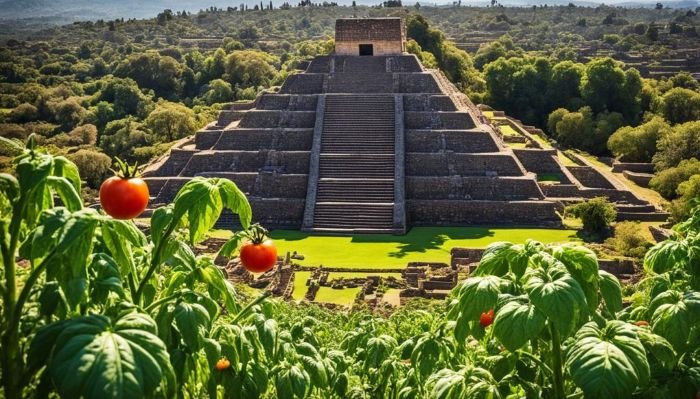
When Hernán Cortés reached Tenochtitlan in 1519, tomatoes were already a standard market commodity. Bernardino de Sahagún – a Franciscan friar who documented Aztec culture through systematic interviews with indigenous informants over several decades – recorded tomato sellers at the Tlatelolco market offering red, yellow, and small varieties alongside ground seeds, squash, and peppers. The tomato was embedded in Aztec cooking in ways archaeologists now recognize as precursors to modern Mexican cuisine.
The pairing of tomatoes with chili peppers – the combination that defines Mexican cooking – was ancient by the time Europeans arrived. Both plants grew in the same climatic zones, shared similar cultivation requirements, and were combined in sauces centuries before Spanish contact. Sahagún’s accounts describe a sauce of tomatoes, ground peppers, and pumpkin seeds used to dress fish and other proteins – a preparation structurally identical to what is now called salsa. The peppers carried their own nutritional and culinary weight in that combination, something the Aztecs had understood for generations before Europeans classified either plant.
What the Aztecs did not leave behind is written cultivation data in the modern agronomic sense. Our understanding of pre-Columbian tomato agriculture comes from Sahagún’s ethnographic records, archaeological residue analysis on pottery shards, and the genetic work of researchers like Harry Paris at the Agricultural Research Organization in Israel, who has traced domestication timelines through seed and fruit morphology studies. The picture is considerably clearer than it was thirty years ago, but the early cultivation history still has gaps that genetic sequencing is only beginning to fill.
Europe’s Two-Century Hesitation – Poison Plates and a Botanist Who Got It Half Right
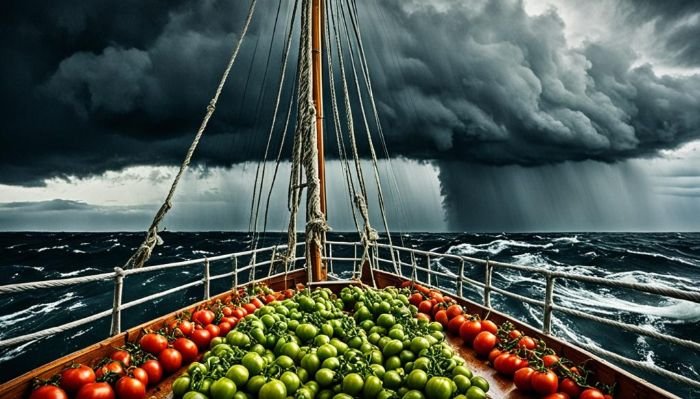
The tomato arrived in Spain and Portugal sometime between 1521 and 1540, carried by returning conquistadors. For roughly two centuries after that, European aristocrats grew it as an ornamental plant and left it largely uneaten. The reasons are worth examining because they were not entirely irrational.
| Year | Event |
|---|---|
| ~7000 BCE | Wild Solanum pimpinellifolium foraged in coastal Peru and Ecuador |
| ~500 BCE | Domestication begins in central Mexico |
| 1519 | Cortés records tomatoes at Tlatelolco market, Tenochtitlan |
| 1544 | Mattioli publishes first European botanical description |
| 1597 | Gerard’s Herball classifies tomatoes as dangerous in England |
| 1692 | Latini publishes first European tomato recipe in Naples |
| 1847 | Commercial tomato canning begins in New Jersey |
| 1893 | US Supreme Court rules tomato is legally a vegetable for tariff purposes |
| 2021 | FAO reports global production at 186 million metric tons |
The most documented cause of tomato-related illness in 16th and 17th century Europe was the pewter plate. Wealthy households ate from pewter – an alloy containing significant quantities of lead – and the acidity of raw tomatoes leached lead into the food. The symptoms that followed were attributed to the fruit, not the plate. Poorer households, who ate from wooden boards and earthenware, did not experience the same pattern, and they adopted tomatoes into their cooking considerably earlier. Andrew Smith, in his 1994 study “The Tomato in America,” identifies this plate-illness cycle as the primary mechanism behind aristocratic resistance in northern Europe.
Botanical fear compounded the social one. John Gerard, whose 1597 Herball was widely read in England, placed the tomato near mandrake and belladonna in his classification and advised against eating the fruit. Gerard was wrong about the ripe fruit – but he was not entirely wrong about the plant. Tomato leaves and stems contain tomatine, an alkaloid that causes genuine digestive distress in sufficient quantities. The nightshade family, which also includes bell peppers, potatoes, eggplant, and genuinely toxic plants like belladonna, carried a reputation that was not pure superstition. The family resemblance to dangerous plants was an accurate observation. The error was applying it to the ripe fruit.
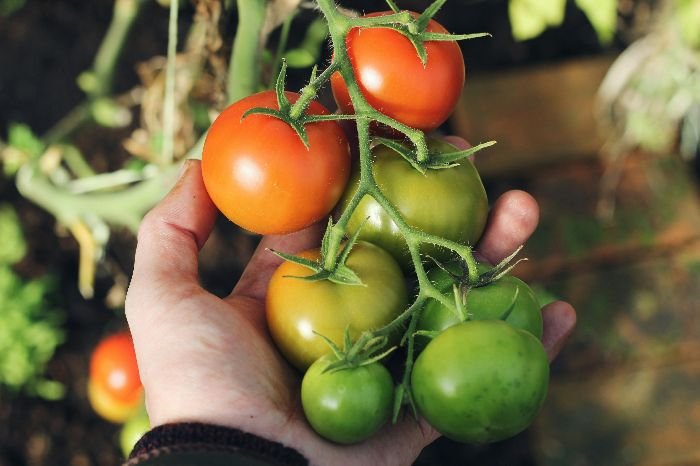
Pro Tip: Compost tomato foliage at the end of the season rather than leaving it accessible to chickens or small animals. Ripe tomato fruit is safe, but leaves contain tomatine at levels that cause real harm if consumed in volume.
If the poor adopted tomatoes before the wealthy – and the historical record suggests they did, consistently across Europe – that inverts the usual assumption about how culinary innovation moves through societies. Elite kitchens are often credited with driving food culture forward. The tomato’s history raises a harder question about where that dynamic actually breaks down.
The Mediterranean Breakthrough – When Italy and Spain Rewrote Their Kitchens
Spain adopted the tomato into everyday cooking by the early 1600s. Southern Italy followed within a generation, and the uptake was faster in the south than the north – a pattern that reflected geography more than culture. The Mediterranean growing season suited tomatoes in a way that central and northern European climates did not. A plant requiring long, hot summers was always going to find its first European home in Andalusia and Campania, not in England or the Low Countries.
The earliest Italian recipe incorporating tomatoes dates to 1692. Antonio Latini, who worked as a steward in a Naples household under Spanish Habsburg administration, included a tomato sauce in his culinary manual Lo Scalco alla Moderna and described it as “Spanish-style” – which tells us the preparation traveled from Iberia into southern Italy before Italian cooks reframed it as their own. This is not a trivial detail: it means Italian tomato cooking was already a hybrid tradition before it became canonical.
Tomatoes solidified their place in Italian cuisine through the 18th century. By the early 19th century, when pizza began to take its modern form in Naples, the tomato had been a kitchen staple for over a century. The Margherita pizza, supposedly created in 1889 for Queen Margherita of Savoy, arrived at the end of a two-hundred-year normalization process, not the beginning of one. The tomato on a Neapolitan pizza in 1889 was as unremarkable as olive oil.
Observation: I often notice that gardeners growing heirloom tomatoes for the first time are surprised by the color variation – yellow, purple, chocolate-brown, and green-when-ripe varieties feel exotic, but they reflect the genetic range that existed before 20th-century commercial breeding narrowed the supermarket selection to uniform red.
Global Spread After 1800 – How Trade Routes and Canning Built a Culinary Constant
From the Mediterranean, tomatoes moved along established colonial and commercial trade routes into West Africa, South Asia, and Southeast Asia, integrating into cooking traditions that now consume them at scales that make early European production look marginal. China is today the world’s largest tomato producer, accounting for roughly 35 percent of global output – a figure that would have been unimaginable to any 16th-century botanist describing a plant Europeans were still afraid to eat.
The FAO reported global tomato production at approximately 186 million metric tons in 2021. India, Turkey, and the United States follow China in the rankings. That distribution reflects both the tomato’s genuine adaptability and the scale of breeding work that produced varieties suited to radically different climates, soil types, and growing seasons. The number of registered tomato varieties globally now exceeds 10,000.
In North America, adoption was slower. Thomas Jefferson grew tomatoes at Monticello by 1809 and served them to guests, but public uptake lagged well behind Europe. The legal classification question reached the US Supreme Court in 1893: in Nix v. Hedden, a New York produce importer contested import duties by arguing tomatoes were botanically a fruit. The court agreed on the biology but ruled on culinary convention – served with the main course, not dessert, the tomato was legally a vegetable. That ruling still stands.
Commercial canning accelerated domestic adoption faster than any argument about botany or safety could. Harrison W. Crosse began commercial tomato canning in New Jersey in 1847, and by the 1880s, canned tomatoes were available year-round in urban markets at prices accessible to working households. The technology that made the tomato a permanent kitchen staple was not agriculture – it was preservation.
Where To Start
If you grow tomatoes at home and have never thought much about their origin, the growth stages your plants move through – from seed germination to fruit set – are physically unchanged from those wild Andean plants that nobody bothered to cultivate for millennia. Understanding that history does not change how you grow tomatoes, but it reframes the beefsteak or cherry tomato in your garden as the end result of a very long selection process that is still ongoing.
If you want to understand why certain heirloom varieties taste sharper, sweeter, or more complex than supermarket tomatoes, that variation traces back to the genetic diversity preserved in Mexican and Andean wild populations. Commercial breeding over the 20th century traded much of that range for uniform color, consistent size, and shelf stability. The flavor came second. Heirloom growing is, in a sense, a small reversal of that trade.
If you are ready to get something into the ground this season, the companion planting approaches that work well with tomatoes draw on combinations that have practical roots – including the traditional Mesoamerican pairings that Sahagún documented in the 1500s. The combinations were not arbitrary.
Conclusion
The tomato’s five-century journey from foraged Andean berry to global culinary staple is less a story of discovery than of resistance slowly worn down by circumstance. The plant survived two centuries of aristocratic European avoidance, arrived in global kitchens on the back of colonial trade rather than admiration, and became indispensable in cuisines that never knew it existed in 1500. Each of those turning points – Sahagún’s market records, the pewter plate mechanism, Latini’s Naples kitchen, the New Jersey canning operation – is specific enough to locate in time and place, which makes the overall trajectory harder to romanticize and easier to understand.
What the tomato’s history makes clear is that a plant’s culinary adoption depends less on its qualities and more on the conditions surrounding its introduction. Fear, poverty, geography, and a Supreme Court case all shaped the trajectory. At the end of a good growing season, when you cut into a ripe tomato and the smell hits before the taste, that moment carries about ten thousand years of selective pressure and five hundred years of cultural argument behind it.
FAQ
Where did tomatoes originally come from?
Wild tomatoes originated in coastal Peru and Ecuador, where Solanum pimpinellifolium grew without cultivation for thousands of years. Domestication – the point where humans began intentionally selecting and growing the plant – happened in central Mexico, likely between 500 BCE and 700 CE. The Nahuatl word tomatl, used by Aztec speakers in Mexico, became the root of the English word tomato, which is why linguists treat Mexico as the location of origin for the cultivated plant even though the wild ancestor grew further south.
Why did Europeans think tomatoes were poisonous?
The fear was partly grounded in real observation. The tomato belongs to the nightshade family, Solanaceae, whose members include genuinely toxic plants like belladonna and mandrake. Tomato leaves and stems do contain tomatine, an alkaloid that causes digestive distress. What botanists like John Gerard misidentified in 1597 was the ripe fruit, which is safe. The illnesses that reinforced European fears were largely caused by lead leaching from pewter plates reacting with the fruit’s acidity – the tomato was blamed for a problem caused by the dishware.
What is the Nahuatl word for tomato, and what did it mean?
The Nahuatl word is tomatl, which referred generally to round, fleshy fruits. Both the red tomato and the tomatillo carried related names in Nahuatl – xitomatl and tomatl respectively – reflecting their separate domestication histories. Spanish speakers transcribed the word as tomate, and it spread into Italian, French, English, and most European languages with minor phonetic changes. Tomatl is one of a small group of Nahuatl words – alongside chocolate, avocado, and chile – that entered global use directly from indigenous Mesoamerican languages during the 16th century.
Can you eat green tomatoes safely?
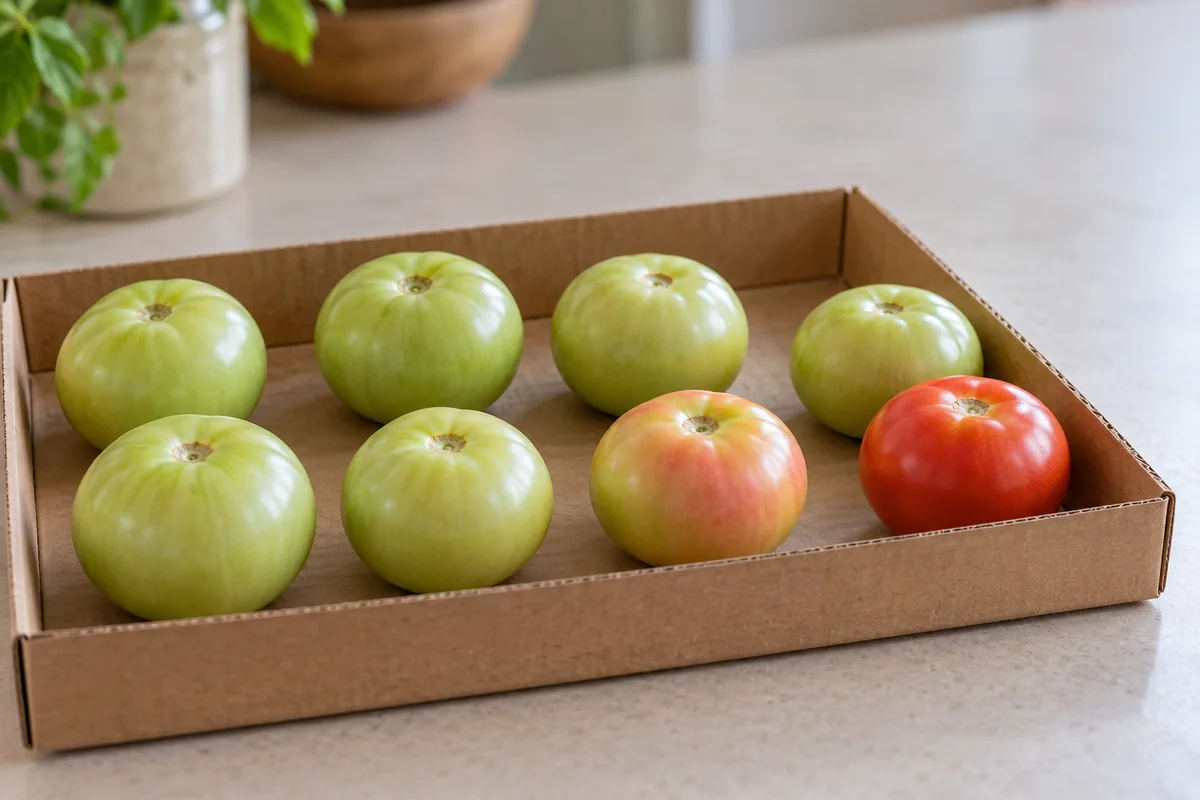
Ripe green-when-ripe varieties are fully safe. Unripe red tomatoes are a different matter – they contain tomatine at higher concentrations than ripe fruit, and consuming large quantities can cause nausea and digestive upset. Traditional preparations like fried green tomatoes use partially ripe fruit, and most people eat a small enough amount that the effect is minimal. The leaves and stems are a more serious concern and should not be eaten at any stage. The practical threshold for ripe fruit is not a concern for normal consumption, but the leaves are worth treating carefully around animals.
What happens if animals eat tomato plant leaves?
Tomatine in tomato foliage is toxic to dogs, cats, and horses in sufficient quantities, causing gastrointestinal symptoms and, in large doses, more serious cardiac effects. Chickens and goats have variable sensitivity. For home gardeners, the practical guidance is to compost tomato foliage away from areas where pets or livestock can access it, rather than leaving cut stems and leaves on the ground at the end of the season. The ripe fruit itself is not a concern for most animals in reasonable amounts.
When exactly did Italians start cooking with tomatoes?
The earliest documented Italian tomato recipe dates to 1692, in Antonio Latini’s Lo Scalco alla Moderna, written in Naples. Latini described a tomato sauce in the Spanish style, indicating the preparation came into southern Italy from Iberia rather than originating there. Casual kitchen adoption in southern Italy likely predates this written record by some years, but the 1692 text is the oldest surviving evidence. Northern Italy followed significantly later, with widespread adoption not occurring until the mid-1700s – roughly 150 years after the first European botanical descriptions of the plant.
Why are tomatoes legally classified as vegetables in the United States?
The classification came from the 1893 Supreme Court case Nix v. Hedden, in which a New York produce importer contested import tariffs by arguing that tomatoes were botanically fruits. The court agreed that tomatoes are botanically berries but ruled that the legal definition for trade purposes should follow culinary convention rather than biology. Since tomatoes are served as part of a savory meal rather than as dessert, the court classified them as vegetables for tariff purposes. The ruling was specific to import law and does not affect botanical classification, which still considers the tomato a berry.
Which country produces the most tomatoes today?
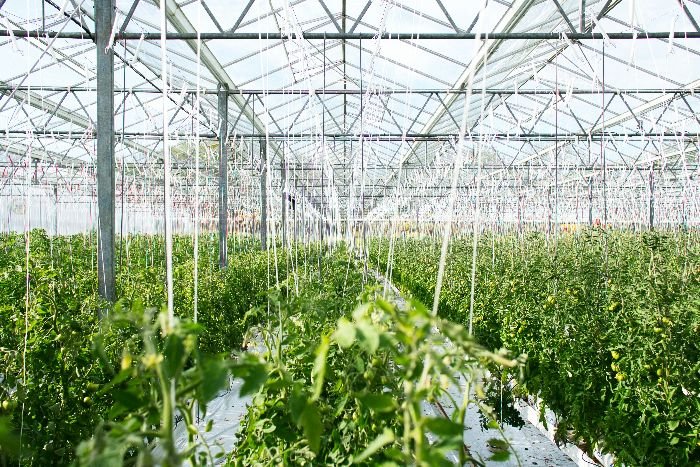
China produces roughly 35 percent of the world’s tomatoes, making it by far the largest producer. India, Turkey, and the United States follow at a distance. FAO data from 2021 puts global tomato production at approximately 186 million metric tons annually, making the tomato the most produced vegetable in the world by weight. This concentration in China reflects both the adaptability of modern tomato varieties and the scale of controlled-environment agriculture – including large-scale greenhouse operations – that has expanded dramatically over the past thirty years.