




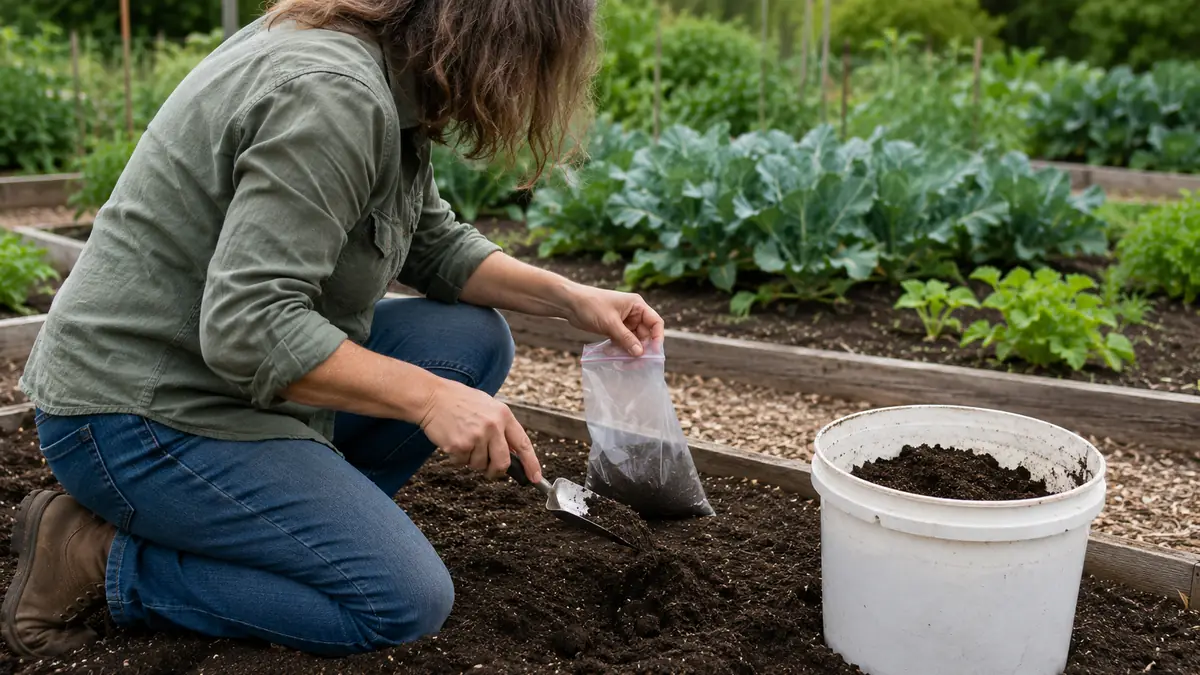
Garden soil can look poor for several different reasons. Yellow leaves, weak seedlings, slow fruiting, crusted soil, and stunted roots may point toward low nutrients, pH trouble, compaction, wet soil, dry soil, or a crop that was planted into the wrong condition. A soil test helps separate chemistry from texture and watering problems before amendments go into the bed.
Most garden beds need some kind of care, but the first correction matters. Compost can help structure, fertilizer can replace nutrients, lime can raise pH, sulfur can lower pH, and better bed preparation can open the root zone. Those moves should not be chosen from leaf color alone.
A soil test is most valuable when the next amendment could change chemistry. It gives a baseline for pH, organic matter, phosphorus, potassium, and other report categories, depending on the lab. That baseline keeps a garden from being amended repeatedly in the wrong direction.
Key Takeaways
- Test before adding lime, sulfur, phosphorus, potassium, micronutrients, or repeated manure-based compost.
- Symptoms can point toward stress, but pH, moisture, roots, salts, and drainage decide whether the symptom is a nutrient problem.
- A useful soil sample keeps normal bed soil separate from unusual spots, recent amendment pockets, and problem zones.
- pH affects nutrient availability, so fertilizer can fail when the root zone cannot take up what is already present.
- The report should guide restraint as much as action; a high nutrient reading can mean stop adding, not add more.
Table of Contents
Quick Soil Test Decision Table
Start with the decision the bed is asking for. Some soil problems can be handled with physical preparation and compost. Other problems need a report before lime, sulfur, fertilizer, or manure-based compost changes the chemistry further.
| If the garden shows | First check | Best next move | Avoid |
|---|---|---|---|
| Pale leaves across several crops | pH, root health, moisture, and nutrient levels. | Test before adding fertilizer or lime. | Assuming all yellowing means nitrogen shortage. |
| New bed with unknown fill or past treatment | pH, organic matter, phosphorus, potassium, and possible salt or contamination risk. | Test before planting heavy feeders. | Dark soil is automatically balanced soil. |
| Hard clods, crusting, or poor water entry | Texture, compaction, and soil moisture at working time. | Improve structure and bed preparation; test if growth problems continue. | Chemical amendment will fix a physical root barrier. |
| Repeated poor growth after compost or fertilizer | pH, nutrient excess, drainage, and amendment history. | Test before adding another rich material. | More amendment is safer than waiting. |
| Acid-loving or pH-sensitive crops are planned | Soil pH and lab recommendation. | Use the report before changing pH. | A home symptom check can set lime or sulfur rates. |
When a Soil Test Is Worth Doing
Test before chemistry changes
A soil test is worth doing before a new garden bed, before major amendment spending, before pH correction, after repeated crop failure, and in beds with a history of heavy compost, manure, fertilizer, or unknown fill. It is also useful when several crops show the same stress even though watering and drainage look reasonable.
A basic lab test can report categories such as pH, organic matter, phosphorus, potassium, and texture estimate. The exact categories vary by lab. A garden soil test can include soil texture estimate, pH, organic matter, phosphorus, and potassium. Those categories help decide whether the next move is compost, fertilizer, lime, sulfur, or restraint.
Time the test before the bed is already committed
Testing works best when there is still time to act on the report. A new bed should be tested before planting if soil history is unclear. An established bed can be tested before a major amendment cycle, after repeated poor growth, or after a correction has had time to settle. Fall testing can leave more time for pH-related corrections, while spring testing can still help prevent last-minute fertilizer or compost overuse. Fall testing is especially useful when lime, sulfur, or long-settling amendment decisions may need time before spring planting.
Testing is less urgent when a productive bed only needs a seasonal compost layer and no chemistry correction is planned. In that case, visible structure, crop response, and a modest organic matter routine may be enough. Once lime, sulfur, phosphorus, potassium, or repeated manure-based compost enters the decision, testing becomes the cleaner path.
Long-term soil health improvement still depends on organic matter, root access, water movement, and biological activity. The test does not replace those field checks. It adds the chemistry layer that the eye cannot read reliably.
How to Take a Useful Soil Sample
Sample the bed you actually want to manage
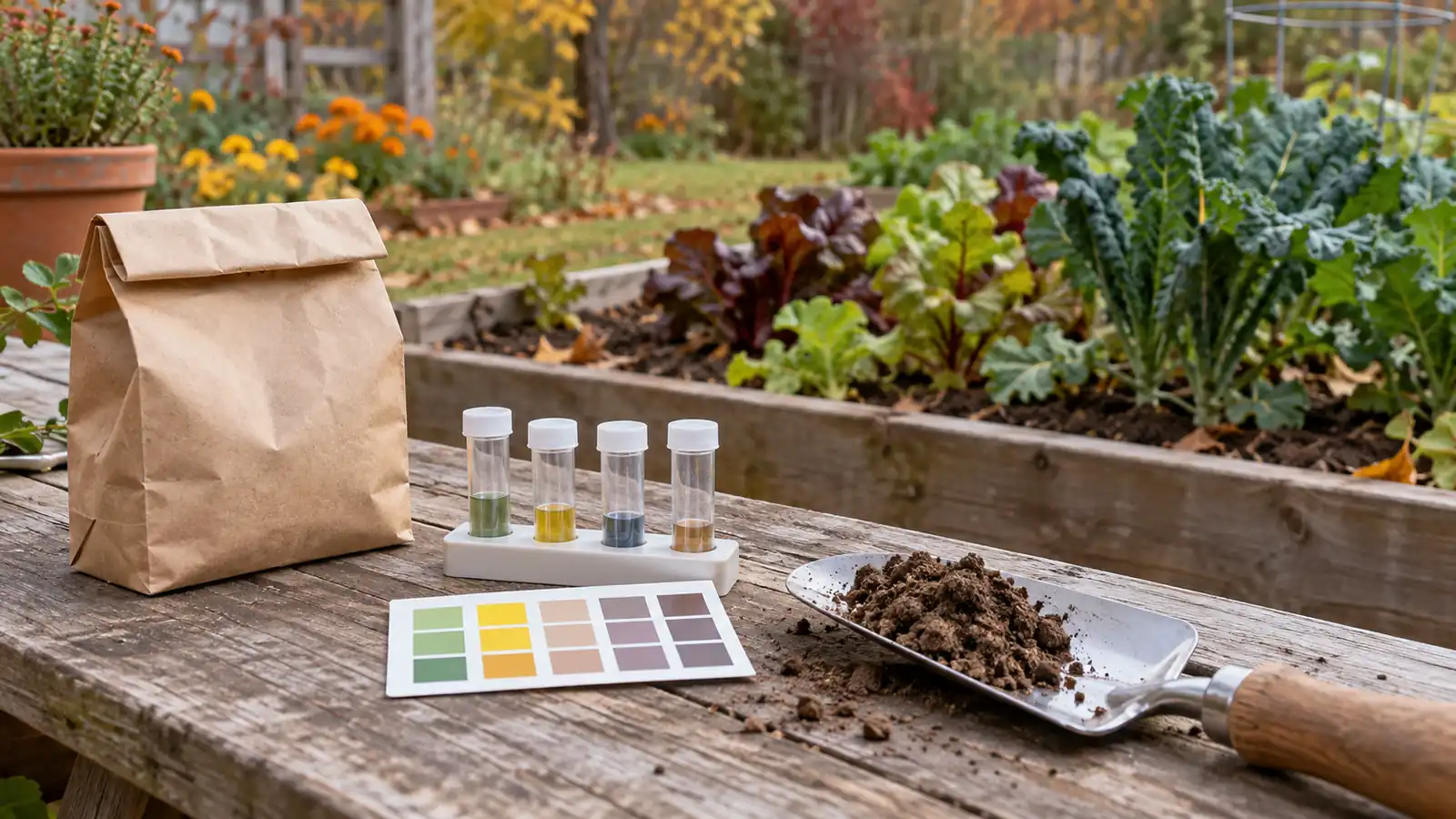
A soil test is only as useful as the sample. A scoop from one corner can miss the rest of the bed. A sample mixed from several spots gives the lab a better picture of the growing area. Keep unusual spots separate: a compost pile edge, burned area, wet low pocket, or former fertilizer spill can distort the result if it is mixed into the main sample.
For a vegetable bed, collect small cores from several evenly spaced points in the rooting area, keep unusual spots separate, mix the normal-bed cores in a clean container, remove stones and plant debris, and send the amount the lab requests. Soil testing supports informed fertilizer and soil amendment choices because it connects pH and nutrient analysis to the bed being tested.
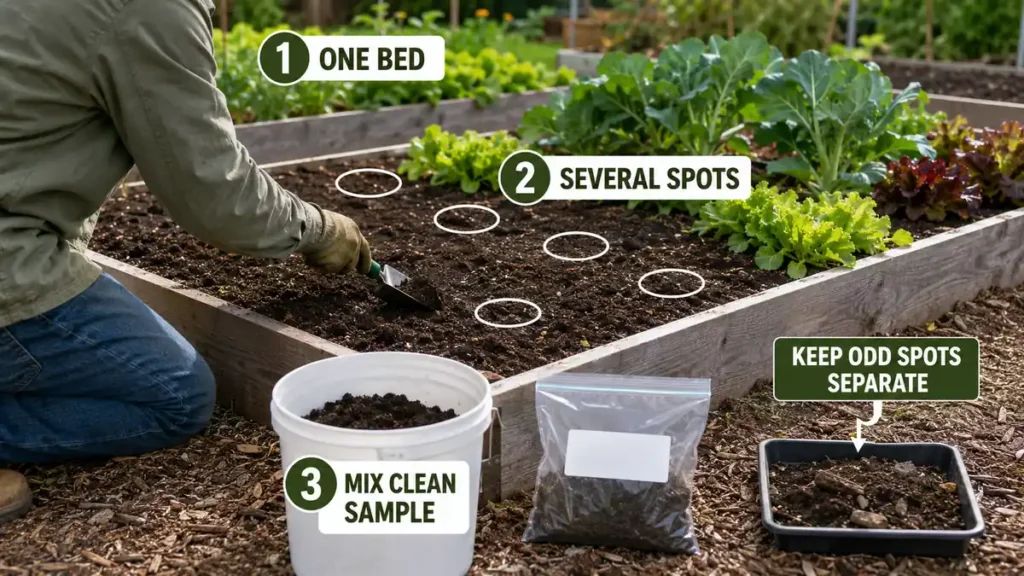
Basic garden soil sampling sequence
- Choose one bed or management area at a time.
- Keep unusual spots separate from the normal bed sample.
- Collect several small cores from evenly spaced points in the rooting area.
- Mix only the normal-bed cores in a clean bucket.
- Remove mulch, fresh compost pockets, fertilizer granules, roots, stones, and debris.
- Label the sample with bed name, crop area, and recent amendment history.
- Send the amount and container type requested by the lab.
Keep recent amendments out of the mixed sample
Use clean tools, a clean bucket, and the lab’s own bag or container when it provides one. Keep mulch, fresh compost pockets, fertilizer granules, roots, stones, and plant debris out of the mixed sample. Separate beds with different histories, crops, drainage, or amendment use should be sampled separately because one mixed report can hide the problem area.
If one part of the garden is failing while the rest grows well, sample it separately. A problem-zone sample can show whether that corner has a pH, salt, nutrient, or drainage-related pattern that would disappear inside a whole-bed mix. Label each sample with the crop area and recent amendment history before sending it out.
Sample timing matters. Testing before planting gives time for pH and amendment decisions to happen before roots are already stressed. Testing after a heavy compost or fertilizer application may show the effect of that recent input rather than the baseline the bed had before it was changed.
How pH Affects Nutrient Availability
pH can block uptake even when nutrients are present
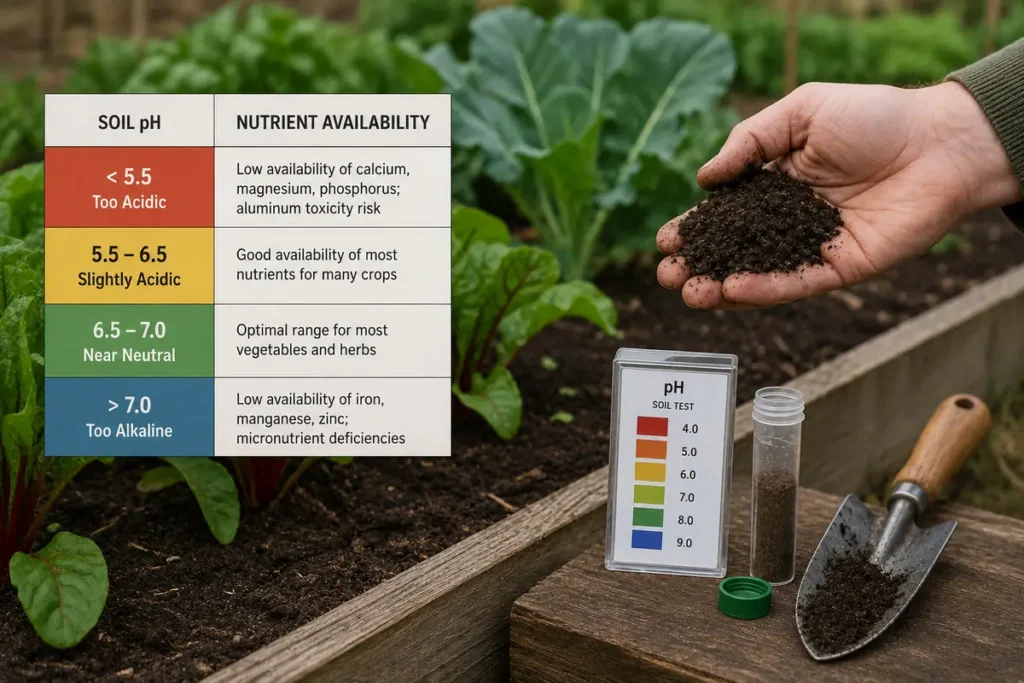
Soil pH changes how available nutrients are to roots. A nutrient can be present in the soil and still be hard for a plant to use when pH is outside the crop’s working range. That is why weak growth does not always mean the bed needs more fertilizer.
Low pH can affect calcium, magnesium, phosphorus, and microbial activity. High pH can make iron, manganese, and some other micronutrients less available to plants. The exact correction depends on the crop, soil type, and lab method. Soil pH is a major soil-test category because it influences nutrient availability, nutrient uptake, microorganism activity, and organic matter breakdown.
pH correction should follow the crop and report
Most vegetable beds perform best in a slightly acidic to near-neutral range, but crop needs differ. Blueberries, brassicas, tomatoes, herbs, and flowers do not all use the same pH target. The soil report and crop plan should guide correction, especially where lime or sulfur is involved.
Why Symptoms Are Not Enough Evidence
One symptom can have several causes
Leaf symptoms are useful signals, but they are weak evidence by themselves. Yellowing can come from low nitrogen, cold soil, saturated roots, dry roots, high pH, low pH, disease, transplant shock, or damaged roots. Purple leaves can point toward phosphorus trouble, but they can also appear when roots are cold and uptake slows. Leaf curl can come from heat, water stress, pests, herbicide exposure, or root damage.
Repeated symptoms across crops deserve a soil baseline
That is why the first check should pair the symptom with soil condition. Look at the pattern across crops, the age of the leaves, recent weather, root condition, bed moisture, and amendment history. If several unrelated crops show the same stress, or if the bed has been amended repeatedly, the soil test becomes more useful than another quick feed.
A nutrient correction still belongs in the larger plant-care picture. Fertilizer basics for gardeners help after the report points toward a nutrient need, while soil structure, drainage, and root health decide whether the plant can use that nutrient.
Soil Test Interpretation Table
Read the report as action and restraint
The report should be read as a decision map, not a shopping list. Each result category answers a different question. Some categories call for action. Others tell you to avoid adding more.
The highest-risk amendment decisions are pH changes, phosphorus additions, potassium correction, micronutrients, and repeated manure-based compost. Those inputs should follow the report because they can shift chemistry or build up beyond the crop’s need.
| Report result type | What it tells you | Next decision | Risk to avoid |
|---|---|---|---|
| Soil pH | Whether the soil is too acidic, near target, or too alkaline for the crop plan. | Follow lab guidance before adding lime or sulfur. | Changing pH from symptoms alone. |
| Buffer pH or lime requirement | How strongly the soil resists pH change, when the lab reports it. | Use the report rate rather than a general lime amount. | Applying the same lime rate to every bed. |
| Organic matter | How much decomposed organic material is part of the mineral soil. | Add compost or organic matter if structure and crop response support it. | Using organic matter percentage as the only soil-health measure. |
| Phosphorus | Whether phosphorus is low, adequate, or already high by that lab’s method. | Add phosphorus only when the report and crop need support it. | Adding bone meal or manure-based compost to soil that is already high. |
| Potassium | Whether the bed has enough potassium for growth, water regulation, and fruiting demand. | Correct based on the report and the crop being grown. | Assuming poor fruiting always means potassium shortage. |
| Soluble salts or electrical conductivity | Whether salts may be stressing roots, when the lab includes this measure. | Reduce salty inputs and improve leaching or drainage where appropriate. | Adding more fertilizer to roots already under salt stress. |
| Micronutrients | Whether trace elements may limit growth or become less available because of pH. | Use crop-specific and lab-specific guidance before applying micronutrients. | Spraying or adding trace elements without knowing pH context. |
Soil test reports commonly include pH, phosphorus, potassium, magnesium, calcium, organic matter, and fertilizer or lime recommendations. The report is useful because it connects those categories to a recommendation instead of leaving the gardener to choose amendments from symptoms.
How to Choose Amendments After a Soil Test
A soil test does not choose every garden task for you. It shows which chemistry changes are justified, which inputs should stop, and which problems still belong to soil structure, drainage, watering, or root access. Use the report with the bed condition, crop plan, and amendment history before adding anything that can build up or shift pH.
| Report or bed condition | Likely amendment direction | When to avoid it | What to check next |
|---|---|---|---|
| Low pH with a lab lime recommendation | Use lime according to the report. | Avoid lime if pH is already near or above the crop range. | Crop pH target and buffer pH or lime requirement. |
| High pH with micronutrient symptoms | Follow lab-specific guidance before using sulfur or micronutrients. | Avoid treating yellow leaves as a simple fertilizer shortage. | Iron availability, drainage, crop sensitivity, and local soil type. |
| Low phosphorus | Add phosphorus only if the report and crop need support it. | Avoid bone meal or manure-based compost when phosphorus is adequate or high. | Soil pH, crop stage, and existing compost history. |
| High phosphorus | Stop phosphorus-heavy inputs. | Avoid manure-based compost and balanced fertilizers with phosphorus. | Fertilizer label, compost source, and runoff risk. |
| Low organic matter with good drainage | Add finished compost or plant-based organic matter gradually. | Avoid using compost as a substitute for fertilizer when the report shows a specific shortage. | Soil texture, moisture behavior, and crop demand. |
| Poor water entry or compaction | Improve structure, root access, and timing before chemical correction. | Avoid lime, sulfur, or fertilizer as a fix for sealed soil. | Moisture at working time, drainage, and root depth. |
The amendment choice should follow both the report and the physical bed. A low nutrient result may call for correction, but sealed soil, saturated roots, or poor water entry can still prevent the crop from using that correction well.
Which Amendments Need Test Results First
Inputs that can build up need proof first
Lime, sulfur, phosphorus fertilizer, potassium fertilizer, micronutrients, and repeated manure-based compost should be test-led. These inputs can change chemistry or build up over time. Compost made from plant material is usually gentler, but even compost can add nutrients when applied heavily year after year.
Texture problems still need field checks
Texture improvements need both field observation and report context. Compacted clay needs structure protection and organic matter, but pH or nutrient corrections still need a test. Sandy soil may need organic matter and mulch for moisture, but repeated fertilizer can move beyond roots if watering and texture are not managed.
If a bed has already been overfed, the safer move is to stop the input and read the report before adding more. Recovery from overfertilized garden soil depends on knowing whether the root zone is dealing with excess salts, excess nutrients, poor drainage, or another stress.
How to Act on the Report Without Overcorrecting
Start with the biggest constraint. If pH is far from the crop’s range, fix the pH path before chasing small nutrient differences. If phosphorus is already high, avoid phosphorus-heavy amendments even if the bed looks tired. If potassium is low and the crop is a heavy fruiter, the correction may matter more than another general compost layer.
Apply amendments in the form and amount the report supports. Then give the bed time to respond. Lime and sulfur do not behave like instant plant food. Organic matter changes structure over repeated wetting, drying, root growth, and microbial work. Fertilizer can feed a crop, but it cannot open compacted soil.
Keep notes after the correction. Record the date, amendment, amount, crop response, and weather. Future soil management for garden beds gets easier when the next soil test can be compared to what actually happened in the bed.
Conclusion
Testing garden soil before amending protects the bed from the wrong correction. Symptoms can point toward trouble, but they cannot separate pH, nutrient shortage, excess fertilizer, water stress, compaction, and root damage by themselves. A soil test adds the chemistry layer that the eye cannot see.
The best amendment plan starts with the bed’s visible condition, then uses the report to decide which inputs belong. Compost supports structure and soil life. Fertilizer replaces nutrients when the report and crop need support it. Lime and sulfur belong under test guidance. That order keeps the garden moving toward better soil instead of another cycle of overcorrection.
FAQ
Should I test garden soil before adding compost?
A modest compost layer for structure may not need a test every time. A test becomes more useful when the bed has received years of compost, manure, or fertilizer, or when the next step could change pH or nutrient levels.
How often should garden soil be tested?
Many home gardens benefit from periodic testing every few years, with faster retesting after major corrections, new bed creation, repeated crop failure, or heavy amendment history. The best interval depends on local soil type, crop intensity, amendment history, and whether the last correction changed pH or nutrient levels.
Can a home pH kit replace a lab soil test?
A home pH kit can give a rough pH reading, but it usually does not replace a lab report for nutrient levels, organic matter, lime requirement, or full amendment recommendations. Use a lab when the correction involves fertilizer, lime, sulfur, or repeated crop failure.
Where can I get garden soil tested?
Garden soil can usually be tested through a local extension office, university soil lab, private lab, or mail-in soil testing service. Choose a lab report when amendment decisions involve lime, sulfur, phosphorus, potassium, micronutrients, or repeated crop failure. Home kits can help with rough pH checks, but they usually do not replace lab guidance for nutrient and amendment decisions.
What soil pH is best for vegetables?
Many vegetables grow well in slightly acidic to near-neutral soil, but the right target depends on the crop and local soil. Follow the crop plan and lab recommendation instead of using one pH number for every bed.
Can yellow leaves mean the soil needs fertilizer?
They can, but yellow leaves can also come from wet roots, dry roots, cold soil, pH problems, disease, transplant shock, or nutrient excess. Check the pattern, roots, moisture, and soil test before feeding repeatedly.
Should I add lime every year?
No. Lime should follow soil pH and lab guidance. Adding lime without a test can push pH too high and make some nutrients harder for plants to use.