Last Updated July 22, 2026
Onion development stages follow a precise biological sequence, and the decisions you make at each step either compound or cancel each other by harvest time. What sets onions apart from most vegetables is that every phase builds something inside the bulb you cannot yet see – more rings, more layers, more mass. A bed of onions in midsummer looks like a waiting game. It is not. Bulb size is already being determined, leaf by leaf, ring by ring, in the vegetative weeks before any swelling appears at the soil surface. Understanding the mechanism behind each stage changes how you read your plants: what the early leaves are doing, when the photoperiod switch fires, and what the falling tops are actually telling you about the right moment to pull.
Onion Growth Stages At A Glance
Time to harvest: Most onions need 90 to 120 days from transplant to harvest. Seed-grown onions need another 8 to 10 weeks before transplant, while curing adds 2 to 4 weeks after harvest.
Across the onion plant growth stages, leaf count sets the bulb’s potential, day length starts bulbing, and neck condition determines the harvest window. These onion growing stages follow biological triggers rather than a single calendar.
Key Takeaways:
- Each leaf produced in the vegetative stage becomes one ring inside the bulb – neglect early growth and the rings are thin at harvest
- Choose your onion variety by latitude before anything else – planting a long-day type below 37°N prevents bulb formation regardless of care
- Harvest when 30-40% of tops have fallen, not when all are down – earlier pull means longer storage life
- Plants thicker than a pencil at transplant time are at risk of bolting if temperatures drop below 50°F for more than two weeks
- Curing completes the outer skin – the outermost layers finish forming during the first week of cure, not in the field
Table of Contents
Germination and Root Establishment – The Foundation You Cannot See
Onion seeds germinate in 7 to 10 days at soil temperatures between 65°F and 77°F. Below 50°F, germination stalls. Above 85°F, it fails. The shoot emerges as a loop – a curved first leaf that straightens and pulls the seed coat free as it rises. That hook shape is normal and resolves within a day or two.
What happens underground during this window matters more than most gardeners anticipate. Onions develop shallow, sparsely branched roots with most activity concentrated in the top 12 inches of soil, according to Dixondale Farms’ root development research. The root system never becomes extensive the way a tomato’s does. Surface crusting from rain or overhead irrigation immediately restricts water uptake because onion roots cannot push through compacted surface soil the way tap-rooted vegetables can. Consistent shallow watering at 1 inch per week works because it targets the zone where the roots actually are.
Phosphorus availability is critical here. Onions are more phosphorus-sensitive than most vegetables, particularly in cold soils where uptake slows even when phosphorus is present in adequate amounts. A half-strength liquid fertilizer with phosphorus in the first two weeks after germination reduces transplant shock later and supports the root establishment the plant draws on through every subsequent stage.
Seeds vs. Sets vs. Transplants
Seeds offer the widest variety selection and a clean developmental start, but add 8 to 10 weeks of indoor growth before the field timeline begins. Sets reach soil faster but carry a bolting risk when the bulbs were oversized at cure. Transplants split the difference – the most predictable for timing and the easiest to match to the correct planting window by region.
Vegetative Growth – Every Leaf Is a Future Ring
Here is the fact that changes how you think about this stage: every leaf an onion produces in the vegetative phase becomes one concentric ring inside the finished bulb. A plant that grows 10 healthy leaves will have 10 rings at harvest. A plant that grew 10 leaves but lost two early ones to drought, crowding, or nitrogen shortage will have thinner, tighter rings on those layers. The leaf you neglect above ground is the ring you shortchange below it.
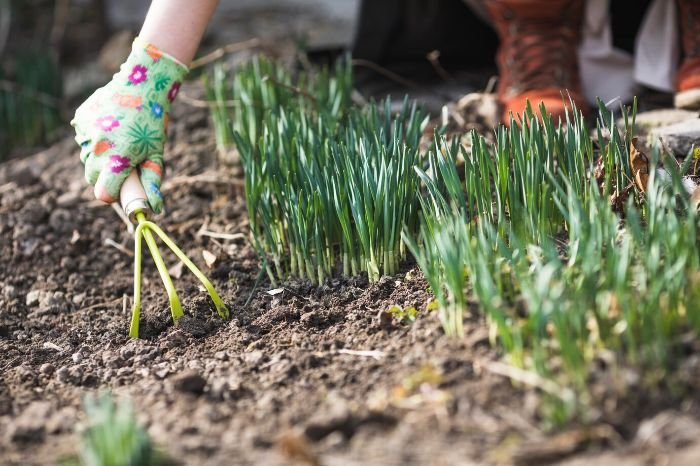
This stage runs from the first true leaves until bulb initiation – typically 60 to 80 days from transplant. NC State Extension describes the vegetative phase as the period when the number of leaves formed determines the potential size of the bulb, with each leaf sheath eventually thickening into a scale. Leaf count is the ceiling on bulb size, set before bulbing even begins.
Nitrogen feeds this phase. A balanced fertilizer at transplant, shifting toward moderate nitrogen at the midpoint, keeps leaf production steady. Yara’s crop nutrition data shows onions have their highest nitrogen uptake rate in the six weeks before bulbing begins. Sulfur also matters during this window – it directly influences the flavor compounds that distinguish a well-developed storage onion from a bland one.
Observation: I often notice that onion plants transplanted too shallow – with the root-to-shoot junction sitting above soil level – produce fewer leaves in this stage. Setting the base just at or slightly below the soil surface lets the plant anchor faster and maintain the vegetative momentum it needs in the first few weeks.
Spacing at 4 to 6 inches between plants keeps competition manageable and opens the bed for companion plantings that reduce pest pressure without disrupting root zones. Crowded onions compete for nitrogen and light, truncating leaf production – and truncated leaves mean fewer rings.
Does the number of leaves at transplant time actually predict final yield? Research from multiple extension services says yes – more leaves at transplant means a meaningful head start in the ring-building process the bulb depends on. The same leaf-area principle operates across vegetable growth broadly, but onions make it unusually legible because you can count the outcome at harvest.
Bulb Initiation – Photoperiod, Latitude, and the Switch That Cannot Be Faked
Bulb initiation is the most misunderstood stage in onion development. The plant does not begin bulbing when it reaches a certain size or age. It bulbs when day length crosses a variety-specific threshold – and no amount of fertilizer, watering, or warmth substitutes for that trigger.
The standard classification covers three categories. Short-day varieties initiate at 10 to 12 hours of daylight, suited to latitudes below 35°N. Long-day varieties need 14 or more hours, which only northern latitudes reach in spring. Intermediate varieties initiate at 12 to 14 hours, which makes them the right choice for the 35 to 40 degree latitude band that neither extreme fits.
| Type | Day Length Needed | Best Latitude Range | Example Varieties |
|---|---|---|---|
| Short-day | 10-12 hours | Below 35°N | Texas Grano, Vidalia, Southern Belle |
| Intermediate | 12-14 hours | 35-40°N | Candy, Super Star, Expression |
| Long-day | 14+ hours | Above 40°N | Walla Walla, Copra, Yellow Sweet Spanish |
Johnny Seeds notes in their grower resources that daylength adaptation falls on a continuum with overlap, not distinct boundaries. Gardeners in the 32-37 degree latitude band – North Carolina, Tennessee, Arkansas, New Mexico – often plant long-day varieties based on a broad “cool climate” assumption, then find the bulbs never size up. That latitude needs intermediate types. The Johnny Seeds latitude-daylength map is the clearest public resource for matching variety to location before ordering seed.
What physically happens at the initiation moment is more interesting than most guides describe. When day length reaches threshold, the growing point stops producing new leaf initials. The bases of existing leaves begin accumulating sugars. The leaf sheaths start swelling laterally. The bulb is not a new structure – it is a swollen leaf base, and the plant has been building the raw material all season. The threshold moment is when it starts depositing resources there instead of into new growth.
The Bolting Risk Window
Bolting – a seed stalk instead of a bulb – happens when the plant reads a cold period as “winter has passed” and shifts into year-two reproductive mode. Onions that experience two or more weeks below 50°F while their stem diameter exceeds pencil width undergo vernalization. WSU Extension identifies this stem diameter as the key variable: small transplants tolerate cold without bolting; larger ones do not. Get transplants in the ground before they reach pencil thickness, and time the field date to avoid extended cold after establishment.
Bulb Enlargement and Maturation – What the Final Six Weeks Determine
Once bulbing begins, the plant redirects everything – water, sugars, mineral nutrients – into the swelling scales. This phase runs 4 to 8 weeks depending on variety and conditions. Bulb size is now a function of how many leaves were built in the vegetative stage and how efficiently the plant can move resources into them.
Nitrogen should drop off now. Continued high nitrogen after initiation pushes vegetative growth instead of bulb fill. Potassium becomes the primary driver, supporting sugar transport and skin development. Onions are 89 percent water by weight at harvest, and drought stress specifically during bulb enlargement causes splitting and irregular lobing – the outer scales cannot accommodate the inner ones pushing out faster than the wrapper allows. Consistent irrigation prevents this; deep periodic soaking does not.
During the final week or two, the outermost leaves die back naturally. That process is not loss. Those leaves are becoming the dry papery skin of the finished bulb. Each outermost leaf papers over its scale as it desiccates, locking in what was built during vegetative growth. The smell of drying onion skin on a warm July afternoon is one of the clearest seasonal markers in the growing year – and a sign the bulb is doing exactly what it should.
Pro Tip: Stop all irrigation 2 weeks before your estimated harvest date. The soil drawdown firms the outer wrapper layers and reduces surface moisture that encourages rot in storage. Onions harvested from dry soil have noticeably tighter, more papery skins than those pulled from irrigated beds.
Reading Harvest Signals – Two Tests Beat One Visual Rule
The instruction to wait for tops to fall is standard and imprecise. When all tops have fallen, the optimal harvest window for storage has passed. UMass Extension specifies that onions intended for long storage should come out of the ground when 30 to 40 percent of tops have naturally bent – not when the last one goes down.
The neck-pinch test is more reliable than visual observation alone. Squeeze the constricted area just above the bulb. A firm, slightly papery neck means the connection between leaf and bulb is closing off and the bulb is beginning to seal. A soft, pliable neck means that process is not complete – the bulb will store poorly if pulled now.
For fresh eating, earlier pull is fine and gives you larger bulbs. For storage onions, the target is firm neck and 30-40 percent tops down. The tradeoff is real: waiting for every top to fall produces larger bulbs with shorter shelf life. Pulling at the right signal produces slightly smaller bulbs that hold through winter.
Curing – The Development Stage That Continues After You Pull the Bulb
Curing is not storage preparation. It is the final stage of onion development.
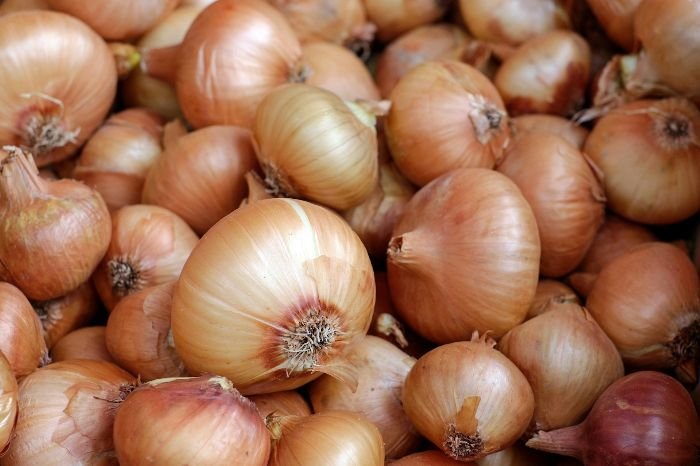
At harvest, the outermost skin layers have not finished forming. The dying outer leaves are still transitioning into the papery wrapper that protects the bulb. Curing gives that biological process time to complete. The skin tightens, dries, and seals the neck. A bulb moved to storage without proper curing lacks this seal – moisture escapes faster, and the opening at the neck stays accessible to mold and bacteria.
The compounds concentrated in those outer layers – quercetin, organosulfur compounds, and other antioxidants – are also what gets preserved or lost depending on how carefully this final stage is handled. Proper skin formation protects both the nutritional value and flavor developed over the entire growing season.
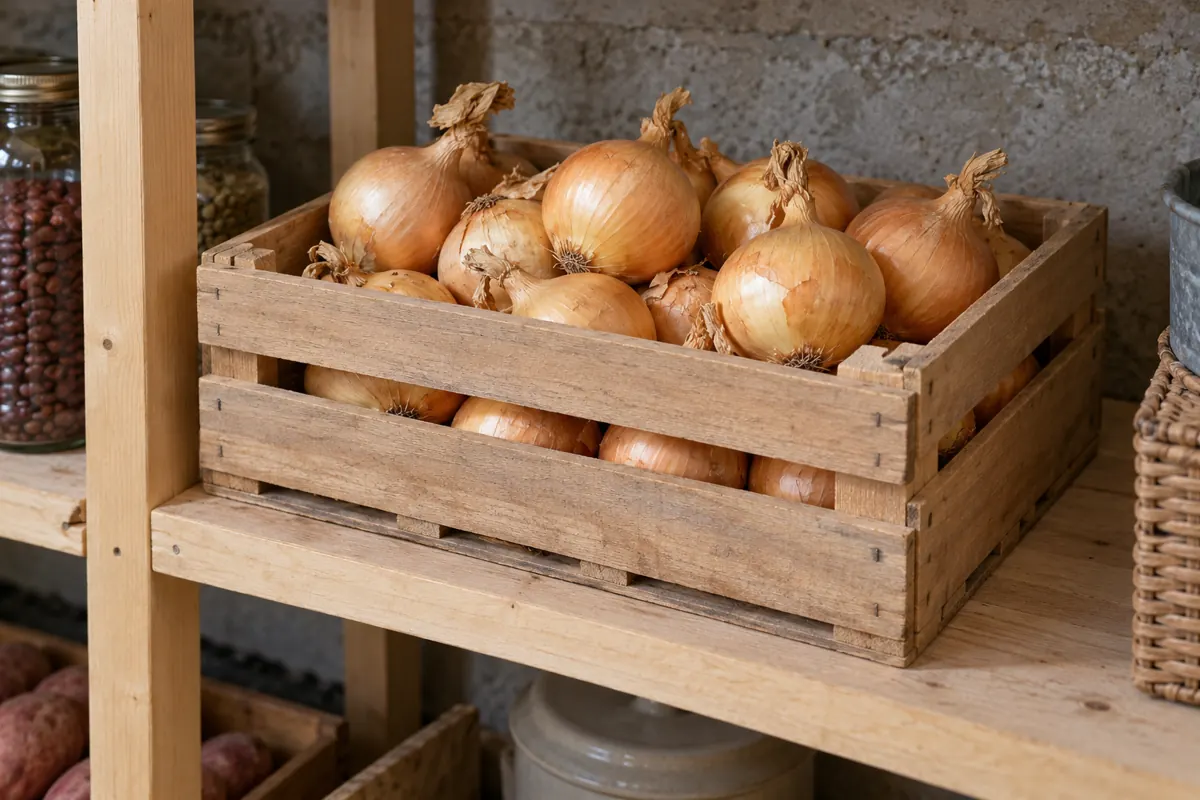
Two to four weeks at 75°F to 85°F with good airflow is the standard range. A garage floor with a box fan works. Keep direct sunlight off the bulbs during curing – it bleaches the skins and encourages soft rot. The neck should feel completely paper-dry before you clip tops to 1 inch and move bulbs to long-term storage. Any softening during the cure period means use those bulbs immediately. Well-cured onions store 6 to 8 months. Onions moved to storage too soon store 4 to 6 weeks.
Why Grow Onions?
Following the bulb onion growth stages through curing gives you more than a larger harvest. Properly cured bulbs stay in kitchen rotation for months, while red and yellow onions contribute quercetin, organosulfur compounds, fiber, vitamin C, and potassium. Red onions also supply anthocyanins.
Keep the clean fleshy outer layers when preparing them because onion flavonoids are more concentrated toward the outside. The advantage of growing onions is practical rather than medicinal: you control the variety, harvest timing, cure, and storage without turning a useful food into a health treatment claim.
When Development Goes Wrong – Tracing Failures Back to Their Stage
Most onion problems visible at harvest started two or three stages earlier. Knowing which stage is responsible tells you where to intervene next season rather than adjusting at the symptom level.
Small bulbs with many thin rings point to a truncated vegetative stage. Low nitrogen, crowded spacing, or shallow transplanting cut the leaf-building phase short before initiation fired.
Double bulbs form from two different causes that look similar at harvest. Cold shock at transplant – or planting oversized sets – can divide the growing point before the plant reaches the initiation threshold. Variety mismatch for latitude produces the same appearance through a different mechanism. Both are pre-initiation failures with different fixes.
Split lobes and cracked scales are a bulb-enlargement failure. Drought stress during active scale expansion causes the outer wrapper to crack as the inner ones push out faster. Consistent moisture in the final 4 to 6 weeks before harvest prevents this.
Seed stalks instead of bulbs signal bolting from vernalization – plants past pencil-width when temperatures dropped below 50°F for an extended period. Earlier planting or smaller transplants address this for next season.
No bulb formation at all, despite healthy plants, almost always means variety mismatch. A long-day onion in Georgia will grow beautiful leaves all season without ever bulbing. Garlic follows the same stage-to-failure logic in how vernalization and variety selection interact – if you grow both bulb crops, the garlic growth stages article covers how the same diagnostic pattern applies to clove-forming crops.
Conclusion
Onion development runs on a tighter internal logic than most garden vegetables. Each phase feeds the next, and each failure has a stage address – not a general “something went wrong” conclusion.
The leaf-to-ring relationship is the mechanism worth holding onto. Every time you water on schedule, thin to correct spacing, or choose the right variety for your latitude, you are adding a ring to a bulb that will not be visible for months. By the time that ring appears at harvest – firm, dry, golden-skinned, smelling faintly of a summer already past – the stage that built it is long gone. Which is exactly why the vegetative phase, the one that looks most like waiting, is the one that sets the ceiling on everything that follows.
FAQ
What triggers onion bulb formation?
Day length is the trigger, not plant age or size. When daylight hours reach a variety-specific threshold – below 12 for short-day types, 12-14 for intermediate, above 14 for long-day – the growing point stops producing new leaves and the plant redirects resources into swelling the existing leaf bases. Temperature, fertilizer, and watering cannot substitute for the right photoperiod. This is why matching variety to latitude is the single most consequential decision in onion growing, made before anything else.
How many development stages does an onion have?
Six distinct stages: germination, vegetative growth, bulb initiation, bulb enlargement, field maturation, and curing. Some guides expand this to 11 or 13 by numbering substages separately, but those six describe the biological transitions where care decisions actually change. Curing is often excluded and treated as storage preparation – it belongs on the list because the outer skin is still actively forming during the first week of cure.
What happens if you plant the wrong onion variety for your latitude?
A long-day variety planted below 37°N will grow healthy, lush leaves through spring and never receive the 14-plus hours of daylight it needs to initiate bulbing. You end up with a well-fertilized plant and no usable bulb by the time summer heat shuts growth down. The reverse is equally common: a short-day variety in a northern garden initiates bulbing too early, before the plant has built enough leaf mass to support a full-sized bulb. Latitude determines which type will actually bulb at the right time in your location – checking it before ordering seed prevents the most frustrating onion failure there is.
Can you eat onion tops during the growing season?
Yes, but each leaf removed is one ring removed from the finished bulb. If you want green onion tops, grow a bunching variety like Evergreen Hardy White specifically for that purpose, or designate a row as green onion harvest so the tradeoff is intentional. Pulling tops from a storage onion crop for kitchen use directly reduces bulb size – the loss is not theoretical, it is countable at the end of the season.
Why do onion tops fall over, and when should you pull after they do?
The neck loses structural rigidity as the plant closes off the connection between bulb and tops. Photosynthesis slows, the tops cannot support their own weight, and they bend at the neck point. This process starts with the outermost, most mature plants and moves through the bed over several days. Pull storage onions when 30 to 40 percent of tops have naturally fallen – waiting for all tops to fall pushes past the peak harvest window for long-term storage life.
What causes a bolted onion, and can it still be eaten?
Bolting happens when onion plants past pencil-width in stem diameter experience two or more weeks below 50°F. The plant reads prolonged cold as a completed first winter and shifts into year-two reproductive mode, sending up a hollow round seed stalk from the center of the leaf cluster. Bolted onions can be eaten but develop a woody core and store poorly – use them immediately. Next season, plant smaller transplants earlier so plants are not past the vulnerable size threshold when spring temperatures are still unreliable.
How do I know when onions are really ready to harvest?
Use two checks together. First, count the percentage of tops that have naturally fallen – 30 to 40 percent fallen is the target for storage onions. Second, pinch the neck above the bulb. A firm, slightly papery neck means the plant has begun closing off the connection and the bulb is sealing. A soft neck at harvest means the process is not complete – that bulb should go directly to the kitchen. Waiting for all tops to fall before pulling pushes the bulb past its peak storage condition.
How long do onions take to grow?
Most onions take 90 to 120 days from transplant to harvest. Short-day types in the South often mature closer to 90 to 100 days because spring day length reaches their initiation threshold earlier in the season. Long-day types in northern gardens typically run 110 to 120 days before tops begin falling naturally. From seed rather than transplant, add 8 to 10 weeks of indoor growth before the field clock starts. Curing adds another 2 to 4 weeks before the bulbs are storage-ready.