




Updated April 12, 2026
Carrot development follows a clear sequence: seedbed preparation, germination, seedling establishment, taproot initiation, root enlargement, harvest, and postharvest handling. Each carrot stage has visible above-ground and below-ground cues, a usual timing range, common delays, and root-quality risks from seed to table.
Carrots need different stage tracking than broader vegetable growth stages. Like other vegetables, carrots move from germination into active vegetative growth and harvest maturity, but early mistakes in seedbed prep, thinning, and moisture control often show up weeks later as forked, hairy, cracked, green-shouldered, or undersized roots.
Most garden carrots take about 65 to 75 days from seed to harvest, though baby roots can be pulled sooner and storage types can run longer. Germination often takes one to three weeks, the first true leaves follow soon after emergence, and visible shoulder fill usually starts around the middle of the season. The main harvest window opens once the root matches the size and shape of the variety.
Key Takeaways:
- Direct-seed carrots because transplanting commonly forks the root
- Keep the seed zone evenly moist until the whole row emerges
- Thin on time or you will grow tops instead of full roots
- Protect the root shape early with deep, loose, stone-free soil
- Use shoulder size, root shape, and weather risk to time harvest
- Trim tops quickly after harvest if you want roots to stay crisp in storage
Table of Contents
Seedbed Preparation Stage – Straight Carrots Start Before Germination
With carrots, seedbed structure is the first quality decision of the season. Illinois Extension recommends preparing soil 8 to 9 inches deep so roots can penetrate fully, while University of Maryland recommends direct-seeding into deep, loose, well-drained soil free from rocks, clods, and debris. That is the real beginning of carrot development, because the taproot will keep reading the structure you give it long after the row looks healthy on top.
What A Good Carrot Seedbed Looks Like
A good carrot seedbed is fine-textured at the surface for clean sowing and deeper down it stays loose enough for straight root penetration. Raised beds work especially well because they help create depth and drainage without compaction. If your soil tends to crust, clump, or hold stones, fix that before sowing rather than hoping the crop will grow through it.
What Damages Root Quality Before The Row Even Emerges
Poor seedbed architecture causes defects that show up much later. Illinois Extension notes that clods, poor preparation, and excess undecomposed debris can interfere with penetration and twist roots. University of Maryland warns against root disturbance later, which means the crop needs its pathway built correctly from the start, not repaired midseason.
What Protects Quality In This Pre-Sowing Stage
Build depth, remove stones, avoid fresh manure, and incorporate only moderate nutrients before planting. That is where long-term soil health and balanced plant nutrients matter more than rescue feeding later. A carrot bed should feel prepared, not rich and fluffy on top while dense and resistant underneath.
Carrot Development Timeline – What Happens Above Ground, Below It, And After Harvest

The total timeline is only a starting point. Root development depends on what each stage is doing below the soil. Oregon State Extension’s seed-temperature chart shows that carrots can germinate in soil as cool as 40 degrees F, but they move much faster in warmer conditions. South Dakota State notes that germination can still take close to three weeks, which is why keeping the top layer evenly moist matters more with carrots than with many larger-seeded crops.
Carrots are usually direct-seeded and left undisturbed because the taproot responds poorly to handling. South Dakota State lists transplanting as one cause of forked roots, so spacing and soil contact have to be set correctly from the start.
Pro Tip: Track four moments for each sowing: seed date, first emergence, thinning date, and first visible shoulder fill. The gap that stretches usually tells you where the crop lost quality.
| Stage | Typical timing | What it looks like | What protects quality | What usually goes wrong |
|---|---|---|---|---|
| Seedbed preparation | Before sowing | Deep loose stone-free soil with a fine surface | Good soil structure and moderate pre-plant fertility | Clods, compaction, fresh manure, and debris |
| Germination | About 7 to 21 days after sowing | Cotyledons rise in a thin even line | Warm moist seed zone and shallow sowing | Crusting, dry surface soil, and uneven emergence |
| Seedling establishment | Weeks 1 to 3 after emergence | First true leaves appear and the row starts filling in | Timely thinning and shallow weeding | Crowding, weed pressure, and root competition |
| Taproot initiation | Weeks 2 to 5 after emergence | Top growth steadies while the main root chooses its shape underground | Loose deep soil and no root disturbance | Forking, hairiness, and stunted roots |
| Root enlargement | Roughly weeks 5 to 10 from sowing | Shoulders widen and the root begins filling out | Even moisture, correct spacing, and covered crowns | Cracking, green shoulders, and all tops no roots |
| Harvest | About days 55 to 80 and beyond, depending on type | Firm root, filled tip, usable shoulder size, uniform taper, tops trimmed after harvest | Sampling by size, timely lifting, and cool humid storage | Woody texture, splitting, wilting, and storage losses |
At every checkpoint, compare top growth with expected root activity underneath it. A carrot row can look healthy above ground and still be building poor roots below ground if spacing, soil structure, or moisture broke down earlier.
Germination Stage – Keep The Seed Zone Even Until Emergence
Carrots fail early more often than they fail late. Oregon State’s germination chart places carrot seed at a 40 degrees F minimum with an 80 degrees F optimum, but in real beds timing still ranges from about a week in warm soil to nearly three weeks in cool ground. South Dakota State adds the part gardeners feel most clearly: the seedbed has to stay moist the whole time.
What Healthy Germination Looks Like
Healthy emergence shows up as a narrow, fairly even green line instead of a few scattered seedlings appearing over many days. Cotyledons open cleanly, the row is easy to see from end to end, and there are only small gaps rather than long bare stretches.
What Delays It
The main delays are simple: the top layer dries out, the surface crusts after rain, the seed is buried too deeply, or the soil stays too cold. Carrot seed is small, so even a short dry spell near the surface can interrupt emergence. That is why a seedbed that looks only slightly dry on top can still produce a thin row.
What Protects Root Quality Later
Patchy germination is not just an early cosmetic problem. It creates an uneven stand that is harder to thin correctly, which leads to mixed root sizes and weak spots in the row. If the crop starts unevenly, the harvest usually ends unevenly too.
Seedling Stage – Build An Even Stand Before Roots Start Competing
Once carrots emerge, the seedling stage becomes a spacing and competition stage. The row still looks delicate, but this is where the plant either gets room to form a proper storage root or starts competing itself into thin, weak carrots.

What Healthy Seedlings Look Like
Healthy carrot seedlings stand upright, begin producing feathery true leaves, and fill the row evenly enough that you can judge spacing clearly. The tops should look light but active, not flattened by crusted soil or buried under weeds.
What Delays This Stage
Weeds matter more here than many gardeners expect because young carrots grow slowly at first. South Dakota State notes that weeds need to be controlled carefully during the first few weeks. If weeds get ahead or the row stays too crowded, the carrot invests in survival and top growth instead of building a strong, straight root path below.
What Protects Yield And Shape
Thin once seedlings are large enough to handle accurately, usually when the row is clearly visible and plants are a couple of inches tall. University of Maryland recommends thinning to 1 to 2 inches apart. The yield chain is direct here: late thinning leads to crowding, crowding leads to small roots, and small roots turn a full bed into a disappointing harvest.
If you are working in a mixed bed, this is also where good spacing discipline matters more than clever pairing. Nearby plants can still support the bed when used well in companion planting for vegetables, but carrots need open root room and a calm seed zone to size properly.
Early Root Development Stage – The Taproot Starts Choosing Its Final Shape
This is the most underrated carrot stage because the important work is hidden. By the time gardeners notice a forked or hairy root at harvest, the damage was usually set much earlier when the taproot first met resistance, crowding, excess nitrogen, or direct injury.
What Healthy Root Initiation Looks Like
Above ground, the tops become steadier and a little fuller without turning coarse or overly lush. Below ground, the carrot is extending one main root in a straight line. You cannot see that directly without sampling, so the useful signal is consistent, moderate top growth in an evenly thinned row.
What Causes Forked, Hairy, Or Stunted Roots
South Dakota State points to rocky or heavy soil as a cause of forked roots. The same guide warns that too much nitrogen decreases root growth. University of Maryland also cautions against using fresh manure, which can encourage forked or hairy roots. Put together, the pattern is clear: carrots want loose soil, moderate feeding, and almost no disturbance once they start.
What Protects Root Quality In This Stage
Use a deep, loose, stone-free seedbed and work toward long-term soil health before sowing day, not after roots have begun to form. Avoid fresh manure, skip transplanting, cultivate shallowly, and keep spacing clean. A carrot that meets resistance now may still grow, but it often grows into the wrong shape.
The effect on harvest is easy to underestimate. A forked or hairy root is not just less attractive. It cleans more slowly, stores less neatly, and usually signals that the bed lost efficiency weeks before the crop was pulled.
Root Enlargement Stage – When Shoulder Fill Tells You If The Crop Is On Track
Once the carrot has chosen its basic shape, the next question is whether it can fill properly. Illinois Extension notes that shoulders may begin swelling enough to need extra soil cover around 40 to 50 days after planting. This is the most useful midseason checkpoint because shoulder size tells you whether the root is actually bulking or just carrying good-looking tops.

What Healthy Enlargement Looks Like
Healthy enlargement is gradual, not explosive. The crown thickens, the shoulder becomes visible at the soil line, and a sample root shows a smoother taper with a more filled tip. The tops stay green and functional without turning excessively dark or lush.
What Slows Enlargement Or Causes Cracking
If a midseason carrot planting still shows almost no shoulder fill by about day 45 to 50, something has probably slowed the crop. The usual culprits are crowding, compact soil, inconsistent moisture, or excess nitrogen feeding the tops more than the root. University of Maryland notes that cracked roots can follow irregular watering, especially when dry soil is followed by a big flush of water.
| Checkpoint | Healthy read | Delay or defect signal | What it costs you |
|---|---|---|---|
| Shoulder width | Steady visible widening as the crop matures | Little or no shoulder fill by midseason | Delayed harvest and undersized roots |
| Crown coverage | Top of the root stays covered by soil | Shoulders exposed to sun | Green shoulders and lower eating quality |
| Sample root shape | Straight root with a smooth taper | Hairy, forked, or cracked samples | Poor storage and lower table quality |
| Top-to-root balance | Moderate healthy tops with filling roots | Lush tops with thin roots | All tops and no real crop |
What Protects Quality In This Stage
Keep moisture even, hill a little soil over exposed crowns as roots swell, and avoid chasing growth with extra nitrogen. South Dakota State notes that green shoulders can be prevented by mounding soil around the row when roots are swelling. This is also the point where light mulching and simple soil moisture monitoring help smooth out the swings that lead to cracking and uneven enlargement.
Harvest Stage – Read Shoulder Size, Taper, And Tip Fill Before You Pull
Harvest is not one fixed date. It is a decision window. South Dakota State suggests harvesting when roots are about 3/4 inch in diameter at the upper end, while University of Maryland recommends pulling fresh-use carrots before roots exceed about 1 inch in diameter. Illinois Extension adds that many plantings can be harvested over a 3- to 4-week window rather than all at once.
When To Leave Carrots In The Ground Longer
Leave carrots a little longer when the roots are still below the target size for the variety, the weather is cool, and the shoulders and tops still look healthy. Cool fall conditions often improve sweetness and help the crop size more calmly than summer heat does.
When To Pick Early
Pick early if the roots are already usable and the bed is heading into heavy rain, cracking pressure, or pest pressure. Extra days in the ground only help when they improve size without increasing risk. Once roots start cracking, greening, or turning coarse, waiting is no longer a quality gain.
What A Mature Carrot Looks Like
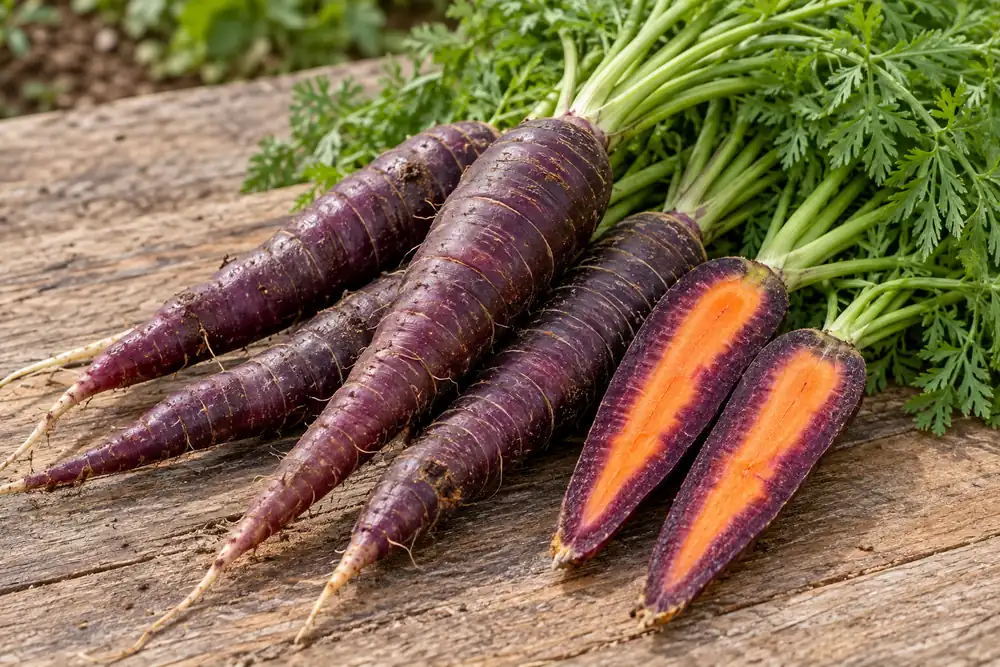
A mature carrot is firm, fairly straight, well colored, and shaped like the variety is supposed to be, with a filled tip and a usable shoulder. UC Davis describes high-quality carrots as firm, straight, bright, and low in hairiness, with no green shoulders. That is a useful harvest read because it combines size with actual eating and storage quality.
| Harvest cue | What you want to see | What the cue tells you |
|---|---|---|
| Crown and shoulder | Shoulder sized for the variety and not greened over | The root is filling properly and has stayed protected from sun |
| Taper | Smooth even taper instead of abrupt swelling or twisting | The root developed with fewer structure or spacing problems |
| Tip fill | Blunt or properly filled tip, not a stringy thread | The root reached useful maturity instead of stalling early |
| External color | Uniform color for the type, without pale patches or green shoulders | The root stayed covered and held quality through enlargement |
The UC Davis carrot fact sheet supports the same maturity and storage markers: firm roots, straight shape, bright color, low hairiness, and no green shoulders.
From Harvest To Table – Trim Tops, Hold Crispness, And Protect Flavor
The seed-to-table promise is not finished when the root comes out of the ground. Quality can still be preserved or lost in the first few minutes after harvest. University of Maryland recommends cutting off and composting the green tops immediately after harvest to reduce moisture loss and keep roots crisp. Illinois Extension similarly advises trimming tops for storage instead of leaving the foliage to keep drawing water from the root.
Sort Roots For Fresh Use Or Storage
Once carrots are out of the ground, sort smaller tender roots for fresh use and save the soundest, fullest roots for storage. Roots that are already coarse, split, or oversized should be used first instead of packed away. The table-quality line is simple: roots should still be sweet, crisp, and easy to prep, not oversized and tiring to use.
What To Do Right After Harvest
Move roots out of sun quickly, trim tops, and separate the best roots for storage from any cracked or damaged ones that should be used first. University of Maryland notes that topped carrots can store for up to 4 to 5 months at 32 degrees F and 90 to 95 percent relative humidity. That gives you the practical table-side distinction: the best carrot is not just the one that grew well, but the one that was handled correctly after harvest.
Carrots do not keep improving just because they stay in the ground longer. Illinois Extension notes that overgrown roots are less tasty and may develop a tough woody core, while Maryland describes some types as becoming fibrous with age.
Carrot Life Cycle Beyond Harvest – Why Gardeners Usually Stop In Year One
For eating, most gardeners treat carrots as annuals. Biologically, they are biennials. University of Maryland states that carrots require two growing seasons to complete their life cycle. In the first season they build the storage root and leafy top. After winter chilling and renewed growth, the plant shifts into reproduction and sends up a flower stalk.
| Season | What the plant is doing | What it means for gardeners |
|---|---|---|
| Year one | Building leaves and storing energy in the root | This is the main seed-to-harvest window for table carrots |
| Year two | Using stored energy to flower and set seed | The root turns woody and quality drops, but seed saving becomes possible |
That second-year shift explains bolting and the change from storage-root quality to seed production. The edible crop belongs to the first year. The reproductive crop belongs to the second. Once the plant commits to seed, the root stops being the part you wanted to grow.
Conclusion
Carrot development stages make the most sense when you read them as one connected cycle instead of a single harvest date. The seedbed sets the shape. Germination sets the stand. Thinning protects room. Early root development fixes the future form of the crop. Enlargement reveals whether the row is really producing. Harvest and storage decide whether that work actually reaches the table in good condition.
Let the crop’s current stage guide the next correction. If emergence is thin, fix the seed zone. If roots stay short or forked, go back to soil structure and disturbance. If the tops are heavy but shoulders are not filling, correct spacing, fertility, and moisture. If harvested roots wilt fast, the problem is now postharvest, not developmental. When the whole sequence is working, the tops stay steady, the shoulders widen on schedule, and the roots come out smooth, crisp, and worth keeping from seed all the way to the table.
FAQ
How long does it take carrots to grow from seed?
Most garden carrots take about 65 to 75 days from sowing to harvest, though small baby carrots can be ready earlier and long-season storage types can take longer. Germination alone may take one to three weeks, especially in cool soil.
How do carrots develop underground?
After germination and early seedling growth, the plant extends one main taproot and gradually turns it into a storage root. First the shape is set, then the shoulder widens, the taper smooths out, and the tip fills. That is why soil structure and spacing matter so much early in the season.
When do carrot roots start swelling?
Visible shoulder swelling often begins around the middle of the season, commonly about 40 to 50 days after planting for many garden types. The exact timing depends on variety, soil temperature, spacing, and moisture.
Why are my carrots all tops and no roots?
The most common causes are crowding from poor thinning and excess nitrogen feeding the foliage more than the root. Carrots need room and moderate feeding, not lush top growth, to produce full roots.
What causes forked carrots?
Forked carrots usually trace back to heavy or stony soil, root obstruction, transplanting, fresh manure, or root injury from deep cultivation. The problem starts early when the taproot is first choosing its path.
Can you transplant carrots?
It is usually better not to. Carrots are direct-seeded because moving seedlings can bend or damage the taproot, which raises the chance of forked or misshapen roots later.
Why are my carrots hairy?
Hairy roots can follow root stress, poor soil conditions, fresh manure, or aster yellows disease. If the roots are also poorly colored and the tops look off, disease is more likely. If the crop otherwise looks normal, the issue is often tied to soil or fertility stress earlier in development.
Why are my carrots short or stubby?
Short or stubby carrots usually point to shallow or heavy soil, compacted beds, or a variety that is better suited to those conditions. Long-rooted types need depth. In tighter soil, shorter Danvers-, Chantenay-, or oxheart-type carrots usually perform better.