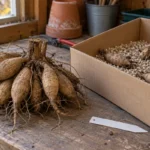


How to store dahlia tubers successfully depends on keeping viable roots cool and frost-free without letting them rot or dry out. Lift them where winter threatens the roots, preserve the crown and neck, and pack only after surface moisture has dried. A storage box should protect living tissue through dormancy; it should never become a damp, sealed container of damaged roots.
Picture opening that box in January. One tuber has deep wrinkles, another gives under a fingertip, and a third still feels firm beneath its tan skin. Those differences call for different corrections. Adding water to all three would worsen the soft one’s condition. Start with healthy stock and a measured storage temperature, then adjust the container and packing material to what happens inside them. An intact crown with a viable bud matters more than an impressive pile of large roots.
Your Winter Storage Starting Point
Before packing
Keep a sound crown and neck. Leave uncertain clumps intact for spring division. Pack surface-dry roots.
During storage
Aim around 40-45°F in a frost-free space. Buffer moisture loss with packing material; avoid trapped wetness.
At inspection
Wrinkling calls for better moisture retention. Condensation or soft rot calls for drying, isolation, and inspection.
The American Dahlia Society uses 40-45°F for conventional storage. Measure your actual space; a freezing garage will ruin the roots.
Key Takeaways
- Preserve crown buds when selecting roots for winter storage.
- Delay division until spring when eyes are hard to identify.
- Avoid sealing wet packing around freshly washed roots.
- Inspect stored stock monthly and after changes in room conditions.
- Keep variety labels attached through digging, storage, and replanting.
Table of Contents
How to Store Dahlia Tubers Before Winter Freezes Them
Store healthy, surface-dry tubers in a cool, frost-free place with packing that limits moisture loss. For a conventional media-based method, around 40-45°F is a practical starting range from the American Dahlia Society. Keep the box accessible for inspection. Dormant roots remain living tissue, so cold damage, dehydration, and decay still matter throughout the leafless dormant period.
First decide whether indoor storage is necessary. Dahlias are tender perennials: the plant survives between seasons only if its living underground tissue survives. Cold-climate guidance from University of Minnesota Extension calls for lifting dahlias. Where the soil freezes around the roots, mulch and a sheltered wall are unreliable substitutes for a protected storage space.
In milder locations, leaving tubers in the ground is a separate option. The regional in-ground method in Oregon State University’s dahlia digging and overwintering guidance requires good drainage and protection. Its zone recommendation belongs to that regional advice. A hardiness-zone number alone tells you little about standing winter water, a cold pocket, or rodents eating the roots.
Lift valuable stock if your site stays waterlogged, local guidance recommends digging, or you cannot protect it from the expected cold. Where local conditions support leaving it, follow every step of that outdoor method, including its drainage requirements. A temporary frost cover protects foliage through a cold night; winter root survival requires protection through the whole cold season.
Lift Mature Clumps Without Breaking Their Necks
Dead foliage does not mean the underground clump is already dead. Dahlia storage roots mature late in the growing season, and their condition at lifting affects how well they keep. Keep foliage intact through its useful growing period; removing spent dahlia blooms can maintain flowering before frost ends the season. In cold-climate guidance from UNH Extension, top growth dying back or being killed by a hard frost signals the lifting period. Dig before the soil freezes around the clump.
Let local weather determine how much waiting is safe. A mild frost followed by workable soil offers a different window from a forecast of sustained freezing. Wet coastal conditions introduce another reason to lift earlier. Avoid leaving hollow, cut stalks exposed to rain for days: water entering the stem increases the risk of crown rot, a problem described in both UNH and American Dahlia Society guidance.
Attach the variety label before cutting. Then loosen soil around the whole plant, working outward far enough to avoid driving the fork through swollen roots. Lift from below once the surrounding soil releases. Pulling on the stalk puts the clump’s weight through its fragile connections.
Freshly lifted necks bend or snap easily. Support the mass with your hands, and ease loose soil away without scraping the skin. A nick creates an entry point for decay organisms; a snapped neck also disconnects the storage root from the crown. Set the clump down gently before deciding whether it will stay whole or be divided.
Pro Tip: Keep each label beside its own clump throughout cleaning. Move one named clump at a time between the digging area and drying surface, so loose roots never become an unidentified mixed pile.
Divide Around Eyes, Crowns, and Intact Necks
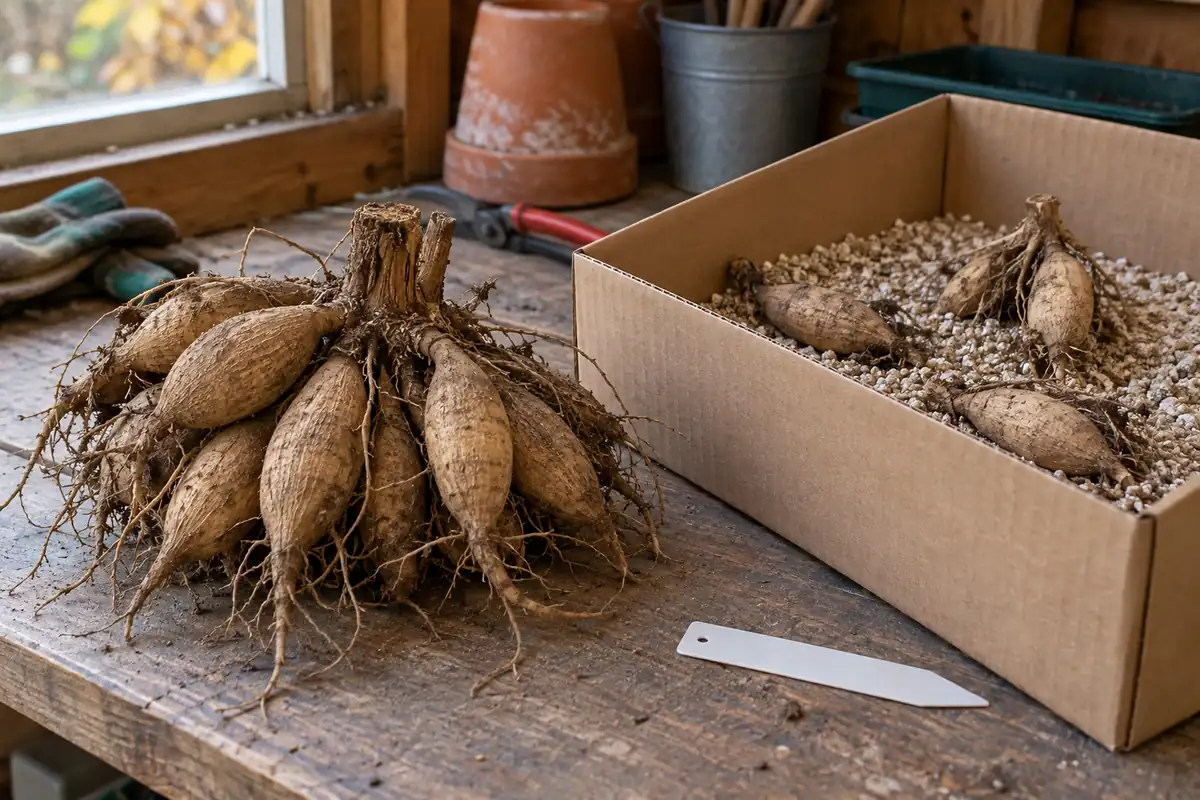
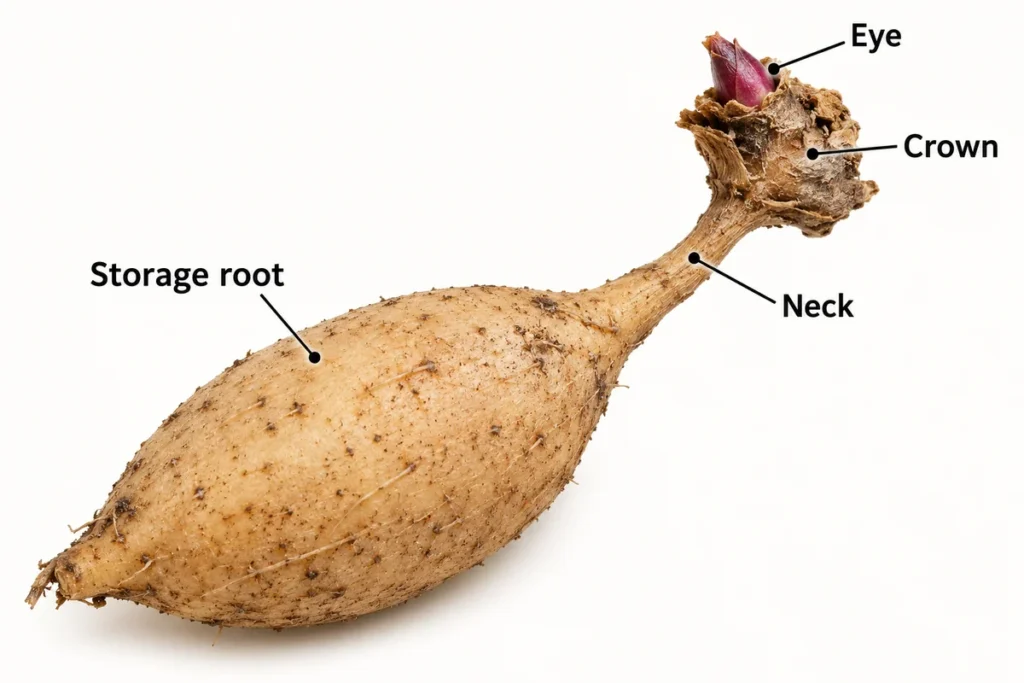
A large, firm root without an eye-bearing piece of crown will not produce a normal new dahlia. The swollen body stores reserves; the shoot starts at a bud on the crown. Unlike a potato, a dahlia does not carry usable eyes scattered across the fleshy storage root. That anatomy determines where a division belongs.
Find the bud before making a cut
Follow the tuber body toward its narrower neck and the crown near the old stem. An eye begins as a small bump and later develops into a sprout. Healthy skin has a tan surface and firm resistance under gentle pressure. Inspect the narrow connection without flexing it to test its strength.
Keep crown tissue with a viable eye attached to each division. A root dangling on a broken neck is poor planting stock, even if the body still looks plump. Superficial skin damage is a different problem: it calls for inspection and careful drying, not an automatic assumption that the neck has failed. Discard roots with broken connections or obvious spreading decay.
Choose fall or spring division by what you can identify
Fall division saves storage space, and fresh clumps are easier to cut than some hardened winter clumps. The drawback is visibility. Eyes are harder to recognize before they swell, so cutting every root free in October risks creating pieces with no usable bud.
If you cannot identify the eyes confidently, store the intact clump or larger sections and divide in spring. More crown tissue stays together, giving you time to see where growth starts. You will need a larger box, and some varieties become tougher to separate. Both choices have a cost; forcing small divisions only to fit a container risks losing the plant.
The fall-versus-spring tradeoff appears in American Dahlia Society and Oregon State guidance. It also matters for small, thin-necked roots. Limited reserves and delicate connections make drying losses more consequential for small roots. Size alone is no reason to discard them. Keeping a larger section together is a reasonable beginner choice where individual buds are uncertain.
Use a sharp cutting tool and sanitize it between clumps after removing soil and plant residue. Choose a tool disinfectant and follow its labeled dilution and contact time. Disease spreads mechanically when a blade carries infected material into fresh cuts. Do not carry a suspected diseased plant into the healthy storage batch just because a few roots look undamaged.
Wash and Dry for the Storage Method You Chose
Washing is useful when soil hides the crown and you plan to divide now. An intact clump kept for spring division also has a supported no-wash route. The instructions differ because they start with different forms of stock and different preparation methods.
For washed clumps or fall divisions
Remove loose soil gently, then rinse without stripping or damaging the skin. Cleaning exposes the crown, broken necks, and suspect tissue that packed soil concealed. Avoid a forceful jet aimed at the thin connections. A cleaner root still needs drying before it goes into a box.
Spread washed stock in a shaded, ventilated place. Turn a hollow stalk so trapped water drains away, keep labels together with the roots, and allow surface moisture to disappear. Packing a wet clump traps water close to damaged tissue, creating conditions that favor decay.
Drying times describe conditions, not a countdown that proves readiness. A few days at 60-70°F in shade with ventilation fits UNH Extension’s preparation method. The American Dahlia Society gives about a day to a day and a half for many divided roots, depending on size, temperature, and humidity. Illinois Extension gives a short drying period for dahlias in its tender-bulb method. Use the physical endpoint: no free surface water, firm roots, and cuts dry enough for packing.
For an unwashed clump kept until spring
At lifting, brush off excess soil, protect the necks, and let the remaining clinging soil dry. Oregon State’s spring-division method explicitly avoids washing before winter storage. It also warns against packing a soaking, muddy clump. Leaving some dry soil attached is different from trapping wet soil in a sealed tote.
Watch the roots during preparation. A surface that still glistens is wet; a body developing deep wrinkles is losing too much water. Move prepared stock into its storage setup once it reaches the chosen method’s dry condition. Long exposure to drying air is particularly risky for small divisions.
Begin conventional home storage with healthy roots, careful drying, and suitable packing. Routine fungicide dipping is not a prerequisite. The American Dahlia Society’s conventional-storage account reports no keeping advantage from its author’s routine dip experience. That is an individual account, not proof that treatment never helps. If a treatment is used, the current product label and plant-specific directions control its use. Do not improvise a bleach bath from a remembered ratio.
Choose Cool Storage That Controls Moisture Loss
A box in a garage is only suitable if that part of the garage stays frost-free. Measure the temperature beside the stored roots, including during cold spells. Dormancy slows growth; it does not protect living tissue from freezing. Warm storage also encourages premature sprouts and increases decay risk.
A conventional setup around 40-45°F matches the American Dahlia Society’s guidance. UNH describes storage below 50°F and above freezing. Oregon State gives a lower 34-40°F range for its methods. These are overlapping practical examples, not an instruction to chase the coldest possible corner. Near-freezing storage leaves little margin when an unheated room suddenly drops overnight.
Use the medium as a moisture buffer
Coarse vermiculite, coconut coir, wood shavings, and sand appear in supported storage methods. Their job is to limit dehydration without creating a wet environment around the roots. Cover the stock according to the method and keep varieties identifiable. Fine, damp material pressed tightly against a tuber behaves differently from a loose, coarser packing layer.
For a cool, dry room, choose a setup that retains moisture around firm roots. UNH uses lightly moistened packing; its warning is that too much moisture leads to rot. A dry room and an open cardboard box also lose water over time. Inspect before adding moisture. Spray only when the roots show excessive moisture loss.
In damp storage, begin with surface-dry stock and avoid wet packing. Condensation on a bag or lid tells you to examine the roots and the enclosure. Oregon State’s media-based methods leave bags open and avoid airtight tote lids to prevent moisture buildup. Drier packing and air exchange address that situation. Excessive ventilation in a dry room can dehydrate the roots.
Observation: A room’s humidity and the moisture inside a closed bag are different conditions. Firm roots beside a sweating bag need an enclosure check even when the surrounding garage feels dry.
Keep complete methods separate
Plastic wrap is a specialist alternative for individually prepared divisions. Its preparation differs from packing whole clumps in a box. The American Dahlia Society describes cleaned, dried, separated roots wrapped without a storage medium. Its historical grower account does not establish that this method is superior in every home.
For a first season, choose one complete conventional method and keep it inspectable. Do not combine damp packing, freshly washed roots, and airtight wrapping because each appears somewhere in separate instructions. Different preparation and moisture conditions explain why opposing packaging advice exists.
Which part of your storage space is most likely to change first during winter: its temperature, its dryness, or the moisture trapped inside the container? Put the thermometer and the accessible inspection box where you will notice that change.
Stop Rot and Shriveling During Winter Checks
Inspect conventional stored stock monthly, as recommended by the American Dahlia Society, and after a cold spell or a change in room conditions. Open the container, examine the packing, and handle roots gently. A wet lid and a shrunken root call for different adjustments.
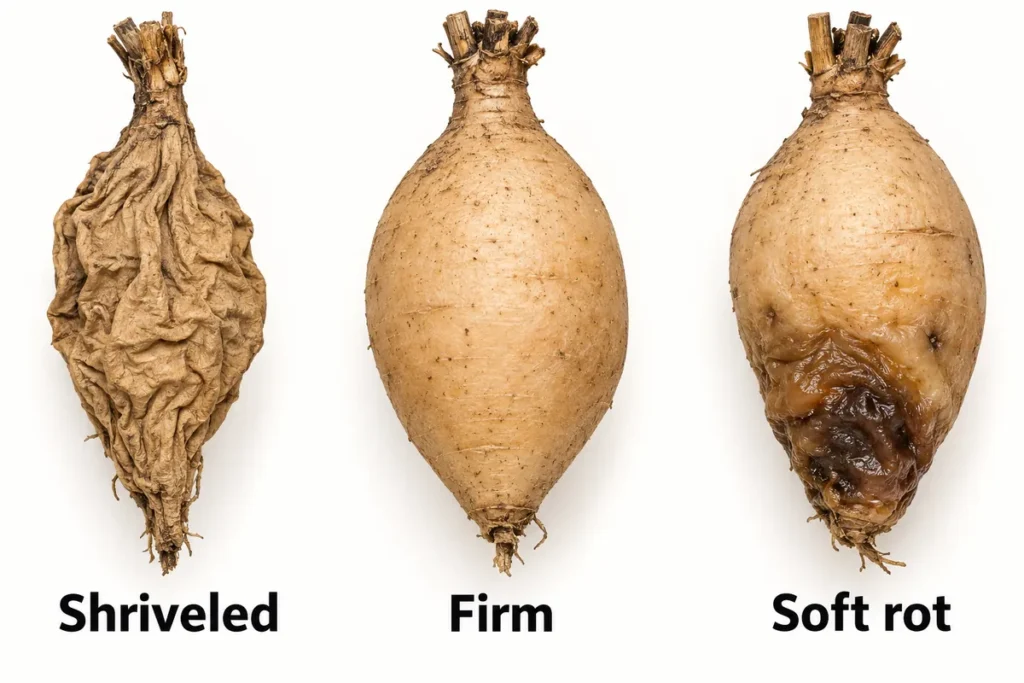
Firm stock keeps its shape under light pressure. Desiccated roots develop wrinkles and lose volume; active soft rot produces collapsing, damp tissue that gives readily beneath a fingertip. A brown patch alone does not identify the problem. Compare its texture, the crown’s condition, and what has changed since the last inspection.
Correct the storage conditions along with the symptom
| What you find | Likely storage problem | First action |
|---|---|---|
| Condensation or wet packing | Excess moisture trapped in the enclosure | Inspect for decay, let the setup air dry, and adjust ventilation. |
| Soft, collapsing tissue or spreading mold | Active deterioration, sometimes following injury | Separate affected stock; discard extensive rot and correct the environment. |
| Wrinkles and shrinkage without wet decay | Excessive moisture loss | Lightly moisten the packing or reduce moisture escape, then reassess. |
| Shoots developing well before planting time | Storage is encouraging growth too early | Measure temperature and move dormant stock to a cooler frost-free location. |
For shrinking roots, slightly moisten the storage medium with a spray bottle, a correction described by Illinois Extension. Stop before the packing becomes wet. Spraying every root or soaking the whole batch skips the moisture check and risks starting rot around otherwise sound tissue.
Soft spots, mold, and dryness are also the inspection signs in University of Minnesota Extension’s winter checklist. Its rot warnings include digging injury, excessive warmth, and poor air circulation. Remove damaged stock and fix those conditions before returning the healthy roots.
Salvage only when sound tissue remains
A localized damaged tip is different from a soft, rotted crown. For limited rot, cut back until clean, firm tissue remains, preserving the viable crown and eye. That restricted salvage approach appears in the American Dahlia Society’s division and storage instructions and Minnesota’s tuberous-root guidance. Keep the piece separate during drying and reassess it before repacking.
Discard a division if decay reaches the crown, the neck connection fails, or clean viable tissue cannot be preserved. Extensive soft rot is poor stock to gamble on beside healthy roots. Saving every damaged piece increases the chance that one failing root remains unnoticed in the container.
Wake Healthy Tubers as Spring Approaches
Spring storage ends with a viability check, not simply with an empty box. Confirm firm tissue, an intact neck, and an eye-bearing crown before allocating planting space. A root that stayed plump all winter still needs a viable bud to produce a plant.
When your local planting period is approaching, move stored stock to a somewhat warmer protected place to encourage eye development if needed. Oregon State’s method uses a transition to 40-50°F before division; the American Dahlia Society describes warmer spring conditions in its own approach. Avoid warming everything months ahead of use. Long shoots consume reserves and create handling problems before the outdoor soil warms.
Eyes that were hard to distinguish in fall become raised buds or short shoots near the crown. Divide intact clumps around those growth points, preserving their neck connections. Some cultivars develop eyes later than others. An invisible bud on otherwise sound crown tissue deserves another examination after appropriate warming. Give sound tissue time to reveal its growth points.
Return dahlias outdoors only when frost risk has passed and the soil is warm enough for tender growth. The spring planting window belongs to local soil and frost conditions, not a national date. Cold, wet ground exposes a dormant storage root to decay before new roots and shoots establish.
Keep the cultivar name with the planted division. If you stored uncertain pieces separately, inspect their crowns again before moving them alongside healthy plants. A sound short shoot attached to a firm root is a better starting point than a large root with a doubtful connection.
Conclusion
At each inspection, note which container needed a moisture adjustment and which stayed firm without intervention. If one variety repeatedly shrivels and the others keep well, change its enclosure separately next season. Leave the successful containers alone. Keep that note with its label through spring. The result to carry forward is a firm tan root with an intact neck and a small, swelling bud on its crown.
Frequently Asked Questions
Can dahlia tubers stay in their pots over winter?
Yes, under a suitable whole-pot method in a cool, frost-free space. The American Dahlia Society describes storing deliberately grown pot roots in their pots with protective wrapping. A patio pot left outdoors is a different situation: the container and roots still need protection from freezing and excess moisture.
Should I keep small dahlia tubers?
A small root with a sound neck, crown, and viable eye is worth keeping. Thin roots lose moisture readily, so protect them from prolonged drying and inspect their firmness during storage. The American Dahlia Society also identifies cultivar differences in root size and keeping quality.
Can I mix several varieties in one storage box?
If each variety stays clearly labeled and separated, sharing a box does not require losing its identity. Keep names attached through inspection and spring division. When a root breaks off an unlabeled clump, its appearance is an unreliable way to recover the cultivar name.