



Updated March 25, 2026
Potato history stretches back more than 8,000 years, to the cold highlands of what is now Peru and Bolivia, where farmers first domesticated a bitter, frost-tolerant tuber near the shores of Lake Titicaca. That plant did not reach Europe until the 1570s. When it did, it was feared, banned, and blamed for leprosy. Two centuries later, it had ended recurring famine across northern Europe, doubled populations, and – through a single variety grown on a single disease-susceptible genetic line – triggered one of the 19th century’s worst humanitarian disasters. The story of how one crop moved from Andean altitude to European politics, from royal propaganda campaigns to pesticide laboratories, is less a triumph of agriculture than a study in what happens when humans simplify a system they do not fully understand.
Key Takeaways:
- Learn how Andean farmers classified more than 5,000 potato varieties by altitude, taste, and frost tolerance
- Recognize chuño as a 10-year-stable food reserve that sustained Inca armies across the empire
- Trace how Parmentier’s staged theft in 1785 converted a skeptical French public into potato growers
- Avoid the monoculture trap – Ireland’s reliance on a single potato variety turned a crop disease into a famine that killed one million people
- Grow at least two or three distinct potato varieties to spread disease risk across a single season
Table of Contents
Potato Origins in the Andes – the Crop That Fed an Empire Before Europe Knew It Existed
Potato history begins near Lake Titicaca, at elevations between 3,800 and 4,500 meters, where farmers in the altiplano first cultivated wild potatoes approximately 8,000 years ago. The initial domesticated varieties were small, bitter, and frost-tolerant – traits bred over centuries into hundreds of distinct landraces adapted to specific microclimates.
By the time Spanish conquistadors arrived in the Andes in 1532, Andean farmers had developed more than 5,000 named varieties. These were classified by altitude zone, flavor profile, texture, and frost resistance, with separate varieties suited to growing at 2,800 meters and others that thrived only above 4,000 meters where nothing else survives. Historian William McNeill, writing on the potato’s global spread, noted that the Andean system represented one of the most sophisticated plant domestication programs in agricultural history – built without formal taxonomy, entirely through observation and selective cultivation over generations.
The depth of that diversity had a practical logic. In a climate where a late frost or a dry season could eliminate one crop, maintaining dozens of varieties across different elevations meant that no single weather event could destroy the entire food system. That logic would be ignored almost entirely when the potato crossed the Atlantic.
Chuño – the Inca Freeze-Drying Method That Turned Potatoes Into a Strategic Resource
The most consequential thing the Incas did with the potato had nothing to do with cooking it fresh. At elevations above 3,800 meters, where nighttime temperatures drop well below freezing even in summer, Andean farmers developed a preservation process that produced what we now call chuño.
The method worked in stages. Potatoes were spread across open ground before sunrise and left to freeze solid overnight. In the morning, families walked barefoot across the frozen tubers, pressing out the moisture as they broke down. The process repeated for several nights – freeze, trample, dry under the high-altitude sun – until the potatoes were reduced to hard, almost weightless discs. The finished chuño is nearly black, chalky on the surface, and smells faintly of dried earth. Rehydrated in a stew after a year – or after ten – it has an earthy, dense quality closer to dried mushroom than anything fresh.
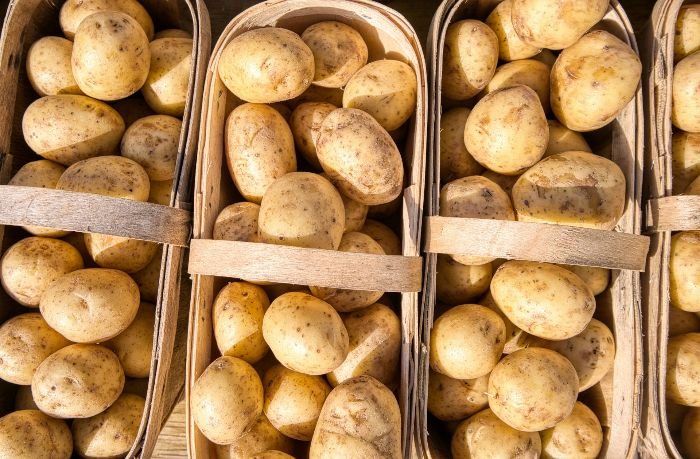
German geographer Carl Troll, studying Andean agriculture in the mid-20th century, argued that chuño production was what made the Inca Empire logistically possible. The Inca state did not use currency or markets in the way European economies did. It ran on labor tribute and distributed food stores, and chuño – stable for 10 to 20 years at altitude – was the reserve that fed armies on the move and storehouses in years of drought. Without a food source that could survive long storage and high-altitude transport, the Inca road system would have had nothing to carry.
The thermodynamic principle behind chuño – using low pressure and freeze-thaw cycles to remove water from food – is identical to the principle behind modern industrial freeze-dryers. The technology was not rediscovered in the 20th century; it was in continuous use in the Andes for at least 700 years before any European laboratory described it formally.
I often notice that gardeners who grow several potato varieties in the same bed rarely lose more than a portion of their crop to blight. A bed of Yukon Gold, a heritage blue, and a floury white performs consistently even in wet seasons – the same diversification logic Andean farmers embedded into their food system centuries ago.
The Potato Reaches Europe – and Meets 200 Years of Resistance
Spanish ships carried potatoes back to Europe sometime in the early 1570s. The first documented cultivation in Spain dates to 1572, when the Hospital de la Sangre in Seville recorded purchasing potatoes for patient meals. From Spain, the plant moved slowly: to Italy by the 1580s, to England and Ireland via Flanders by around 1590, across northern Europe over the following decades.
The reception was almost uniformly poor.
Botanists recognized immediately that the potato belonged to Solanaceae – the nightshade family. The same family included deadly nightshade (Atropa belladonna) and several other toxic plants, and that identification triggered immediate suspicion. The tuber’s knobbly, irregular shape was associated in some European folk medicine with diseased flesh, specifically leprosy. In France, local authorities in Burgundy banned potatoes in 1748 on the grounds that eating them caused leprosy. Protestant clergy in northern Europe raised objections on Biblical grounds: if potatoes were fit to eat, God would have mentioned them in Scripture. The Paris Faculty of Medicine did not officially declare potatoes safe for human consumption until 1772 – approximately 200 years after the Spanish first brought them from the Americas.
The Timeline of the Potato’s Slow European Acceptance
| Year | Event |
|---|---|
| ~6000 BCE | First potato domestication near Lake Titicaca, Andes |
| ~1200 CE | Chuño production systematized under the Inca Empire |
| 1572 | Potato first documented in Spain – Seville hospital records |
| 1590s | Potato reaches England, Ireland, and Belgium |
| 1748 | Burgundy, France bans potatoes; blamed for causing leprosy |
| 1756 | Frederick the Great issues the Kartoffelbefehl in Prussia |
| 1772 | Paris Faculty of Medicine declares potatoes safe for human consumption |
| 1785 | Parmentier receives royal land plot from Louis XVI at Sablons |
| 1845 | Phytophthora infestans destroys the Irish Lumper crop; famine begins |
The resistance was not entirely irrational. Several potato varieties contain solanine, a glycoalkaloid that causes illness in high concentrations, and green-tinged tubers left in sunlight can accumulate enough to cause real toxicity. The botanical suspicion had a basis. What was missing was the distinction between preparation method and intrinsic danger – a distinction no one in 16th-century Europe had the framework to make.
Parmentier, Frederick the Great, and the Art of Making People Want What They Distrust
The potato’s adoption in Europe came less from agricultural logic than from deliberate manipulation by people who understood that hunger alone was not enough to change behavior.
Antoine-Augustin Parmentier was a French pharmacist captured by Prussian forces during the Seven Years’ War (1756-1763). He spent time in Prussian captivity eating potatoes – food considered fit for prisoners and animals – and came out convinced that the crop could solve France’s recurring grain shortages. On his return, he began a long campaign to change French public opinion.
The Royal Field Gambit
In 1785, Parmentier persuaded Louis XVI to grant him access to a plot of wasteland at Sablons, near Paris, to grow potatoes. He planted the field, posted royal guards at the entrance during daylight hours, and then withdrew them at night. The implied message was clear: the king’s soldiers protect this crop. Peasants from surrounding areas began stealing potatoes from the field under cover of darkness – which was precisely what Parmentier intended. By the time people were growing their own plants from stolen seed, the psychological barrier had broken. Something you risk to steal is something worth having.
Parmentier also hosted dinner parties where every dish – soup, main course, dessert, bread – was made from potatoes. Benjamin Franklin attended at least one. Louis XVI wore potato flowers as a boutonniere when receiving guests. These were calculated acts of cultural reframing, and they worked.
| Figure | Country | Method |
|---|---|---|
| Antoine-Augustin Parmentier | France | Staged royal field theft; hosted potato dinner parties attended by Franklin |
| Frederick the Great | Prussia | Threatened to cut off ears and noses of peasants who refused to plant potatoes |
| Louis XVI | France | Wore potato flowers publicly; granted Parmentier the Sablons field |
| Benjamin Franklin | USA (diplomat) | Attended Parmentier’s dinners; helped circulate positive association |
In Prussia, Frederick the Great took a different approach. His Kartoffelbefehl – the Potato Edict of 1756 – ordered peasants to plant potatoes and threatened mutilation for non-compliance. The potato was too important to leave to preference. Both methods worked. By the early 19th century, potatoes had become the primary caloric source across much of northern Europe, and the speed of that shift was unlike anything that had happened with a new crop in recorded European agricultural history.
Pro Tip: Parmentier’s legacy survives in the kitchen as vichyssoise – the cold potato and leek soup named in his honor. Using a waxy variety like Charlotte or Maris Peer instead of a floury Russet gives a richer, less starchy result, and the texture holds better when chilled.
How the Potato Ended European Famine – and Set Up the Deadliest One
The nutritional case for the potato was real. An acre of potatoes produced 3 to 4 times more calories than the same acre of wheat, and those calories came with enough vitamin C to prevent scurvy – something wheat alone could not provide. A family could subsist on potatoes and milk with no other food source and remain reasonably healthy through a winter. That fact mattered enormously in a century when harvest failures meant starvation.
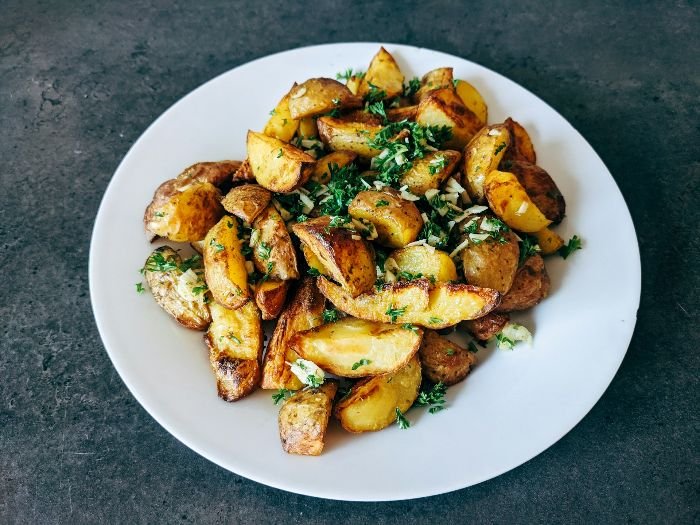
Economists Nathan Nunn and Nancy Qian, in a 2011 paper published in the Quarterly Journal of Economics, analyzed the relationship between the potato’s introduction and population growth across the Old World. Their conclusion: potato adoption accounts for approximately 26% of population growth in Europe and Asia between 1700 and 1900, and roughly 12% of the urbanization that accompanied industrialization. The potato was not incidental to the demographic transition – it was a driver of it.
If you grow up in a country where famine is a living memory rather than a historical abstraction, you plant whatever yields the most calories on the least land. Ireland’s farming families, many working plots of less than an acre under rack-rent tenancies that extracted most of their cash income, converged on the Lumper variety – high-yielding, dependable, calorie-dense, and genetically nearly identical from farm to farm across the entire country.
The Lumper and the Logic of Monoculture
When Phytophthora infestans – late blight – reached Ireland in 1845, it found a country with no genetic buffer. A field of Lumpers had the same disease resistance profile across every plant because every plant was essentially a clone. The pathogen crossed Ireland in months.
Late blight moves with visible speed. A field can show blackened, rotting stems by afternoon that appeared green at dawn, and the smell – damp earth turning to decay, sharp and sulfurous – carries across field boundaries in the direction of the wind. By autumn 1845, that smell had spread across most of the country’s potato-growing land.
One million people died between 1845 and 1852. Another million emigrated. The population of Ireland fell by 20 to 25 percent in five years. The Famine’s immediate cause was biological, but its depth came from structure: a monoculture crop, a tenant farming system with no food reserves, and a political framework that continued exporting grain from Ireland while the population starved.
The potato’s caloric efficiency – 3 to 4 times that of wheat per acre – was the same property that created dependency. Efficiency simplified the food system, and simplification made it fragile.
The Colorado Beetle and the Potato’s Unlikely Role in Inventing Modern Pesticides
Potato monoculture in the United States created a separate crisis. As American settlers pushed west across the Great Plains in the mid-19th century, they planted potatoes wherever the soil allowed, and the Colorado potato beetle (Leptinotarsa decemlineata) – a native insect that had previously fed on a wild relative of the potato in the Rocky Mountains – discovered an unlimited food supply and followed the expanding farmland east.
The beetle reached the Atlantic coast by 1874 and crossed to Europe by 1877. Farmers had no effective response. Hand-picking, burning infested fields – nothing worked at scale against an insect that reproduced fast enough to recover from any disruption within a single season.
The solution came from an industrial pigment. Paris green – copper acetoarsenite, a vivid turquoise compound used in wallpaper, theatrical face paint, and rat poison – was found in the late 1860s to kill beetles when dissolved in water and sprayed on foliage. It was the first synthetic pesticide deployed at agricultural scale. It was also acutely toxic to humans, poisoning farmworkers who mixed it without protection and contaminating waterways near treated fields.
Paris green was followed by Bordeaux mixture (copper sulfate and lime) in the 1880s, then by a succession of increasingly refined compounds across the 20th century. The direct line from Colorado beetle to Paris green to the modern pesticide industry is not a metaphor – it is a causal chain. The beetle problem created the demand; the demand created the industry; the industry shaped how industrial-scale food production manages disease and pest pressure to this day. The potato created the conditions for all of it.
The Monoculture Problem – What 1845 Ireland Still Tells Us About Today’s Potato Supply
Commercial potato farming in the United States today relies heavily on a small number of high-yielding varieties. The Russet Burbank – the long, brown potato that fills most supermarket bags and accounts for the majority of McDonald’s french fries – dominates American potato agriculture to an extent that makes the Irish Lumper situation look varied by comparison. The Russet Burbank is susceptible to late blight. It requires significant fungicide applications to survive the wet seasons when it is most profitable to grow.
The same dynamic plays out in home gardens. A wet July in a single-variety plot can blacken the whole planting inside a week. Growing two or three varieties with different parentage – a waxy type, a floury type, and a heritage line – spreads the risk. If one is susceptible to the blight strain present that season, others may hold.
The International Potato Centre (CIP) in Lima, Peru – one of the world’s major agricultural research institutes – maintains a gene bank of approximately 4,600 wild and cultivated potato varieties. Many are Andean landraces carrying disease resistance traits absent from commercial lines. Modern breeders are crossing wild Andean material back into commercial varieties specifically to recover resistance that uniform farming has bred out over decades.
If a single plant variety could destabilize a country’s food supply today, what else would have to fail alongside it? In 1845 the answer was: a land tenure system with no margins, no crop reserves, no alternatives, and a political structure with no interest in intervening. Most of those structural conditions are not unique to the 19th century.
The Andean farmers who built the system this article started with – 5,000 named varieties, altitude-calibrated diversity, decade-long chuño reserves – had solved this problem empirically, over generations, before any European had tasted a potato. The solution was slow, and it required accepting that variety was protection, even when uniformity was cheaper.
Conclusion
Eight thousand years of selective breeding, 200 years of European resistance, a French pharmacist who staged a royal theft, a Prussian king who threatened mutilation, a single diseased Irish harvest that killed a million people, and a paint pigment that launched the pesticide industry. The potato did not simply spread across the world – it was pushed, weaponized, feared, manipulated, and then held hostage to the same efficiency logic that had made it indispensable.
The Andean gene bank in Lima holds 4,600 varieties as a hedge against exactly that efficiency. The highest-yielding rows of Russet Burbank in Idaho carry a fraction of the genetic range that a single Andean village plot contained in 1532. What you see when you look at a modern supermarket potato – uniform, smooth, identical – is not the endpoint of the potato’s history. It is the moment in that history that looks most like the summer of 1844 in Ireland, before anyone noticed the smell.
FAQ
When did potatoes first arrive in Europe?
Potatoes reached Spain and Portugal in the early 1570s, carried back by Spanish sailors returning from Peru. The first documented record of potato cultivation in Europe appears in hospital records from Seville in 1572. From Spain, the plant moved slowly northward, reaching England and Ireland by around 1590 and northern Europe over the following century. Despite that early arrival, widespread adoption did not occur until the 18th century – in many regions, more than 150 years after the first introduction.
Why did Europeans refuse to eat potatoes for so long?
Botanists correctly identified the potato as a member of Solanaceae, which includes deadly nightshade – a genuinely toxic plant. That classification triggered lasting suspicion. In France, the tuber’s knobbly surface was associated with leprosy, and Burgundy formally banned potato cultivation in 1748 on those grounds. Protestant clergy raised objections because potatoes appear nowhere in the Bible. The Paris Faculty of Medicine did not officially clear potatoes for human consumption until 1772 – approximately 200 years after Spanish sailors first brought them from the Americas.
Can you really live on potatoes alone?
A diet of potatoes and whole milk comes close to nutritional completeness. Potatoes provide complex carbohydrates, vitamin C, potassium, B6, and iron; milk adds calcium and fat-soluble vitamins. Irish farming families subsisted on this combination for generations with few deficiency symptoms – which is part of why the Lumper monoculture became so entrenched. A pure potato diet without dairy would become deficient in vitamins A, D, and B12 over time, and the caloric density means an adult male performing physical labor would need to eat roughly 3 to 4 kilograms of potatoes per day to maintain energy output.
What is chuño and how did the Incas make it?
Chuño is a freeze-dried potato product developed by Andean farmers at high altitude, where overnight temperatures drop below freezing even in summer. Potatoes were spread on open ground before dark, allowed to freeze solid overnight, then trampled by foot in the morning to press out the moisture. The process repeated for several nights, followed by sun-drying at altitude. The result – dark, hard, and almost weightless – stores for 10 to 20 years without refrigeration. Chuño was the logistical foundation of the Inca food distribution system and fed armies moving across the empire’s road network. The thermodynamic principle it uses is identical to that of modern industrial freeze-dryers.
What happens if you grow only one potato variety every year?
A single-variety plot has no genetic buffer against disease. If late blight reaches a bed of genetically uniform plants, every plant responds to the pathogen in the same way – which typically means all of them are affected at roughly the same time. In a wet season, a single-variety planting can go from healthy to complete loss inside a week. Growing two or three varieties with different parentage – a waxy type, a floury type, and a heritage line – spreads the risk. If one variety is susceptible to the blight strain present that season, the others may hold through to harvest.
Did the potato really reduce war and conflict in Europe?
Economists Nathan Nunn and Nancy Qian examined this question in a 2011 study published in the Quarterly Journal of Economics. Their analysis found that adoption of the potato in a region correlates with a 26% reduction in the likelihood of armed conflict, likely because the crop increased caloric availability and reduced the food scarcity conditions that historically preceded smaller-scale conflicts. The effect was strongest in northern Europe, where potato adoption was fastest and most widespread during the 18th century. The mechanism is indirect: better-fed populations are more economically productive and less susceptible to the resource competition that drives subsistence-level violence.
Why was Ireland hit so much harder by the blight than other European countries?
Ireland’s tenant farming structure left most rural families with less than an acre of land under rack-rent tenancies that extracted most of their cash income. On that constraint, the Lumper potato – high-yielding per square foot, calorie-dense, and able to grow in poor soil – was the rational choice. Over time, subsistence farming across the entire country converged on a single variety with nearly identical genetic makeup from farm to farm. When Phytophthora infestans arrived in 1845, there was no genetic diversity to slow its spread and no food reserves or alternative crops to absorb the loss. Other European countries had diversified food systems and did not depend on a single variety for the majority of their calories. The blight affected them too – but they had margins Ireland did not.
Where does the potato stand in global food production today?
The potato is the world’s fourth-largest food crop by production volume, after wheat, rice, and maize. Annual global production runs to approximately 375 million metric tons, with China and India now accounting for more than a third of that total. In Europe, per-capita consumption has declined over the past 40 years as diets have diversified, but the crop remains a primary caloric source across much of sub-Saharan Africa and Central Asia, where its yield efficiency on marginal land mirrors the same logic that made it indispensable in 18th-century Europe.