



Updated March 26, 2026
Choosing a dracaena variety by appearance alone leads most buyers to discover the hard way that leaf color and light tolerance are not the same thing. A marginata with its burgundy-edged blades looks architectural in a catalog, but it sulks and drops leaves in the north-facing corner you had in mind for it. The wrong choice rarely kills the plant – dracaenas are stubborn about survival – but it creates a slow, frustrating decline that is entirely avoidable.
The key variable is light. Secondary variables are height at maturity, growth rate, and whether the household has a cat or a dog. Eight common varieties can be compared by those criteria and matched against what they actually need in a room. A reliable choice depends on matching the variety to the room’s real light, space, and household conditions.
Key Takeaways:
- Check actual light levels before choosing – marginata needs bright indirect, fragrans survives true low light
- Expect brown leaf tips from tap water fluoride, not from underwatering
- Janet Craig and Corn Plant are the two varieties built for genuinely dim rooms
- Verify pet safety before buying – all dracaenas carry saponin toxicity for cats and dogs
- Match growth rate to your space – marginata climbs fast, compacta barely moves in a year
Table of Contents
Eight Varieties, One Genus – What the Numbers Actually Show
The dracaena genus expanded considerably in 2017 when researchers reclassified the entire Sansevieria family under Dracaena, based on DNA evidence compiled by the Missouri Botanical Garden. Snake plants, formerly Sansevieria trifasciata, are now Dracaena trifasciata. Lucky Bamboo, sold as a water-grown tabletop plant, is Dracaena sanderiana. The reclassification matters for buyers because many nurseries still use old names, which can make plant labels and variety names look inconsistent across retailers.
Dracaena draco (Dragon Blood Tree), in its native Canary Islands habitat, is one of the longest-lived plants in the world. The Royal Horticultural Society has documented specimens exceeding 600 years. Indoors it stays a manageable 3-5 feet and grows very slowly, but it is the only dracaena you might legitimately pass down.
| Variety | Common Name | Indoor Height | Light Need | Growth Rate | Pet Safe? |
|---|---|---|---|---|---|
| D. marginata | Dragon Tree | 4-6 ft | Bright indirect | 12-24 in/yr | No |
| D. fragrans | Corn Plant | 4-6 ft | Low to medium | 6-12 in/yr | No |
| D. trifasciata | Snake Plant* | 8 in – 4 ft | Low to bright | 2-4 in/yr | No |
| D. deremensis ‘Janet Craig’ | Janet Craig | 3-6 ft | Low to medium | 6-10 in/yr | No |
| D. reflexa ‘Song of India’ | Song of India | 3-5 ft | Medium to bright | 8-12 in/yr | No |
| D. sanderiana | Lucky Bamboo | 1-3 ft | Low to medium | Variable | No |
| D. deremensis ‘Lemon Lime’ | Lemon Lime | 3-5 ft | Medium | 8-14 in/yr | No |
| D. draco | Dragon Blood Tree | 3-5 ft | Bright indirect | Very slow | No |
*D. trifasciata (snake plant) was reclassified from Sansevieria in 2017. Many nurseries still use the old name.
Low Light, Dark Corners – Varieties That Hold Up Away From Windows
Dracaena fragrans, the Corn Plant, is the benchmark for low-light tolerance in this genus. University of Florida IFAS extension research has documented D. fragrans surviving at 25 foot-candles – roughly the light level of an interior hallway or windowless office. The leaves are broad and matte, almost dusty in texture, and they hold their structure in dim conditions where most houseplants thin out and reach. It grows slowly in low light, typically 6-8 inches per year, but it does not decline.
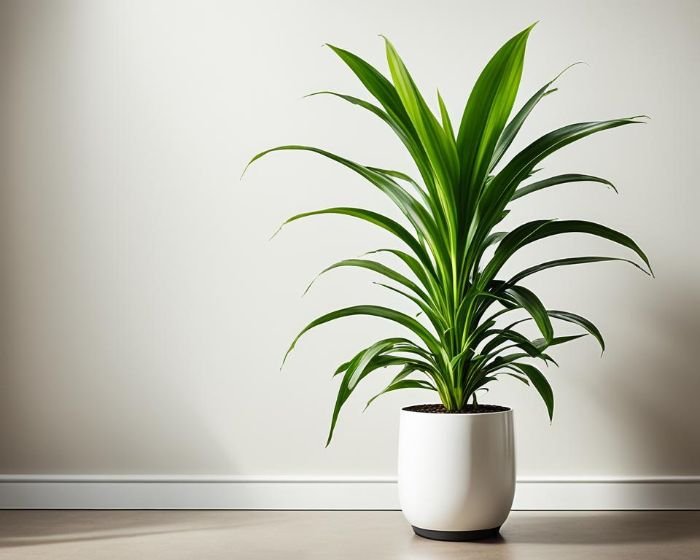
Janet Craig (D. deremensis ‘Janet Craig’) matches that tolerance with a tidier form. The deep green strap-shaped leaves grow in dense rosettes and stay compact long enough for medium-sized rooms before the plant starts pressing against the ceiling. Where fragrans develops a visible trunk over time – the cane turning gray and marked where old leaves dropped – Janet Craig holds its rosette shape for years, which makes it the better choice when you want the full plant to stay visible rather than becoming a tall silhouette with bare stem.
The compact option for desks and shelves
D. deremensis ‘Compacta’, sometimes sold as Janet Craig Compacta, adds roughly 1-3 inches per year. That is not a rounding error. For a north-facing desk or narrow shelf that needs a living element without periodic cutting back, Compacta holds its position for years without intervention. The trade-off is price – it costs more per inch than any other dracaena because nurseries grow it for years before it reaches sale size.
If the room is too dim even for Compacta – a basement office or interior room with only artificial light – pothos handles those conditions more forgivingly than any dracaena will.
Pro Tip: To test light before buying, hold a sheet of white paper in the intended spot at noon with your back to the nearest window. If you can read standard printed text clearly, you have enough light for marginata. If the paper looks flat or gray, choose fragrans or Janet Craig instead.
Bright Spaces and Statement Silhouettes – When Form Matters as Much as Light
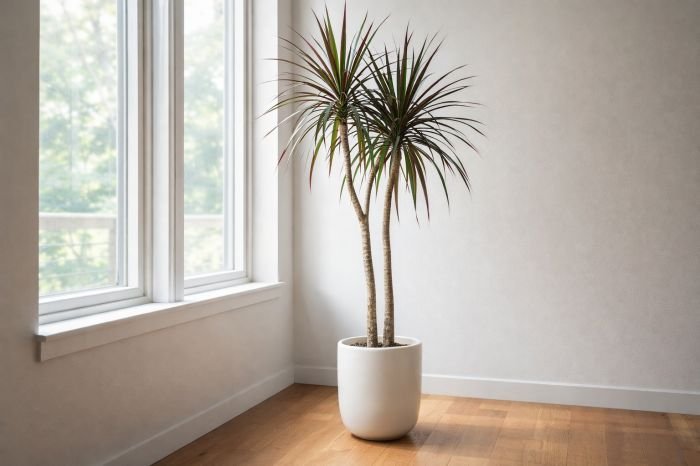
Dracaena marginata is the most widely sold species in the US and the most commonly placed in the wrong room. Its appeal is the silhouette: multiple arching trunks with tufts of narrow burgundy-edged blades at the tips, each trunk going pale and papery where old leaves dropped – a tonal contrast that reads as architectural in bright rooms and looks merely ragged in dim ones. Marginata needs at least 100-150 foot-candles of consistent indirect light and adds 12-24 inches per year when that light is met. The plant people call a “low-maintenance decorative” is one of the faster-growing options in this genus when conditions are right.
Song of India (D. reflexa ‘Song of India’) reaches similar heights with striped yellow-and-green foliage that brings more visual weight than marginata. It needs medium to bright indirect light and does not tolerate temperatures below 60 F. Where marginata tends toward the vertical, Song of India branches more willingly and fills horizontal space. It is the better pick for a wide corner with balanced light from two sides, and it holds its leaf color longer than marginata does when light levels drop seasonally.
Lemon Lime (D. deremensis ‘Lemon Lime’) is the mid-range option that bridges the two groups. The neon-edged leaves hold up in medium indirect light – less demanding than marginata, more color than Janet Craig. Growth is moderate, height caps around 5 feet indoors, and it is one of the easier varieties to find at most garden centers.
The more interesting question with marginata and Song of India is not which looks best right now, but which one you will still be comfortable with in three years when it has grown past the window ledge and needs to be relocated or cut back.
Fluoride and Brown Tips – The Watering Habit That Backfires
Dracaenas are unusually sensitive to fluoride. Unlike most houseplants, which process fluoride through normal metabolic pathways, dracaenas accumulate it in leaf tissue over time – particularly at the tips. The result is brown tip die-back that most people blame on underwatering or low humidity, but the correct diagnosis changes the treatment entirely. Adding more fluoridated tap water to address what looks like thirst makes the problem progressively worse.
The varieties most affected are marginata, Song of India, and most variegated cultivars. D. fragrans and Janet Craig show more tolerance, though not immunity. University of Florida IFAS guidelines on fluoride toxicity in foliage plants put the visible tip-burn threshold at approximately 0.25 ppm in irrigation water – a level that falls within the fluoride range of treated municipal water in most US cities. Switching to filtered, distilled, or collected rainwater typically stops new browning within two to three watering cycles.
Yellowing leaves with limpness and lightweight soil point toward a different problem altogether – check for signs of underwatering if the soil is bone dry and the lower leaves are yellowing rather than just browning at the tips.
I often notice that plants with persistent brown tips are in households watering on a strict schedule from the tap, while the same variety in a household using filtered water or collected rain stays clean-tipped regardless of how often they water. The difference has nothing to do with care frequency.
Which Variety Fits Your Situation
If your room has no direct sun and the light at midday feels diffuse – a north or east room, or a space set back 8+ feet from the nearest window – the choice narrows to Corn Plant, Janet Craig, or Compacta. These three are the only varieties in this genus that perform reliably in those conditions. Corn Plant will eventually reach ceiling height; Compacta will still be desk-sized a decade from now.
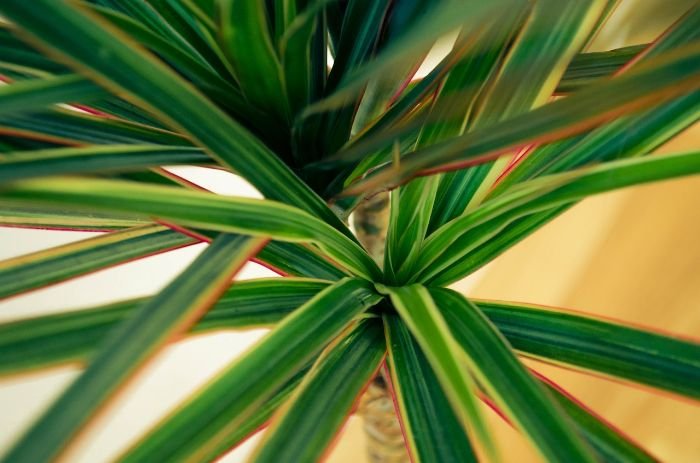
If you want a floor plant that becomes a room feature – tall enough to anchor a corner, visible from across the space – marginata is the most common starting point provided the room has consistent bright indirect light from a south or west window. Song of India fills the same role with more leaf color and slightly less light demand. Both will need ceiling clearance within a few years and respond well to being cut back when they do.
If the household has cats or dogs, pet safety must be checked before buying any dracaena. All dracaenas contain saponins, which are toxic to cats and dogs, as confirmed by the ASPCA Animal Poison Control Center’s plant toxicity database. There is no pet-safe dracaena. Spider plants and parlor palms are the most widely available pet-safe alternatives with comparable ease of care; bromeliads offer a more architectural statement for bright rooms without any toxicity risk.
If you need something for a shelf or desktop that stays under 18 inches, Lucky Bamboo grown in water is the practical answer – no soil, tolerates low light, stays contained. Compacta works for a soil-grown desktop plant, but expect to pay for the slow growth time already invested by the nursery grower.
Conclusion
The range of dracaena varieties is wide enough that most room conditions have a valid match somewhere in this genus. The mistakes happen at the buying stage – when someone picks by leaf color or height and places the plant in a spot that cannot support it. Marginata in a dim corner, Compacta in a room that is too warm and dry, Song of India in a north window: all of them will survive for months before the damage becomes visible, which makes the cause easy to misread and slow to correct.
Pick the variety that fits the light and the space you have, not the one that looked best in the store. A Corn Plant that fills out steadily in a low-light hallway over three years is more satisfying than a marginata that never settles. When the leaves stay full and the color holds without intervention, you know the match was right from the start.
FAQ
Which dracaena variety is best for low light?
Dracaena fragrans (Corn Plant) and D. deremensis ‘Janet Craig’ are the two with documented tolerance for genuinely low light – as low as 25-50 foot-candles, which is typical of interior rooms without close window access. D. trifasciata (snake plant) handles an even wider range and survives near-dark conditions, though growth drops to almost nothing below 50 foot-candles. Avoid D. marginata and Song of India in dim rooms; they will survive but will not hold their color or form, and the slow decline is hard to reverse once it starts.
Why does my dracaena have brown leaf tips?
Brown tips on dracaenas are most commonly caused by fluoride accumulation from tap water, not underwatering. Dracaenas store fluoride in leaf tissue rather than processing it, and the tips are the first to show damage. Switching to filtered, distilled, or collected rainwater typically stops new browning within two to three watering cycles. If the leaves are yellowing with limpness rather than just browning at the tips, inconsistent watering or low light is the more likely cause – fluoride damage looks crisp and brown, not yellow and soft.
Are all dracaena varieties toxic to cats and dogs?
Yes. Every species in the Dracaena genus – including recently reclassified members like snake plant (D. trifasciata) and Lucky Bamboo (D. sanderiana) – contains saponins. In cats, ingestion can cause vomiting, lethargy, and dilated pupils; in dogs, vomiting and hypersalivation. There is no pet-safe dracaena. The toxicity level is considered mild to moderate rather than severe, but veterinary contact is recommended any time a pet ingests plant material.
What is the difference between dracaena marginata and dracaena fragrans?
The differences are significant in practice. D. marginata is a tree form – multiple trunks, narrow burgundy-edged blades, a distinctly architectural silhouette that grows 12-24 inches per year in good light. It needs bright indirect light to maintain its form. D. fragrans (Corn Plant) grows broad strap leaves from a single thick cane, tolerates genuinely low light, and grows more slowly. Fragrans occasionally produces a flower cluster with a strong sweet fragrance – a rare event indoors, but striking when it happens. Marginata almost never blooms indoors. If your room is bright, marginata is the statement plant; if it is dim, fragrans is the practical one.
Can dracaena grow in water?
D. sanderiana (Lucky Bamboo) is specifically suited to water growing and is commonly sold that way – water is its preferred growing medium for home use. Other dracaena species can root in water and be propagated that way, but they do not perform as well long-term in a fully aquatic setup. A soil-grown dracaena cane placed in water will typically root but shows reduced vigor compared to a soil transfer, because roots adapted for water differ structurally from soil roots. Lucky Bamboo is the one variety where water growing is a legitimate long-term option, not just a propagation method.
What happens if a dracaena outgrows its space?
Cut the main cane at the height you want. Most dracaena varieties will sprout new growth just below the cut within four to eight weeks. The cut section can itself be rooted as a new cutting if the stem is green and healthy. Marginata and fragrans respond well to this; Compacta branches very slowly after a cut and may take several months to show new growth. Cut into green tissue only – at least a few inches above any discolored or browning section – and the plant recovers cleanly. Cutting too close to dead tissue is the most common mistake, and it slows the response significantly.
Is snake plant the same as dracaena now?
Botanically, yes. A 2017 molecular phylogenetic analysis reclassified Sansevieria into the Dracaena genus based on DNA evidence. The common snake plant, formerly Sansevieria trifasciata, is now officially Dracaena trifasciata. Most US nurseries still sell it under the Sansevieria label or simply as “snake plant,” and that labeling will likely persist for years given the name recognition. The care requirements have not changed. A care guide written for Sansevieria trifasciata applies identically to what is now called D. trifasciata – the reclassification was taxonomic, not practical.