Updated April 22, 2026
There are over 3,500 bromeliad species, and most of them will grow indoors – but not all of them in your specific window. Choosing the wrong genus for your light level is the most common reason a bromeliad looks great in the store and fades at home. The family spans squat earth-huggers that thrive in near-darkness, architectural rosettes that want morning sun, and rootless air plants that anchor to a piece of driftwood with no pot required.
Pick up an Aechmea in summer when the sun fills a south-facing room, and it looks obvious. Move it three feet from that window in January, and the mistake becomes clear. Knowing what your space actually offers – not what you wish it offered – is where bromeliad selection starts.
Key Takeaways:
- Measure your light before choosing a genus – rooms below 150 foot-candles suit Cryptanthus and Neoregelia, not Guzmania
- Replace cup water every 1-2 weeks to prevent bacterial rot in Aechmea, Vriesea, Guzmania, and Neoregelia
- Expect one bloom cycle per plant – the offset pup flowers again in 12-18 months under good conditions
- Avoid overwatering the soil: bromeliads absorb moisture through leaves and cup, and root rot sets in faster than it does with most houseplants
- Match variety to purpose: choose Guzmania for a 4-6 month color display, Neoregelia for permanent foliage interest
Table of Contents
Bromeliad Selection Starts With Light – Everything Else Is Preference
Most plant guides describe bromeliads as “easy” without distinguishing between genera that genuinely tolerate shade and those that need a bright east or west window to produce any color at all. That gap between genera is real. It determines whether you are setting yourself up for success or frustration before the plant ever leaves the nursery.
The Bromeliad Society International recognizes 72 accepted genera within the family, covering habitats from cloud forests to semi-desert rock faces. Nearly all of them originate in the Americas – one species, Pitcairnia feliciana, grows in Guinea and stands as the only bromeliad native to Africa, likely carried there by birds millions of years ago. The six genera you will find at most garden centers – Guzmania, Neoregelia, Aechmea, Vriesea, Tillandsia, and Cryptanthus – sample very different points on that habitat spectrum. Two decisions narrow that list to one or two candidates for your space: how much indirect light your chosen spot receives, and whether you want the plant to deliver a temporary color event or a permanent foliage display.
| Genus | Light Requirement | Main Appeal | Bloom Duration | Tank Plant |
|---|---|---|---|---|
| Guzmania | Bright indirect | Long-lasting flower bract | 4-6 months | Yes |
| Neoregelia | Medium to bright indirect | Year-round foliage color | Inconspicuous | Yes |
| Aechmea | Medium to bright indirect | Bold structure and spike | 3-6 months + berries | Yes |
| Vriesea | Medium indirect | Patterned leaves and spike | 3-5 months | Yes |
| Tillandsia | Bright indirect to some direct | No soil, versatile display | Varies by species | No |
| Cryptanthus | Low to medium indirect | Ground-level foliage, compact | Inconspicuous | No |
One more variable matters before buying: do you want a plant that holds water in a central cup, or one that absorbs moisture entirely through its leaves? Tank-forming genera (Guzmania, Aechmea, Vriesea, Neoregelia) need their cups refilled every week or two and the water flushed occasionally to prevent stagnation. Tillandsia and Cryptanthus require no cup management at all – which matters if you travel or prefer a lower-touch routine.
Guzmania – The Variety That Blooms for Four Months Without Drama
Guzmania is the most widely sold bromeliad in the US, and for good reason: it blooms reliably, holds that bloom for four to six months, and asks for relatively little in return. The flower you see is not a true flower but a bract – a modified leaf structure that holds its color long after the small white flowers inside it have finished. This is the source of Guzmania’s staying power on a shelf.
Cultivars Worth Knowing
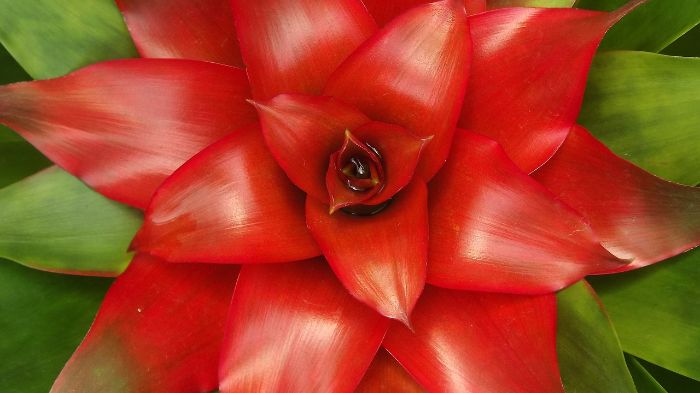
Guzmania lingulata is the species most commercial cultivars derive from. In nurseries you will find it sold as ‘Luna’ (pure yellow bract), ‘Empire’ (deep red with a compact rosette), and ‘Rana’ (orange with faintly green-tinged tips). Size ranges from compact forms that sit comfortably in a 4-inch pot to fuller rosettes reaching 18 inches across at maturity. The foliage is plain gloss green, which means the bract carries the entire visual weight – so cultivar color choice matters more here than in genera where the leaves themselves are decorative year-round.
What Guzmania Needs to Perform
Bright indirect light is the baseline. A north-facing window will keep Guzmania alive but tends to produce washed-out bracts at reduced size. East- or west-facing windows with 3-4 hours of filtered sun are ideal. Direct midday sun bleaches the foliage within weeks.
The plant will bloom once, then slowly decline while producing one to three offsets at its base. Those pups can be separated when they reach roughly one-third of the parent’s size and will bloom again in 12-18 months. According to Clemson Cooperative Extension, a single parent plant can yield multiple generations of pups if kept in good condition – which makes Guzmania a long-term investment despite the single bloom cycle.
Pro Tip: To trigger a reluctant Guzmania to bloom, enclose the plant loosely in a clear plastic bag with a ripe apple for 7-10 days. The apple releases ethylene gas, which signals the plant to initiate its bloom cycle. Remove the bag immediately if condensation turns opaque.
Neoregelia – When Foliage Is the Whole Display
Neoregelia is the genus for people who want year-round color without waiting for a bloom cycle. Unlike Guzmania, which is essentially a green plant until the bract appears, Neoregelia carries its color in the leaves themselves – in banding, spotting, streaking, or solid flushes of red, bronze, and cream that intensify as light exposure increases.
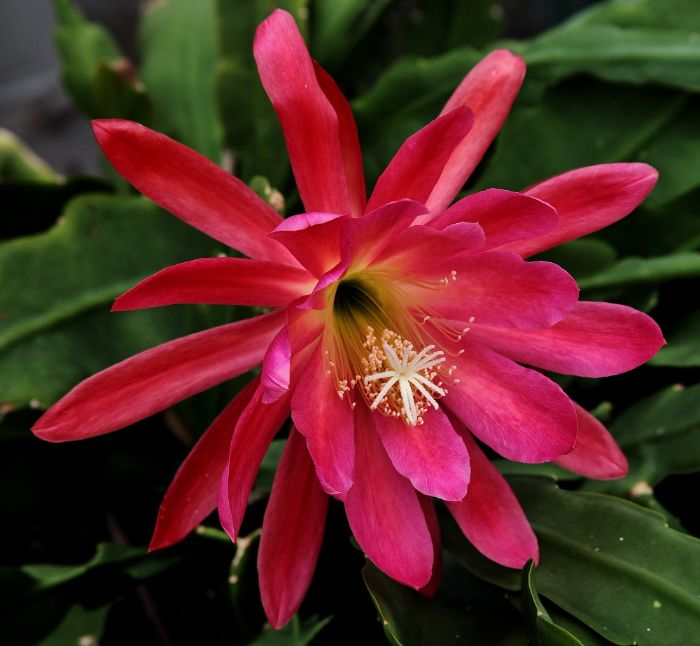
Reading the Center Cup as a Signal
The innermost leaves of Neoregelia flush bright crimson in the weeks before the plant blooms – a change so reliable it functions as an internal countdown. The actual flowers are tiny and sit below the water line of the cup, which means they go almost unnoticed. What remains visible is a deepening center color that can persist for months after flowering has finished.
Neoregelia carolinae ‘Tricolor’ is the most recognizable cultivar: green-and-cream striped leaves with red tips, a tight rosette that stays under 12 inches across. ‘Fireball’ is the compact outlier – a dense, dark-red miniature reaching only 4-6 inches across, widely used in terrariums and dish gardens. Neoregelia concentrica shows large purple-blotched leaves and reads better as a focal point than as a grouping plant.
Observation: I often notice that Neoregelia placed in medium indirect light holds its leaf pattern but loses red color intensity within a few weeks. Moving it closer to a bright east window – without any direct sun – is usually enough to restore that depth of color within a month.
The honest tradeoff with Neoregelia: it performs best with more light than many buyers expect, and in genuinely low-light rooms the foliage color flattens noticeably. The table above marks it as “medium to bright indirect,” but the upper end of that range is where the color really shows.
Aechmea – Structure and Shelf Presence That Outlast the Bloom
Aechmea fasciata is one of the few bromeliads whose visual interest comes from three different sources at once: the silver-banded grey-green leaves, the powder-pink bract, and the blue-violet berries that follow as the bract fades. Those berries can persist for six months or more, which extends the display window well past any other genus on this list.
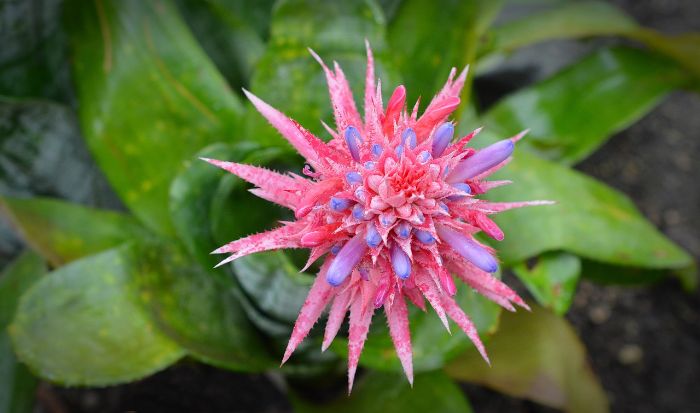
The leaves have a stiff, architectural quality – they feel almost like hard rubber, and the silver cross-banding gives them a matte, textured finish that reads differently depending on the angle of light. This is a plant that belongs on a table or low shelf where it is seen from the side rather than above.
Other Aechmea Worth Knowing
Aechmea chantinii, sometimes called the Amazonian zebra plant, has more dramatic leaf banding and a longer, branched flower structure. It is harder to find but worth seeking at specialty bromeliad nurseries. Aechmea ‘Blue Tango’ is a compact hybrid with a dense blue-and-pink inflorescence – shorter lived than fasciata’s bract but distinctive while it lasts.
The University of Florida IFAS Extension notes that Aechmea tolerates lower light than Guzmania, making it more forgiving in rooms that do not receive direct exposure. It still needs indirect brightness to produce its bract reliably, but it will hold its foliage through a winter period with reduced light in a way that Guzmania may not.
Vriesea Varieties – Patterned Leaves With a Spike Above
Vriesea straddles the line between foliage plant and flowering plant better than most. The leaves on the majority of Vriesea species carry horizontal banding in shades of dark and lighter green, occasionally with maroon or silver overtones – a pattern that makes them visually interesting before any bloom spike appears.
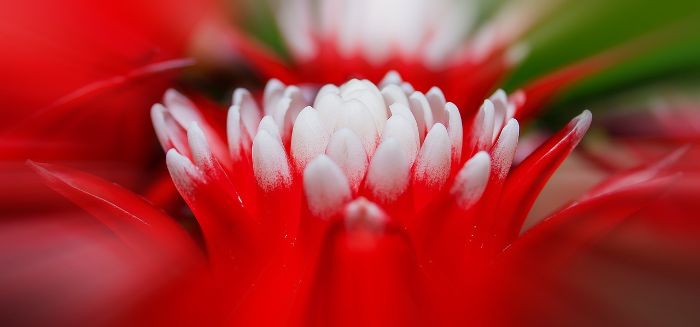
Vriesea splendens, commonly sold as Flaming Sword, is the reference plant for the genus: a flat-bladed red or orange inflorescence that rises 18-24 inches above the rosette and holds its color for 3-5 months. The blade-like shape is distinct enough to read clearly from across a room, making it useful in spaces where most plants disappear against a busy background.
The University of Wisconsin Extension describes Vriesea as one of the more shade-tolerant flowering bromeliads, capable of performing in spots with 150-200 foot-candles of indirect light – conditions where Guzmania would struggle to produce a bract. That tolerance makes Vriesea a practical option for hallways or north-facing rooms where you still want something that blooms.
The failure state is worth naming clearly: if Vriesea is placed too far from any natural light source, the bract loses color saturation and the leaf banding fades to a uniform dull green. The plant survives. It just no longer looks like itself.
Tillandsia – No Soil, No Tank, Different Rules
Tillandsia is the largest genus in the bromeliad family. Close to 650 species according to the Bromeliad Society International – ranging from the Spanish moss draping live oaks in the American South to desert-adapted forms clinging to cacti in Baja California. It is also the genus most commonly misunderstood as a novelty item rather than a plant with specific, meaningful requirements.
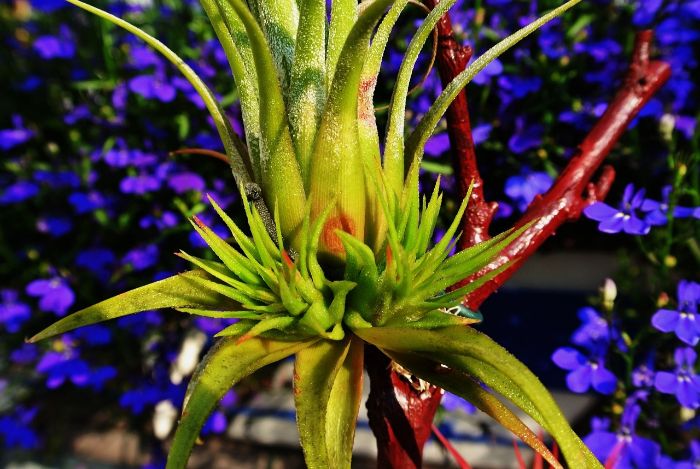
Three Species That Cover the Range
Tillandsia xerographica is the genus’s showpiece. It forms a wide rosette of thick, silver-grey leaves that curl outward at the tips, reaching 12-18 inches across at maturity. The silver color comes from dense trichomes – scale-like surface structures that absorb water vapor from the air and help the plant manage moisture in dry conditions. The texture and weight of the leaves feel unlike any other bromeliad: substantial, faintly waxy, with tips that spiral loosely like old ribbon. In good light, xerographica has a sculptural presence that no potted bromeliad matches. It is also among the most drought-tolerant air plants, making it suitable for drier homes with fewer watering opportunities. Mounting it on cork bark or driftwood shows the form best and is how the Clemson Cooperative Extension recommends displaying most epiphytic Tillandsia.
Tillandsia ionantha is the other end of the scale: a compact, spiky species roughly 2-3 inches tall that flushes bright red when approaching bloom and produces a small violet flower. It is inexpensive, available everywhere, and easily grouped on cork bark or wire frames. The bloom cycle is shorter than xerographica’s, but the red coloration phase alone lasts several weeks.
Tillandsia cyanea – the pink quill – is different enough from other Tillandsia to surprise most buyers. It has strap-like leaves, grows in a potting mix rather than mounted, and produces a flat pink paddle bract with violet flowers emerging from its edges. Of the three, it requires the most careful watering management and performs best with consistent humidity above 50 percent.
Mounting and Watering Logistics
Air plants are watered by submerging them in room-temperature water for 20-30 minutes once a week, then shaking off the excess and letting them dry upside down within 4 hours. Leaving water trapped at the base of the rosette is the most common cause of rot. Mounted or hanging displays – on cork, wood, or wire frames – encourage the airflow that prevents this, which is why mounted Tillandsia consistently outlive those kept in closed glass containers.
If Tillandsia absorbs moisture through its leaf surface rather than its roots, why does it rot so readily when its base sits in trapped water? The trichomes that pull in humidity cannot push out excess – once water pools at the growing point for more than a few hours, the damage to the base tissue begins. Dry air pulls; it does not drain.
Conclusion
Bromeliads reward the buyer who starts with the room, not the plant. Light level sets the genus. The choice between a temporary color event and a permanent foliage display narrows it to one or two candidates. From there, cultivar selection comes down to preference – the red bract of Guzmania ‘Empire’ and the yellow of ‘Luna’ ask the same of your window.
One detail most buyers overlook: all tank-forming bromeliads should have their cup water refreshed every 1-2 weeks and fully flushed once a month. Stagnant water in low-airflow conditions will smell within two weeks. A bromeliad kept in good condition – clean cup, appropriate light, modest soil moisture – will produce a pup that blooms on roughly the same schedule as the parent. That second bloom, after you have grown the offset yourself, is usually the one that confirms you have found the right match for your indoor plant collection.
FAQ
What is the easiest bromeliad to grow indoors?
Guzmania lingulata is the most forgiving of the tank-forming genera for typical indoor conditions. It tolerates bright indirect light without burning, holds its bract color for four to six months with minimal input, and produces offsets reliably. For a truly low-maintenance option with no cup management at all, Tillandsia ionantha requires only a weekly soak and dries quickly – though its bloom is shorter and less dramatic than a Guzmania.
Do bromeliads need direct sunlight?
Most indoor bromeliad genera perform best in bright indirect light – the kind that casts a soft shadow but not a sharp one. Direct sun through a south or west window during summer will bleach Guzmania and Vriesea foliage within weeks. Tillandsia xerographica is the practical exception: it handles several hours of direct morning sun and benefits from it in terms of leaf coloration and compact form. As a general reference point, if the spot feels comfortable for reading in natural light without squinting, it is within the right range for most bromeliads.
Can you rebloom a bromeliad after it flowers?
The parent plant blooms once and will not rebloom regardless of care. What you can do is grow out the pups – offsets that emerge at the base of the parent after flowering. Separated when they reach one-third to one-half the parent’s size, pups grow into full plants and bloom again in 12-18 months under good conditions. This is the standard propagation cycle for the family, and it means a single purchased plant can produce flowering descendants for years if the offsets are kept and tended.
What happens if I don’t refill the cup on my bromeliad?
In dry indoor air below 40 percent relative humidity, a tank bromeliad with an empty cup will begin showing brown, papery leaf tips within two to three weeks. Bromeliads absorb moisture through the cup and through leaf surface tissue, and in low-humidity environments the cup is the primary water source. Leaving it dry for extended periods stresses the plant during active growth and can shorten the bloom cycle on plants that have not yet flowered. The maintenance cadence that prevents both desiccation and rot is a weekly refill and a full flush of the cup once a month.
How do I identify what genus my bromeliad is?
The leaf margin is the fastest identifier for common indoor genera. Aechmea leaves carry small spines along the edges – you can feel them by running a finger from base to tip. Guzmania and Vriesea have smooth margins. Neoregelia also has fine serrations, but usually finer than Aechmea. Tillandsia is identifiable by its silver, trichome-covered surface and the complete absence of a water-holding cup. If the plant has smooth leaf edges and holds water in its center, check the leaf pattern: plain gloss green points to Guzmania, horizontal dark-and-light banding points to Vriesea.
Are Tillandsia harder to care for than potted bromeliads?
They require a different routine rather than a harder one. The main mistake is treating them as decorative objects that need no water – a result of how they are often sold in sealed glass terrariums with no care instructions. Tillandsia actually need more frequent moisture contact than a potted bromeliad in a cup, but the contact time is short: 20-30 minutes of soaking, then dry quickly and completely. The failure mode is rot from trapped water, which happens in low-airflow containers when plants are not dried after soaking. Mounted or open displays eliminate that risk almost entirely.
Which bromeliad has the longest-lasting flower display?
Aechmea fasciata holds the combined display longest when you include the post-bract phase. The powder-pink bract lasts 3-6 months, and the blue-violet berries that follow can persist for another 4-6 months before the plant begins its decline. Guzmania’s bract phase runs 4-6 months with no ornamental follow-up. Vriesea splendens sits in the 3-5 month range. For pure bract longevity, Guzmania cultivars bred for the cut flower trade tend to outlast their garden-center relatives by several weeks, since bract durability is the main selection criterion in commercial breeding.