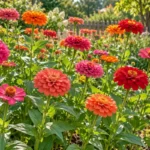

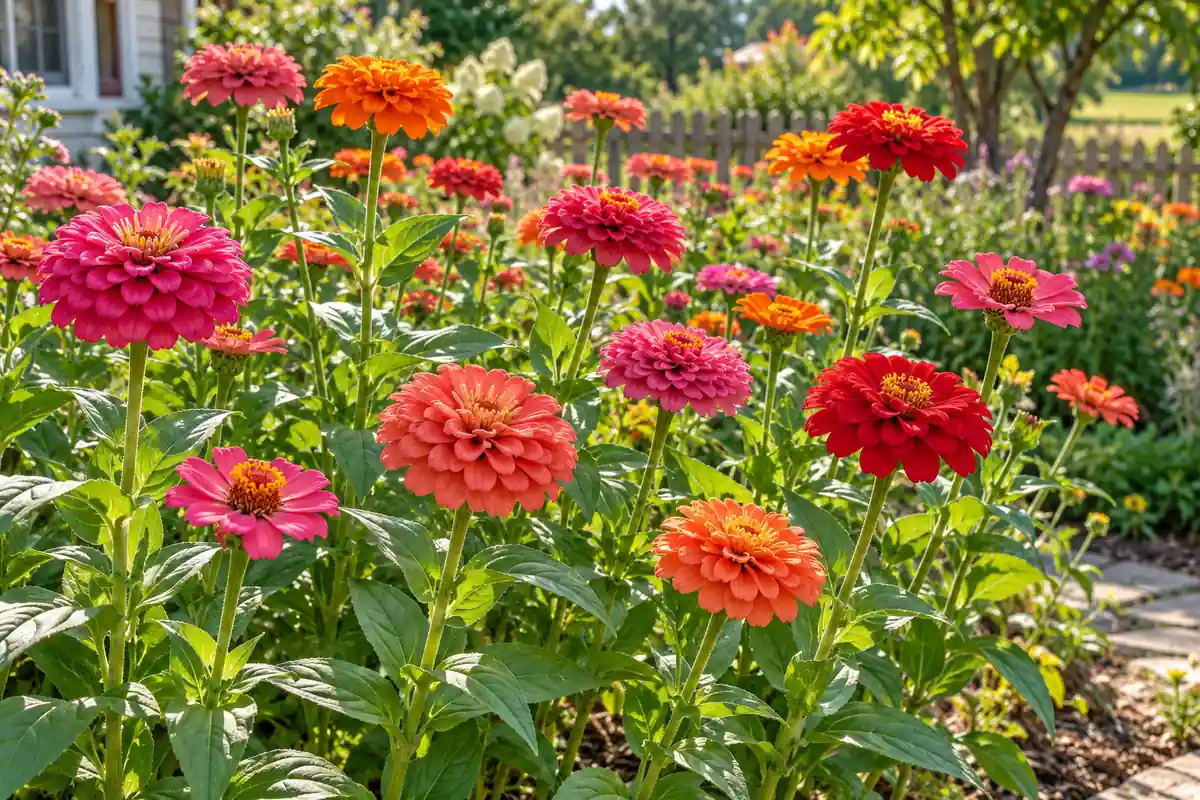
How to grow zinnias starts with choosing a variety that fits the space, planting after frost in warm soil and leaving room for its mature branches. Tall cutting types and compact bedding hybrids need different handling. Give both sun, drainage and attentive watering during establishment, then adjust pruning to the plant you chose.
A seed packet showing one large flower tells you little about the plant beneath it. Some zinnias make low, broad mounds; others send coarse-leaved stems several feet upward. That difference determines the pot, planting distance and whether pinching helps. Flower form matters too: an exposed center gives visiting insects easier access than a tightly packed head. Decide whether you want a front border, patio color or repeated bouquets before sowing. The planting and care become more manageable once the mature shape and purpose are clear.
Match the zinnia to the job
- A low border or pot: choose a compact series such as Profusion, Zahara or Crystal. Check mature width as well as height.
- Long stems for bouquets: choose a tall cutting type such as Benary’s Giant or Oklahoma, with harvesting access and support where needed.
- A warm bed ready for seed: direct sow after frost; Minnesota’s guidance uses 1/4-inch depth and garden soil at least 70°F.
- A short season: start annual zinnias indoors about four to six weeks before safe outdoor planting.
Space for the labeled mature habit. Do not apply a dense commercial cutting-row layout to every home border.
Key Takeaways
- Read mature dimensions before buying a pot or marking rows.
- Wait for frost-safe conditions and check soil warmth before sowing.
- Thin crowded seedlings early so branching leaves retain airflow.
- Pinch selected tall cutters; spare naturally compact branching plants.
- Inspect white growth separately from brown or angular leaf spots.
Table of Contents
Choose Plant Habit and Flower Form Before Sowing
Common garden zinnias include upright Zinnia elegans, lower narrowleaf Z. angustifolia and compact hybrids often labeled Z. marylandica or Z. hybrida. They are usually grown as warm-season annuals. Prairie zinnia, Z. grandiflora, is a different perennial species and does not follow every annual seed-starting timetable.
The cultivar name is more useful than a general promise of dwarf or giant flowers. Wisconsin Extension’s zinnia species and cultivar descriptions show how much both height and spread vary. A short plant can still occupy considerable bed width.
| Garden aim | Examples to consider | What changes in care |
|---|---|---|
| Low edging or small container display | Crystal series; compact narrowleaf plants | Allow the labeled spread; do not expect long bouquet stems. |
| Broad, compact border color | Profusion or Zahara hybrids | Leave width for the mound; routine deadheading may be unnecessary for Profusion. |
| Repeated cutting | Benary’s Giant or Oklahoma | Keep stems reachable, consider support and use cultivar-appropriate pinching. |
| Flowers for visiting insects | Single or open-centered semidouble selections | Check exposed flower centers as well as plant size and disease tolerance. |
Single flowers show their central disk clearly. Semidoubles have additional petal rows with some center still visible. Dense doubles can conceal it. Pollinator access varies with cultivar, so do not assume every showy head supplies equal pollen or nectar. A mix of pollinator-friendly plants can extend feeding opportunities beyond the zinnia season.
How to Grow Zinnias From Seed or Young Transplants
Direct sowing suits a frost-free bed that has warmed enough for germination. Indoor starts help when the outdoor season is short. Seedlings do not gain much from being set into cold, wet ground merely because they have outgrown their tray.
Measure soil temperature in the seedbed, not afternoon air above it. University of Minnesota’s outdoor directions use at least 70°F for direct sowing and about 60°F for setting out transplants. The frost risk must also have passed. These are different stages: an established young root system and a germinating seed are not interchangeable.
| Planting route | Sequence and check |
|---|---|
| Direct sow | Wait for frost-safe, warm soil. Sow about 1/4 inch deep, following the packet. Keep the seed zone evenly moist until emergence, then thin to the cultivar’s spacing. |
| Start indoors | Sow annual types about four to six weeks before safe setout. Use clean seed-starting medium, suitable warmth and shallow covering. Give seedlings bright light promptly after emergence. |
| Set out transplants | Gradually acclimate seedlings to outdoor sun and wind. Plant into warmed, drained soil after frost danger. Water the root ball and check establishment before allowing longer dry periods. |
Wisconsin lists 65 to 70°F for annual seed germination; Minnesota gives a warmer indoor example of 70 to 75°F. Use the seed supplier’s directions and keep the medium temperature consistent. Favorable germination times are examples, not a deadline after which every ungerminated seed is dead.
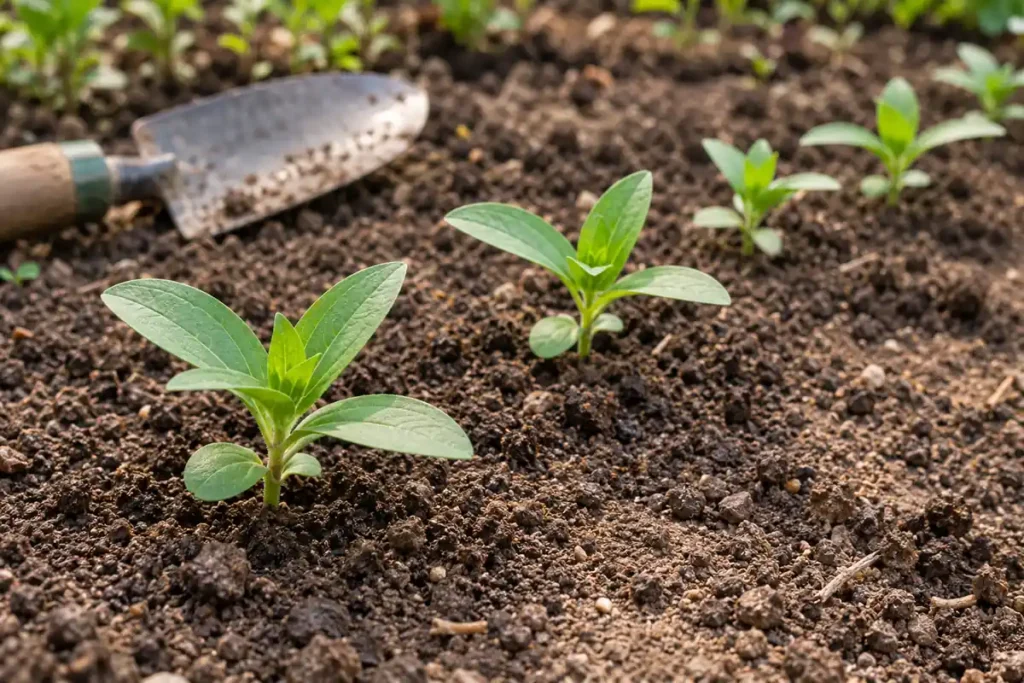
Keep the shallow seed zone moist without leaving it saturated. Check below the surface if nothing emerges: cold mix, dried seed contact or damaged seed can require different corrections. Once shoots appear, uncover the tray and provide light and air. A warm sealed cover left over growing plants can keep the stems too damp.
Collapsed stems, weak stretched growth and yellow leaves are different seedling problems. Identify the symptom before adding water or fertilizer. Handle transplants by their root ball and avoid tugging tender stems.
Give Mature Leaves Sun, Space and Moving Air
Choose a genuinely sunny site. North Carolina State classifies full sun as at least six hours of direct light; Minnesota recommends eight or more hours for strong zinnia performance. A six-hour bed is not automatically unsuitable, though a shadier location can produce weaker growth and fewer flowers. Check the changing shade from buildings, fences and taller plants.
A flower choice matched to the available light is more productive than feeding a sun-loving plant in a shaded corner. Also leave open air around the canopy. Dense leaves pressed against a wall can stay humid even when the flowers receive afternoon sun.
Home-garden spacing ranges roughly from 8 to 24 inches in Minnesota’s guidance, depending on plant habit. Read the chosen cultivar’s mature width and measure center to center. Flower-head diameter is not the planting distance. Two small transplants set close together can become overlapping mounds within weeks.
Commercial cutting instructions sometimes use much closer in-row distances. Mississippi State describes a managed cut-flower system with six inches within rows and two feet between rows. That layout includes a different harvesting routine and possible support. It is not a universal shortcut to more flowers in a humid home bed.
For pots, choose a compact plant and a container with working drainage holes and room for its roots and mature canopy. A narrow decorative pot may hold a small transplant yet dry rapidly once flowering branches fill out. Keep water from collecting in an undrained outer container. Tall cutting varieties are usually easier to manage in a bed with reachable stems.
Adjust Water and Feeding to the Root Zone
Water a newly planted root ball before it dries through, then check the surrounding soil as the roots spread. For established bed plants, feel the upper one to two inches before watering. Loose dry soil crumbles; wet soil clings and feels cool against the fingers. Rain, wind and a hot container can change the interval considerably.
Apply water at the base so it reaches the root zone without repeatedly splashing soil onto leaves and petals. Avoid leaving the roots in saturated soil. A wilted plant in a heavy, wet pot needs drainage checked, not another automatic soaking.
Do not diagnose every pale leaf or pause in flowering as hunger. Check light, root moisture and plant health first. Use a soil test or known soil fertility to decide what nutrients are needed. A soil test suited to the nutrient question is more useful than buying a bloom booster solely because flowers slowed.
Feeding advice differs among growing guides. Minnesota’s general zinnia page suggests regular bloom feeding; its disease guidance emphasizes soil-test needs and avoiding excess nitrogen. Apply fertilizer to an identified need and follow the product rate. Extra phosphorus is not a guaranteed solution for an already fertile bed.
Heat-loving does not mean uninterrupted flowering under every summer condition. North Carolina State notes a possible bloom slowdown during peak southern heat. If moisture and roots are healthy, watch the new buds as temperatures ease. Increasing fertilizer without finding a deficiency can add soft foliage without correcting the heat response.
Pinch Growing Tips and Remove Spent Blooms Selectively
Pinching and deadheading remove different structures at different times. Pinching takes the young growing tip to encourage side branches. Deadheading removes a finished flower before the plant devotes more growth to seed development. Bouquet cutting can also remove flowers and leave nodes that produce later shoots.
| Operation | When it fits | What to leave |
|---|---|---|
| Pinching | A vigorous tall cutting variety when branching is wanted | Healthy true-leaf nodes below the removed tip |
| Deadheading | A faded flower on a variety that responds to regular removal | A living leaf pair or branching point below the cut |
| Leaving flowers alone | A compact self-cleaning type such as Profusion, or selected flowers retained for insects | Healthy growth; remove only damaged material as needed |
For Benary’s Giant cutting plants, Minnesota’s trial-based recommendation is to pinch after three or four sets of true leaves develop. Use clean snips just above a retained leaf pair. The rounded seed leaves at the bottom are cotyledons, not the true-leaf sets used for this stage.
Pinching trades the dominant tip for branching. It can delay the first main flower, so it is a deliberate cutting-garden choice. Do not pinch every compact seedling on the assumption that all zinnias need the same treatment.
For an ordinary faded head, follow its stalk down to a healthy leaf pair and cut above that point. Avoid leaving a long bare stub. Compact Profusion hybrids can produce new flowers above older ones without compulsory deadheading, an exception documented by North Carolina State. Tidying them is optional when the plants are otherwise flowering well.
Cut Fully Developed Flowers and Retain New Shoots
Choose an open, developed head held upright on a sound stem. A tight green bud or floppy young head is a poor bouquet candidate. The petals should look fresh, and the stem should feel firm enough to carry the flower without folding.
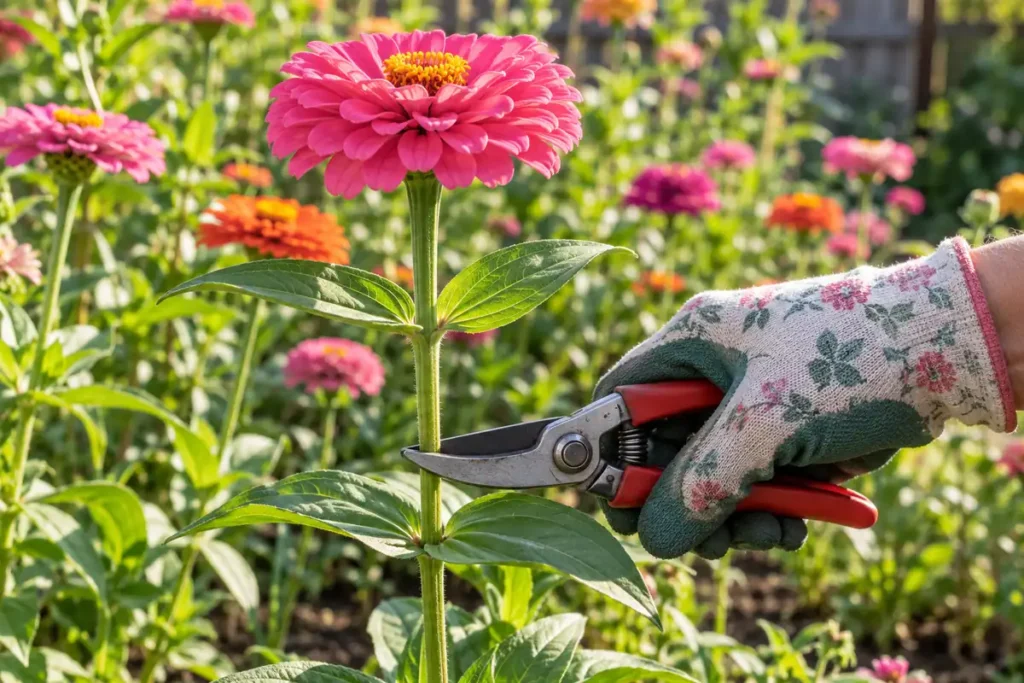
Cut during a cool part of the day using clean, sharp snips. Mississippi State’s harvest guidance leaves two or three leaf pairs on the remaining stem for subsequent growth. Place cut stems promptly into a clean water bucket and move them out of direct heat. Keep foliage that would sit underwater out of the vase.
Protect tall stems before they lean or fall across a path. Stakes or suitable flower support can help in exposed cutting beds. Minnesota’s Benary’s Giant trial did not test netting, so its results do not establish a universal gain from installing it. Let wind exposure and stem behavior determine whether support is needed.
Leave some open-centered flowers standing if insects are part of the planting’s purpose. A cutting bed and a feeding patch can share space, provided the harvest does not remove every usable bloom at once. No fixed number of bouquets per plant follows from a cultivar’s advertised height.
Separate Powdery Mildew From Spots and Root Stress
White or gray flour-like patches suggest powdery mildew. Round brown lesions, angular dark spots or gray fuzzy decay point toward other possibilities. Check the leaf surfaces, undersides, stems and flower heads before choosing a treatment.
| Visible sign | Possible cause | First useful response |
|---|---|---|
| White-gray powder over leaf surfaces | Powdery mildew | Check severity, spacing and flowering; tolerate mild cases that do not impair growth. |
| Angular dark spots with yellow margins | Bacterial leaf spot is one possibility | Avoid working wet plants or splashing foliage; obtain diagnosis for spreading damage. |
| Round reddish-brown spots with pale centers | Alternaria leaf spot is one possibility | Remove badly affected material, reduce splash and reassess airflow. |
| Wilt with persistently saturated soil | Root stress or root disease | Check drainage and root condition before watering again. |
| Stippling, webbing or chewed edges | Mites or chewing insects may be involved | Inspect undersides and find the pest; holes alone do not identify it. |
Powdery mildew can infect without a film of water on the leaf. Root-zone watering helps reduce splash-related problems, but it cannot guarantee mildew prevention. Resistant cultivars, sunlight, airflow and avoiding excess nitrogen all matter. Minnesota’s flower-garden powdery mildew guidance distinguishes tolerable cosmetic infection from disease that reduces growth or flowering.
For recurrent problems, choose a better-adapted, relatively resistant series next season and clear diseased debris. Resistance is not immunity. Fungicides protect susceptible healthy tissue under appropriate directions; they do not erase existing mildew from covered leaves. An uncertain brown spot also does not justify treating for a fungal disease, especially when bacteria may be involved.
Severely distorted green flowers or unusual shoot proliferation deserve a closer diagnosis, including possible aster yellows. Do not keep deadheading a visibly abnormal plant as though ordinary seed set explains it. Consult local Extension when symptoms spread or the cause remains unclear.
Conclusion
Choose the mature plant first, wait for warm frost-safe planting conditions and leave its leaves room to grow. Follow root moisture and new growth through the season. Selective pinching, appropriate deadheading and cutting mature blooms can keep a suitable variety productive, with disease checks guided by what the plant actually shows.