




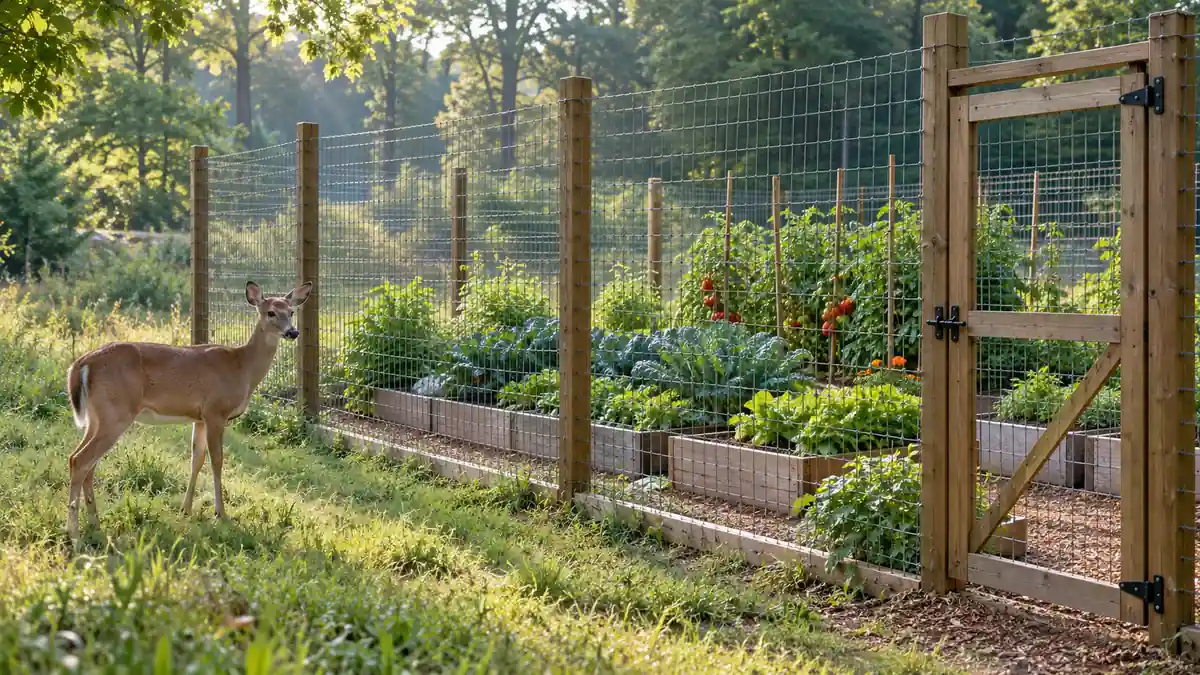
How to keep deer out of garden beds depends on whether you need fewer bites or a barrier that keeps animals away from the crop. For repeated losses, start with physical exclusion; reserve repellents and motion deterrents for supplemental protection or damage you are prepared to tolerate. A row of bean stems with ragged ends and fresh hoofprints in damp soil deserves a different response from a few holes in otherwise intact leaves.
The expensive mistake is buying another deterrent with the same access route still open. A tall fence with an unlatched gate still admits deer, and a tight plant cage loses protection as branches grow through its mesh. Protecting a small vegetable enclosure or a few valuable plants is frequently more manageable than fencing the whole yard. Choose the area first, then a defense you will keep working.
Choose the area you need to protect
Repeated vegetable losses
Enclose the crop with a continuous deer fence. About 8 feet is the conventional passive-fence starting point, with secure gates and a closed lower edge.
A few valuable plants
Use supported individual cages. Keep leaves and shoots inside the protected space as they grow.
Occasional browsing
Try a label-permitted repellent or motion deterrent if some loss is acceptable. Repeated fresh bites call for stronger protection.
Lower fences depend on enclosure design. Electric fencing needs a suitable maintained system; repellents never make a guaranteed deer-proof perimeter.
Key Takeaways
- Confirm the browser before treating every missing leaf as deer.
- Protect fewer plants if whole-yard fencing exceeds your budget.
- Close ground-level gaps because height alone leaves entrances open.
- Inspect after storms and adjust cages as branches expand.
- Read edible-crop labels before spraying vegetables with deer repellent.
Table of Contents
How to Keep Deer Out of Garden Beds: Identify the Browser
Ragged stem ends and missing shoot tips point toward browsing, especially when the same damage appears on shrubs above the vegetable beds. Deer lack upper incisors, so they pull vegetation against a hard upper dental pad and tear it away. Colorado State University Extension’s Preventing Deer Damage distinguishes that shredded surface from the sharper angled cuts left by rabbits. Old, dried damage is harder to interpret.
Inspect a newly damaged stem in good light. Torn fibers have a rough, uneven edge; a clipped stem presents a cleaner face. Then inspect the ground. Paired hoof impressions pressed into cool, damp soil are useful supporting evidence. A damaged plant and a track nearby still need to fit the same event. Photograph fresh marks before rain or footsteps erase them.
Use several clues together before choosing a defense:
- Find newly missing leaves, buds, or shoot tips.
- Compare torn ends with cleanly clipped stems.
- Follow tracks or repeated entry paths toward the damaged plants.
- Inspect shrubs as well as low vegetables for browsing.
- Use a trail camera if the animal remains uncertain.
A camera is an identification aid, not a deterrent. Aim it toward the suspected entrance to record the route into the planting. Insects, rabbits, and deer also visit the same garden, so a deer fence will not resolve every damaged leaf. Integrated pest management starts with identifying the organism and judging the injury before selecting a treatment.
Set the loss you are prepared to tolerate
If an occasional chewed ornamental shoot is acceptable, a monitored deterrent is a proportionate first attempt. Repeated overnight loss of vegetable transplants justifies exclusion sooner. The useful measure of pressure is continuing damage to your protected plants. A universal deer-count threshold would ignore their behavior and the losses involved.
How much of the crop would you accept losing during a deterrent trial? Answer that before spending money. When the answer is almost none, protect the planting before another experiment. A smaller enclosure with a dependable entrance is more useful than a larger perimeter you routinely leave open.
Deer Fence Height Matters Along With Gates and Gaps
About 8 feet is the conventional starting height for a passive deer fence around a garden. That recommendation appears in Iowa State University Extension’s garden deer-fencing guidance. A passive fence works through physical separation, so its lower edge, openings, and access gate belong to the same design.
Measure the protected space before ordering rolls and posts, including the paths needed for harvesting, carrying compost, and moving a wheelbarrow. With raised-bed gardening, enclosing several beds and their working paths avoids opening a separate cover for every task. Bed walls alone do not exclude deer.
Why a lower fence needs a specific setting
Some shorter barriers discourage jumping when the landing space is small or hidden. Iowa State describes a 6-foot fence around an area smaller than 10 by 10 feet, and solid privacy fencing that obscures the landing area, as conditional examples. Neither is a general promise for an open vegetable plot. Keep those exceptions tied to their geometry.
An existing fence that stopped deer last year has demonstrated performance at that site, not a universal height rule. More hungry animals, an easier approach, or a damaged section change the test. University of Minnesota Extension’s Protecting Trees and Shrubs in Winter also warns that motivated deer overcome barriers. Treat repeated intrusion as a reason to reassess the enclosure.
Choose material you will inspect and repair
Woven or welded wire forms a durable barrier; properly supported deer mesh offers a lighter alternative. Plastic mesh is more vulnerable to tears and falling debris, a limitation described in University of Maryland Extension’s The 4 Pillars of Managing Deer Damage. Price the supports, entrance, installation, and repairs together to compare complete enclosures.
Walk the bottom edge before adding height
Deer also enter under or through an incomplete fence. Follow the ground line through hollows, corners, and gate openings. Secure the material using the installation method appropriate to the system, and repair spots lifted by animals or washed-out soil. Leave the entrance shut whenever you are away from the planting.
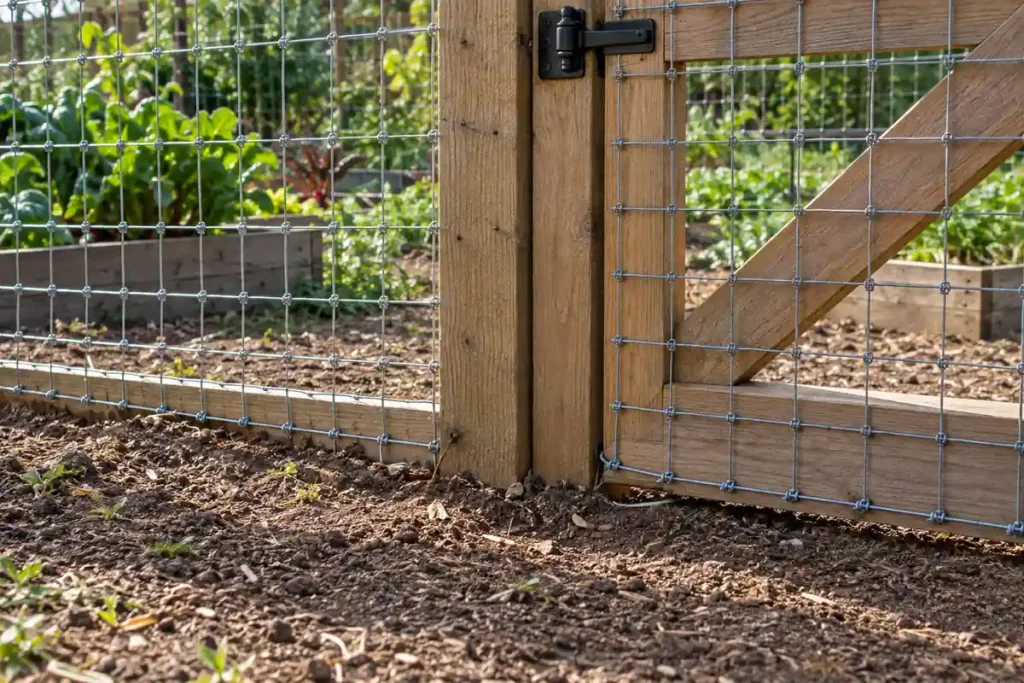
Run the gate through a normal working visit: carry your tools inside, set them down, and close it. A latch that catches cleanly is easier to use than one requiring a lifted, dragging gate. Include that repair in the fence budget. Also keep attractive foliage away from the mesh, where a deer standing outside still reaches it.
Individual Plant Cages Stop Reach Without Fencing the Yard
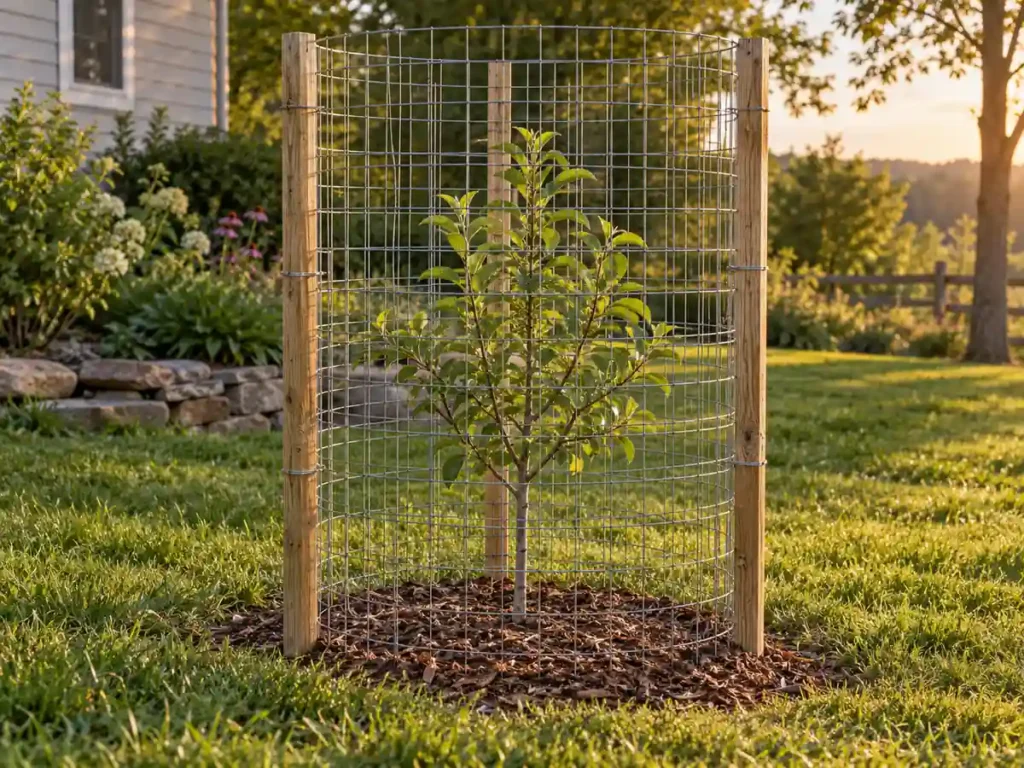
A few vulnerable plants need protection close to the planting. A freestanding cage separates a deer from the leaves and trunk and preserves access elsewhere. Targeted wire cylinders for young trees and shrubs are a small-scale exclusion option in Iowa State’s White-tailed Deer: Damage Management.
Build the protected space around the full plant, including its leaves. Leaves pressed against the wire remain accessible from outside. Allow room for growth and a way to open the cage for watering, pruning, and inspection. A barrier you must dismantle for every visit encourages long periods without protection.
Browsing and antler rubbing need different protection
Missing buds and torn shoot tips indicate feeding. Scraped bark on a young trunk presents another risk: antler rubbing. A narrow trunk guard leaves branches exposed and does not necessarily keep a buck away from the tree. Colorado State’s guidance distinguishes trunk tubes from the additional fencing needed where rubbing remains a problem.
Inspect the support points as well as the mesh. A cage leaning into a flexible sapling transfers pressure to the trunk; loose cut ends and ties also create avoidable contact. Keep the barrier independently supported and adjust it before growth reaches the wire. The goal is separation without rubbing the bark.
For a small vegetable bed, choose a localized enclosure you will close after harvesting. Plant height, enclosure size, and the animal’s reach determine its suitability; there is no single cage diameter or height that protects every planting. A cover intended for insects also needs assessment for deer access and the way it withstands pushing.
Pro Tip: Inspect a plant cage from outside after each flush of growth. If a leaf or shoot crosses the mesh, expand the protected space before browsing begins there.
In an edible landscape, group vulnerable plants where protection and harvesting are practical. Scattering desirable crops across an open yard multiplies the barriers you must open, shut, and maintain. Keep the high-value planting manageable before expanding it.
Electric Fencing Depends on Contact, Layout, and Maintenance
An electric fence discourages contact through an electrical pulse and learned avoidance. Its performance depends on a working system and the animal detecting it. A short electric arrangement therefore has different operating requirements from a tall physical barrier. Temporary polytape and permanent multi-strand fencing should be considered separately.
Match the configuration to the protected area, season, and deer pressure. Iowa State’s wildlife damage-management guidance separates temporary conductive ribbon or rope from permanent high-tensile arrangements and explains that the necessary configuration changes with the setting. A strand count taken from one successful garden does not specify a suitable system for yours.
Temporary and permanent systems ask for different work
Visible conductive tape is suited to seasonal protection where regular inspection is practical. Visibility and the conditioning steps specified for the design matter. Deer that fail to detect a strand or repeatedly penetrate it defeat the intended protection. Follow the complete supported system, including its visibility and conditioning requirements.
Permanent multi-strand designs require deliberate installation and a continuing maintenance plan. Offset or two-tier layouts occupy horizontal space as well as height. The depth-perception difficulty those layouts create is described in Maryland’s deer-management publication. Their wider footprint also affects mowing, paths, and access. An open strip beside a bed is part of that footprint.
Choose a system only if someone will inspect it throughout the protected season. Vegetation touching energized conductors creates leakage or shorts. Branches and damaged components also interrupt performance. A neglected temporary fence loses protection even when its posts still stand upright. Repair the working system before relying on its appearance.
Resolve site fit before ordering equipment
Confirm municipal, property, and association requirements for the proposed fence. Account for children, pets, regular visitors, public access, gates, and the manufacturer’s installation and warning instructions. A purpose-built fence energizer and an appropriate supported design belong together. Do not connect fence wire directly to household power or improvise electrical components.
Discuss the complete layout with a qualified installer or local Extension specialist if the system’s fit is unclear. Describe the garden area, browsing pattern, seasonal use, access needs, and maintenance availability. Those details determine a useful recommendation more than a promise that one, two, or five wires always work.
With frequent browsing, include power and fence-performance checks in each garden visit, using the test equipment and procedure specified for that system. This is a practical operating habit, not a universal inspection interval. After a storm, inspect before assuming yesterday’s protection is intact.
Deer Repellents Lose Protection With Weather and New Growth
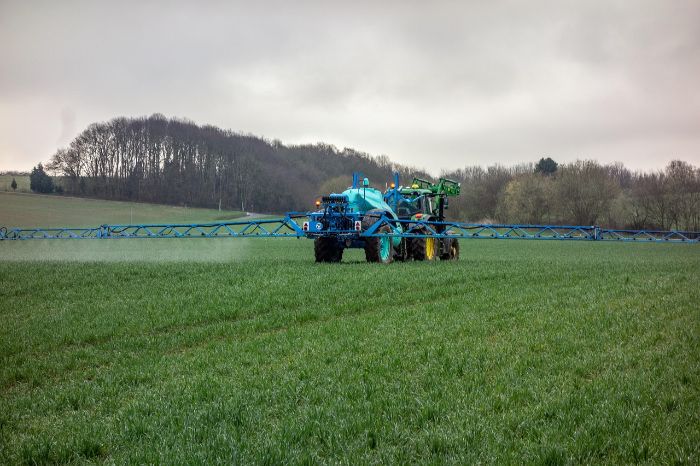
A treated leaf does not protect the fresh shoot growing beside it. Repellents act through taste, odor, or both, and their usefulness changes with the product, weather, deer pressure, and available food. Contact treatments cover plant surfaces; area products are used around the protected space according to their directions.
Before selecting a deer repellent for a vegetable garden, read its label to confirm the intended crop or site, permitted placement, application rate, and harvest restrictions. A product intended for ornamental shrubs is not automatically suitable for lettuce, herbs, or tomatoes. A natural ingredient does not establish permission to spray edible leaves.
Keep edible-crop permission separate from effectiveness
Physical barriers remain the more dependable protection for edible crops; repellents need crop-specific label checks. That distinction appears in the June 2026 Ask Extension answer about protecting tomato plants from deer. Follow the label of the product in your hand. Crop permission comes from those directions.
Mark the treatment date and the plants covered. After rain, overhead irrigation, or rapid new growth, compare conditions with the label’s reapplication directions. There is no single repeat interval for every repellent. Rain and irrigation prompt renewed application for many products, a limitation in the University of Minnesota’s winter tree-and-shrub guidance.
Strong odors are another practical cost. A repellent beside a seating area or harvest path affects how pleasant the garden is to use. Apply only as permitted, keep the container instructions, and judge protection by fresh injury.
Motion deterrents and resistant plants reduce risk
A motion sprinkler needs a working water supply and an unobstructed detection area. Test its trigger using the manufacturer’s procedure, then observe fresh damage. A silent device with a disconnected hose has stopped serving its purpose. Deer also learn predictable stimuli or approach outside the triggered area, so a functioning device still needs outcome checks.
Plant susceptibility is relative. Season, hunger, and alternative forage change browsing, and a rarely eaten plant does not create a physical wall around beans. Keep especially valuable plants protected even when less-preferred ornamentals surround them. Plant selection remains a useful risk reduction layer where some browsing is tolerable.
Soap, human hair, and ultrasonic gadgets do not justify a season-long guarantee. Reported results depend on the setting and the exact method. A home remedy that disappoints in one yard also does not prove every odor treatment fails everywhere. If crop loss continues, move toward exclusion before another planting is lost.
Deer management should also remain separate from treatments for insects. Natural pest control includes measures directed at very different organisms; an insect spray does not repair a deer entrance. Keep each treatment tied to the damage it addresses.
Fresh Browsing Reveals Where the Protection Failed
Start with the location of the new injury. Leaves missing only along the fence suggest reach-through feeding; damaged plants well inside an enclosure require an entrance check or renewed animal identification. Walk the perimeter before buying another deterrent. Match the correction to the observed failure.
After wind or heavy rain, inspect branches resting against the fence and soil pulled away from its bottom. Press a loose support gently to judge movement without leaning your weight into the barrier. A bowed panel and a gate scraping against wet soil are visible repair jobs. Address them before the next unattended night.
Keep a simple record of new damage, location, weather, and the action taken. Old bare stems remain bare after a successful repair; judge the next shoots and buds for new injury. If the same entrance is used again, improve that part of the system. If a correctly operating deterrent still permits losses you cannot accept, protect the crop physically.
Extend inspection through the season. Cages need adjustment as plants expand, and winter browsing places woody growth at risk after vegetable beds are empty. A method that worked when other forage was abundant deserves a fresh assessment when conditions change. Protect the plants still at risk after the vegetable harvest.
Conclusion
Before planting another vulnerable crop, make the entrance as easy to close as it is to open. If a wheelbarrow visit routinely leaves the gate ajar, repair the latch or change the access arrangement before adding more fence. That small working detail decides whether the full perimeter functions during ordinary garden use.
After a repair, photograph the surviving shoot tips and compare fresh growth during your next garden visits. Continuing bites call for another inspection or stronger exclusion. Intact new leaves unfolding above the old ragged stems are the visible result to follow.
Frequently Asked Questions
Will a deer cage also keep rabbits away?
Only if its material and lower edge also exclude rabbits. Large openings in a deer barrier leave small animals a route through, so assess their protection separately. University of Minnesota Extension uses fine hardware cloth and ground-level closure for rabbit protection. Add the appropriate lower barrier when rabbit damage is also confirmed.
Should I remove plant cages when the vegetable season ends?
Winter leaves young trees and shrubs exposed to a different browsing period. Keep suitable protection throughout their vulnerable period, and inspect clearance around branches and trunks. Remove or adjust a guard that is rubbing bark or restricting growth. The vegetable harvest alone does not establish that a nearby young tree is safe.
Will a motion sprinkler work after the water is shut off?
A water-based deterrent stops delivering its intended stimulus when its supply is off. Before seasonal shutdown or freezing weather, choose another suitable layer for plants that still need protection. Drain and store the device according to its instructions. Its continued presence supplies no spray.