




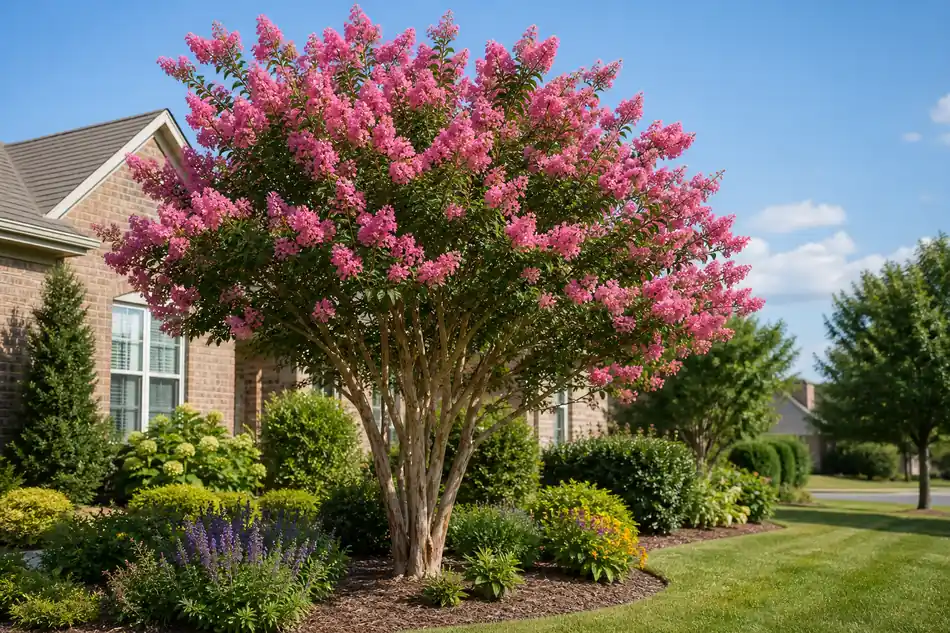
Crepe myrtle care succeeds when the tree gets full sun, open air, deep watering during dry bloom weather, and only light winter pruning. A healthy tree feels almost self-running by midsummer: bark peels in smooth cinnamon patches, flower panicles hold above the canopy, and the leaves stay clean instead of carrying white mildew or black sooty film. Most weak bloom, suckering, and disease pressure starts with three mistakes: too much shade, too much nitrogen, and hard heading cuts that force soft growth. Treat crepe myrtle as a flowering tree with a root system to protect and a natural frame to preserve, and it rewards you with summer color, fall foliage, and winter bark without annual repair work.
Quick Care Check
Give crepe myrtle 6 or more hours of direct sun, water deeply during dry bloom weather, keep 3 to 5 inches of mulch off the trunk, and prune only in late winter to remove suckers, crossing wood, and dead tips.
| What You See | Likely Cause | First Move |
|---|---|---|
| Few flowers and long soft shoots | Shade, excess nitrogen, or hard pruning | Open light, stop feeding, and remove only problem wood next winter |
| White powder on buds or young leaves | Powdery mildew favored by shade and poor airflow | Thin crowded suckers and shift future plantings into full sun |
| Black film on leaves or bark | Sooty mold growing on insect honeydew | Inspect for aphids on leaves and bark scale on stems before spraying |
Key Takeaways
- Give full sun before blaming fertilizer for weak bloom
- Water deeply during bloom droughts, not every shallow morning
- Keep mulch wide and off the trunk flare
- Prune in late winter and leave the top intact
- Check black bark for insects before treating fungus
Table of Contents
Full Sun Drives The Flower Show
Crepe myrtle is a sun-built tree. The flower buds form on current-season growth, and that growth needs bright light, warm wood, and moving air to mature before the summer panicles open. In half shade, the canopy stretches, the flower clusters thin, and the leaves stay damp longer after humid nights.
Full sun is the first care decision because it controls bloom and disease pressure together. Heavy shade is tied to reduced growth, weaker flowering, and more sooty mold or powdery mildew in the University of Georgia Extension crape myrtle culture guidance. Light changes how fast leaves dry after humid nights, and fungal spores germinate more easily when young tissue stays crowded.
Walk around the tree at noon in June. If one side sits under a maple canopy or a roof overhang, the shaded side will usually carry longer internodes and fewer flower buds. Leaves there feel softer and cooler; sunlit leaves feel firmer and slightly leathery. That texture difference comes from cuticle development and carbohydrate supply, not fussiness.
Site choice still matters after planting. If the tree is young and clearly shaded, move it during dormancy before years of feeding and pruning get spent around a light problem. If flower color, mature height, or cold tolerance are still undecided, compare crepe myrtle types and growing habits with the best crepe myrtle varieties by size and climate before pruning becomes the only tool left.
Deep Watering Keeps Summer Panicles From Shrinking
A new crepe myrtle needs consistent moisture as roots leave the nursery ball and enter native soil. An established tree needs less routine attention, though dry weather during flowering still changes the bloom. Panicles can shorten, leaves can dull, and the canopy can pause right when the tree should be pushing its strongest summer display.
Thorough watering at planting, followed by weekly water during dry weather for the first two months, is the establishment rhythm in the UGA Extension culture guidance. That first window is about root contact. Water settles soil around fine roots, closes air pockets, and lets capillary movement pull moisture into the surrounding profile. Correct depth and root flare placement in the crepe myrtle planting guide make that water reach roots without pooling against bark.
Established crepe myrtles tolerate drought better than many flowering ornamentals, and best bloom still needs moisture at root depth. During a dry spell in July or August, push a screwdriver or soil probe 6 inches into the root zone near the drip line. Smooth resistance with a cool feel means the deeper profile still holds moisture. Dry grit, warm soil, and a probe that stops hard at 2 inches mean water is missing the active roots.
Water the whole root zone slowly enough that the surface darkens and stays dark for a few minutes. A fast hose blast makes channels in mulch and can run beyond the root area before soil pores absorb it. In sandy soil, split the watering into two passes 10 minutes apart. In clay, water more slowly and stop if the surface shines or puddles.
Root Flare And Mulch Set The Moisture Boundary
Crepe myrtle roots perform best when oxygen and moisture stay balanced. The tree accepts a wide soil range and declines in a sealed, wet planting hole or under mulch piled against the bark. Roots need pore space for oxygen because respiration powers new root tips. Waterlogged soil slows that respiration, and a buried trunk flare keeps bark damp where it should be dry.
Moist, well-drained soil and full sun sit at the center of the NC State Extension Lagerstroemia indica plant profile, with occasional wet or dry tolerance after establishment. That flexibility helps the tree work in streetscapes and hot yards, and drainage still sets the ceiling. If water sits in the planting area after a normal rain, root stress will show as yellowing leaves, weak extension, and a tree that looks thirsty even when the soil is wet.
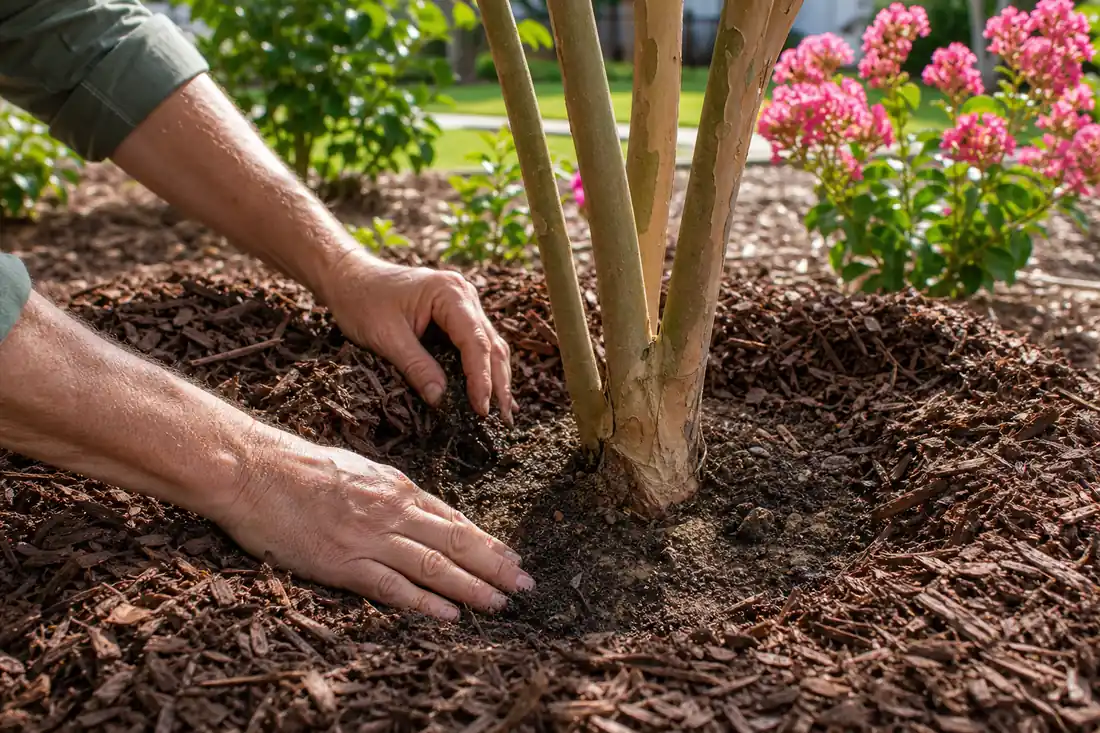
Mulch should look like a wide, shallow blanket, never a cone. A 3 to 5 inch mulch range after planting appears in the UGA Extension guidance, using pine straw, pine bark, shredded hardwood, or shredded leaves to conserve moisture and buffer temperature. Keep that material pulled several inches away from the trunks. You should see the flare widen at soil level, with bark exposed to air.
| Care Detail | Good Range | Failure Signal |
|---|---|---|
| Mulch depth | 3 to 5 inches over the root zone | Wet bark, soft trunk base, or surface roots buried too deeply |
| Root flare | Visible at soil level | Mulch touching stems or soil mounded against bark |
| Water movement | Soaks in slowly without standing | Puddling, sour smell, or water racing through channels |
Do not turn this into a full soil rebuilding project unless the site demands it. A detailed soil preparation plan for crepe myrtle belongs before planting. Once the tree is established, your job is quieter: protect the root zone from heat, keep mulch off bark, and avoid cutting roots with repeated bed edging.
Late-Winter Pruning Protects The Natural Frame
The worst crepe myrtle pruning mistake is trying to make the tree bloom by cutting the top back hard. Crepe myrtle flowers on new growth, and the tree can make that growth without topping. Hard heading cuts create swollen knuckles, weak shoots, and a brushy canopy that catches mildew and aphids more easily.
The right pruning window is late winter to early spring before new growth begins, the same dormant timing used for many deciduous flowering trees. Early fall pruning pushes tender growth as the plant moves toward dormancy, a cold-injury risk flagged in UGA Extension pruning guidance. For a broader timing check across woody plants, the best time to prune different plants keeps crepe myrtle in the late-winter group.
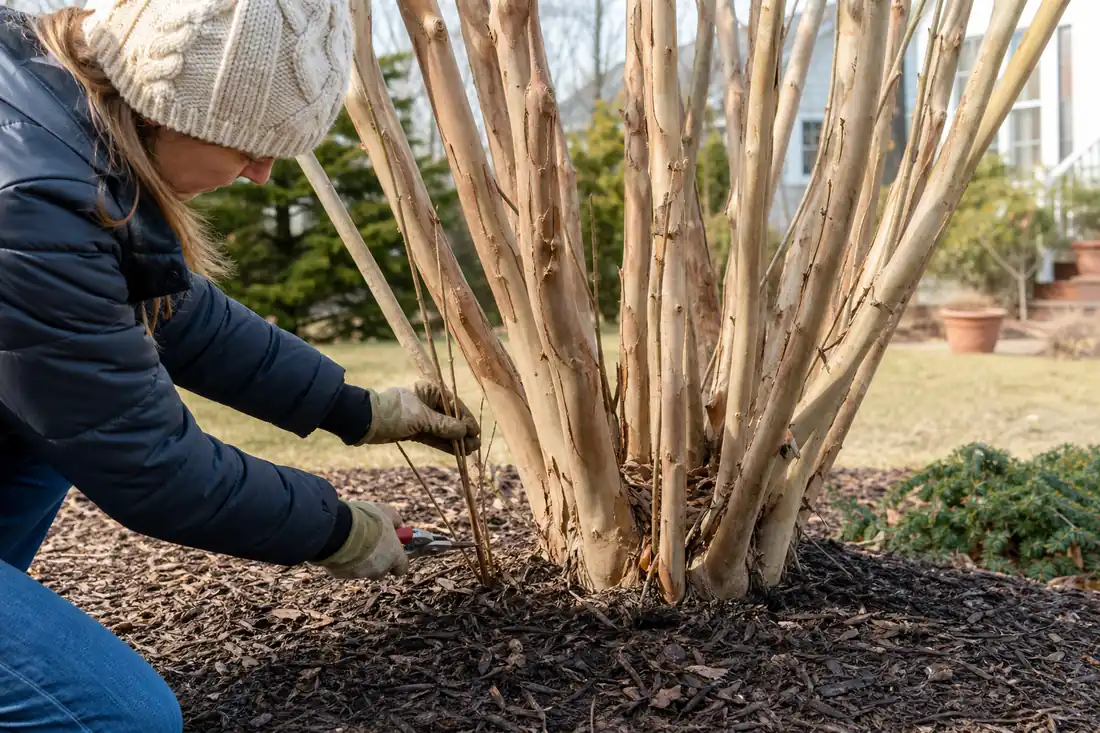
Work from the ground up. Remove basal suckers at pencil thickness. Cut out dead, broken, crossing, or inward-growing branches. Leave the upper scaffold mostly alone unless a branch rubs or crowds the center. A mature crepe myrtle should look like a lifted vase, never a row of stubs.
Three to five well-spaced main trunks usually give the cleanest tree form. UGA’s tree-form guidance uses radially spaced shoots and gradually removes lower side branches as the plant gains height. That slow lift exposes the mottled bark without stripping the canopy that feeds the roots.
What if the tree was already topped years ago? Choose the strongest new shoots from each old cut, then remove the extra whips over two dormant seasons. A single hard correction can leave too little leaf-producing wood. Slow repair looks less dramatic and gives the tree time to rebuild stored carbohydrates and close old wounds.
Light Feeding Keeps Shoots From Outrunning Flowers
Crepe myrtle rarely needs aggressive feeding in decent garden soil. The tree blooms on new growth, and excess nitrogen makes the wrong kind of growth: long, soft, leafy shoots that shade themselves and attract sap-feeding insects. A tree that is dark green, tall, and flower-poor is often overfed or underlit.
For established plants, one spring broadcast feeding with a balanced 8-8-8 or 10-10-10 fertilizer is enough in the UGA Extension culture guidance. The care move is restraint. Feed before rain or water it in, then stop. Repeated summer feeding keeps tissue soft when the tree should be hardening wood and setting a clean rhythm of growth.
Use the soil and the leaves as your first test. Pale new leaves with normal light exposure can point to nutrient shortage, high pH, root stress, or waterlogged soil. Dark green leaves with few flowers point somewhere else. Before adding fertilizer, ask one thinking question: is the tree short on nutrients, or is it already spending too much energy on leaves?
Container-grown dwarf crepe myrtles need more attention because irrigation leaches nutrients from the potting mix. Use a slow-release balanced fertilizer in spring, then watch the internodes. If new shoots stretch far beyond the plant’s usual spacing and bloom drops, reduce the dose next season. The plant is giving you the answer in stem length.
White Powder, Black Film, And Leaf Spots Mean Different Problems
Crepe myrtle problems usually announce themselves on the surface. White powder on buds, yellow leaf spots, sticky leaves, blackened bark, or lacy beetle feeding each points to a different pressure. Treating every mark as a fungus wastes time and can harm beneficial insects that are already working.
Powdery mildew, Cercospora leaf spot, aphids, Japanese beetles, and sooty mold are the recurring issues in Clemson Cooperative Extension’s crape myrtle pest and disease factsheet. The prevention pattern repeats: plant resistant varieties, use full sun, keep air moving, and avoid crowding. Those cultural controls work because they change the leaf surface environment where pests and fungi gain ground.
Powdery mildew reads as a white to gray coating on young leaves, shoots, and flower buds. The Clemson factsheet identifies the pathogen as Erysiphe lagerstroemiae and points to shaded, damp, crowded sites as the worst settings. Rub a leaf gently between thumb and finger. Mildew feels dry and dusty; sooty mold feels darker, filmier, and often follows sticky honeydew.
Cercospora leaf spot behaves differently. Yellow spots appear on upper leaf surfaces, and susceptible cultivars can lose foliage in late summer or fall after warm, moist weather. That timing matters. Early spring white coating points toward mildew; late-season spotting and leaf drop point toward leaf spot.
Black residue deserves a closer look before any fungicide. Sooty mold grows on honeydew from sap-feeding insects. Aphids feed on leaves and tender twigs; crepe myrtle bark scale gathers on stems and trunks. Lady beetles, lacewings, hover fly larvae, parasitic wasps, and insect-feeding fungi all feed on crepe myrtle aphids in Clemson’s biological-control notes, so a light aphid population does not automatically need a broad insecticide.
The U.S. National Arboretum connection matters when choosing future plants. Clemson lists Lagerstroemia indica x fauriei hybrids developed at the U.S. National Arboretum as resistant to powdery mildew, with several cultivars also showing better tolerance to Cercospora leaf spot. If disease pressure is a yearly problem, cultivar resistance solves more than repeated spraying.
| Visible Sign | Likely Issue | Care Response |
|---|---|---|
| White coating on buds and young shoots | Powdery mildew | Increase sun and airflow, remove infected suckers, choose resistant cultivars |
| Yellow spots and late-season leaf drop | Cercospora leaf spot | Reduce crowding, clean fallen leaves, avoid overhead wetting where possible |
| Sticky leaves and black film | Aphids or bark scale with sooty mold | Find the insect source before choosing soap, oil, or labeled treatment |
Winter Recovery Starts With Roots And Live Wood
Winter damage shows up slowly. A crepe myrtle may look bare and lifeless in March, then push new growth weeks later from live stems or the base. Cold injury is most likely near the northern edge of the plant’s range, in exposed sites, and after late fertilizer or fall pruning leaves soft tissue in place.
Winter injury risk rises in hardiness zones 5 to 6, especially for top growth, in the NC State plant profile. That is why root protection matters more than wrapping every stem on a mature southern tree. Mulch buffers soil temperature, and a sheltered position reduces drying winter wind. In pavement-heavy sites, crepe myrtle in urban environments needs extra attention to reflected heat in summer and exposed roots in winter.
Do not rush spring pruning after a freeze. Scratch a small section of bark with a clean thumbnail or knife. Green beneath the bark signals living cambium; tan or brown, dry tissue is dead. Wait until buds swell before removing questionable tips, because crepe myrtle can break late from older wood after a cold winter.
Young trees in exposed sites need the most help. Keep mulch wide, avoid late nitrogen, and stop pruning once fall approaches. In colder yards, a crepe myrtle may behave more like a large shrub than a clean small tree. Summer regrowth with flowers is adaptation to winter limits, not failure.
Where To Start
Your crepe myrtle grows leaves and barely blooms. Before adding fertilizer, watch the tree at noon and count the hours of direct sun. If it gets less than 6 hours, start by opening light or planning a dormant-season move for a young tree.
The tree blooms, then the bark and leaves turn black by midsummer. Look for sticky leaves, aphids under foliage, and white scale on trunks before treating the black coating. Sooty mold is the residue; the insect source is the fix.
Your crepe myrtle has knuckled stubs from years of hard pruning. Do not cut it back hard again this winter. Select the strongest replacement shoots, remove the weakest suckers, and spread the repair over two dormant seasons.
A newly planted tree looks tired in summer heat. Pull mulch back from the trunk, probe the soil 6 inches down, and water slowly at the drip line if the profile feels warm and dry. This week, fix water placement before changing fertilizer or pruning.
Conclusion
Crepe myrtle care works best when the big decisions stay simple: full sun, wide mulch, deep water during bloom droughts, restrained spring feeding, and late-winter pruning that protects the natural frame. If the tree gets less than 6 hours of sun or receives heavy nitrogen after midsummer, expect leaves and shoots to win over flowers.
Start with the visible signals before reaching for a product. White dust on young growth, black film on bark, dry soil at 6 inches, and knuckled pruning cuts each ask for a different correction. When the care is right, the tree carries clean leaves, upright flower clusters, and peeling bark that catches afternoon light without needing yearly rescue.
Frequently Asked Questions
How much sun does a crepe myrtle need?
Crepe myrtle needs at least 6 hours of direct sun for strong bloom, with full sun giving the cleanest growth in humid regions. Shade reduces flower production and keeps leaves damp longer, which raises powdery mildew pressure. If only one side blooms well, the shaded side is telling you where the problem starts.
Should I prune crepe myrtle every year?
No. A well-placed crepe myrtle needs only light correction in late winter or early spring. Remove suckers, dead wood, crossing branches, and low limbs that interfere with the tree form. Annual topping weakens structure and creates soft shoots that invite mildew and aphids.
Why is my crepe myrtle not blooming?
Low light, excess nitrogen, drought during bloom, cold dieback, and hard pruning are the usual causes. Start with sun exposure and shoot texture. Long soft stems with few flowers point to shade or overfeeding; short panicles during a dry summer point to missed deep watering.
Can crepe myrtle survive winter damage?
Yes, if the roots and lower stems remain alive. Wait until buds swell before removing suspect wood, then use a scratch test to separate green cambium from dead brown tissue. In colder zones, the plant may regrow from the base and bloom lower than expected.