
Updated April 11, 2026
Choosing a crepe myrtle gets expensive when the plant that looked graceful in a nursery pot turns into a tree that crowds a walkway, shades a window, or gets topped every winter just to keep it in bounds. Size mistakes do more damage than color mistakes. The best crepe myrtle for a tight front bed is not the best one for a driveway island, and the best one for a humid Zone 8 yard is not always the safest pick at the cold edge of Zone 6.
The cleaner way to choose is to filter in this order: mature size, hardiness, disease resistance, then flower color. Once those three fit the site, color becomes fun, not costly. A good match gives you long summer bloom, bark that peels in smooth cinnamon or gray patches, and a canopy that looks natural without yearly rescue pruning.
The safest way to choose is a four-step filter: size first, zone second, mildew resistance third, color last. If a cultivar fails the first three tests, no bloom shade will make it right for the site.
Key Takeaways
- Measure mature width before you fall for flower color
- Use USDA zone as a filter, not a promise
- Favor resistant cultivars in humid or crowded landscapes
- Match bark and bloom to the season you watch most
- Avoid large cultivars where yearly topping feels inevitable
Table of Contents
Crepe Myrtle Size Comes First – Mature Height And Width Decide Placement
N.C. State Extension notes that crepe myrtles range from about 3 feet to more than 20 feet tall, and that spread matters just as much as height. That range is too wide to shop by color alone. A dwarf mound that stays under a window and a 20-foot vase that belongs in a lawn island should never be standing on the same mental shortlist.
Growth habit matters inside the same size band. A 10-foot Acoma reads loose and lightly cascading; a 10- to 15-foot Catawba reads denser and rounder. A 21-foot Natchez does not just grow taller than a Tonto. It claims a different kind of air space and wants a different backdrop. Stand in the spot you have in mind and ask one question before you buy: do you want bloom at eye level, or a canopy rising above the fence line five years from now?
| Landscape job | Mature size | Reliable picks | Why they fit |
|---|---|---|---|
| Patio pot, low border, or foundation edge | 2-5 ft | Pocomoke, Chickasaw | True dwarf habits, easy to mass, realistic near walks and entries |
| Small courtyard or narrow front bed | 8-12 ft | Acoma, Tonto | Manageable scale, strong flower show, easier to keep natural form |
| Mid-size accent tree | 10-15 ft | Catawba, Osage | Enough canopy for presence without overwhelming a modest yard |
| Street tree, driveway island, or large specimen | 13-21+ ft | Yuma, Natchez | Better trunk display, stronger clearance, more convincing tree silhouette |
I often notice that gardeners who say a crepe myrtle outgrew its space did not miss the mature height by two feet. They missed the mature width by six or eight, then spent years cutting back the very branches that gave the tree its shape.
Width is the trap. N.C. State lists Natchez up to 21 feet wide, and even a smaller Tonto still wants room to throw a real crown. If the planting bed is only 5 feet deep, do not talk yourself into a medium cultivar just because the bloom color is perfect. Buy the adult tree, not the nursery pot.
Climate And Hardiness – Winter Minimum Is Only Half The Story
The USDA Plant Hardiness Zone Map is a filter, not a guarantee. USDA states that the map is based on average annual extreme minimum winter temperature, not the coldest temperature a site has ever seen. That distinction matters. A cultivar sold as safe in 6b may survive a run of ordinary winters and still lose top growth in one sharp cold snap.
N.C. State adds another detail many buyers miss: crepe myrtles fail from cold and from lack of summer heat to ripen wood properly. That is why the same cultivar can behave like a clean small tree in one Zone 7 garden and resprout from the base like a shrub in another. Warm season heat, wind exposure, and winter sun all change the result.
At the cold edge, buy for recovery as much as beauty
If you garden in 6a, 6b, or a windy 7a site, shop the hardiness line before the flower table. N.C. State lists Natchez and Pocomoke into Zone 6; Catawba begins at Zone 7. That does not make Natchez the automatic winner in every cold garden. It means Natchez belongs on the list, and Catawba needs a warmer, more protected site if you expect tree form instead of winter dieback.
Protected walls, reflected heat, and mulch help. They do not rewrite the cultivar. A crepe myrtle planted at the edge of its range may still bloom well, then flower on regrowth lower down than you expected. If your design depends on a lifted canopy over a path, that difference is not cosmetic.
In warm zones, stop pretending every site is equal
Zone 8 or 9 gardeners can grow far more options. Even there, the microclimate matters. A cramped bed between a wall and driveway bakes differently than an open lawn with airflow. A cultivar that stays clean and glossy in a breezy full-sun site can mildew badly in a humid pocket that only gets morning sun. Warm climates widen the menu. They do not erase the need to match plant to place.
Crepe Myrtle Color, Bark, And Fall Interest – Pick The Season You Care About Most
Most buyers start with flower color and stop there. A crepe myrtle earns its place for more than eight summer weeks. Bark, fall foliage, branch structure, and how the bloom reads against your house color all matter once the first flush is gone.
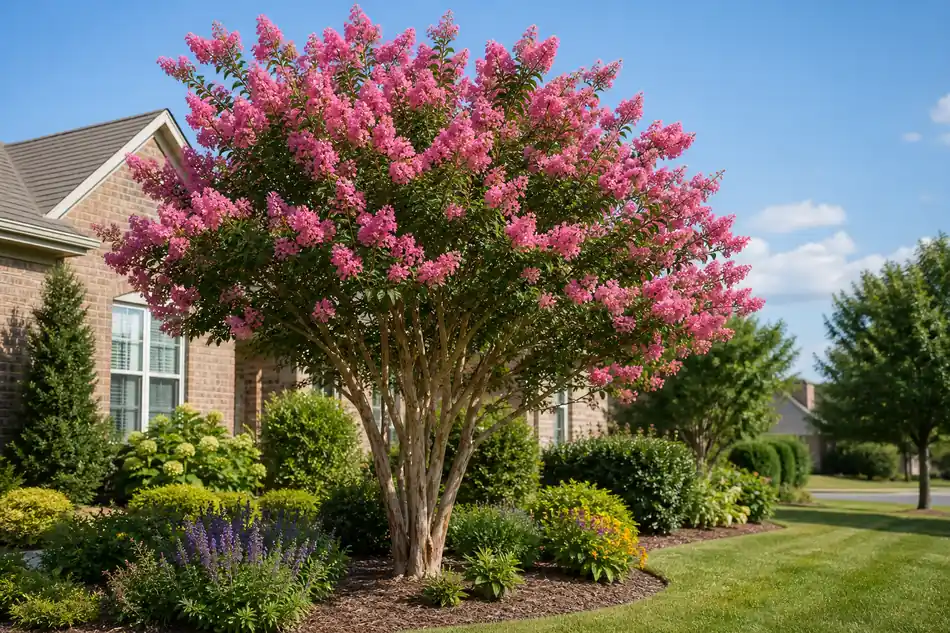
White-flowering cultivars such as Natchez and Acoma cool down hot spaces visually. In strong summer sun they read clean, not loud, and the bark keeps working after bloom ends. Natchez is one of the best commonly sold choices for bark alone. The trunk exfoliates into cinnamon and pale gray patches that catch low winter light even when the branches are bare.
Red and purple cultivars bring punch, with real tradeoffs
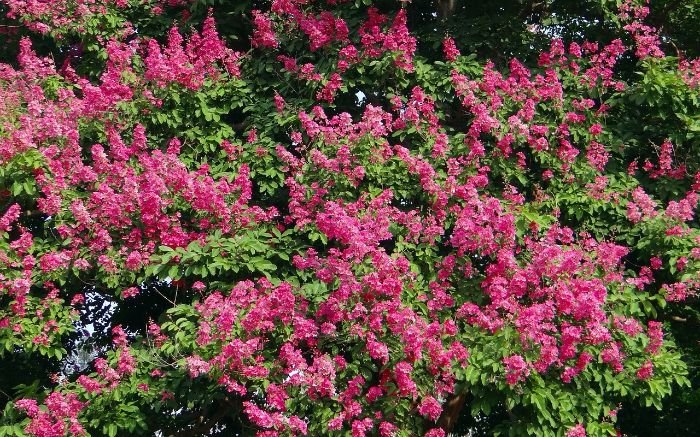
Tonto carries saturated magenta-red flower color on a smaller frame, which is why it works so well in courtyards and front beds. Catawba pushes deeper into purple and follows that with orange-red fall color. N.C. State notes one real annoyance many articles skip: the flowers can stain walkways or even the paint of a nearby car. Deep color near pale hardscape looks dramatic in bloom and messy after rain.
That is not a reason to avoid rich cultivars. It is a reason to place them honestly. If the tree will overhang a driveway, white and soft pink are easier to live with. If the planting sits against evergreen shrubs or dark siding, purple and red do more visual work from a distance.
Late bloom versus bark interest is a real choice
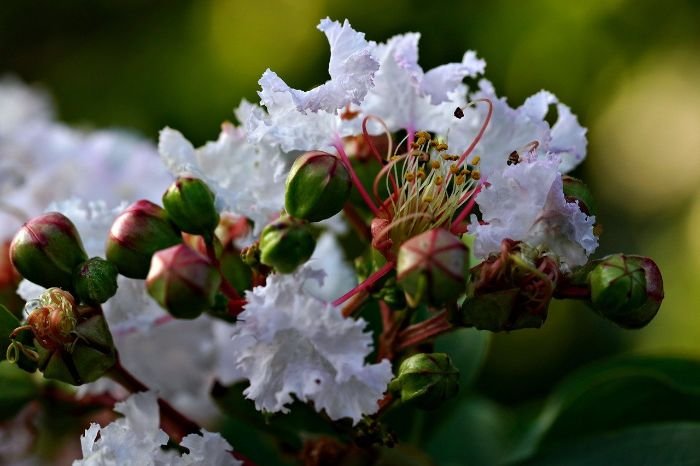
Catawba earns attention because it blooms late and carries dark purple flowers at a size many suburban yards can still handle. Acoma earns attention differently. Its white panicles and semi-weeping habit are gentler, and the trunk becomes part of the show sooner. If you sit outside on summer evenings, flower color will dominate the decision. If you look at the planting from inside all winter, bark may matter more than bloom shade.
Mildew-Resistant Crepe Myrtle Varieties Matter More In Humid Landscapes Than An Unusual Bloom Shade
Clemson Cooperative Extension updated its crape myrtle disease factsheet in August 2024 and makes the main point plainly: powdery mildew hits hardest in shady, damp, crowded conditions. Their recommendation is not complicated. Plant in full sun, avoid crowding, and choose resistant varieties. That advice matters far more in the Southeast than a sales tag promising an exotic color name.
Clemson also notes that the Lagerstroemia indica x fauriei hybrids developed by the U.S. National Arboretum are resistant to powdery mildew, and it lists Tonto, Sioux, Osage, Tuscarora, Tuskegee, and Lipan among the stronger choices. That is the kind of information worth moving ahead of color preference when your summers are humid and your planting beds do not dry fast.
The honest failure state is easy to predict: if the site gets only half a day of sun and the canopy will be boxed in by fences or shrubs, even a good cultivar may still spot or mildew. Disease resistance is not a license to ignore airflow. It simply gives you a wider safety margin.
- Tonto is one of the cleanest small choices when you want bold red-magenta color without a giant canopy.
- Osage works well when you want a softer pink and better bark interest at a medium size.
- Natchez stays near the top of the list for white flowers, larger scale, and low-drama performance.
- Sioux and Tuscarora are the pink options to watch when the site has room and full sun.
If disease pressure has been a recurring problem in your yard, do not buy the cultivar that needs a perfect site unless you actually have one. Buy the one that stays clean in ordinary conditions.
Best Crepe Myrtle Varieties By Landscape Job – Quick Matching Scenarios
Decision tools work better than long cultivar catalogs when the goal is to plant once and be done with it. The point is not to memorize dozens of names. The point is to narrow the field to the few that actually fit the job in front of you.
For a patio pot or low wall
Pocomoke is the safer pick than most gardeners realize. N.C. State describes it as a drought- and disease-tolerant dwarf that tops out around 5 feet, with 3-foot spacing working in mass plantings. That makes it realistic for large containers, low hedges, and small-space color where a full tree would look absurd.
For a narrow front bed
Acoma and Tonto belong here more often than the nursery lineup suggests. Choose Acoma if you want white bloom and a lighter, semi-weeping outline. Choose Tonto if you want harder color and a tidier, more upright frame. Both are easier to live with near a house than a large tree-form cultivar that will beg to be chopped back later.
For a purple-flowering small tree
Catawba still earns its reputation. The flower color is deep, the fall color is strong, and the scale fits many suburban yards. Just keep it away from spots where dropped petals will stain a driveway or a pale path. It is a beautiful tree in the right place and an annoying one in the wrong place.
For a driveway island or street-side planting
Natchez is hard to beat when you have real room. N.C. State notes its tolerance for clay soil, air pollution, and urban conditions, which is exactly the mix that matters in tougher landscape settings. The higher canopy also clears sightlines more naturally, and the white bloom plus mottled bark stay readable from the street without looking heavy against asphalt, brick, or concrete. That same durability is part of what makes crepe myrtle in urban environments such a recurring topic. Large cultivars make sense there. They do not make sense tucked four feet off a porch.
For humid yards where mildew has been a repeating headache
Start with Tonto, Osage, Natchez, Sioux, or Tuscarora before you chase unusual series names. Clemson’s disease list is a better buying tool than a bench full of flowering pots. Resistance will not fix a bad site. It does keep one recurring problem from becoming the whole story of the plant.
Read The Plant Tag Before You Buy – Five Details That Save Years Of Cleanup
The label is only useful if you read it like a designer, not a shopper. Bloom color and current pot height are the least important details on the tag. Mature width, hardiness, training habit, and disease notes carry far more weight once the tree is in the ground.
Pro Tip: Mark the mature spread on the ground with a hose before you buy. A label that says 12 feet wide feels abstract in the nursery and very real once that circle is crossing a path or touching a wall.
- Read the mature width before the mature height. Width drives pruning mistakes more than height.
- Check the lowest listed zone and ask whether local growers see top dieback there.
- Notice whether the plant is sold as shrub form, tree form, or multi-trunk.
- Look for mildew or Cercospora resistance if your summers are humid.
- Picture where petals, seed pods, and bark will drop in July and fall.
Once the cultivar is chosen, the mechanics matter. The next step is not fertilizer. It is correct placement, spacing, and soil drainage. The details in site and soil preparation for crepe myrtle, planting crepe myrtle trees, and light structural timing such as the best time to prune different plants matter more than any miracle feed on a nursery shelf.
Do not plant a 20-foot cultivar 4 feet from siding and plan to solve it with pruning. That decision creates the very topping cuts people later call inevitable. They were avoidable on buying day.
Conclusion
Buy the adult tree, not the nursery pot.
If you are torn between two cultivars, choose the one with the smaller mature spread or the better disease resistance unless the site clearly favors the larger plant. Those decisions age well. The wrong crepe myrtle gives you knuckled pruning cuts and annual regret. The right one throws bloom where you wanted it, keeps a natural frame, and leaves bark glowing through winter when the garden has gone quiet.
FAQ
Can I keep a large crepe myrtle small by pruning every year?
Not well. Hard annual cutback controls height in the short term, and it also creates weak shoots, swollen knuckles, and a shape that never looks settled. N.C. State warns that severe pruning leads to poorer form and breakage-prone stems. If you already know the space is tight, pick a smaller cultivar now instead of planning a permanent correction routine.
What is the best crepe myrtle for Zone 6?
The safest Zone 6 choice is rarely the flashiest one on the sales bench. Pocomoke, Acoma, and Natchez are among the more dependable commonly sold options because they are listed into Zone 6 by extension sources. Site exposure still matters. In cold pockets, some cultivars will behave more like shrubs than small trees after harsh winters. Buy from a local nursery that has seen the cultivar through several winters, then mulch well and avoid the windiest planting spots.
Which crepe myrtle stays small enough for foundation planting?
Two to five feet is the safe band for true foundation use. Pocomoke and Chickasaw fit that scale; Tonto does not, even though it is sold as a smaller form compared with big tree cultivars. Once the mature width passes 6 to 8 feet, the plant stops acting like a foundation shrub and starts acting like a small tree that happens to be too close to the house.
What is the best crepe myrtle for small yards?
For truly small yards, start with the smallest mature footprint that still gives the effect you want. Pocomoke and Chickasaw work best where space is tight and you need a dwarf or low border. Acoma and Tonto fit the next tier up when you want a real small tree or larger shrub presence without moving into large-canopy territory. The best choice is the one whose mature width still fits after five or ten years, not the one that looks best in a 3-gallon pot.
Which crepe myrtle has the best mildew resistance?
Powdery mildew gets traction when foliage stays damp and air movement stays low. Clemson says the U.S. National Arboretum hybrids are the resistant group to watch, and it specifically lists cultivars such as Tonto, Sioux, Osage, Tuscarora, and Tuskegee among the stronger performers. Natchez also remains a dependable larger option. Resistance is still not a substitute for full sun and spacing that lets the canopy dry out.
What is the best crepe myrtle for humid climates?
In humid climates, start with resistant cultivars before you think about unusual color or foliage series. Tonto, Osage, Natchez, Sioux, and Tuscarora are strong places to begin because they combine better mildew resistance with proven landscape performance. Full sun and airflow still matter. Even a resistant cultivar can spot or mildew if it is boxed into a damp, crowded bed.