
How to get rid of tree of heaven depends on whether you have an independent seedling or shoots supplied by an established root system. Pulling a genuinely small seedling is a different task from removing a mature tree whose roots already extend through the yard. Cutting that tree first often produces more shoots, leaving a shorter trunk and a larger follow-up problem. Confirm Ailanthus altissima before taking action, especially where native sumac or walnut grows nearby. Then inspect the plant’s size, neighboring shoots, leaf stage, and proximity to structures or utilities. Root-directed control, suitable timing, and repeated monitoring belong in the removal plan from the beginning. A clean-looking stump is not evidence that the living network below it has died, and a cluster of knee-high sprouts is not necessarily a collection of easy seedlings.
Identify the plant, then identify the root situation
Small independent seedling: remove the complete root when manageable and the soil is moist.
Established tree or connected suckers: plan root control before elective felling. A single cut or pull will not resolve the network.
Tree near wires, buildings, or a property boundary: arrange qualified site assessment. An immediate hazard takes priority over ideal seasonal timing.
Key Takeaways
- Confirm leaflet glands and other traits before removing look-alikes.
- Distinguish independent seedlings from shoots connected to older roots.
- Avoid elective felling before planning control of established roots.
- Match treatment timing to method, leaf stage, and locality.
- Revisit the area during growth to catch new shoots.
Table of Contents
Confirm Compound Leaves and Basal Leaflet Glands
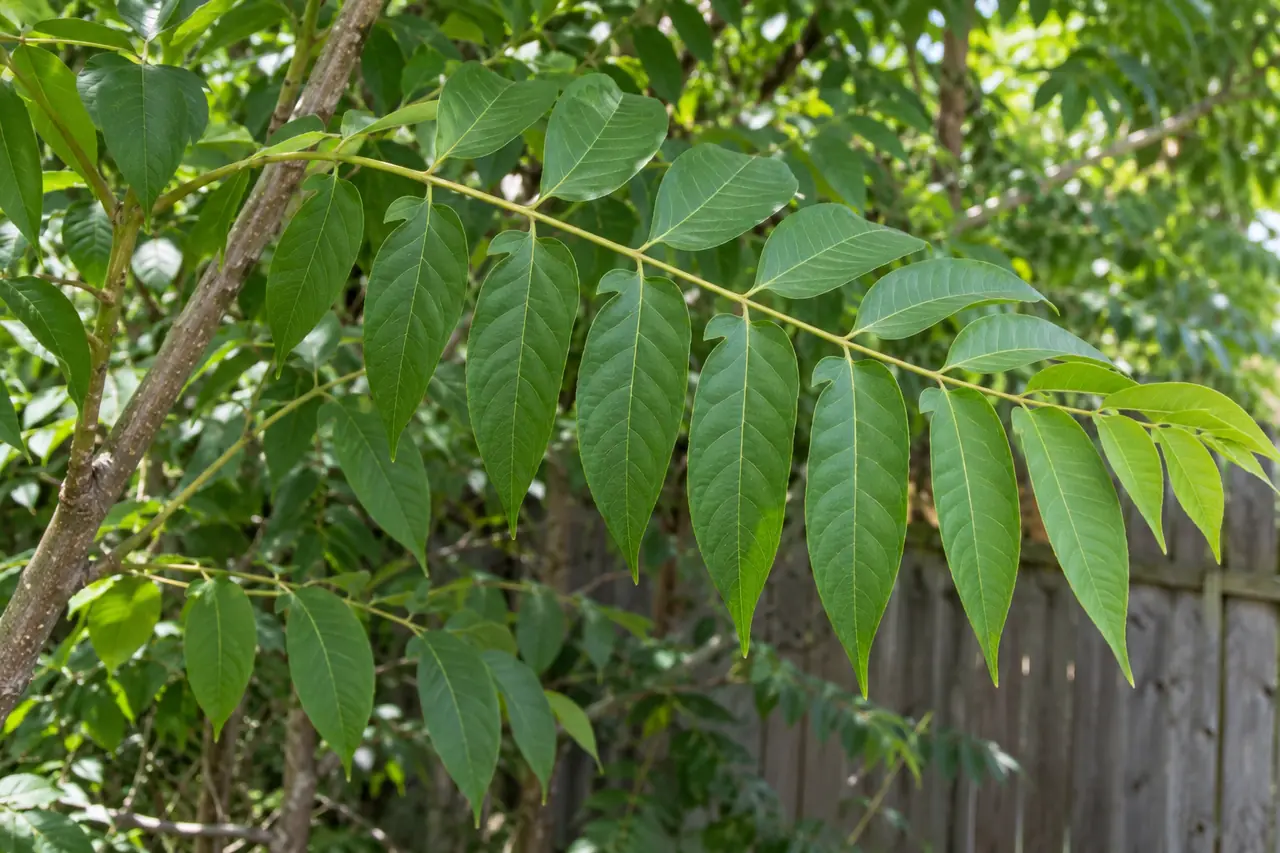
One long featherlike unit is a compound leaf. The smaller blades arranged along its central stalk are leaflets. Inspect an individual leaflet’s edge. Distinguish the leaf’s central stalk from the woody shoot supporting it.
Tree-of-heaven leaflets have mostly smooth margins with short projections near their bases. Small glands occur on those basal projections. University of Maryland Extension’s tree-of-heaven identification and removal guidance describes these traits alongside twigs, bark, and winged seeds.
Native black walnut and staghorn sumac commonly have toothed leaflet edges. Their fruit and other features also differ. Walnut produces nuts; staghorn sumac develops upright reddish fruit clusters; female tree-of-heaven bears clusters of winged seeds called samaras. When fruit is absent, identification needs other observable traits or local confirmation.
A crushed leaf has an unpleasant odor, yet smell is subjective and walnut foliage is aromatic too. Maryland Extension’s Plant and Insect Identification FAQs discusses that confusion. A smooth-edged leaflet with a basal gland carries more diagnostic weight than someone describing a smell as peanut butter or burnt nuts.
Inspect an accessible shoot without climbing or pulling hazardous branches. Photograph the whole compound leaf, a close leaflet base, the twig, and any fruit. Very young seedlings have fewer developed features, so identification from a single small leaf is less dependable.
If the identity is unclear, obtain local confirmation before treatment. The general process of garden weed identification starts with plant structure and growth habit; the same discipline prevents the removal of a useful native tree mistaken for Ailanthus.
Seedlings and Connected Suckers Need Different Removal
Tree-of-heaven spreads through seeds and through shoots arising from established roots. A newly germinated plant has its own developing root system. A root sucker draws on an older network, even when the visible shoot looks small enough to pull with one hand.
Notice the surroundings before tugging. Multiple woody shoots near an old trunk or stump suggest a possible connected system. Shoots farther away might be connected too, but proximity alone cannot establish that every plant shares a root. A seed-bearing female also produces independent recruits.
| Plant situation | What to assess | Practical approach | Failure to avoid |
|---|---|---|---|
| Small confirmed seedling in workable soil | Whether the complete independent root is removable | Careful hand removal in moist soil | Breaking off the stem and leaving the root |
| Several shoots near an established tree or stump | Possible connected roots and neighboring ownership | Coordinate a root-management and monitoring plan | Assuming each small shoot is an independent seedling |
| Established trunk | Hazards, access, treatment method, and leaf stage | Plan appropriate root control before elective felling | Cutting first and expecting the stump to finish the job |
| Storm-damaged or immediately hazardous tree | Risk to people, structures, and utilities | Qualified hazard management with subsequent sucker control | Delaying an unsafe situation for a preferred treatment month |
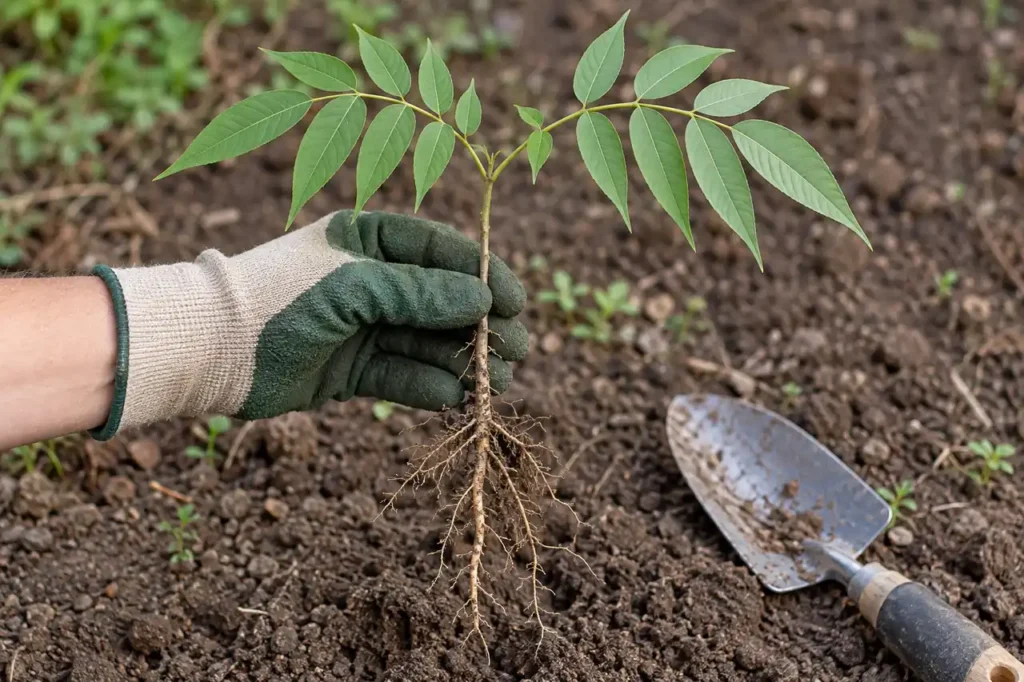
Remove a genuine seedling completely
For a manageable young seedling, moist soil makes it easier to free the root without snapping it. In dry compacted ground, the stem breaks before the embedded root comes free. Stop if removal would damage nearby desirable roots, buried infrastructure, or the edge of a structure.
Do not excavate a large lateral root network with a hand tool merely to prove a connection. Mark the location and seek site-specific advice when roots lead toward a mature tree, neighboring property, or utility area. Breaking a sucker from a parent root removes the visible shoot, not the stored energy supplying the system.
How to Get Rid of Tree of Heaven Starts Below the Trunk
Established roots store resources and produce replacement growth after top removal. Felling, repeated injury, or an attempted quick girdle leaves that belowground capacity in place. A stump remains at the original trunk position, and new shoots emerge elsewhere.
A root-directed systemic treatment is designed to move through the living plant. Maryland’s removal guidance describes foliage, bark, or trunk approaches selected for the situation. The exact product, method, plant size, site, and legal use conditions must match; an active ingredient name alone is not an application plan.
For elective removal, assess root control before arranging the final cut. If professional treatment is chosen, coordinate the treatment-to-felling sequence with the qualified provider. A pause is needed for systemic action; the time is determined by the method and condition, not by booking a chainsaw immediately after application.
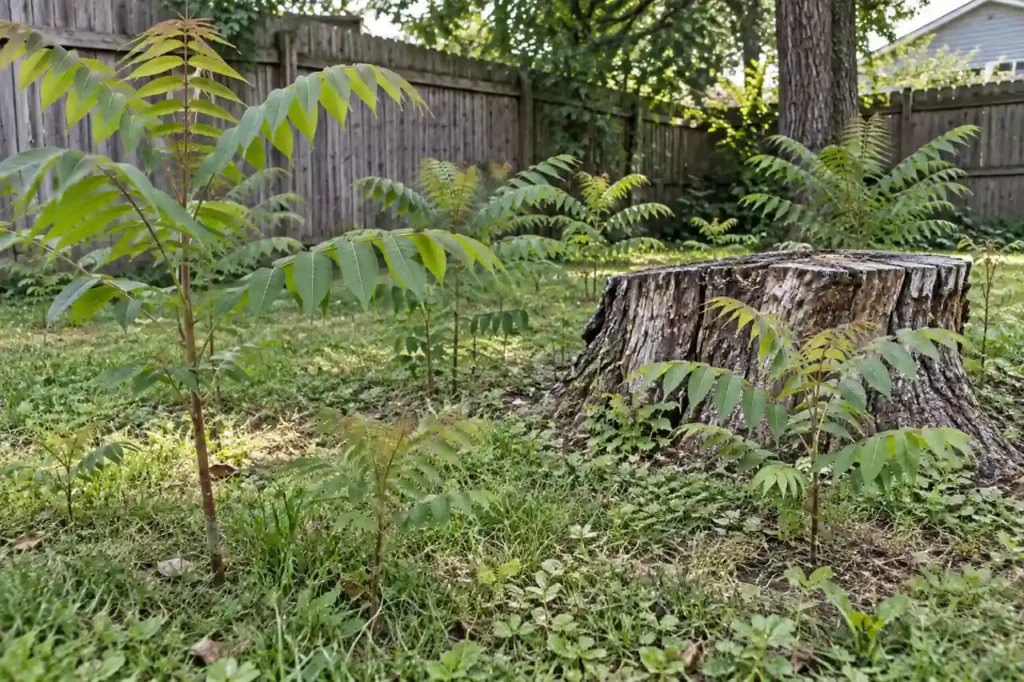
Cut-stump success at one visible stump does not prove that an entire connected colony is gone. Follow the response across the site, including shoots outside the immediate stump area. A remaining supply from an untreated connected tree or neighboring stand changes the outlook.
A dangerous leaning tree, broken branch, or utility conflict needs qualified assessment promptly. An ideal physiological window does not justify leaving an immediate hazard unmanaged. Explain the invasive-root problem to the arborist so safety work and later regrowth management are planned together.
Do not use national instructions to improvise incisions, chemical mixtures, or felling work around a home. State rules, product labels, nearby desirable plants, and the structure itself change what is suitable. Arrange an assessment using those site details before choosing a removal method.
Leaf Stage and Application Method Set the Treatment Window
Late-season transport toward storage roots explains why many root-control programs emphasize late summer and early fall. A living leafy plant moves resources belowground before dormancy. An appropriately selected systemic method uses that transport pathway.
Maryland Extension’s April 2026 garden guidance identifies the period from summer through the onset of autumn leaf color as particularly effective. Observe the plant’s stage. A calendar date alone cannot tell you whether an October tree in your climate still has an active green canopy.
Read wider calendars with their method attached
The separate Maryland woodland management guidance describes basal applications over a broader period and highlights late-season effectiveness in its local setting. That does not make a foliar treatment on a dormant tree equivalent to a correctly selected bark method.
Keep plant stage, application method, local climate, and the label together. If leaves are already coloring or gone, ask whether the chosen approach remains suitable or whether treatment should be planned for another period. Do not substitute an online month range for that decision.
Supply photographs and a short site description when seeking advice: current foliage, trunk size, neighboring shoots, nearby plants, water bodies, structures, and access. Those details help a specialist distinguish an appropriate residential method from one designed for a woodland stand.
Year-round feasibility for one method is not a guarantee of equally good root control at every date. Monitoring remains part of the work even after a well-timed treatment. Apparent loss of leaves or top growth is an observation to record, not a final proof of eradication.
Pro Tip: Save a photograph of the canopy’s leaf stage when a professional treatment is arranged. Include the method and date in your notes so later regrowth is assessed against what actually happened.
Repeated Shoot Removal Depletes Roots Slowly
Nonchemical management of an established system requires persistence. Remove new sprouts promptly during active growth so they have less opportunity to replenish stored energy through photosynthesis. A one-time mow followed by a summer of vigorous regrowth works against that objective.
Maryland’s removal guidance recognizes repeated mechanical suppression as an option after trunks are removed or fallen. Its limitation is the repeated work. Dense colonies, difficult access, and neighboring source trees make completion harder than removing a small independent seedling.
Set up a route that you can revisit safely. Mark the known shoot area and inspect beyond it when new growth appears. Flexible young shoots and small leaves are easier to address than woody stems allowed to thicken. Avoid leaving the task until shoots have formed a substantial leafy canopy.
Will you be able to revisit the whole root-sucker area throughout active growth? Arrange access before work begins when shoots grow behind a neighbor’s fence or beneath dense planting. Repeatedly clearing only the visible center leaves unaddressed growth elsewhere.
Protect desirable vegetation during recruit removal. Aggressive digging through mixed roots, scraping broad areas, or pouring salt into soil introduces damage unrelated to controlling the invasive tree. Vinegar and household mixtures do not supply a verified root-eradication program for an established clone.
Use an integrated management approach: confirm the target, choose a workable intervention, monitor its response, and adjust when the observed outcome differs from the plan. A chemical-free program needs realistic access and maintenance commitments.
New Suckers and Seedlings Require Continued Surveillance
The site remains a management task after the main trunk is gone. Inspect for regrowth during subsequent active growth periods, distinguishing possible suckers from new seed-derived recruits. An apparently dead top does not remove incoming seeds from nearby female trees.
Keep the follow-up locations and observations simple. Mark new shoots, note whether they recur at previous points, and photograph changes. If a professionally treated tree continues producing vigorous regrowth, contact the provider before considering another treatment.
Coordinate across the property boundary
Connected Ailanthus shoots might occur on more than one property. Obtain permission and coordinate work where the management area crosses an ownership line. Do not treat a neighbor’s plants or assume a fence interrupts the belowground system.
After removal, make the ground accessible for inspection. A dense new planting immediately concealing the old shoot area makes small recruits harder to find. Where a ground cover or mulch is appropriate, arrange it so recurring woody shoots remain visible.
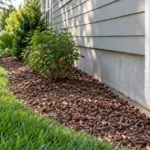
For a replacement bed beside a house, assess mulch and foundation termite risk before spreading chips against the wall. Tree removal does not change the need for an exposed inspection area or sensible drainage.
Choose any replacement tree for the actual light, available space, and local suitability. A different species planted into the same tight structural conflict recreates an access problem. Keep the replacement tree’s root flare visible at planting, and allow space for its mature size. Keep the old invasion area under observation even after a new landscape begins to establish.
Conclusion
Before committing to removal, mark the parent tree and the visible shoot area, then resolve identification, access, and hazards. If roots or ownership extend beyond the area you control, coordinate the work before making the first elective cut.
Keep the same observation route after removal. New green shoots among low ground cover are easier to address when noticed early, before they become another row of woody stems along the fence.
Frequently Asked Questions
Will removing tree-of-heaven eliminate spotted lanternflies?
Spotted lanternflies use tree-of-heaven as a preferred host and also feed on other plants. Removing it does not guarantee that the insects disappear. Follow regional lanternfly guidance separately from the tree’s root-control plan.
Can I identify it in winter without leaves?
Twigs, leaf scars, bark, and any retained winged seeds offer clues. Winter identification is harder when those features are unavailable or immature. Obtain local confirmation before acting on an unidentified bare sapling.
Does a tree without seed clusters still need management?
Yes, when it is confirmed tree-of-heaven and removal is appropriate. Male trees do not produce seeds, but established plants still spread through root suckers. The absence of samaras does not establish that a tree is harmless or independent of a colony.