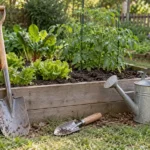

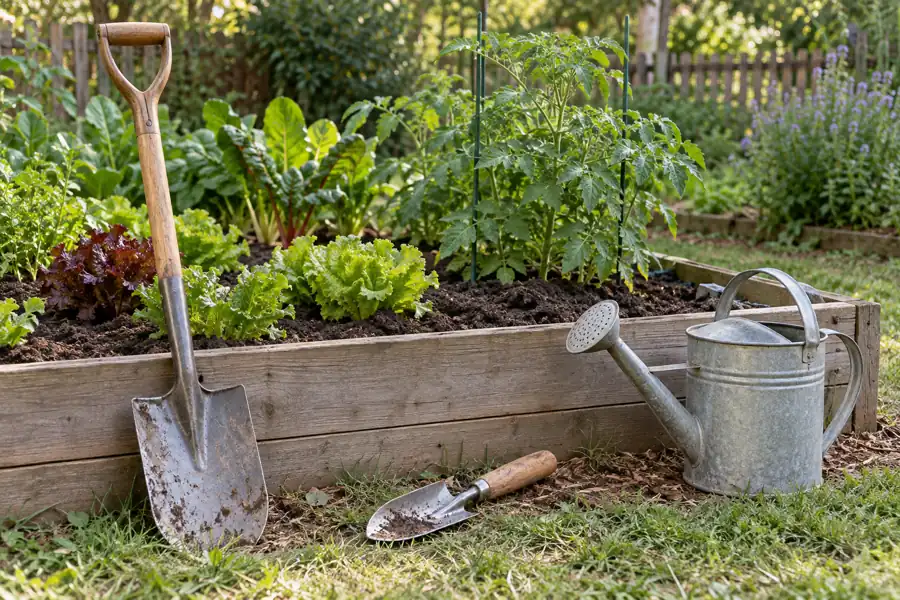
Gardening tools make more sense when you look at the working end first. A pointed scoop digs and carries soil. A flat blade cuts a neater edge. Short rigid rake teeth level a seedbed, and a flexible fan gathers loose leaves. The handle gives you reach or leverage; the head determines what happens when the tool meets soil, stems, or debris.
You do not need to buy every type to start gardening. A few tools suited to your beds and plants may handle most jobs. Container planting asks for small, controlled movements; opening a ground-level bed or moving mulch needs different equipment. Use the pictures to recognize each tool, then compare its job with the work in front of you. Names can overlap between stores and regions, so the shape of the blade, tines, or cutting jaws is often the better clue.
Match the tool to the job
- Dig or lift soil: round-point shovel, garden spade, or spading fork.
- Plant and weed close to plants: hand trowel, garden hoe, or hand cultivator.
- Gather or level: bow rake for soil; leaf rake for loose leaves.
- Cut stems: bypass hand pruners for small cuts; loppers for larger stems within their rating.
- Water or move supplies: watering can for small plantings; wheelbarrow for hauling.
A tined fork is not a scoop, and a leaf rake is not a soil rake. Match the working head before choosing the handle.
Key Takeaways
- Identify the working head before relying on a tool’s name.
- Choose a pointed shovel for digging and a spade for edges.
- Separate rigid soil rakes from flexible leaf-gathering rakes.
- Match cutting tools to stem size and the tool’s rating.
- Start with the tools your actual planting tasks require.
Round-Point Shovel: A Curved Scoop for Digging and Lifting
A round-point shovel has a broad steel head that curves into a scoop and ends in a pointed tip. The shoulders above the blade give your foot somewhere to press. That combination helps the blade enter soil and carry a load after you lift it. Look at the hollow scoop in the picture; it is a useful distinction from a flatter garden spade.
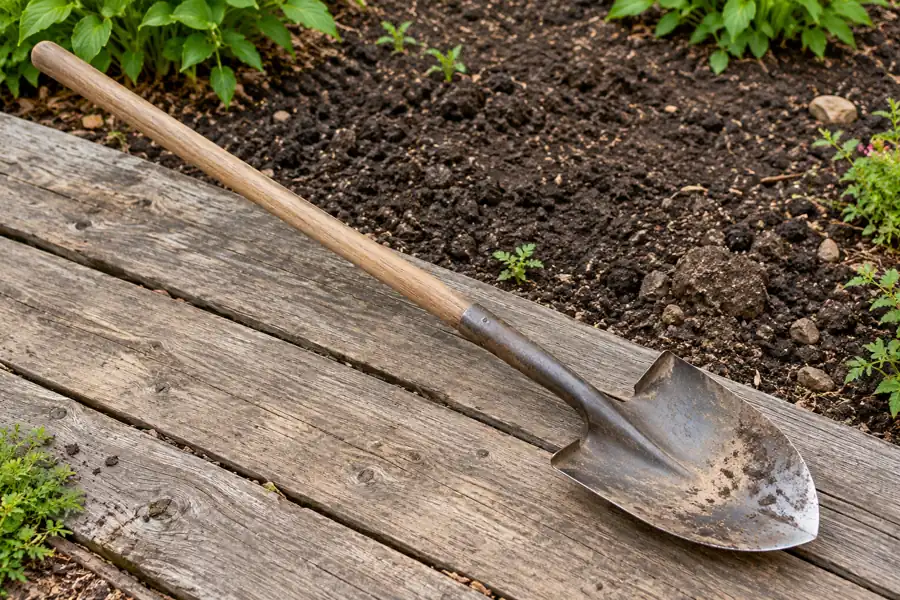
Use it for digging planting holes, lifting loose soil, and moving material in manageable amounts. A heavy scoop can become difficult to control when it is extended far from your body. Take smaller loads if lifting makes you twist or struggle to place the soil where you want it.
The pointed tip can enter a patch of firm ground more readily than a broad straight edge. It does not make every root or buried stone easy to cut. Stop and reassess a sudden hard obstruction. The parts of a garden shovel also help you recognize whether the blade, socket, and handle are doing the job you expect.
Garden Spade: A Flat Blade for Cleaner Cuts in Soil
A garden spade usually has a flatter, straighter blade than a round-point shovel. The lower edge may be straight or slightly shaped, and the handle often ends in a D grip. Pressing that edge into ground creates a more defined cut, which makes it useful beside a bed or when lifting a plant with a block of soil.
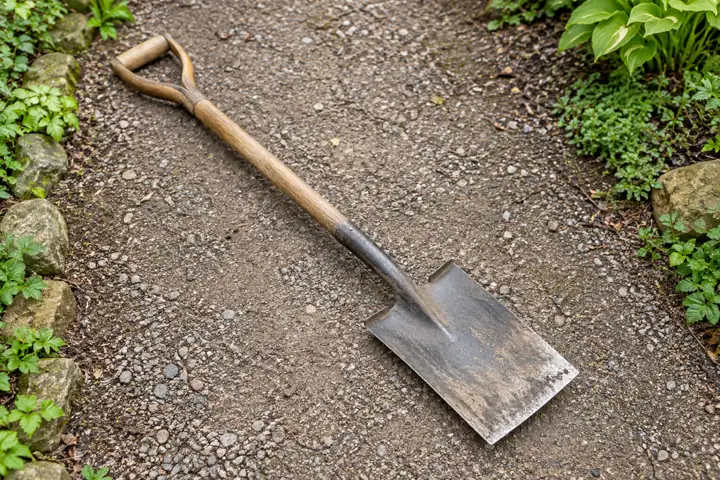
Use a spade for digging, edging, and working in a smaller area where a wide scoop would disturb too much ground. Push the blade down, then lift a manageable section. The clean line left by a straight edge looks different from the rounded bite of a pointed shovel.
A flat transfer shovel may also have a squared blade, so a straight edge alone is not a complete identification. Compare the blade’s depth, curvature, and intended function. A deep scoop holds loose material; a relatively flat garden spade favors a cutting and digging movement. Choose by the work, especially when a retailer uses the names loosely.
Spading Fork: Stout Tines That Loosen and Lift Soil
A spading fork has a few strong tines, commonly four, attached to a substantial handle. The tines are thicker and flatter than the thin curved prongs of a bedding fork. They enter the ground separately, then loosen and lift the soil as you move the handle. Soil can fall between the tines instead of remaining on a solid blade.
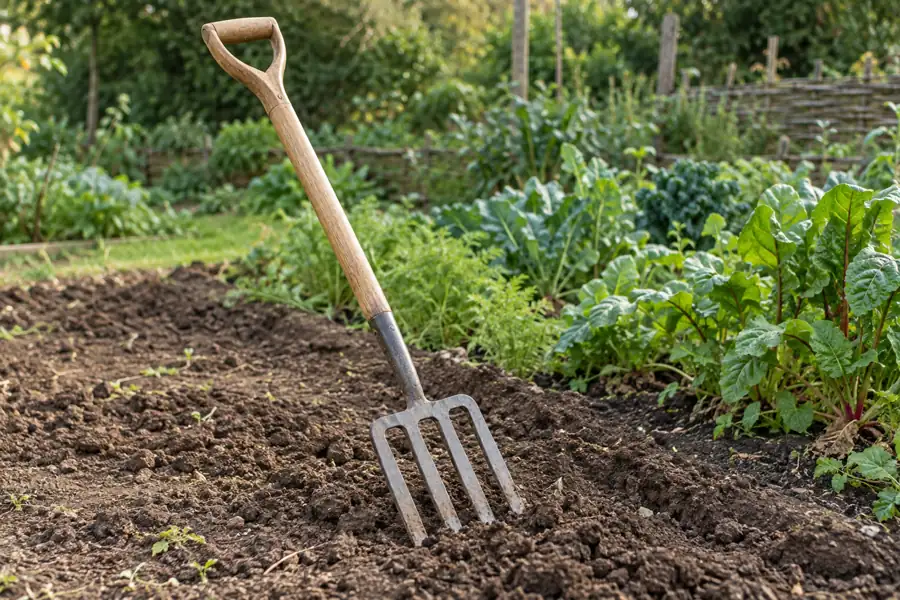
Use it to loosen workable soil, lift plants or bulbs, and handle divisions where a scoop is unnecessary. Its gaps make it poor at carrying a pile of sand or fine soil. A shovel holds that material more effectively. The fork’s usefulness comes from penetrating and separating material, not from holding everything you lift.
A bedding or hay fork has a different job: moving loose bulky material such as straw. Do not force its lighter, curved tines into firm soil as if it were a spading fork. Check the thickness and shape near the head before identifying an unfamiliar fork, then keep your feet clear of the tine tips.
Hand Trowel: A Small Scoop for Planting Holes
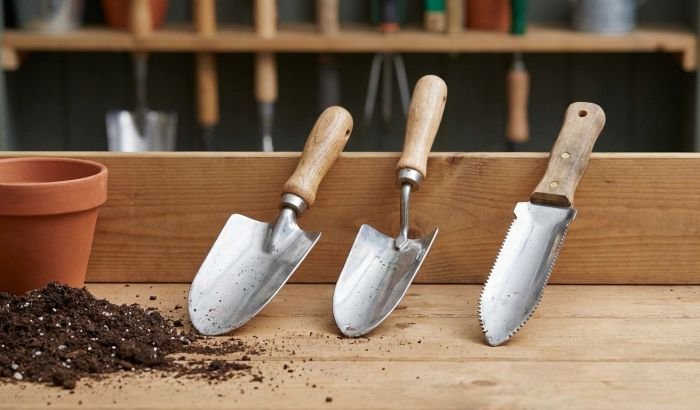
A hand trowel is a small, one-handed digging tool with a short grip and scoop-shaped blade. It gives close control around pots, seedlings, and small planting holes. The narrow working end can fit where a full-size shovel would displace nearby plants. You can also move small amounts of potting mix without filling a large scoop.
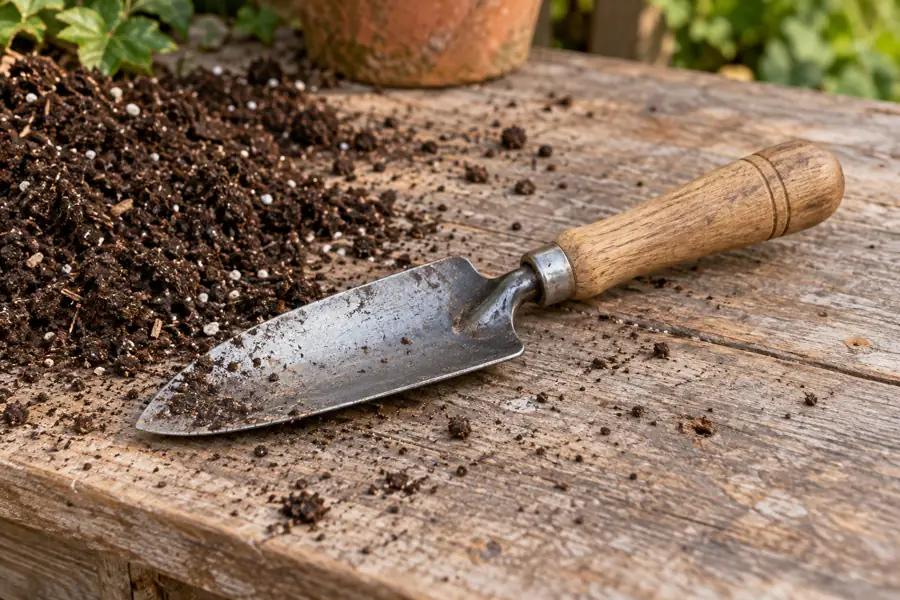
Use it to open a transplant hole, work loose soil around a small root ball, or lift a small weed. If the soil feels hard enough to bend the blade or strain the handle joint, change the approach. A trowel is not a lever for prying a large buried rock out of compacted ground.
Grip size and blade width change how easily you control it. A handle that feels secure when dry can become slippery when wet or muddy. Check how it sits in your hand before a long planting session. Different garden trowel shapes suit different small jobs; the general scoop shown here is a starting point for recognition.
Garden Hoe: An Angled Blade for Shallow Weed Cutting
A traditional draw hoe has a long handle and a flat cutting blade set at an angle to it. You move the blade through the surface soil to cut small weeds and draw loose material toward you. Its edge slices; it does not gather soil in a scoop. Other hoe shapes change the movement, so identify the blade before copying a technique.
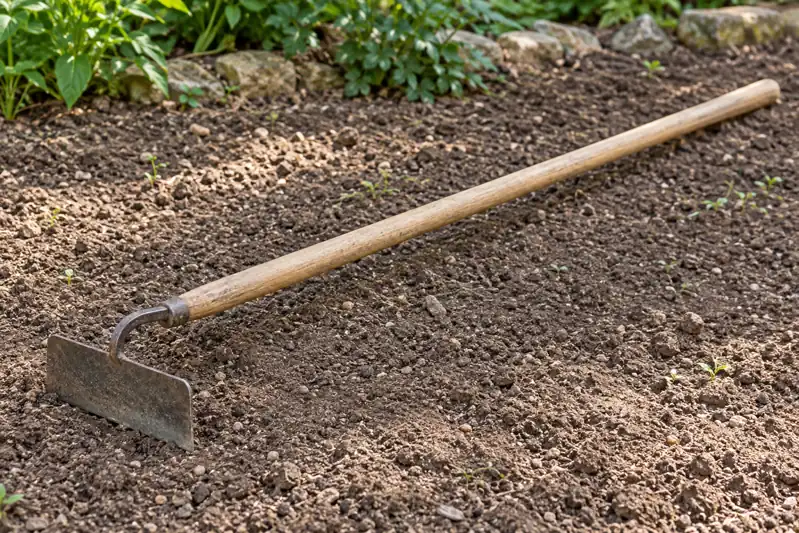
Use shallow strokes when small weeds are the problem. Digging deeply between established plants can disturb their roots and bring more buried weed seeds toward the surface. A small weed released from crumbly soil offers less resistance than an established clump whose roots hold a large piece together.
The solid blade distinguishes a hoe from a tined cultivator. A hoe cuts or draws soil with an edge; a cultivator scratches through it with separate prongs. Neither removes every deep perennial root in one pass. Keep the blade away from plant crowns and use a more controlled hand tool when the target is close to a stem.
Hand Cultivator: Curved Tines for Surface Soil Work
A hand cultivator looks like a small claw, with a short handle and several curved tines. Pulling it through loose soil separates small clods and disturbs shallow weeds. Each tine follows its own narrow path, which explains why it scratches and loosens rather than cutting a continuous straight edge.
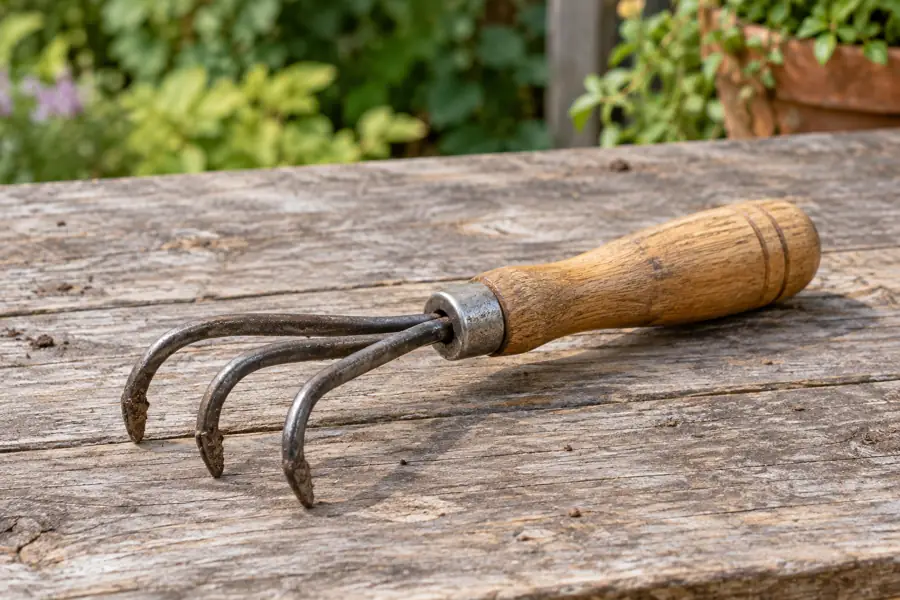
Use it in a small open patch, a container, or between plants when there is room to keep the tines away from roots. A light crust may break into smaller crumbs. Wet soil that smears against the metal calls for a pause, not stronger repeated scraping. Keep the work shallow around established plants.
A cultivator cannot carry a scoopful of potting mix like a trowel. It is also different from a weeding fork designed to reach a particular root. Look at the curved, separated prongs in the picture and ask whether scratching the surface actually solves the problem in front of you. For one deep-rooted weed, exposing the root with a suitable digging tool may be more useful.
Bow Rake: Rigid Teeth That Level a Seedbed
A bow rake has a short, rigid row of metal teeth, commonly supported by curved metal bows connecting the head to the handle. The teeth break up and move loose material across a bed. The back of the straight head can smooth it. This gives the rake a soil-working function that a flexible fan rake cannot perform as effectively.
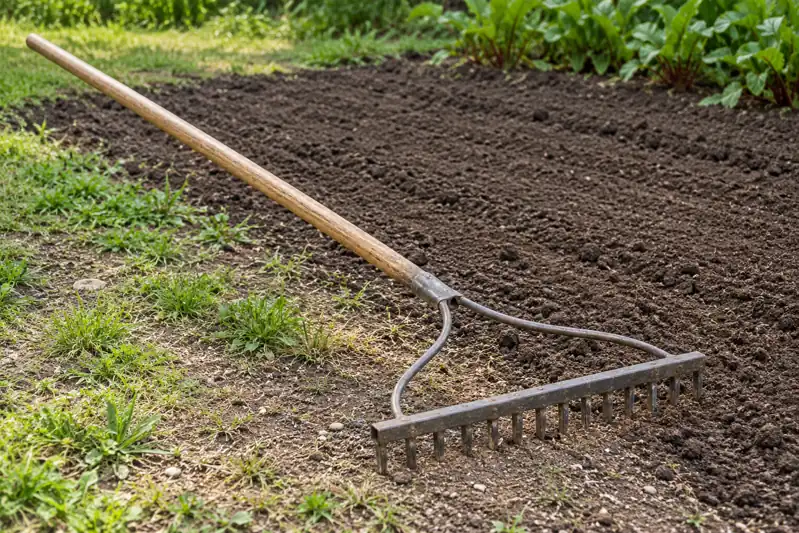
Use it to level a prepared seedbed, gather small stones, or spread loose material. A light drag over friable soil leaves fine lines and moves small clods. Catching on a large stone produces a different sound and resistance; stop and remove the obstruction without wrenching the head.
Rigid teeth can catch stems or scratch turf when the job is simply gathering leaves. Switch to a leaf rake for that task. The differences among garden rake types come from the head and tooth design, so a long handle does not make two rakes interchangeable.
Leaf Rake: Flexible Fan Tines for Loose Debris
A leaf rake has a broad fan of thin tines made from metal or plastic. They flex as you pull the head across grass or loose leaves, gathering light material over a wide area. The fan is the recognition clue. It spreads the contact points much farther apart than a rigid garden rake.
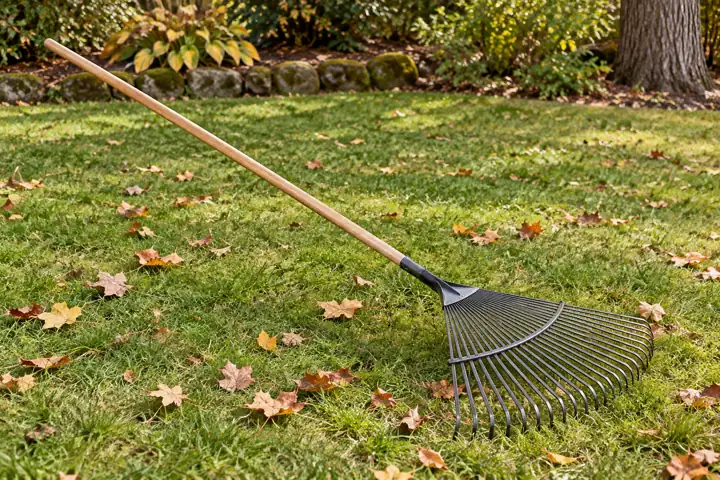
Use it to collect fallen leaves, grass clippings, and similar loose debris. Dry leaves rustle and move readily; damp matted leaves feel heavier and can catch between the tines. Work in smaller amounts when a heavy wet pile makes the head bend or the handle difficult to control.
A leaf rake is a poor substitute for the rigid rake that levels soil. Flexible tines bend away from a clod that needs moving. There are also narrower fan heads for confined spaces, which can be useful between plants where a broad head snags stems. Select the width for the space you are clearing, and keep delicate shoots outside the path of the tines.
Bypass Hand Pruners: Passing Blades for Small Stem Cuts
Bypass hand pruners have two short handles and a cutting blade that passes beside a counterblade, much like scissors. Open jaws show the curved cutting surfaces. Squeezing the handles moves the blade through a stem. A spring usually opens the tool again when your grip relaxes.
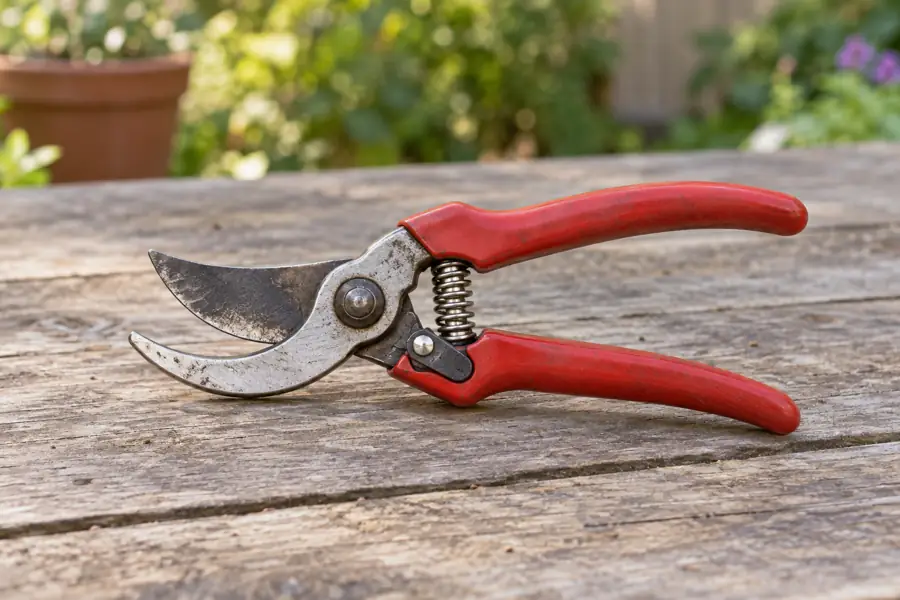
Use them for small pruning cuts and suitable crop harvests. A clean cut separates a stem without the long pulling movement that can tear attached tissue. Peppers, eggplant, and okra are among the crops harvested with hand pruners in University of Georgia Extension guidance. Match the tool to the stem and its rated capacity.
An anvil pruner closes a blade against a flat surface; it does not have the same passing-blade action. Long-handled loppers are another tool again. Check these differences when choosing pruning shears. If a cut requires excessive force or twisting, stop. A larger handle is not a reason to exceed a tool’s cutting limit.
Loppers: Long Handles That Add Cutting Leverage
Loppers have two long handles and a relatively small cutting head at the opposite end. They use both hands and increase leverage at the jaws. The illustrated pair has bypass blades, although anvil designs also exist. The long handles distinguish them from one-handed pruning shears and from hedge shears with long cutting blades.
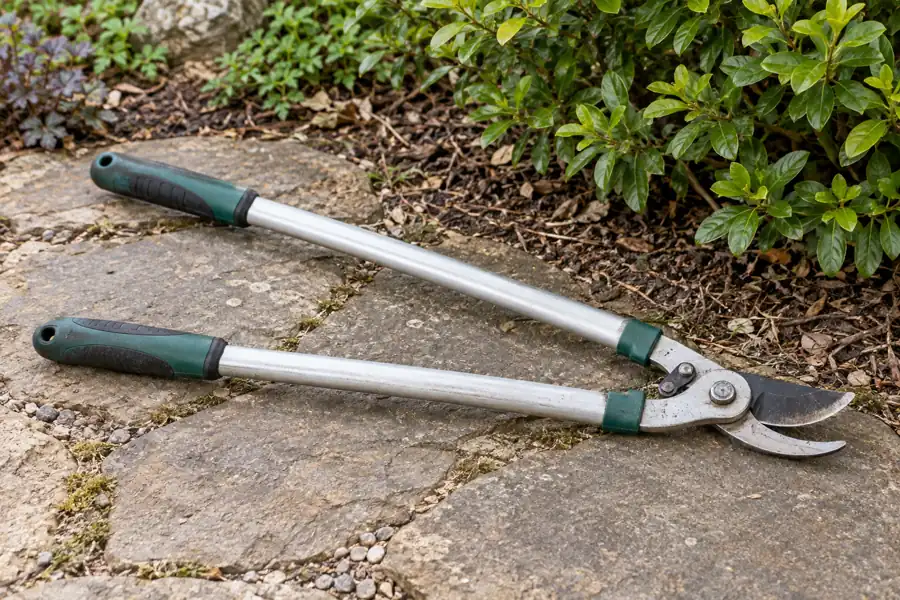
Use them for larger stems or branches that fit the particular tool’s rating. Put the branch within the jaws and make a controlled cut. A thick stem that will not fit properly is a signal to choose another suitable tool, not to force the handles until something gives. There is no single cutting diameter for every lopper.
Leverage can hide how much force reaches the cutting head. Inspect the joint and blades before working, and keep fingers clear of the moving jaws. For frequent small cuts on soft stems, hand pruners may give more manageable control. Loppers become useful when the stem and task justify their larger size.
Watering Can: A Spout and Rose for Controlled Watering
A watering can carries water in a container with a handle and pouring spout. A perforated rose at the end breaks the flow into smaller streams. That changes how the water reaches the surface: a gentle spread is useful around newly sown seeds, where a concentrated jet could displace soil.
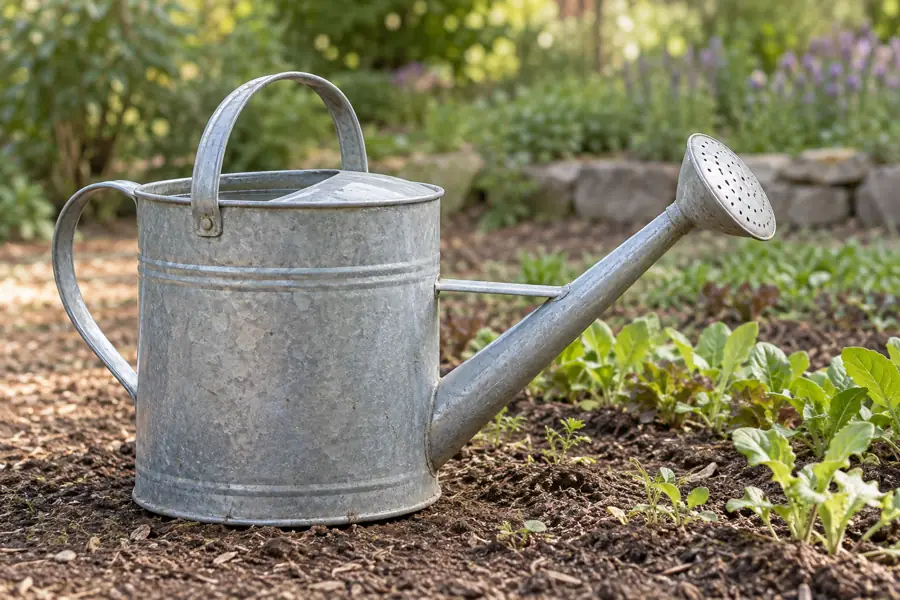
Use it to water seeds, transplants, and small container plantings. Pour slowly enough that the mix accepts the water. A stream that runs off the surface tells you to pause and reconsider the flow or soil condition. Filling the can only as far as you can comfortably carry is more useful than struggling with its maximum capacity.
The rose and grip arrangement matter more than decorative color. A hose or irrigation system becomes more practical across a larger area. For small plantings, different watering can features change how comfortably you carry and direct the water. Water the root area; a good-looking can does not establish that a plant needs watering.
Wheelbarrow: A Tub and Wheel for Moving Garden Materials
A wheelbarrow has a carrying tub, front wheel or wheels, and two rear handles. Lifting the handles transfers part of the load onto the wheel; tipping the tub helps unload loose material. The pictured single-wheel design can turn in tight places and also needs balance to keep it upright.
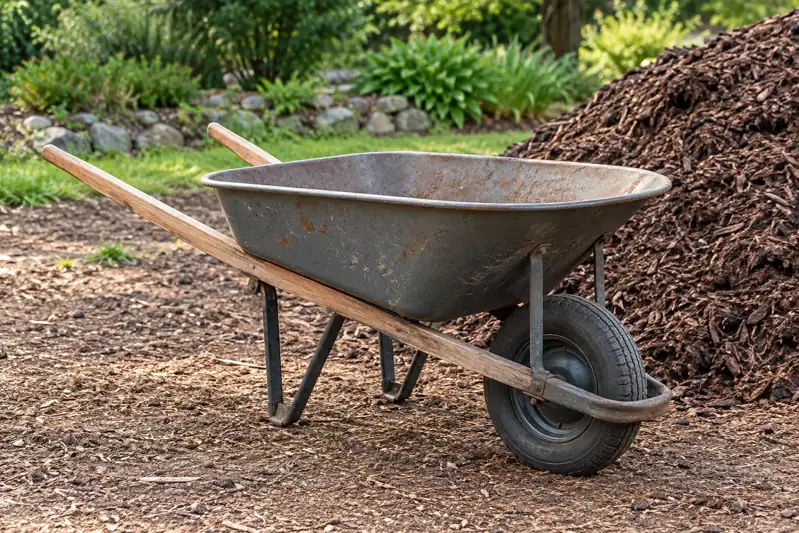
Use it to move mulch, compost, soil, or supplies across a garden. An overloaded tub is harder to guide, particularly over ruts or an uneven path. Reduce the load when the handles pull heavily on your arms or the wheelbarrow starts leaning beyond comfortable control. Several manageable trips can be easier than one unstable load.
Garden carts commonly use two or four wheels and have different balance and unloading arrangements. Compare stability, route width, and the material you move when choosing a wheelbarrow. A larger tub is useful only if you can move its filled weight safely along the path you actually have.
Choose Gardening Tools for the First Job You Need to Do
For planting a few containers, start with a hand trowel and a manageable watering can. For an existing ground-level bed, add the tool that handles the current problem: a hoe for shallow weeds, a bow rake for leveling, or a shovel for digging. A shrub with stems beyond hand-pruner capacity creates a different need from a tray of vegetable seedlings.
Borrowing a tool before buying one can reveal whether its weight and grip suit you. The task and user-fit guidance for hand tools, written by University of Georgia horticulturists David Berle and Robert Westerfield and reviewed with Heather Kirk Ballard, emphasizes that one size does not fit everyone. The starter vegetable-garden tool list from Illinois Extension also favors basics over an accumulation of gadgets.
Try the working motion with an empty tool and enough clear space around you. A smooth handle should let you hold it securely; a loose head or split grip needs attention before use. Add equipment when a recurring task justifies it. Recognizing twelve tool types does not mean your garden needs twelve purchases.
Conclusion
Look at the head, name the job, and choose a tool you can control. A pointed scoop, straight blade, rigid tooth row, flexible fan, or passing pair of blades each changes what happens at the plant or soil. Start with the next real task in your garden, then add a different tool when its shape solves a problem your current one cannot.