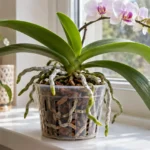


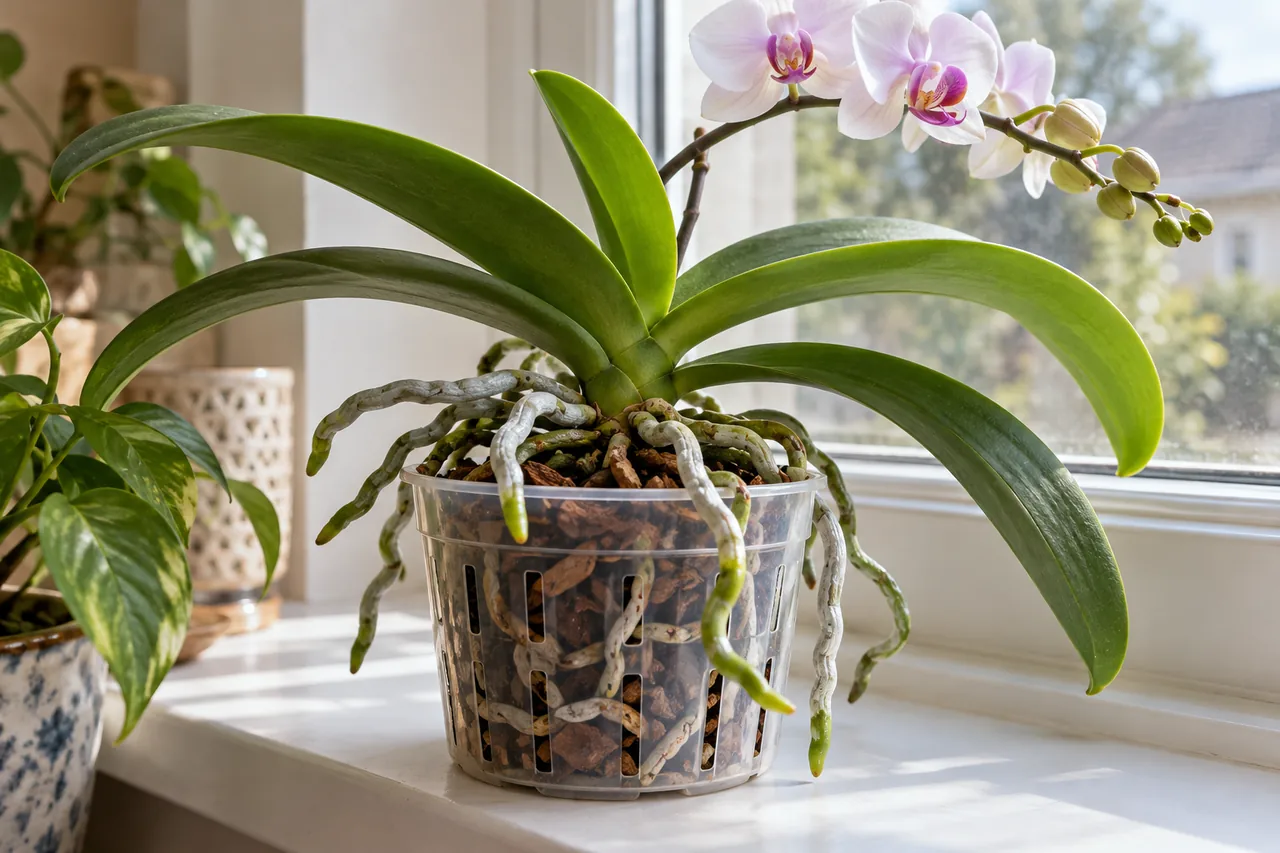
Orchid roots growing out of pot are normal on many moth orchids when the roots remain firm and the potting medium is in good condition. A thick silvery root curling over the rim is not automatically a sign that the container is too small. Phalaenopsis orchids are epiphytes, adapted to growing with roots exposed to air. Inspect the roots inside the pot as well as those outside it. Firm tissue, intact bark, and a growing plant suggest a different action from hollow roots sitting in a dense wet mass. The choice is between leaving useful roots alone, adjusting watering, or repotting for an actual root-zone problem. Cutting every untidy root or forcing it beneath the bark removes function without establishing what the orchid needs.
Check roots and medium together
Firm aerial roots with sound medium: leave them intact. Their position alone is not a repotting emergency.
Hollow or soft roots with persistently soggy, degraded medium: assess root loss and replace the failing growing environment.
Healthy flowering plant that genuinely needs more root space: plan gentle repotting around the end of bloom and new root growth, unless deterioration requires earlier action.
Key Takeaways
- Assess firm root tissue before deciding whether repotting is necessary.
- Preserve healthy aerial roots even when they extend awkwardly.
- Inspect the inner medium when outer roots appear dry.
- Time routine repotting around flowers finishing and new roots.
- Reassess dry-down after changing the pot or growing medium.
Table of Contents
Orchid Roots Growing Out of Pot Follow an Epiphytic Habit
A moth orchid’s pot is a cultivation container, not a signal to every root that it must stay inside. In its natural growth habit, roots anchor the plant and receive water on exposed surfaces. Aerial extensions above the medium are therefore compatible with a healthy plant.
The American Orchid Society’s orchid root anatomy describes velamen, the specialized outer layer surrounding the living inner root. It absorbs and holds water. The exposed surface is thick and textured, with a growing tip at the end of an active root.
On a typical Phalaenopsis, dry exposed roots appear silver or gray and wetted roots often look greener. A root resting above the bark dries differently from one surrounded by moist medium. Its color should not set the watering schedule for the entire pot.
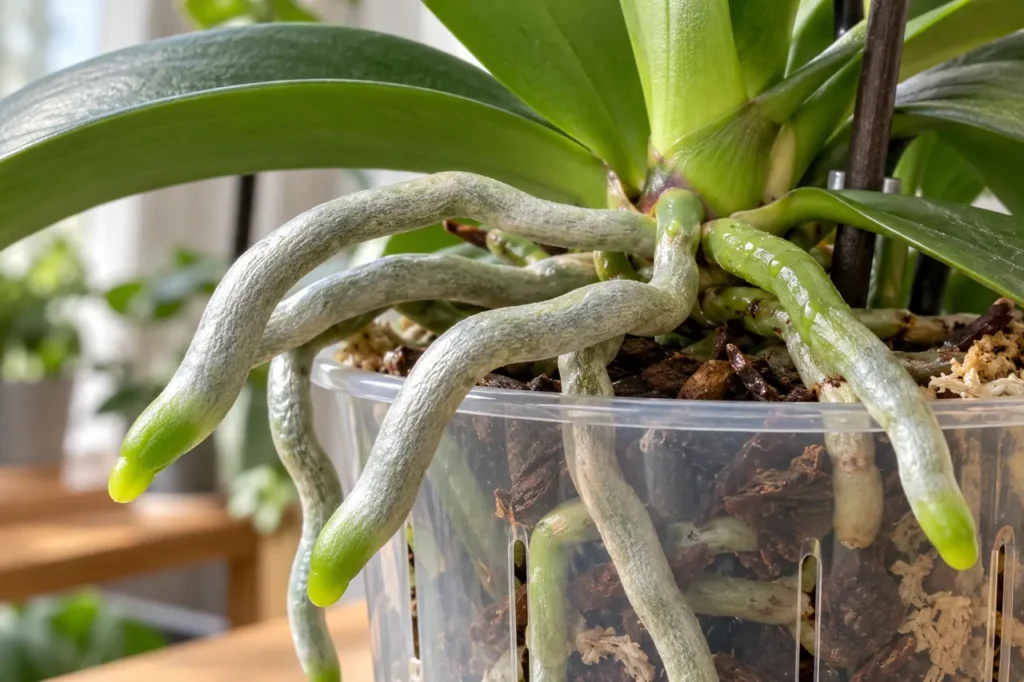
Observe where roots originate and how they attach. Aerial roots growing from the stem above the medium are different from a plant whose entire root mass has split its container or become impossible to manage. Location is a prompt to inspect, not a complete diagnosis.
Confirm the orchid’s identity before extending those conclusions. Phalaenopsis is the common moth orchid with broad fleshy leaves. Other orchid genera include different growth habits and seasonal requirements. Obtain genus-specific culture guidance for an unfamiliar plant.
Firm Velamen Differs From Hollow or Collapsing Tissue
Root texture is more informative than a white-versus-green rule. A functioning aerial root feels firm under a very gentle touch. A dead or rotted section might be hollow, papery, soft, or collapsing. Handle exposed roots carefully; a hard squeeze creates the injury you were trying to detect.
Inspect more than one location. A healthy-looking root over the rim does not establish that all roots inside the pot are sound. One old damaged segment also leaves the condition of other roots unresolved. Look for the proportion of functioning roots and the condition of the plant they support.
Use appearance, texture, and growing conditions together
| Observation | What to inspect | Likely next move | Avoid |
|---|---|---|---|
| Firm silver roots outside the pot | Medium condition and roots inside | Leave intact if the root zone is sound | Calling all pale roots dead |
| Green or differently colored fresh tips | Whether growth remains undamaged | Handle carefully and monitor | Bending or squeezing tender tips |
| Hollow, papery, or soft collapsed roots | How much of the root mass is affected | Assess root damage and the growing environment | Choosing a larger pot without addressing the cause |
| Escaping roots with firm bark | Actual crowding versus normal aerial extension | Observe or plan a justified repot | Forcing all roots beneath the medium |
| Wet dense medium with declining roots | Drainage, trapped water, and material breakdown | Replace the failing root environment promptly | Waiting indefinitely to preserve flowers |
Root-tip colors vary among orchids. Green is familiar on many moth orchids, but pigment and growth stage alter appearances. Absence of a fresh tip during a pause in growth is not a death test.
If velamen has already broken away, a wiry inner strand might remain. Do not strip the coating from other roots to compare them. The American Orchid Society distinguishes the water-holding outer layer from the true root within it; apparently pale outer tissue still performs a job.
For an uncertain plant with extensive damage, photograph the root mass, leaf bases, pot, and medium before trimming. An orchid specialist or local plant diagnostic service needs that context. Color alone is not enough to prescribe root removal.
Decomposing Medium Changes the Need to Repot
Repotting is justified when the plant’s root environment has deteriorated or its growing root system genuinely needs a different container. Several aerial roots outside the rim do not establish either condition. Examine the medium and the root mass before choosing a replacement pot.
The two reasons are separated in the American Orchid Society’s When Should I Repot? guidance: failing growing medium and actual outgrowth. Replacing old medium sometimes requires the same pot size. Size should follow the remaining roots, not the span of the leaves.
Fresh-looking bark on top might conceal a dense, moisture-retaining center. Notice whether the pot becomes lighter between waterings, whether the inner material remains wet unusually long, and whether roots in that area are declining. A sour odor together with persistent wetness and damaged tissue deserves investigation; smell alone does not identify a pathogen.
Bark that crumbles under light pressure and compacts into smaller particles has a different air-and-water behavior from intact pieces. Sphagnum also needs evaluation in the actual setup. It is not automatically unsuitable, but tightly packed material and an unsuitable watering routine leave roots in a different environment from a loosely managed medium.
Inspect the decorative outer container. A well-drained inner pot loses its advantage if runoff remains around its base. The principles of proper pot drainage apply before you conclude that roots outside the pot caused the problem.
An oversized replacement pot surrounds a reduced root mass with more wet material than the plant can readily use. If many roots have been lost, the appropriate container might be smaller, not larger. Assess what remains after removing clearly nonviable tissue during a justified repot.
Do not add ordinary garden soil to cover exposed roots. Moth orchids need a porous orchid-appropriate medium. Match water retention and particle grade to your indoor conditions and watering habits.
Blooming and New Root Growth Change the Timing Decision
A healthy flowering orchid with stable medium has time for a planned repot. A plant losing roots in a deteriorated wet mass does not benefit from an indefinite delay simply to keep the flowers. Separate routine maintenance from a rescue.
In the Phalaenopsis culture sheet, repotting is ideally associated with the period after flowering. Needed work at other times is possible with careful root handling. The recommendation is tied to moth orchids, not every member of the orchid family.
Use active root emergence as a practical cue
The American Orchid Society’s Repot Your Plants discussion explains the value of new roots establishing in a changed medium. Look for emerging roots and protect their soft growing ends during handling. A broken fresh tip is a real setback even when the older root sheath remains intact.
Choose the moment with the whole plant in view. Firm roots, healthy leaves, and good medium support waiting until the bloom display finishes. Soft failing roots, dense soggy material, or a physically broken container support earlier attention.
Repotting during flowering risks early flower loss. That tradeoff is preferable to leaving a deteriorating root environment untouched when rescue is necessary. It does not justify repotting a sound blooming plant merely because its roots curl over the edge.
If species identity is uncertain, resolve it before using a seasonal instruction. Orchids with different storage structures or dormant periods need different care. A universal spring date or winter watering rule would hide the information that changes the decision.
Prepare the replacement setup before lifting the plant. Having fresh medium and a suitable drained container ready limits unnecessary handling time. Repeated unpotting during supply preparation adds unnecessary handling.
Fit the Container to Living Roots Without Forcing Them
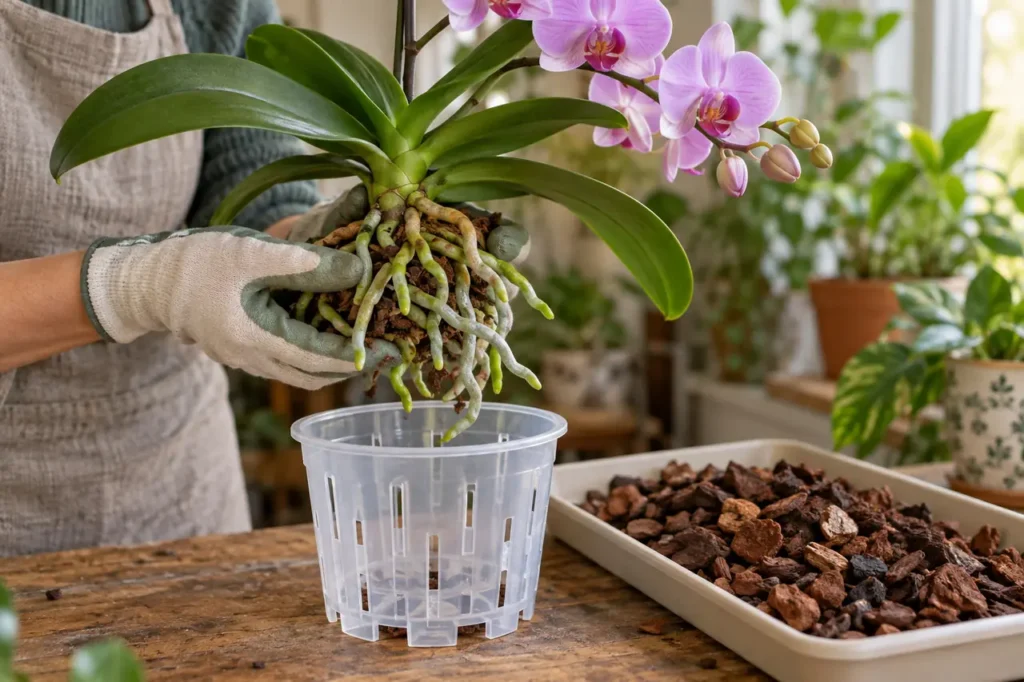
When repotting is warranted, support the orchid at its base. Roots attached to pot edges or emerging through openings tear if the plant is dragged out. Ease the container away carefully and stop when attached tissue resists.
Container and medium choices follow roots and care habits in the American Orchid Society’s Repotting guidance. Create an aerated environment that you can water effectively, with enough space for functioning roots. Excess unoccupied medium increases the wet volume around them.
Remove failed tissue selectively
During an actual root assessment, distinguish clearly soft, rotten, or hollow segments from firm functioning roots. Use clean suitable tools for necessary trimming. Avoid cutting healthy aerial roots for symmetry or removing every discolored section without checking its integrity.
Keep aerial roots where they fit naturally
A dry root might feel firm and brittle. Gentle moistening before handling helps you work without forcing sharp bends, but wetting is not a license to fold roots tightly. Let roots remain outside when they do not naturally fit the container.
Position the stem-root junction near the top of the medium, leaving the crown uncovered. Work the chosen orchid material among the roots gently. Compression that eliminates air spaces recreates a root-zone problem even if the material started fresh.
Use container selection to evaluate drainage, material, and access, with the orchid’s root system determining the final fit. Decorative appearance belongs after those functions have been resolved.
Once the plant is supported, stop repeatedly lifting it to judge progress. Newly emerging roots need protection from disturbance. Keep notes on the old medium, the extent of root loss, and the replacement setup so later changes are interpreted against the work actually done.
Match Watering to the Inner Medium, Not Dry Air Roots
Exposed roots dry faster than material enclosed in a pot. Watering the entire root zone every time an aerial root becomes silver risks keeping the interior wet. Check the inner medium and the plant’s condition together.
For a typical Phalaenopsis in a conventional drained setup, water thoroughly and allow the medium to approach dryness before the next watering. Do not deliberately leave the plant completely dry for an extended period. Its fleshy leaves provide limited storage, so a persistently dry root zone is also a problem.
The interval changes with bark grade, pot size, temperature, light, and humidity. After changing the medium, observe its dry-down and set a routine for the changed conditions. A room that is cooler or dimmer requires another assessment even when the plant has not moved far. The relationship between light and watering changes demand without making a silver aerial root unhealthy.
Pro Tip: Lift the inner pot after watering and again as the medium approaches its normal drying point. Learning that weight change is more informative than the color of one exposed root.
Keep runoff from standing around an ordinary drained inner pot. Specialized wicking or reservoir systems require their own design and management; they are not equivalent to an accidental puddle inside a decorative sleeve. Avoid changing to such a system during an already uncertain root rescue without understanding its requirements.
Water early enough for wet foliage to dry, and keep pooled water out of the central crown. Humidity with air movement is different from continuously wet bark. Misting exposed roots repeatedly does not replace a functioning root-zone watering routine.
Are the roots inside staying wet despite the dry appearance of the ones outside? That difference explains why a neat-looking aerial root is a poor irrigation timer. The general relationship among light, water use, and growing conditions also underlies houseplant care, with orchid-specific root requirements retained.
After repotting, monitor leaf firmness, root-tip activity, and how the medium dries. Old damage does not disappear immediately. Continued deterioration despite a corrected setup needs reassessment, particularly when few functioning roots remain or the plant’s identity is uncertain.
Conclusion
At the next watering, inspect one exposed root and the inner medium without unpotting a healthy plant. If both remain sound, leave the aerial roots where they are and keep observing the normal drying cycle.
When repotting is justified, protect newly emerging tips and avoid making repeated changes before you can assess the result. Progress is visible in firm leaves, intact roots, and fresh tips extending into an airy medium with a suitable drying cycle inside the pot.
Frequently Asked Questions
Must I replace an opaque pot with a clear one?
A clear pot helps you observe roots and moisture. A functioning setup also permits an opaque container. Drainage, suitable medium, and an appropriate watering routine still determine the root environment. Change the container when there is a functional reason.
What if one healthy aerial root breaks accidentally?
Support the remaining roots and prevent further handling damage. One broken root does not justify cutting the rest or repeatedly repotting the plant. Reassess the functioning root mass and keep its growing conditions appropriate.
Should every root tip be bright green?
Tip colors differ among orchids, and roots do not all grow continuously. Judge the plant through root integrity, medium condition, and growth over time. A tip’s color or a temporary growth pause alone is insufficient to declare the root dead.