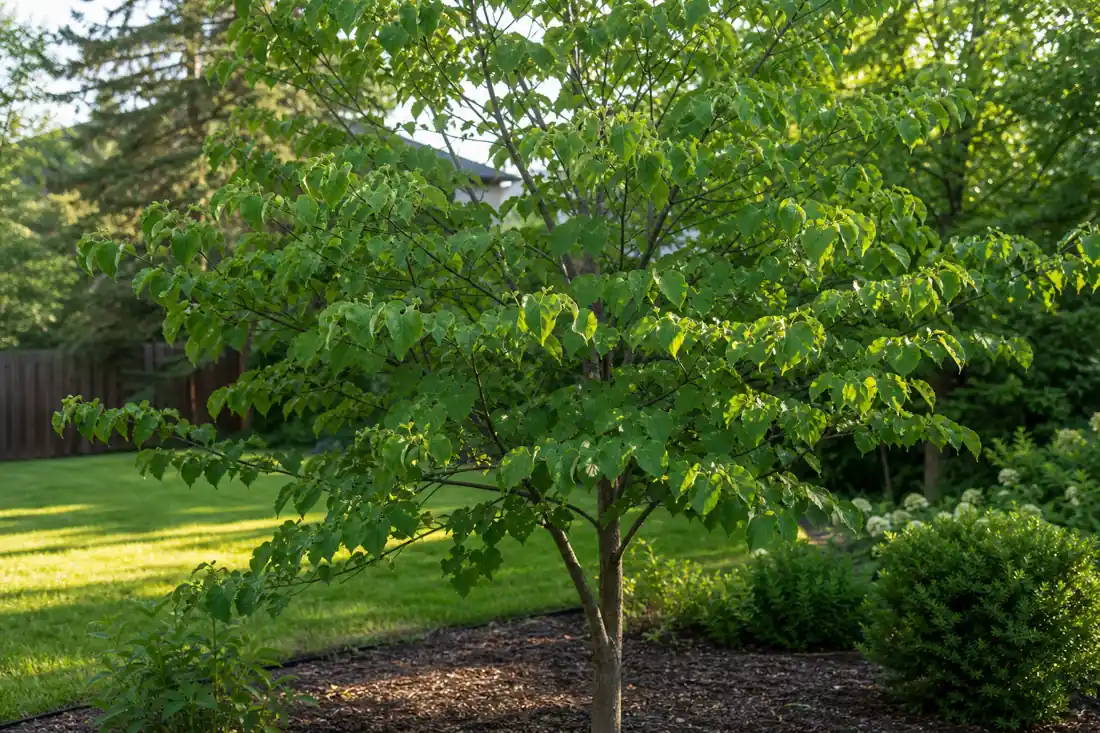




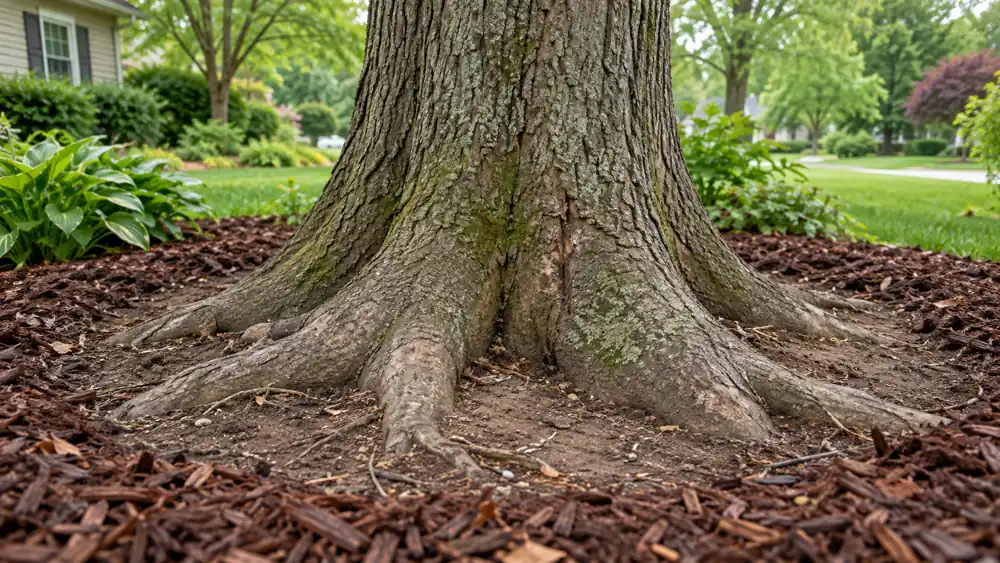
The root flare is the widening at a tree’s base where the trunk transitions into spreading structural roots. On an established tree, that transition should usually be visible near ground level. A trunk disappearing into mulch or soil like a straight pole deserves a closer look, especially if the canopy is thinning or a root presses against the bark.
Start by identifying what covers the base. Loose mulch can be moved without excavating the tree’s anchoring roots. Compacted soil, a buried collar, or a thick root embedded against the trunk calls for a different response. Removing a mulch pile may reveal a normal base; it cannot diagnose everything happening below ground. A careful surface check helps you choose between routine mulch correction, further observation, and professional assessment without turning an uncertain problem into a root wound.
What do you see at the tree base?
Trunk widens into outward-growing roots
Keep loose mulch off the bark and monitor the tree. New decline, decay, or root contact needs another check.
A loose mulch pile hides the base
Gently move loose material away and look again. Do not scrape bark or pull attached roots.
Straight trunk enters soil after mulch is moved
Photograph the base and check planting or grade history. Seek assessment before deeper excavation around an established tree.
Root presses into trunk; lean or major decline
Arrange a qualified arborist’s evaluation. Do not cut roots or dig beneath the root plate.
Key Takeaways
- Find the widening where trunk becomes structural roots.
- Move loose mulch before considering any deeper disturbance.
- Compare the whole base for compressed bark or roots.
- Refer embedded roots and instability to a qualified arborist.
- Track canopy changes without assuming one visible cause.
Table of Contents
Recognize the root flare where the trunk widens
Follow the trunk downward with your eyes. Near the base, its sides generally widen and blend into the larger roots spreading away from the stem. The transition may be broad on an older tree and less pronounced on a young one. Species and age affect the shape, so a modest flare is not automatically a defect.
Look around the entire trunk. Compare an outward sweep on one side with any unusually flat area elsewhere. An uneven outline can be worth investigating, particularly if a root crosses the flat area. Do not judge the base from the lawn-facing side alone or from one photograph taken above a thick mulch layer.
Surface roots farther from the trunk are not the flare itself. A woody root visible in the lawn may be normal anatomy. The trunk-root transition can remain buried closer to the stem. The task is to locate the connection at the base, not to expose every root extending across the yard.
A root collar hidden below added material can remain unnoticed for years. Iowa State University Extension and Outreach’s planting-depth guidance locates the trunk transition at or slightly above the surrounding grade when planting a new tree. That explains the anatomy you are looking for; it does not mean a homeowner should lift a mature tree to change its height.
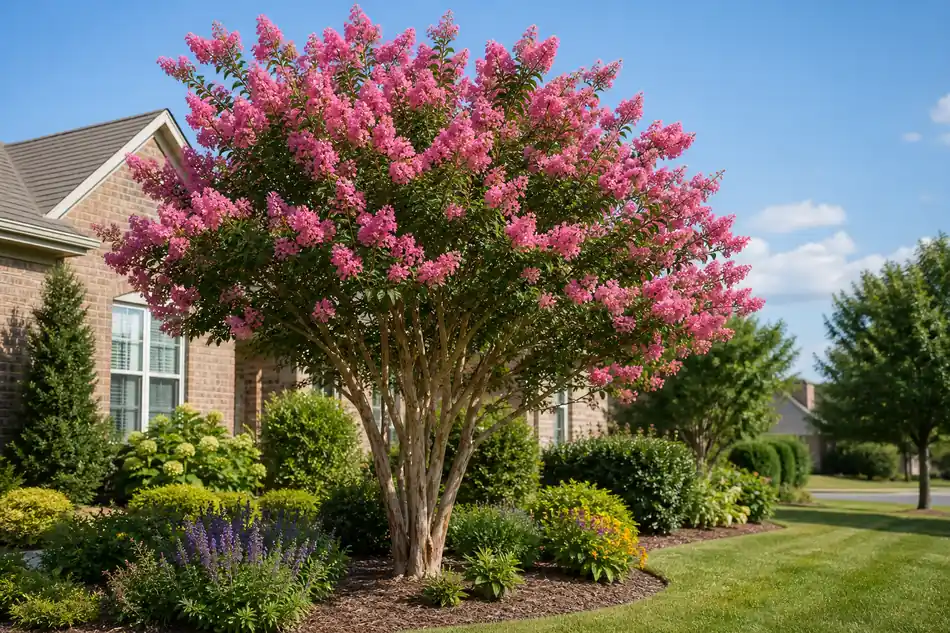
For a newly installed crepe myrtle, planting depth and the surrounding grade can be checked before the root system becomes established. An older landscape tree requires assessment of its existing roots, soil history, and condition before a substantial correction.
Separate mulch cover from soil burial
A mound of bark chips against the trunk can conceal an otherwise correctly positioned base. The loose material may be springy under your fingers, with wet, dark fragments close to the bark and lighter chips above. Moving that layer can reveal the flare without removing the soil that holds the roots.
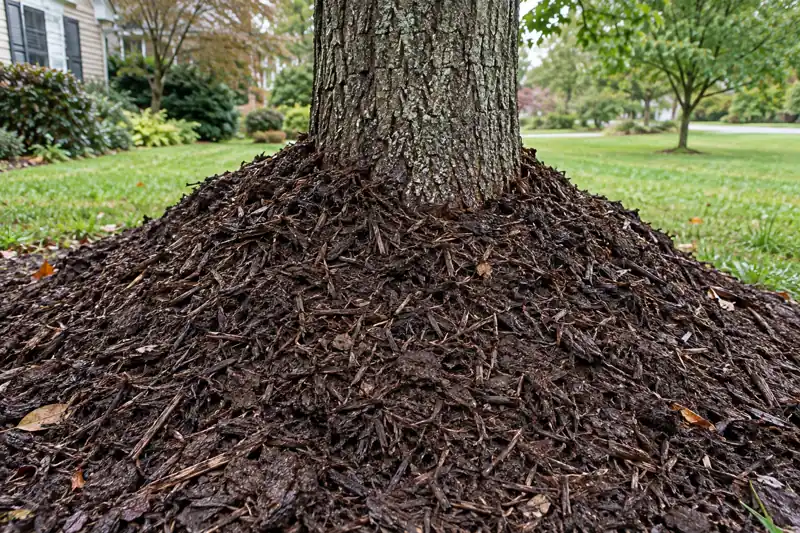
Soil burial is different. The tree may have been planted too deeply, or later landscaping may have raised the surrounding grade. After loose mulch is moved, the trunk still enters firm soil without an obvious widening. That observation raises a question about depth; it does not tell you how far down the structural roots lie.
Check the history before reaching for a shovel. Was topsoil spread when the lawn was renovated? Was a raised bed built around the trunk? Has mulch been added repeatedly without checking the base? A recent change in grade gives the arborist different information from a tree that has looked pole-shaped since installation.
Cover changes bark moisture and root conditions
Prolonged contact with damp material can keep trunk bark wet and conceal deterioration. Buried roots may also occupy soil with restricted air movement. These problems can occur together. After clearing chips, separately assess drainage and soil depth farther out.
A mulch layer over soil can moderate moisture and protect the surface. Keep that function separate from covering the trunk. An accumulated mound against bark makes inspection harder and creates a different moisture environment from the intended cover over soil.
For established trees, buried root collars and excessive planting depth are documented concerns in University of Maryland Extension guidance. The potential benefit of exposing a collar depends on the tree’s condition and the work required. It is not a universal promise that removing soil will reverse decline.
Inspect the surface without injuring the root plate
Choose an observation-first check. If the tree has a new lean, visibly moving ground at its base, major decay, or another apparent failure hazard, avoid working beneath it and arrange professional assessment. Delay the mulch correction until the tree’s safety has been evaluated.
For a stable tree with loose cover, use a gloved hand to move unattached mulch away from the trunk. Work gently enough to leave bark and woody roots untouched. Damp chips may come away easily; resistance from an attached root or firm soil means the task has changed. Do not keep pulling simply because the material resembles a strand of old mulch.
- Inspect all sides of the trunk and note where its contour begins to widen.
- Move only loose surface cover that separates without force.
- Look for roots pressing against the trunk, flattened bark, cavities, or damaged tissue.
- Photograph the exposed surface and the whole tree, including the surrounding grade.
- Stop before deeper soil removal, root cutting, or scraping becomes necessary.
Keep the photographs repeatable. A close view shows the contact point; a wider view shows whether a bed or lawn slopes toward the trunk. A picture of the canopy gives the evaluator a third piece of context. Include a familiar scale object in a photo if helpful, without pressing it into bark or forcing it beneath a root.
Do not probe repeatedly with a sharp tool to find the first root. An established tree’s near-trunk woody roots contribute to anchorage as well as transport. A trench around the base is not a harmless way to reveal its shape, and no single excavation depth is safe for every tree.
If the flare remains hidden after loose cover is removed, record what you found and arrange a collar assessment for a mature or valuable tree. Returning soil to a suspected wound, scrubbing the bark clean, or cutting a root to improve the view can hide or worsen the problem you wanted to diagnose.
Distinguish spreading roots from trunk compression
Normal structural roots spread outward from the trunk. A stem-girdling root follows a different course: it curves around or grows across the base and presses against the stem. As both tissues enlarge, contact can become compression. The visible clue is their relationship, not merely the presence of a root above the ground.
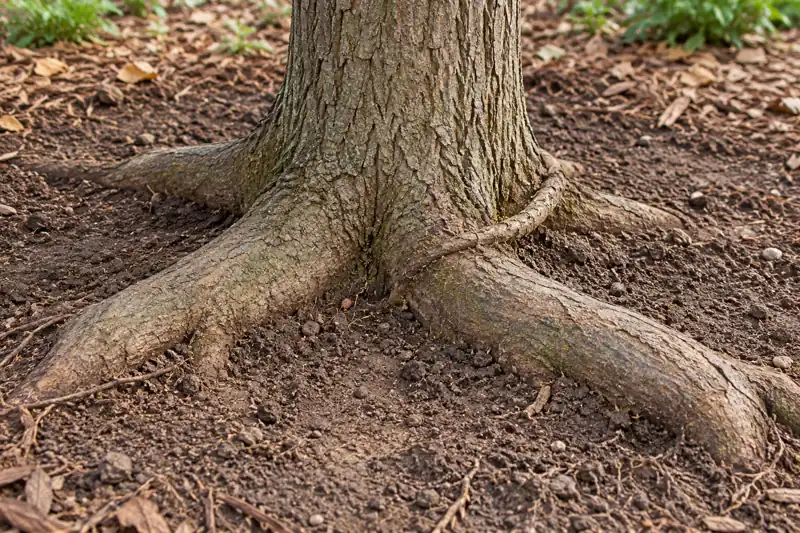
Examine the point of contact without disturbing it. Bark may look flattened or indented where a root presses. One side of the trunk may lack the outward sweep seen on the other sides. An embedded segment can appear partly swallowed by growing wood. Do not pull it outward to see whether it releases.
Compression can interfere with the tissues moving sugars toward roots and can contribute to the tree’s decline. Circling roots sometimes begin in nursery containers, before the tree enters the landscape. Deep planting and constrained soil conditions can also contribute. A tree that grew well for several years may still develop a later problem as woody tissues increase in diameter.
| Observation | Interpretation | What changes the next step |
|---|---|---|
| Roots widen and travel away from the trunk | Often normal structural growth | Look for defects; leave normal structural roots intact |
| A root crosses another root away from the stem | Not automatically stem girdling | Actual contact, pressure, and tree condition need assessment |
| A root presses into the trunk with a flattened contour | Possible stem-girdling problem | Professional assessment before removal |
| Missing flare plus canopy decline | Burial or root problems are possible | Check alternative stress causes and belowground conditions |
Maples are useful examples because root-girdling symptoms are documented in Extension diagnostic material. Knowing whether you have a red, sugar, or another maple species helps supply context for an assessment. Other landscape trees can also develop girdling roots; the problem is not exclusive to maples.
Early fall color, small leaves, scorch, and scattered dead branches deserve attention. Each needs interpretation alongside other observations. The University of Minnesota Extension maple diagnostic tool places environmental stress, girdling roots, cankers, and decay among alternative explanations for canopy dieback. A poor crown and a suspicious base strengthen the reason to investigate, not the certainty of a single cause.
Know when excavation or root cutting needs an arborist
Arrange a qualified arborist’s inspection when soil conceals the collar of an established tree, a root compresses the trunk, or decay and decline accompany the hidden base. Make the location clear when booking: a large tree beside a home, path, or parked vehicles carries different consequences from a small tree in an unused corner.
Professional air-spade excavation moves soil with compressed air to reveal the collar. It is an option for valuable trees described in University of Maryland Extension guidance. Its use still requires judgment about the tree and site; ordinary pressure washers and improvised digging are not equivalent diagnostic tools.
Diameter alone cannot authorize a cut
Root-removal advice depends on attachment and tree condition. Maryland’s girdling-root guidance directs large-root cases to an arborist and cautions that roots grafted into the trunk may be better left undisturbed. A smaller root is not automatically safe to remove simply because it falls below an example diameter.
The distinction between a free root and an embedded segment matters. Colorado State University Extension’s landscape-tree root and soil diagnosis warns that pulling embedded material away can damage trunk tissues and create decay or structural weakness. Leave attached root material untouched until the tree and contact point have been assessed.
Ask what the proposed work is expected to accomplish. Will it expose the collar for diagnosis, remove a particular constricting root, or address a wider soil problem? What could be damaged? Could leaving an attached segment be safer than removing it? Those questions keep the decision tied to the actual defect.
A new or worsening lean, root-plate movement, a hollow or decaying base, and major dead branches increase urgency. Keep people away from an apparent falling hazard and obtain a tree-risk assessment. Removing mulch cannot certify stability, and photographs cannot establish that an unseen root system is safe.
Monitor the crown and the wider rooting area
After a loose-mulch correction, keep the base visible and note what has changed. If the flare appears normal and the tree remains vigorous, routine observation may be enough. If firm soil still conceals it or root contact is visible, arrange the next assessment and leave deeper soil undisturbed.
Compare crown density, new shoot growth, leaf size, and unusual early color over subsequent seasons. Record the timing as well as the symptom. A sparse canopy after drought and a progressively declining canopy with trunk compression may call for different investigations. Existing damaged wood does not become sound simply because the base looks cleaner.
Inspect conditions beyond the collar. Water pooling after rain, repeated vehicle traffic, construction, and raised soil levels can affect a larger portion of the root system. Compacted soil and restricted pore space can limit air and water movement. Plan any correction with the arborist to avoid driving tools into established woody roots.
Do not add fertilizer to compensate for a suspected physical constriction. Address any diagnosed watering or nutrition problem separately from a root pressing into the trunk. Keep those care decisions separate from the structural decision so that improved leaf color does not obscure an unresolved defect.
Recovery varies with the duration and severity of burial, root attachment, decay, and the tree’s remaining function. A professional may recommend monitoring, selective intervention, or a safety decision with a different outcome. There is no dependable survival percentage or universal recovery schedule for an individual tree based on an exposed flare alone.
Conclusion
Locate the widening at the trunk base, identify the material hiding it, and distinguish outward-growing roots from roots pressing into the stem. Move loose mulch gently. Stop when the work becomes excavation or root removal, especially around an established tree. A visible flare improves inspection; the tree’s roots, crown, and stability determine the next decision.
Frequently Asked Questions
Can roots begin circling before a tree is planted?
Yes. Container-grown roots may circle within the nursery root ball before planting. Later growth can make those patterns harder to see, so nursery and planting history can help explain a problem found years afterward.
Does every tree have an equally broad root flare?
No. The visible widening varies with species and age. A young tree may have only a slight transition. Compare the anatomy and surrounding grade before drawing a conclusion from flare size.
Should loose material be piled back against the trunk for winter?
No. Seasonal protection over soil should not recreate a mound against trunk bark. Keep the base observable and ask about species-specific winter needs separately from any buried-collar or root-contact problem.