

A green caterpillar on a tomato, cabbage or parsley plant can call for three different responses. One may strip a crop, another may become a butterfly you want in the garden, and a spiny species may be unsafe to touch. Start with the plant it is eating, then compare its markings, body shape and movement.
Look for fresh damage before reaching for a spray. A caterpillar resting on a fence has given you little evidence about its food. One chewing beneath a cabbage leaf, beside dark droppings and fresh holes, has given you much more. The mature forms below are useful starting points for US gardens, not a complete identification key. Young larvae can look different, and several species share the same host. Photograph an unknown animal without handling it, especially when you see hairs or branched spines.
Start with the host and one clear trait
Tomato or pepper: a large smooth larva with a rear horn suggests a hornworm. Compare side markings and horn color.
Cabbage or kale: check velvety skin, looping movement, or a tiny tapered body. More than one species may be feeding.
Parsley or dill: black bands with yellow spots on a green larva suggest a late-stage black swallowtail. Consider leaving it.
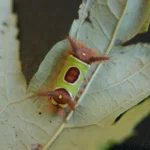
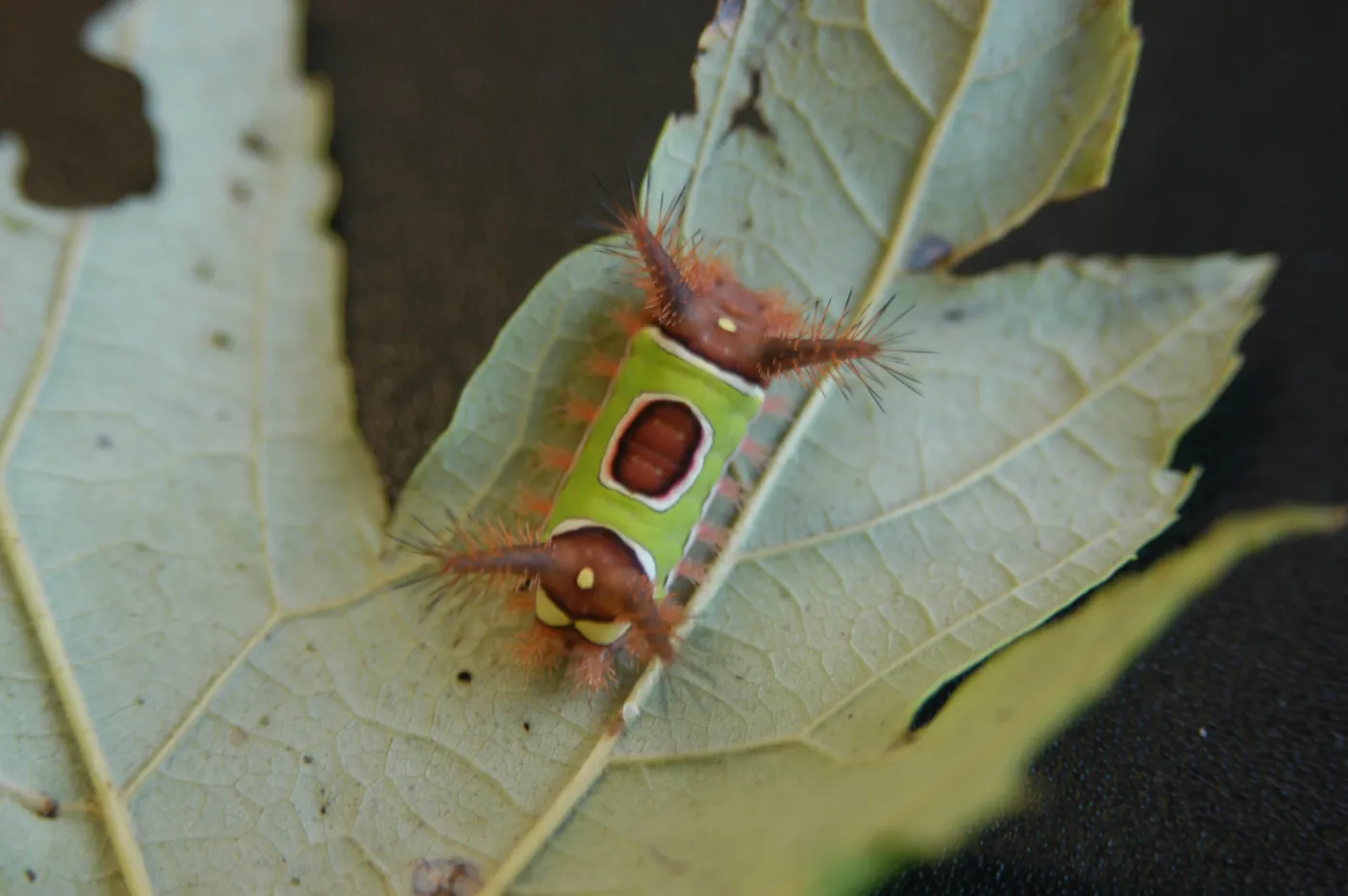
Spines or a green saddle: keep hands away. A photograph and local identification are safer than picking it up.
Key Takeaways
- Identify the feeding plant before comparing color and markings.
- Photograph unknown hairs or spines without touching the caterpillar.
- Check new damage before treating holes left by departed larvae.
- Leave parasitized hornworms carrying white wasp cocoons in place.
- Reserve caterpillar sprays for identified pests and labeled uses.
Table of Contents
Green Caterpillar Identification Chart: Host and Body Clues
Use the feeding plant to narrow the possibilities, then match more than one physical feature. Lengths describe larger larvae; a half-inch specimen is not automatically a small species. The same insect can change color and pattern between molts.
| Likely match | Common feeding plant | Visible clue in larger larvae | First response |
|---|---|---|---|
| Tomato hornworm | Tomato and related crops | White V-shaped side markings; usually dark rear horn | Inspect damage and check for parasitoid cocoons |
| Tobacco hornworm | Often tomato, despite its name | Seven diagonal white side stripes; usually red rear horn | Use markings, not the crop name, to separate hornworms |
| Imported cabbageworm | Cabbage, kale, broccoli and relatives | Velvety green; faint lengthwise yellow stripes; about 1 inch | Turn leaves over and check the growing center |
| Cabbage looper | Brassicas and other vegetables | Pale side lines; arches its middle while moving; up to about 1.5 inches | Watch movement and inspect both leaf surfaces |
| Diamondback moth larva | Brassicas | Small, tapered green body; about one-third inch when grown | Look underneath thin, windowlike feeding patches |
| Black swallowtail | Parsley, dill, fennel and carrot relatives | Later larvae have black bands with yellow spots on green segments | Tolerate feeding when the host has enough foliage |
| Roseslug sawfly lookalike | Rose | Small greenish larva beneath scraped or skeletonized leaves | Confirm sawfly identity; caterpillar Btk is unsuitable |
| Saddleback or Io moth caterpillar | Various plants; regional occurrence | Green saddle with spiny knobs, or branched spines and a side stripe | Do not touch; obtain a local identification |
Fresh Feeding and Body Structure Narrow the Identification
Take one photograph from above, one from the side and one showing the plant and damaged leaf. Include a ruler nearby only if you can position it without contact. Record your state, the date, approximate length and whether the larva was eating. A leaf with crisp, newly chewed edges and dark pellets beneath it is stronger evidence of active feeding than an old brown-edged hole.
The hard, jointed legs just behind the head differ from the fleshy abdominal supports called prolegs. Many familiar moth and butterfly caterpillars have no more than five pairs of abdominal prolegs. Sawfly larvae commonly have six or more. Iowa State University’s sawfly comparison uses this distinction to separate animals that otherwise look remarkably alike. Small legs can be hidden by the leaf or body angle, so an uncertain photograph should remain uncertain.
Do not squeeze an insect to expose its underside. A side view taken as it moves can reveal the supports without handling. Fine hairs can also create a velvety surface that is difficult to see in a distant photograph. Move the camera closer only when you can keep your skin away from the plant and animal.
A single photo rarely settles every case. Tiny larvae, damaged specimens and similar species may need a local Extension identification. Keep the original image resolution: a compressed screenshot can erase the stripe, hair or leg detail needed to distinguish them.
Hornworms Strip Foliage as Their Appetites Increase
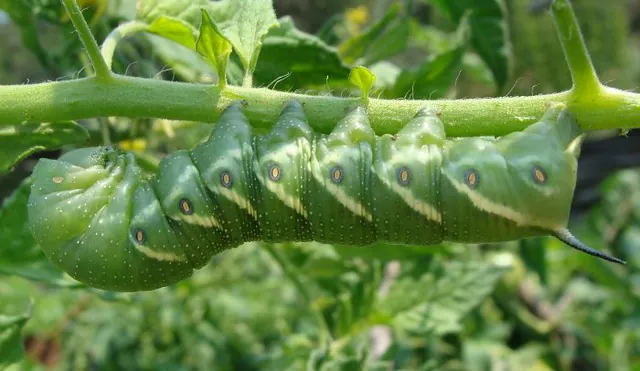
Tomato hornworms and tobacco hornworms can both feed on tomatoes, peppers and other nightshade relatives. In larger larvae, hornworm side markings and horn color help separate the two: white Vs and a usually dark horn suggest Manduca quinquemaculata; seven diagonal stripes and a usually red horn suggest Manduca sexta.
The rear horn is not a stinger. That detail applies to an identified hornworm, not to every green animal with a pointed projection. Mature hornworms may reach 3 to 4 inches, with a smooth, thick body that blends into stems surprisingly well.
Look upward from coarse, dark droppings. A stripped shoot above them often reveals the feeding position. Larger larvae remove foliage quickly, so inspect neighboring stems after finding the first animal. A small plant has less leaf area to spare than a vigorous established vine; tomato growth stage changes how much lost foliage the plant can tolerate.
White rice-shaped cases are wasp cocoons
Clusters of raised white cases attached to a hornworm are often braconid wasp cocoons. They are not hornworm eggs. The wasp larvae developed inside the host and emerged to pupate in those cases. Leave the parasitized hornworm in place so the adult wasps can emerge; check other shoots for separate, actively feeding larvae.
Removing every green caterpillar can remove this natural control along with the pest. Keep the distinction visible during inspection: a smooth feeding hornworm and one carrying parasitoid cocoons warrant different responses. Do not peel the cocoons off.
Three Common Cabbage Feeders Leave Overlapping Damage
Cabbage, kale, broccoli and related crops can host several caterpillars at once. Large irregular holes alone do not identify the culprit. The brassica caterpillar comparison from University of Minnesota Extension combines surface texture, size and movement.
Imported cabbageworm: velvet texture and faint stripes
Pieris rapae larvae are velvety green with faint yellow lines along the body. Larger larvae reach about an inch. Their adult is the familiar white butterfly with dark wing markings. Check beneath broad leaves and around the developing head, where feeding and droppings can be harder to see than damage on exposed outer leaves.
Cabbage looper: a body that arches to move
Trichoplusia ni has fewer middle abdominal supports than many familiar caterpillars. It brings its rear end forward, raising the middle into an arch, then extends again. Larger larvae are pale green with light lengthwise lines and can reach about 1.5 inches. Watch it move naturally; prodding is unnecessary.
Diamondback moth larva: small, tapered and easy to miss
Plutella xylostella larvae remain much smaller, roughly one-third inch when fully grown. Look for tapered ends and thin feeding patches where leaf tissue has been removed from underneath. The remaining surface resembles a translucent window before it breaks into a hole. Size alone is not enough: a young cabbageworm can also be small.
A clean planting can be protected with an appropriate insect-excluding row cover. Check the leaves before covering, close the edges and inspect again after work in the bed. A cover over caterpillars already present does not remove them. Keep watching the growing point and harvestable portion rather than judging only the largest outer leaf.
Black Swallowtail Larvae Need Their Herb Hosts to Grow
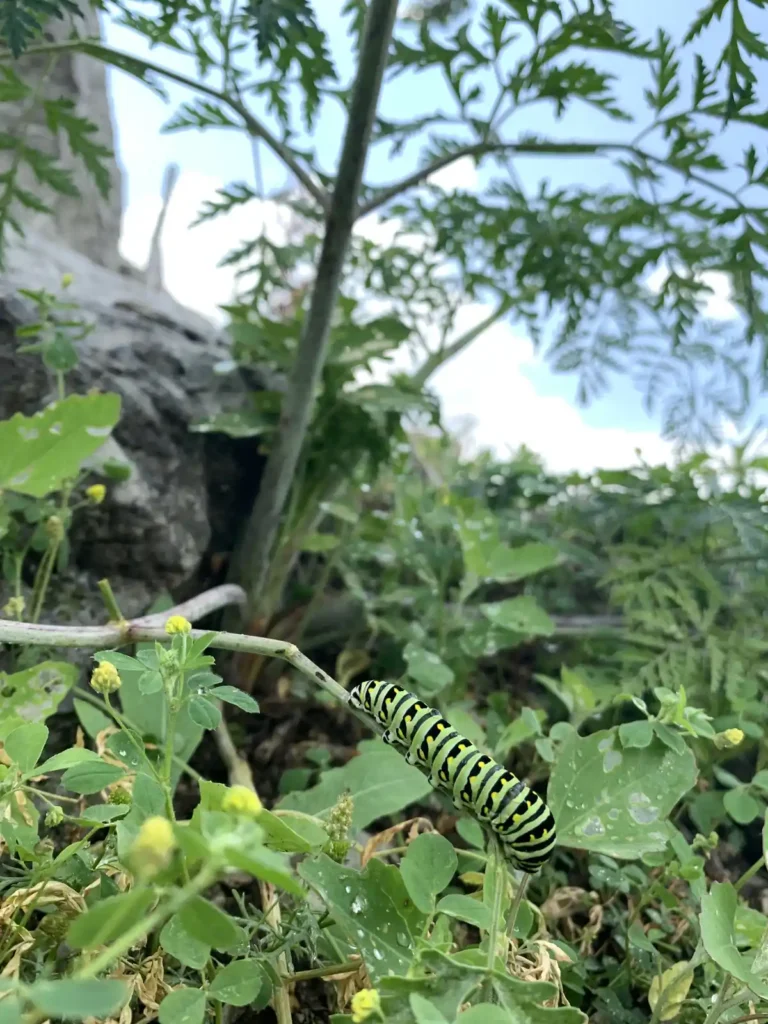
A green larva with black crossbands and yellow spots on parsley, dill, fennel or carrot-family foliage may be a black swallowtail. Early larvae are darker and lack the familiar mature pattern. The University of Minnesota identification record and University of Georgia’s herb guidance connect the larger striped form with these host plants.
Leaving a few larvae can be a deliberate gardening choice. Their feeding produces the next adult butterfly; a spray aimed at saving every parsley leaf can prevent that outcome. On a large established herb planting, the lost foliage may be acceptable. One small pot can run out of food much sooner, so count the larvae and inspect how much suitable foliage remains.
Do not move a caterpillar onto an unrelated plant because it looks greener or has fewer holes. Host suitability matters. If relocation becomes necessary, first confirm the species and a suitable, untreated host; local advice is useful when either identity is unclear.
Adult nectar and larval food are different jobs. Nectar-producing flowers can feed visiting adults without feeding their caterpillars. Choosing plants for butterfly food and shelter means leaving room for some chewed host foliage as well as flowers.
Sawfly Larvae Resemble Caterpillars but Respond Differently
A small green larva under a rose leaf may be a roseslug sawfly. Scraped tissue can leave pale windows, then a lacework of veins. The common name is misleading: the animal is neither a true slug nor a butterfly caterpillar. Sawflies belong to the wasp group.
That identity changes treatment. University of Delaware and Wisconsin Extension distinguish roseslug damage from caterpillar feeding because caterpillar-specific Btk does not control sawfly larvae. Inspect the underside before treating windowpane damage on rose leaves. Clean round cuts from leaf edges suggest another cause again, often leafcutter bees.
An old skeletonized leaf can remain after the feeder has gone. Find a live larva or continuing new damage before acting. Spraying an empty leaf cannot reverse the injury, and removing every damaged green leaf takes away tissue the plant may still be using.
Branched Spines and Saddle Markings Mean Keep Your Distance
Some green caterpillars can sting through defensive spines. A saddleback, Acharia stimulea, has a conspicuous green middle with a brown, pale-bordered saddle marking and prominent spiny projections. University of Florida’s species account places it across much of the eastern United States and documents the venom-bearing structures. It feeds on many kinds of plants, so a host name cannot rule it out.
Io moth larvae, Automeris io, can also be green and carry branched stinging spines, with a contrasting reddish and pale side stripe in larger larvae. They are another reason to photograph an unfamiliar spiny animal from a distance. Do not test a specimen with a finger, thin glove or bare forearm.
Keep children and pets away from an unidentified spiny larva. If it is on frequently handled foliage, obtain local identification and advice about safe removal. After contact, seek appropriate medical guidance; severe symptoms require urgent care. Identification from a web photograph cannot determine an individual’s reaction.
Match Control to the Identified Feeder and Active Damage
Green is camouflage, not a verdict. A caterpillar becomes a moth or butterfly according to its species; a sawfly lookalike becomes a sawfly. Finding one tells you an animal is present. Ongoing feeding, host condition and identification tell you whether intervention is useful.
- Check the plant’s capacity. Look at remaining foliage, the growing tip and the part you expect to harvest. A newly planted seedling and a large perennial do not have the same margin for loss.
- Confirm the feeding is continuing. Photograph the affected leaf and inspect new growth on the next check. Old holes and departed larvae do not justify an automatic spray.
- Use selective physical action first. A few confirmed, nonstinging crop pests can often be removed without treating the bed. Leave wanted butterfly larvae and hornworms carrying parasitoid cocoons. Do not handle an unknown spiny species.
- Check the product’s actual target. If damage is unacceptable and another method is needed, choose only a product labeled for that plant, pest and use. Follow application directions and any preharvest interval.
Bacillus thuringiensis subspecies kurstaki, usually shortened to Btk, must be eaten by susceptible moth or butterfly larvae. It works best on small larvae feeding on treated tissue. It does not solve a sawfly problem, and it can kill desired butterfly caterpillars on treated hosts. UC IPM’s leaf-feeding caterpillar guidance therefore separates crop protection from butterfly plantings.
No single household recipe is appropriate for every green larva. Broad spraying can kill natural enemies or the butterflies you hoped to attract. When identity remains uncertain, send the host name, location and clear photographs to your local Extension service before choosing a pesticide.
Conclusion
Begin with the plant being eaten, then check markings, movement and body structure without touching an unknown animal. Protect wanted butterfly larvae and parasitoid cocoons, investigate sawfly lookalikes, and treat only an identified problem that is still active. Leave an uncertain specimen untouched until its host, markings and local identification agree.