Small evergreen trees fit a yard only when their later height and width fit the space you can actually give them. A slim juniper can grow above a low roof. A dwarf spruce can stay short for years, then become too broad for the entrance where it was planted. Measure the site before choosing a name from a nursery label.
Start with your usable bed width, overhead room, USDA zone and hours of direct sun. Then compare the exact cultivar, including whether its published dimensions describe ten years of growth or several decades. Some useful compact evergreens are shrubs, with multiple stems and foliage reaching the ground. They can work well beside a path, though they will not create the same shape as a small branching tree. A good match leaves room for the plant, your walkway and the maintenance you are willing to do.
Match the space before the plant
Only 2-3 feet of plant width: compare Blue Arrow juniper and Holmstrup arborvitae. Both can reach about 15 feet tall; sun, water and deer pressure help separate them.
A low evergreen accent: consider a compact shrub such as Mops mugo pine. Mounding growth will not create a tree-height screen.
A flowering evergreen tree: Little Gem magnolia needs roughly 8-10 feet of canopy width and 15-20 feet of height in the cited NC State profile.
Check the largest documented width and height, the measurement period, then local growing conditions. A ten-year size is not a permanent limit.
Key Takeaways
- Measure usable width and overhead space before buying plants.
- Check the cultivar’s later size and the age of measurements.
- Separate low shrubs from upright trees and tall columns.
- Match sunlight, summer heat, drainage and winter exposure.
- Keep root flares visible and monitor new root-ball moisture.
Table of Contents
Choose Small Evergreen Trees by Later Canopy Width and Height
Write down the distance from the proposed stem center to each wall, fence, sidewalk and gate. Measure the narrowest part of the bed, leaving the walking space outside it. Look upward for eaves, wires and neighboring branches. A tree can fit the ground footprint and still have nowhere to put its top.
For an approximate circular canopy, divide the expected width by two. A plant that can spread 10 feet has a planning radius of about 5 feet. Put its center 2 feet from a wall and the simplified outline overlaps the wall by 3 feet. Actual growth will respond to light and pruning, so allow extra room for access and ventilation around that approximate outline.
Canopy fit: the same 2-foot distance from a wall
A 10-foot canopy extends about 5 feet from its center. At this position, it overlaps the wall.
A 2-foot canopy uses about 1 foot on either side of its center. Height and access still need checking.
Top views use the same scale: 28 drawing units per foot. These are canopy calculations, not root diagrams, foundation-safety distances or utility-clearance rules.
The word dwarf describes growth relative to other plants; it does not promise a final 3-foot height. The American Conifer Society’s Silver Seedling spruce record even describes growth accelerating after its slow juvenile phase. Ask what happens after the size printed on the tag.
Narrow Upright Evergreens Still Need Vertical Growing Room
| Cultivar and form | Reported height and width | USDA zones | Light and limiting condition |
|---|---|---|---|
| Blue Arrow juniper – columnar evergreen shrub | 12-15 ft high; about 2 ft wide | Hardy to zone 4 in Oregon State profile; upper limit not stated | Full sun; only occasional water once established, not a wet shady strip. |
| Holmstrup arborvitae – pyramidal shrub | 6-15 ft high; 2-3 ft wide | 3-7 | Sun or partial shade; moist drained soil, deer protection may be needed. |
| Sky Pencil Japanese holly – columnar shrub | 4-10 ft high; 1-3 ft wide | 5-8 | Sun or partial shade; alkaline soil and drought can cause trouble. |
| DeGroot’s Spire arborvitae – small tree or large shrub | 15-30 ft high; 4-5 ft wide | 2-8 | Sun or partial shade; moisture and winter shelter, ample overhead room. |
These are source-reported dimensions, not guaranteed stopping points. NC State Extension supplies the cultivar ranges except Blue Arrow, which follows Oregon State University’s landscape-plant profile. The upper ends are useful for rejecting a clearly undersized space before buying.
Blue Arrow juniper
The blue-green column of Juniperus scopulorum Blue Arrow suits a sunny vertical accent where width is limited. Oregon State classifies it as an evergreen shrub; nursery training can affect its silhouette. Its 12-15-foot height still rules out some low eaves and overhead spaces. Drought tolerance after establishment does not remove the need to water a new root ball.
Holmstrup arborvitae
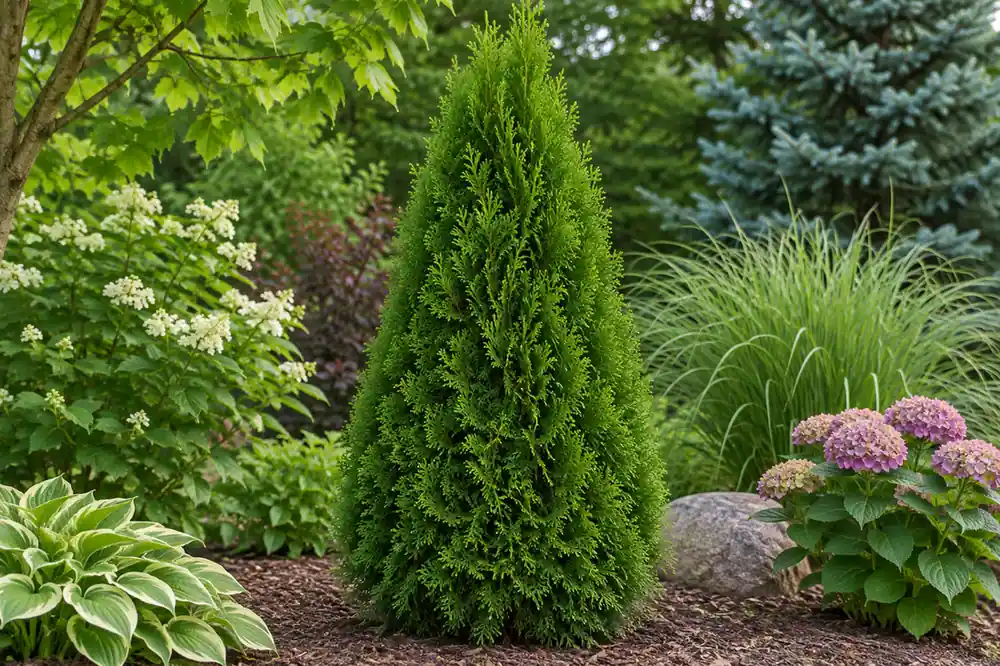
Thuja occidentalis Holmstrup has dense green sprays and a narrow pyramidal outline. It is a better candidate for a moist, draining site than an exposed dry strip. Deep shade can thin its foliage, and deer browsing can remove the low green screen you wanted. A 4-foot bed gives little spare room when the plant reaches the upper 3-foot width.
Sky Pencil holly
Ilex crenata Sky Pencil gives a narrow broadleaf alternative with small, glossy leaves. It is a shrub, not a miniature shade tree. Its reported 1-3-foot width can suit a tight accent where the soil and climate cooperate. Test an alkaline-looking foundation bed before buying: leaf yellowing, drought and hot humid conditions can undermine an otherwise suitable shape.
DeGroot’s Spire arborvitae
Thuja occidentalis DeGroot’s Spire belongs where a tall column is welcome. Its 15-30-foot reported height makes it a poor choice below a low roof, despite dwarf descriptions in nursery catalogs. Twisted, scale-like foliage gives it a different texture from the juniper. Keep its moisture requirements and exposure to snow, ice and drying wind in the decision.
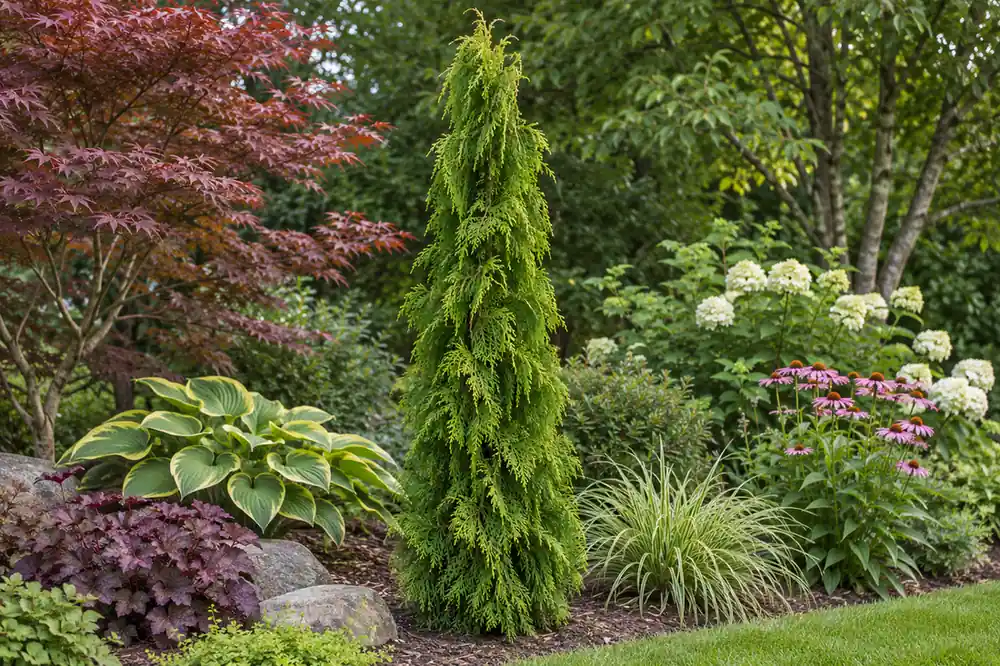
Compact Cones and Mounding Shrubs Use Different Footprints
A lower evergreen can frame a path without becoming a tall screen. Check the width just as carefully. Several dwarf conifers spread farther sideways than their short nursery form suggests.
| Cultivar and form | Reported later height and width | USDA zones | Site or size caution |
|---|---|---|---|
| Conica dwarf Alberta spruce – dense cone, shrub | 10-13 ft high; 7-10 ft wide after decades | 3-6 in NC State profile | Cool conditions; ten-year size is much smaller. |
| Nana Gracilis Hinoki cypress – rounded to conical shrub | Eventually 6 ft or more high; 2-4 ft wide | 4-8 | Sun or partial shade; moist drained soil, shelter from harsh wind. |
| Nana Serbian spruce – spreading to conical shrub | 3-6 ft high; 4-6 ft wide | 4-7 | Sun or partial shade; too broad for many narrow strips. |
| Mops mugo pine – low mound shrub | 3-4 ft high; 2.5-3 ft wide | 2-7 | Sun or partial shade; favors cool summers. |
| Nana eastern white pine – shrub or small tree | 2-7 ft high; 2-10 ft wide | 3-8 | Sun or dappled light; allow for broad growth and avoid salt exposure. |
Conica dwarf Alberta spruce
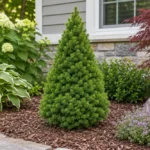
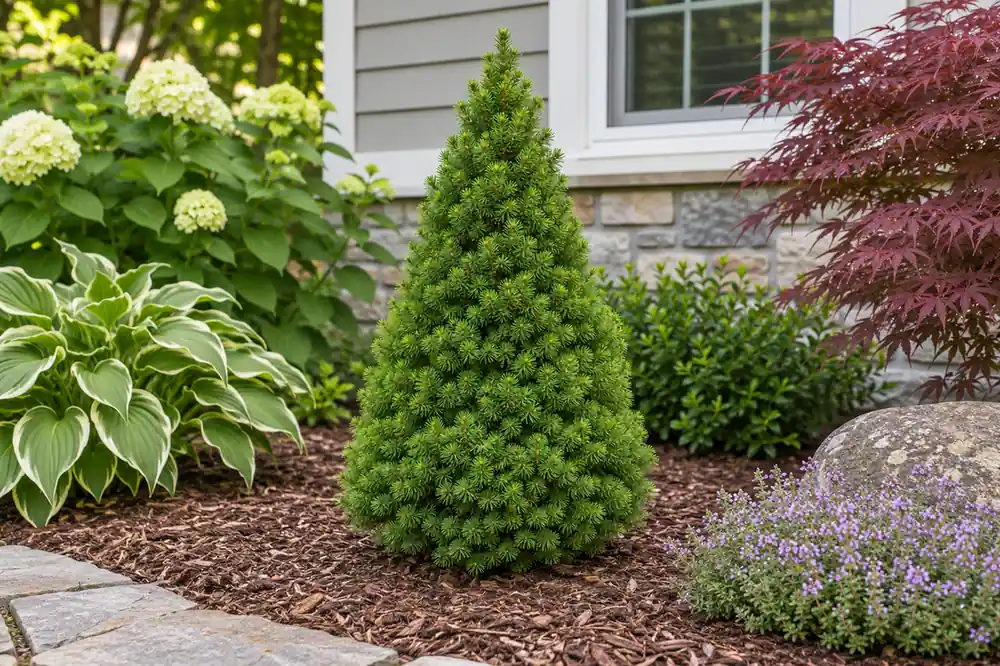
The soft-looking green cone is appealing beside an entrance. Its later footprint deserves a tape measure. The documented growth of Conica spruce is about 3-4 feet high and 1.5 feet wide after ten years, reaching 10-13 feet high and 7-10 feet wide over several decades. Those are separate observations, not a growth curve you can extend by a fixed yearly amount.
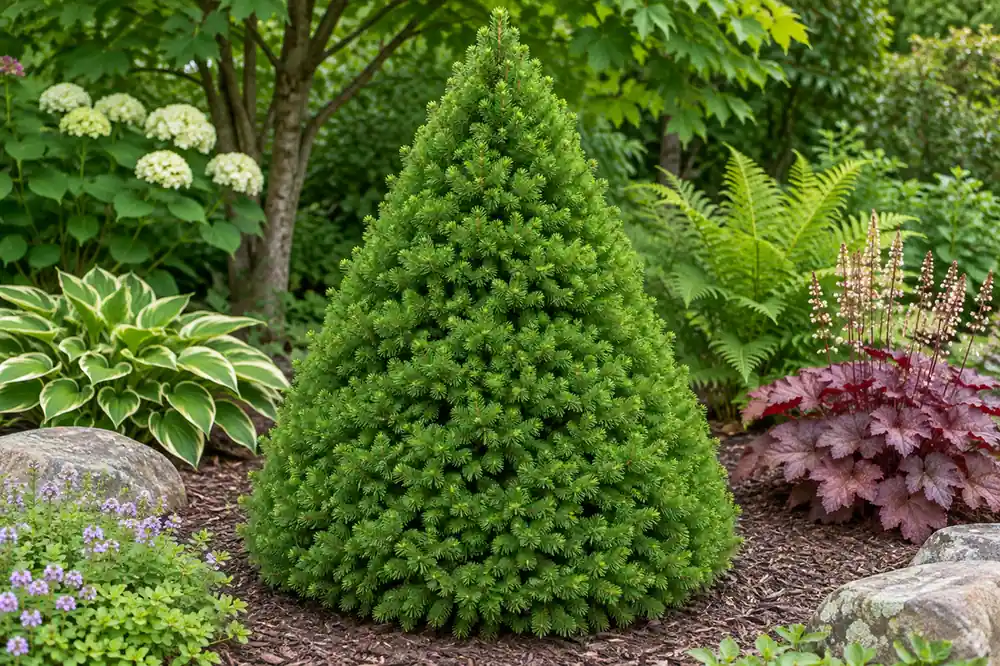
NC State uses the name Picea laxa Conica and zones 3-6. Kwantlen Polytechnic University’s database uses Picea glauca Conica and reports cold hardiness to zone 2. Check local performance at the cold edge. In hot humid summers, reflected heat and repeated mite problems can make this a poor choice regardless of a winter-zone match.
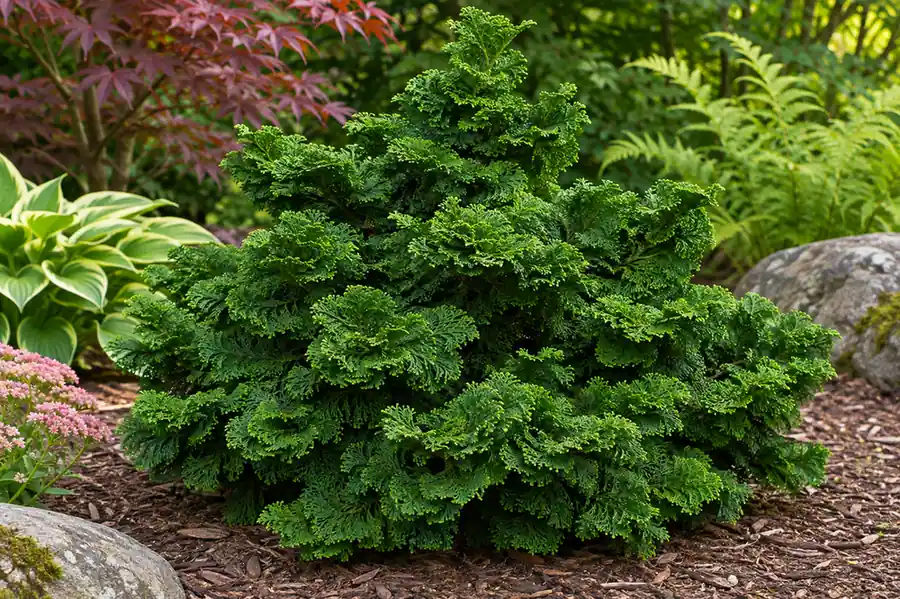
Nana Gracilis Hinoki cypress
The shell-like fans of Chamaecyparis obtusa Nana Gracilis create layered foliage with a coarser texture than the spruce’s fine cone. Young plants are more rounded, becoming conical with age. The NC State description gives 3-4 feet in ten years and eventual height of 6 feet or more. Reserve its later width and choose moist, drained ground protected from harsh wind.
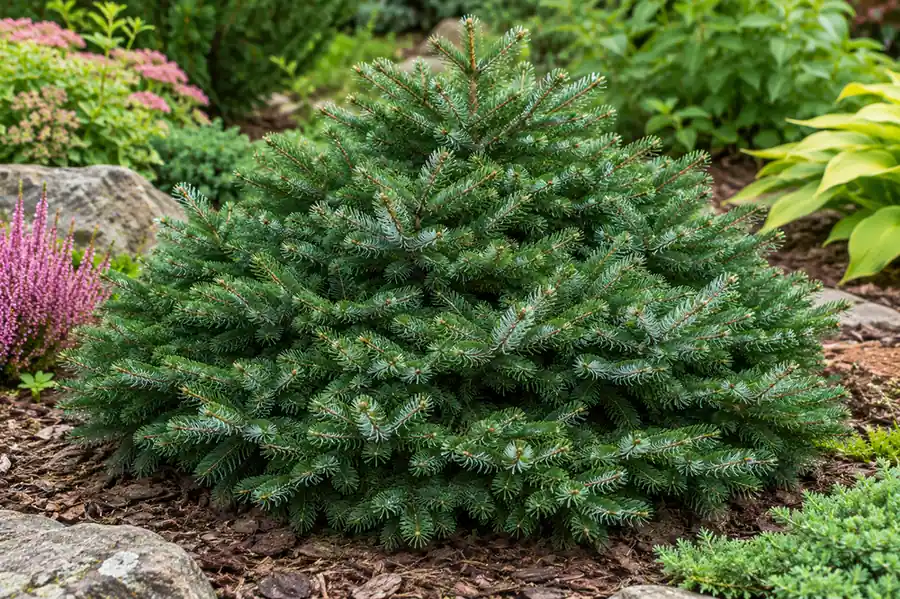
Nana Serbian spruce
Picea omorika Nana begins as a dense, rounded plant and becomes more conical with maturity. Its spreading branches can make a 4-6-foot footprint. A low height does not make it suitable for a 2-foot strip beside a walkway. The pale bands beneath its needles give the foliage a two-toned effect when branches move.
Mops mugo pine and Nana eastern white pine
Pinus mugo Mops is the lower mound of this pair, useful when year-round ground-level greenery matters more than screening. Pinus strobus Nana can spread much farther, with a published width range reaching 10 feet. Its softer needles and rounded form do not make it a narrow foundation plant.
Keep the full botanical name on the label. Nana is used for dwarf forms in several genera, so the word alone cannot identify the plant. Differences among pine species and needle arrangements help distinguish a mugo pine from an eastern white pine before comparing their cultivars.
Flowering Evergreen Magnolias Need a Wider Canopy Allowance
Broad leaves and fragrant flowers can suit a warm-region yard better than a conifer accent. Both magnolias below remain smaller than a full-sized southern magnolia. Neither has the footprint of a slim holly column.
| Cultivar | Reported height and width | NC State zone data | Light and maintenance |
|---|---|---|---|
| Little Gem southern magnolia | 15-20 ft high; 8-10 ft wide | Structured profile 7-8; prose also says 7-9 | Sun or partial shade; allow for leaf litter and possible winter leaf loss. |
| Kay Parris southern magnolia | 15-25 ft high; 8-10 ft wide | 6-9 | Sun or partial shade; room for canopy and reliable establishment water. |
Little Gem magnolia
Magnolia grandiflora Little Gem has glossy leaves with brown undersides and white fragrant flowers. It can be a small tree or a multi-stemmed shrub, depending on the plant and training. Check the actual stock before choosing a position beside a door. A canopy approaching 10 feet wide leaves no maintenance margin in an 8-foot side yard.
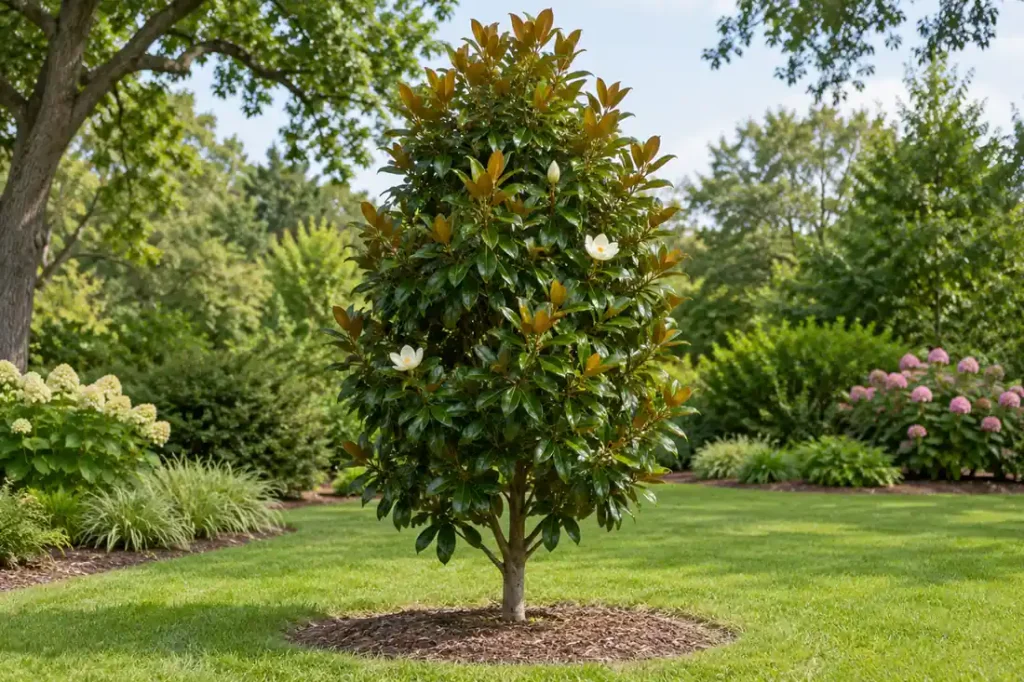
Its NC State record contains different zone bounds in the prose and structured data, shown in the table. Verify local experience near those edges. It may lose leaves in harsh winters, and seasonal leaf litter makes it a less tidy choice above a small deck than the word evergreen suggests.
Kay Parris magnolia
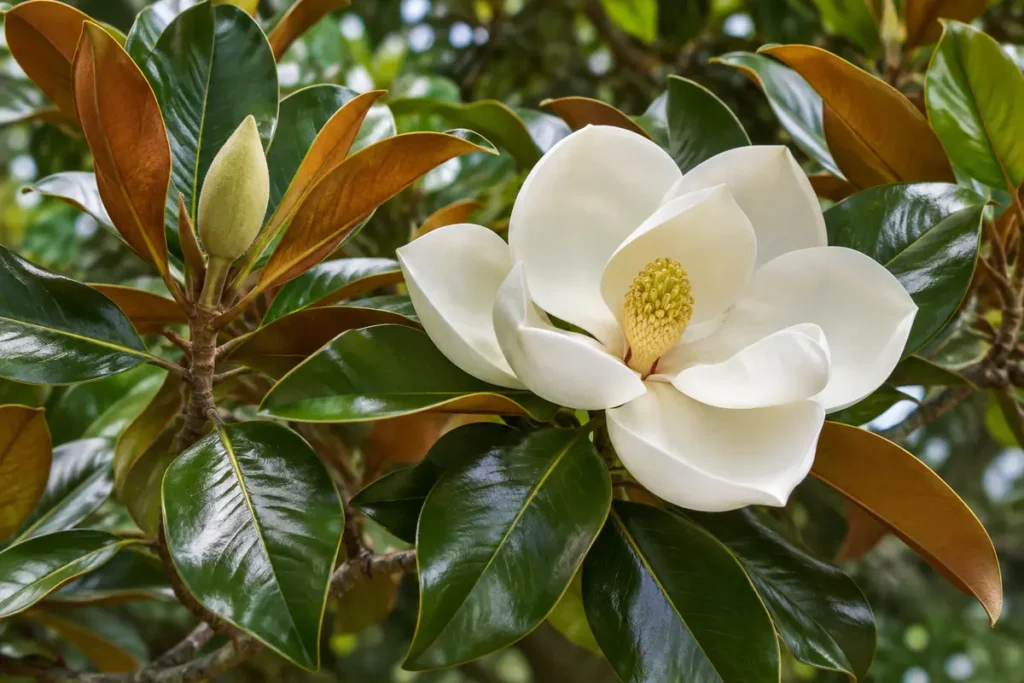
Magnolia grandiflora Kay Parris adds a dense canopy, glossy wavy-edged leaves and orange-brown undersides with a velvety feel. Its reported height reaches 25 feet, with width similar to Little Gem. Give it a specimen position where the foliage can expand. Regional observations of ice-storm performance are not a guarantee of storm resistance in every garden.
Match Sun, Summer Heat and Root Moisture to the Cultivar
USDA hardiness zones describe winter cold conditions. They do not tell you whether a plant will cope with humid summer heat, drying wind or road salt. A cool-climate spruce and a warm-region magnolia can both be evergreen and still belong in different landscapes.
Count direct sunlight at the actual planting position. NC State’s full-sun category means six or more hours; partial shade means roughly two to six. Deep shade beneath a building overhang is different from a few hours of afternoon shelter. Look at the future shade cast by neighboring trees as well as today’s open bed.
Inspect the ground after rain and during a dry spell. Moisture-requiring arborvitae will struggle where a small root ball dries against hot paving. A dry-site juniper is not a remedy for persistently flooded ground. Correct waterlogged soil and drainage problems before buying a cultivar that needs air around its roots.
For holly beside concrete or an amended foundation bed, a laboratory soil test can identify an alkaline soil problem before leaf yellowing starts. Do not buy first and assume fertilizer can correct an unsuitable pH, exposure or summer climate.
Plant With the Root Flare Visible and Water the Root Ball
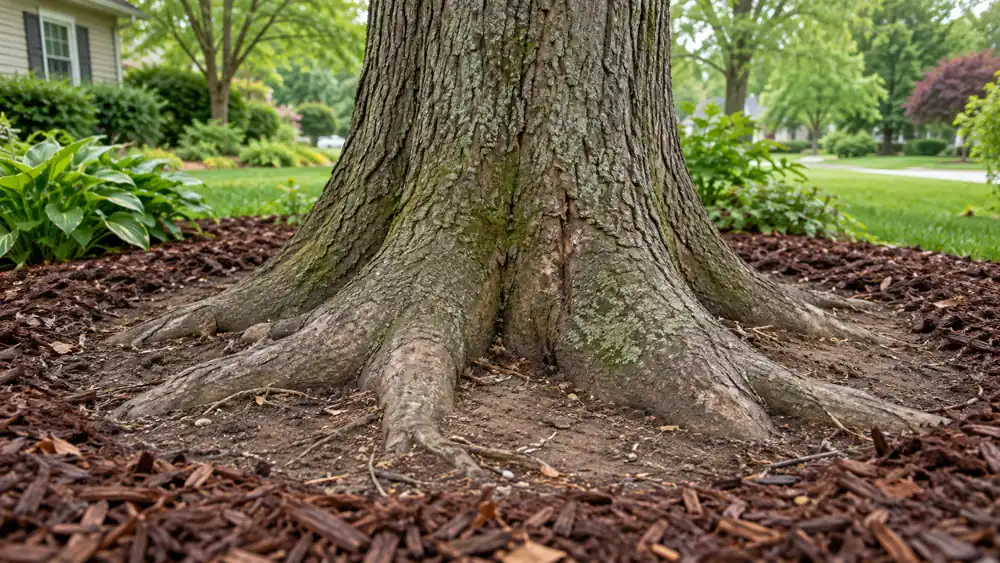
Locate the first main roots where they widen from the stem before judging hole depth. Nursery soil can hide that point. A buried tree root flare needs inspection before backfilling, not another layer of mulch afterward.
Check container stock for a tight mat of circling roots, and use the appropriate correction for that stock. Balled-and-burlapped plants need different handling to preserve the soil ball and remove constricting materials. Get help with heavy plants and lift from beneath the root ball. Check for buried services before digging post holes or a planting hole.
Water the root ball and surrounding soil after planting. Then inspect both: damp garden soil can surround a dry original potting mix. Adjust watering to rainfall, soil texture and the plant’s actual rooting volume. Established drought tolerance describes a rooted plant, not a newly installed container specimen.
Mulch the surrounding soil without burying the stem. University of Minnesota planting guidance uses a 2-3-inch layer kept at least 4 inches away from the trunk. Leave the flare visible and adapt the mulched area to the bed. Gravel at the bottom of a wet planting hole does not create a functioning drainage outlet.
Check Plant Size and Damage Patterns Before Pruning or Feeding
A plant that has outgrown its position may simply be following its cultivar’s growth habit. Thuja Green Giant, for example, has NC State dimensions of 40-60 feet tall and 12-18 feet wide. A small nursery pot does not make it a compact substitute for Holmstrup.
If an installed conifer is crowding a path, verify its identity and later dimensions before committing to repeated severe clipping. Pruning cannot be assumed to preserve dense green foliage on every old stem. A suitable replacement or a properly planned move may serve the space better; large plants need qualified local assessment.
| Visible pattern | Check before treatment | Next step |
|---|---|---|
| Outer tips brown after winter, especially one exposed side | Drying wind, sun exposure, winter soil moisture | Review exposure and establishment care; assess living buds before cutting. |
| Road-facing side browns after snow and salt use | Salt spray or contaminated meltwater | Reduce exposure and get local advice for the affected site. |
| Older lower spruce needles discolor with small black dots | Needle-cast disease among other possibilities | Seek diagnostic confirmation before treating brown needles as mite damage. |
| Foliage thins in shade or during drought | Actual light and root-zone moisture versus cultivar needs | Correct a manageable cause or choose a plant suited to the site. |
The different patterns of arborvitae browning can help separate exposure injury, salt and twig disease. They are clues, not a diagnosis from a distant photograph. Check the affected tissue and get local help when damage spreads or the cause remains unclear.
Conclusion
Choose a named cultivar whose later height and width leave usable space around it. Then check its climate, light and root-moisture needs. A narrow evergreen shrub, a low mound and a flowering small tree can each suit a compact yard, provided their real growth habit matches the job.