

Low maintenance houseplant statistics for 2026 point to a clear buyer preference: people want indoor plants that look designed, survive imperfect care, and do not turn every week into a rescue job. The strongest official market signal is the USDA NASS foliage category, where plants for indoor or patio use reached $931.6 million in 2024 sales, up 34.7 percent from 2019.
The care evidence narrows the claim. ZZ plant and snake plant have the widest forgiveness windows because they combine low-light tolerance, dry-soil tolerance, and long watering intervals. Pothos, cast iron plant, aglaonema, dracaena, aloe, and spider plant also show measurable low-care traits, though each fails under a different mistake: soggy soil, cold drafts, poor drainage, or too little light for new growth.
Key Takeaways
- Use $931.6M as the foliage sales baseline.
- Track foliage growth at +34.7 percent.
- Quote snake plant as a top-five seller signal.
- Compare care by watering window and light tolerance.
- Separate low maintenance from zero maintenance.
Table of Contents
2026 Low-Care Houseplant Snapshot
Sources: Garden Insider calculations from USDA NASS 2024 horticultural data, released December 16, 2025; The Sill 2025 report with 2026 predictions; Ideal Home 2026 houseplant trends; and NC State Extension plant-care records. Trend signals are labeled separately from official production data.
Low Maintenance Houseplant Market Size – Foliage Demand Sets The Base
The official data does not label plants as “low maintenance.” It gives the production base that low-care houseplants sit inside. USDA NASS reported $931.6 million in 2024 sales for foliage plants for indoor or patio use, compared with $691.5 million in 2019. That 34.7 percent increase is the strongest market-size statistic for houseplant foliage demand.
Low-maintenance plants matter inside that category because many high-volume houseplants share the same retail promise: they tolerate ordinary rooms. Pothos, dracaena, aglaonema, cacti, succulents, and snake plants are not sold only as decoration. They are sold as plants that can survive shelves, offices, apartments, missed watering, and imperfect light.
| Market measure | 2024 value | 2019 value | Change | Why it matters |
|---|---|---|---|---|
| Foliage plants for indoor or patio use | $931.6 million | $691.5 million | +34.7% | Closest official foliage-houseplant category |
| Potted flowering plants for indoor or patio use | $1.29 billion | $1.20 billion | +7.2% | Indoor/patio plant base beyond foliage |
| Indoor/patio foliage plus flowering | $2.22 billion | $1.89 billion | +17.3% | Combined houseplant-adjacent production layer |
| Foliage plants sold as pots | $844.4 million | Not separated here | 90.6% of foliage value | Main finished-houseplant format |
| Foliage wholesale value | $885.2 million | Not separated here | 95.0% of foliage value | Shows scale behind retail shelves |
The houseplant market trends data gives the broader sales context. This report narrows the question to care load: which plants have measurable tolerance traits, and which “easy” claims need limits?
2026 Low-Maintenance Trend Signals – Easy Care Is Becoming A Style Category
Trend sources in 2026 are unusually consistent on one point: low maintenance has moved beyond a plain beginner label. Ideal Home’s 2026 houseplant trends described “low-maintenance made luxe” and named Zamioculcas zamiifolia, Sansevieria, drought-tolerant succulents, anthuriums, and kalanchoes as hardy plants expected to stand out during the year.
The Sill’s 2025 report and 2026 predictions give the retail signal behind that shift. Snake Plant Laurentii ranked fifth among its top-selling plants in 2025. The same report said unusual cacti and euphorbias had category interest more than double year over year, and it framed 2026 rare-plant interest around varieties that feel manageable.
| 2026 signal | Statistic or claim | Source type | How to use it |
|---|---|---|---|
| Houseplant sales momentum | 15% increase cited by RHS in 2026 trend reporting | Industry/trend signal | Use as a UK trend cue, separate from U.S. production data |
| Snake plant demand | Snake Plant Laurentii ranked No. 5 in The Sill 2025 top sellers | Retail signal | Shows durable plants still sell in design-forward retail |
| Cacti and euphorbias | Category interest more than doubled year over year | Retail trend signal | Supports sculptural, low-water interest |
| Low-maintenance made luxe | ZZ plant, Sansevieria, succulents, anthurium, kalanchoe named | 2026 trend reporting | Shows low-care plants moving into style-led buying |
| Care confidence | Grow lights, tailored fertilizer, repotting interest rising | Retail behavior signal | Low maintenance is becoming skill-light, not care-free |
These trend signals should not replace official sales figures. They are useful because they explain why a buyer may choose a ZZ plant, snake plant, or sculptural cactus even when rarer foliage plants are available. The plant has to look good after the purchase, not only on the product page.
Care-Burden Statistics – Watering Window Separates Easy From Risky
The most citeable care statistics come from specific plant guidance. Snake plant has one of the clearest low-care windows: spring through autumn watering after the soil dries, and winter watering only every one to two months. ZZ plant has a similar low-care profile, with NC State guidance listing once-monthly winter watering and twice-monthly summer watering only if the soil has dried out completely.
Pothos is more forgiving than many indoor plants, and its care rhythm is different. The plant can survive long periods in low light, needs the potting medium to dry between watering, and is usually fertilized every other month outside dormancy. Spider plant tolerates drought and dry soil; its maintenance rating is medium, a useful correction for easy-care lists.
| Plant | Watering/care statistic | Light tolerance | Maintenance reading |
|---|---|---|---|
| Snake plant | Winter watering every 1-2 months | Tolerates very low light | Top low-care candidate |
| ZZ plant | Once monthly in winter; twice monthly in summer if fully dry | Very low light to bright indirect light | Top low-care candidate |
| Pothos | Dry potting medium between watering; fertilize every other month outside dormancy | Survives long periods in low light | Easy, trailing, fast-recovering plant |
| Aglaonema | Moist spring to fall; reduced winter watering | Excellent for low-light indoor locations | Easy with less dry-soil tolerance |
| Cast iron plant | Good drainage; occasionally dry soil tolerated | Deep shade and dappled sunlight | Slow, low-care shade plant |
| Spider plant | Reduce watering in winter; avoid tap-water leaf-tip burn | Medium light preferred; deep shade tolerated | Forgiving with a medium maintenance rating |
The pattern is simple enough to cite. A low-maintenance houseplant usually earns the label through two traits at once: it can wait between waterings, and it can tolerate a less-than-perfect light position without collapsing quickly.
Low-Maintenance Houseplant Scorecard – Tolerance Beats Popularity
A useful score starts with measurable tolerance. Plants that tolerate dry soil, deep shade, and fewer interventions get a higher low-care score. Plants that need moist soil, high humidity, frequent cleanup, or precise light can still be easy for the right room; they score lower for neglect tolerance than ZZ plant, snake plant, or cast iron plant.
That distinction matters for internal linking too. Pothos growth improves with enough light. Spider plant care still depends on water quality and brown-tip prevention. Easy does not mean the same care routine across species.
| Plant | Low-care score | Why it scores well | Main failure point |
|---|---|---|---|
| ZZ plant | 5/5 | Drought tolerant, low light tolerant, low maintenance, slow growing | Wet feet and overwatering |
| Snake plant | 5/5 | Very low light tolerance, low humidity tolerance, 1-2 month winter watering | Root rot from overwatering |
| Cast iron plant | 5/5 | Low maintenance, deep shade, poor soil, occasionally dry soil | Slow growth can be mistaken for failure |
| Pothos | 4/5 | Low maintenance, heavy shade and dry soil resistance, easy stem cuttings | Leggy vines in weak light |
| Dracaena fragrans | 4/5 | Low maintenance, deep shade to partial shade, slow growth | Fluoride sensitivity and soggy soil |
| Aglaonema | 4/5 | Low-light indoor plant with many cultivars and dry-air tolerance | Cold water, overwatering, drafts |
| Aloe vera | 4/5 | Low maintenance, succulent leaves, good drainage, occasionally dry soil | Too little light or wet soil |
| Spider plant | 3/5 | Drought and dry-soil tolerance, easy plantlet propagation | Leaf-tip burn and medium care rating |
The most honest short list for low-maintenance homes is ZZ plant, snake plant, cast iron plant, pothos, dracaena, and aglaonema. Aloe joins the list in brighter rooms. Spider plant earns a place when propagation, hanging baskets, and pet-friendly value matter more than the lowest possible care load.
Low-Water Houseplant Statistics – Succulents Have A Measurable Market Role
Cacti and succulents are the clearest low-water category inside official foliage data. In the 2024 NASS foliage table, cacti and succulents reached $67.6 million in sales value, equal to about 7.3 percent of the indoor/patio foliage category. A separate NASS cacti and succulents table listed 40.7 million plants sold and $65.0 million in sales value.
Those numbers matter because low-water plants are often discussed as a style trend. They are also a measurable product group. The Sill’s report described unusual cacti and euphorbias as having more than doubled in category interest year over year. Official sales data already treats cacti and succulents as a defined production category.
| Low-water signal | Value | Source type | Reading |
|---|---|---|---|
| Cacti and succulents in foliage table | $67.6 million | Official 2024 NASS data | Indoor/patio foliage value |
| Share of foliage value | 7.3% | Garden Insider calculation | Low-water segment within foliage sales |
| Cacti and succulents state table | 40.7 million plants sold | Official 2024 NASS data | Unit volume signal |
| Cacti and succulents state table value | $65.0 million | Official 2024 NASS data | Closely aligned with foliage-table value |
| Unusual cacti and euphorbia interest | More than doubled year over year | The Sill retail signal | Design demand for low-water plants |
Low-water does not mean low-light. Aloe, echeveria, many cacti, and other succulents can tolerate dry spells. They still need brighter placement than ZZ plant or cast iron plant. A dry windowsill with firm succulent leaves is a low-care setup; a dim shelf with wet succulent soil is not.
Failure Statistics To Watch – Most Easy Plants Still Fail The Same Way
The plant records point to a repeated failure pattern. ZZ plant does not tolerate wet feet. Snake plant roots rot when overwatered. Aglaonema can develop root rot with overwatering and reacts poorly to cold water. Aloe needs good drainage and occasionally dry soil. Spider plant can show leaf-tip burn when tap water contains chlorine and fluorides.
This is the practical edge of the statistics. The best low-maintenance plant is usually the one whose main failure point is easiest for the owner to avoid. For a frequent waterer, pothos or aglaonema may be easier than a succulent. For someone who forgets watering for weeks, snake plant, ZZ plant, or cast iron plant is a better match.
| Failure point | Plants affected | Evidence source | Best correction |
|---|---|---|---|
| Overwatering/root rot | ZZ plant, snake plant, aglaonema, aloe | NC State plant records | Use drainage and wait for dry soil |
| Too little light for growth | Snake plant, ZZ plant, pothos, aloe | Extension and plant-care records | Use brighter indirect light when growth stalls |
| Tap-water leaf-tip burn | Spider plant | NC State plant record | Use filtered, rain, or rested water if tips brown |
| Cold or drafts | Aglaonema, many tropical foliage plants | NC State plant record | Keep away from cold windows and vents |
| Pet or child toxicity | ZZ plant, pothos, dracaena, aloe, snake plant | NC State toxicity notes | Place out of reach or choose pet-friendlier plants |
The toxicity point is a household burden for the owner, not a care burden for the plant. In homes with pets or small children, low maintenance has to include placement, cleanup, and access control.
Source And Methodology Notes – How The Low-Care Statistics Were Chosen
Low-maintenance claims were included only when the source gave a measurable trait, a clear period, or an official sales category. Official market statistics come from NASS. 2026 trend signals are labeled as trend evidence. Plant-care evidence comes from plant records that list watering intervals, light categories, maintenance ratings, drought tolerance, and failure points.
| Source | Latest period used | Evidence type | How it is used |
|---|---|---|---|
| USDA NASS Horticultural Specialties | 2024 data, released Dec. 16, 2025 | Official census data | Foliage value, potted format, wholesale share, cacti/succulent value |
| The Sill Plant Trend Report | 2025 report with 2026 predictions | Retail trend signal | Snake plant seller position, cacti/euphorbia interest, care-confidence cues |
| Ideal Home 2026 houseplant trends | 2026 trend reporting | Industry trend signal | Low-maintenance made luxe, RHS sales signal, named hardy plants |
| NC State ZZ plant record | Current plant record | Plant-care reference | Watering interval, drought tolerance, low maintenance rating |
| NC State snake plant record | Current plant record | Plant-care reference | Winter watering interval, low light tolerance, root rot risk |
| NC State pothos record | Current plant record | Plant-care reference | Low-maintenance tag, long low-light survival, dry-between-watering guidance |
| NC State cast iron plant record | Current plant record | Plant-care reference | Low maintenance, deep shade, poor soil, occasionally dry soil |
| Indoor plant benefits statistics | Garden Insider 2026 draft | Internal context | Separates plant benefits from air-purification overclaims |
Where To Start
For a strongest-statistic citation, start with the market base: foliage plants for indoor or patio use reached $931.6 million in 2024 sales, up 34.7 percent from 2019.
Low-care plant comparisons should use watering windows. Snake plant can move to every one to two months in winter. ZZ plant moves to once monthly in winter and twice monthly in summer only after dry soil.
Trend citations should be labeled as trend signals. Snake Plant Laurentii’s fifth-place seller position at The Sill and cacti/euphorbia interest more than doubling are retail signals, not national market totals.
Real home choices should start with the failure point. If the owner over-waters, avoid succulents in dim rooms. If the owner forgets plants for weeks, start with ZZ plant, snake plant, or cast iron plant.
Conclusion
Low-maintenance houseplants have a real 2026 data story, and the cleanest statistics come from different evidence layers. NASS gives the $931.6 million foliage market and 34.7 percent growth. The Sill and Ideal Home show low-care plants becoming a design-forward trend. NC State plant records show which plants actually carry low maintenance through watering intervals, light tolerance, and failure risk.
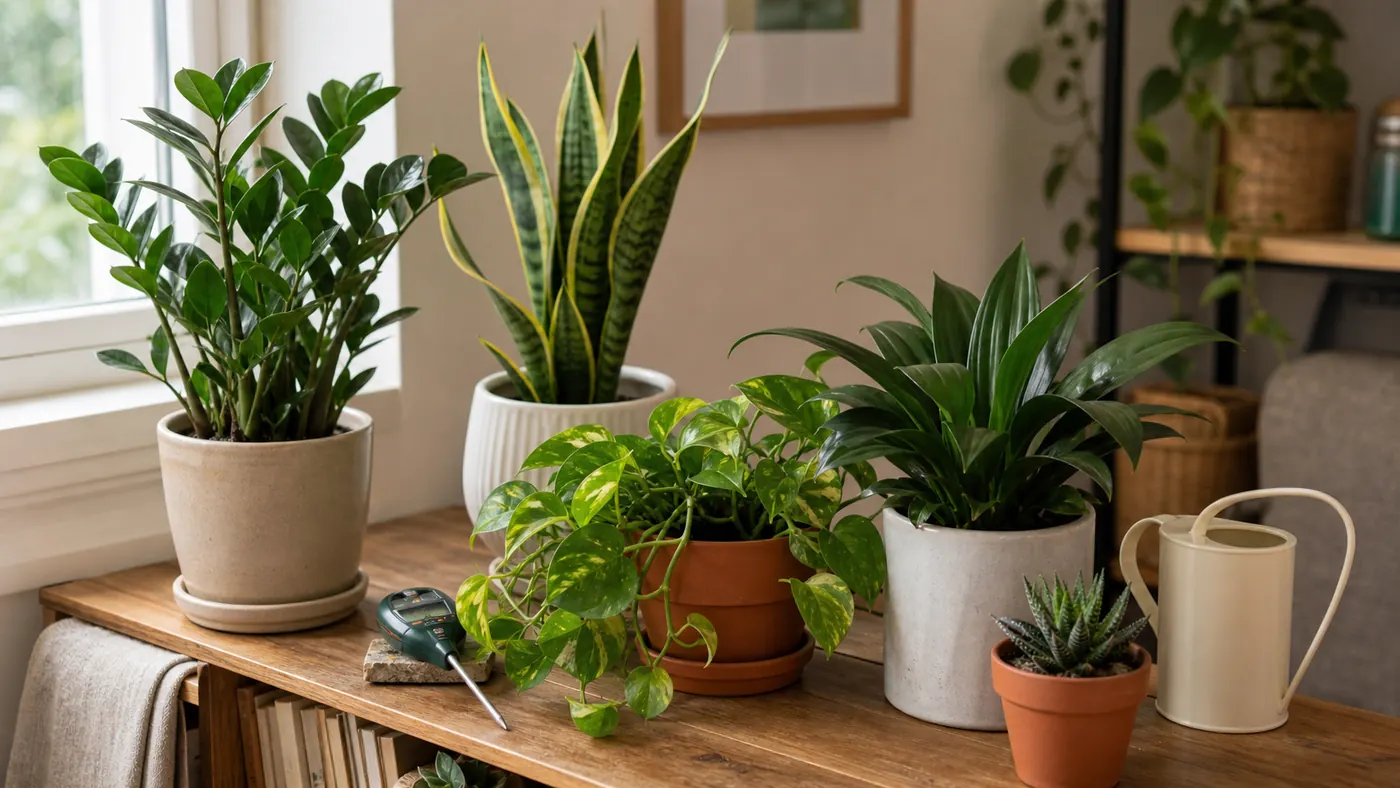
The best plant for a busy home is the one whose weakest point matches the room and the owner. A firm snake plant leaf in a dry pot, a glossy ZZ stem that waits through winter, or a pothos vine pushing clean new leaves under bright indirect light gives low maintenance a measurable shape.
Frequently Asked Questions
What is the most low-maintenance houseplant in the data?
ZZ plant and snake plant have the strongest low-care case. ZZ plant has a low maintenance rating, drought tolerance, very low light tolerance, and a winter watering interval of once per month. Snake plant has a winter watering interval of one to two months and tolerates very low light.
Are low-maintenance houseplants popular in 2026?
Yes, the trend evidence points that way. Ideal Home’s 2026 reporting names low-maintenance made luxe as a houseplant trend, and The Sill’s 2025 data placed Snake Plant Laurentii in its top-five best sellers.
How big is the low-maintenance houseplant market?
There is no official category called low-maintenance houseplants. The closest official base is foliage plants for indoor or patio use, which reached $931.6 million in 2024 sales in USDA NASS data.
Which easy houseplants need the least watering?
Snake plant and ZZ plant have the clearest low-watering guidance among common houseplants. Snake plant can be watered every one to two months in winter, and ZZ plant can be watered once monthly in winter when not actively growing.
Are succulents always low maintenance indoors?
No. Succulents are low-water plants, and many need brighter light than a shelf or windowless office can provide. Aloe and many cacti work best when dry soil is paired with strong light and sharp drainage.