
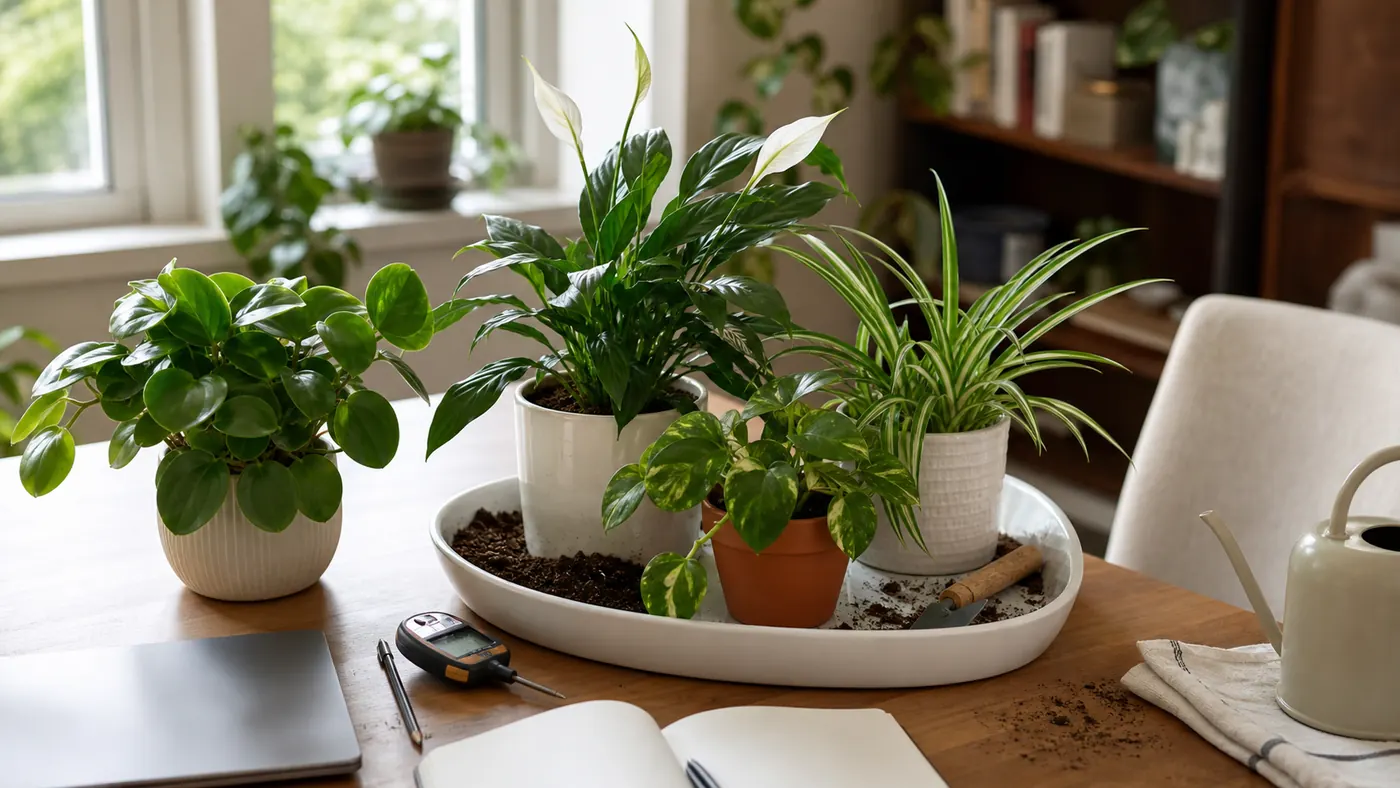
Indoor plant benefits statistics for 2026 support a careful claim: houseplants have better evidence for stress, attention, comfort, and plant-care behavior than for cleaning household air. A 2022 systematic review included 42 records on indoor plants and human function, and its meta-analyses found statistically reliable benefits for diastolic blood pressure and academic achievement.
The air-quality claim needs stricter wording. Americans spend about 90 percent of their time indoors, where some pollutants are often 2 to 5 times higher than typical outdoor concentrations. A 2019 review of potted-plant VOC removal found that a median single plant clean-air delivery rate was only 0.023 cubic meters per hour, far too small to act like real ventilation or filtration in a normal room.
Key Takeaways
- Use 42 records for the strongest evidence base.
- Quote -2.526 for diastolic blood pressure effect.
- Quote 0.534 for academic achievement effect.
- Reject air-cleaning claims for ordinary rooms.
- Match plant benefits to care and placement.
Table of Contents
2026 Indoor Plant Benefits Evidence Snapshot
Sources: Garden Insider summary of EPA indoor air context, Han et al. 2022 systematic review with meta-analyses, Lee et al. 2015 randomized crossover stress study, and Cummings and Waring 2019/2020 VOC removal review. Air-cleaning claims are treated separately from stress and cognition benefits.
Indoor Plant Benefits Evidence – The Strongest Claims Are Narrow
The strongest recent evidence summary is the 2022 systematic review by Han, Ruan, and Liao. It searched English and Chinese databases, screened quantitative empirical research, and included 42 records. The meta-analyses used only 16 records because comparable outcome data were limited.
That review found statistically reliable benefits for two outcomes: diastolic blood pressure and academic achievement. It also reviewed outcomes such as EEG waves, attention, response time, heart rate, cortisol, pain tolerance, sick leave, and task performance. The meta-analysis evidence was not strong enough to confirm every claimed benefit.
| Evidence measure | Statistic | Year | What it means |
|---|---|---|---|
| Systematic review records | 42 records | 2022 | Quantitative studies of indoor plants and objective human functions |
| Meta-analysis records | 16 records | 2022 | Subset with comparable outcome data |
| Diastolic blood pressure effect | -2.526, 95% CI -4.142 to -0.909 | 2022 | Statistically reliable physiological benefit |
| Academic achievement effect | 0.534, 95% CI 0.167 to 0.901 | 2022 | Statistically reliable cognition/learning-related benefit |
| Attention and response time | Positive direction, not statistically reliable | 2022 | Suggestive evidence, not a strong claim |
The practical reading is narrow and useful. Indoor plants can be part of a healthier indoor setting, especially when they are visible, cared for, and placed where people spend time. They should never be sold as medical treatment or as a substitute for ventilation, sleep, movement, or clinical care.
Stress And Blood Pressure Statistics – Active Plant Care Has Better Evidence
A 2015 randomized crossover study by Lee and colleagues tested 24 young male adults. Each participant performed a 15-minute indoor plant transplanting task and a computer task on separate days. The plant task used a common indoor plant, Peperomia dahlstedtii, and compared physiological and psychological responses against computer work.
The results were measurable. Diastolic blood pressure after the plant task was 65.26 compared with 71.75 after the computer task, with P = 0.001. Sympathetic nervous system activity during the last 3 minutes was also lower after the plant task, with log[LF/(LF + HF)] at 0.57 compared with 0.60 for the computer task, P = 0.021. Participants also reported feeling more comfortable, soothed, and natural after the plant task.
| Stress-study measure | Plant task | Computer task | Result | Limit |
|---|---|---|---|---|
| Participants | 24 young male adults | Same participants | Randomized crossover design | Small and narrow sample |
| Task duration | 15 minutes | 15 minutes | Equal exposure time | Short-term response only |
| Diastolic blood pressure | 65.26 | 71.75 | P = 0.001 | Post-task measure, not long-term health outcome |
| Sympathetic activity, last 3 minutes | 0.57 | 0.60 | P = 0.021 | Measured through HRV component ratio |
| Self-rated feeling | More comfortable, soothed, natural | Less favorable | P < 0.01 for tested feelings | Self-report, short test window |
This is stronger than a loose claim that plants are calming. It suggests that touching soil, handling leaves, and doing a small plant-care task may reduce short-term stress response compared with screen-based mental work. A pothos cutting in damp mix, a firm nursery pot, and the earthy smell released during repotting are part of the mechanism because the task changes attention and sensory input.
Cognition And Academic Performance – Evidence Exists, Scope Stays Limited
The 2022 meta-analysis found a statistically reliable academic achievement effect estimate of 0.534, with a 95 percent confidence interval from 0.167 to 0.901. That result supports the idea that indoor plants can influence learning-related outcomes in some settings.
The same review reported positive directions for EEG alpha and beta waves, attention, and response time. Those outcomes did not reach statistical reliability in the synthesis. The evidence is promising within limits. It does not prove that putting one plant on a desk will make every worker or student more productive.
| Cognition-related outcome | Evidence signal | 2022 synthesis result | Use in a citation |
|---|---|---|---|
| Academic achievement | Positive | 0.534, 95% CI 0.167 to 0.901 | Strongest cognition-related statistic |
| Attention | Positive direction | Not statistically reliable | Use cautious wording |
| Response time | Positive direction | Not statistically reliable | Use cautious wording |
| EEG alpha and beta waves | Positive direction | Not statistically reliable | Physiological signal, not a firm outcome |
| Task performance | Mixed across studies | Insufficient comparable synthesis | Avoid broad productivity claims |
For a home office or study area, the practical value is still real. A plant can break visual flatness, cue a pause, and make a desk feel less sterile. The evidence supports careful language: indoor plants may help attention and learning conditions, with the clearest meta-analysis support appearing in academic achievement and blood-pressure outcomes.
Air Quality Statistics – Houseplants Are Not Room Air Purifiers
The most misused indoor plant benefit is air purification. The 1989 NASA chamber work helped popularize the idea. Normal rooms are not sealed chambers. A 2019 review by Cummings and Waring translated 196 experimental outcomes from 12 chamber studies into clean air delivery rates, a standard air-cleaner metric.
The median single-plant clean air delivery rate was 0.023 cubic meters per hour. The review estimated that 10 to 1000 plants per square meter of building floor space would be needed for potted plants to match the VOC removal already provided by typical outdoor-to-indoor air exchange, around 1 air change per hour. That is the statistic to use when correcting houseplant air-cleaning claims.
| Air-quality measure | Statistic | Year | Meaning |
|---|---|---|---|
| Chamber studies reviewed | 12 published studies | 2019 | VOC removal experiments in small sealed chambers |
| Experimental results translated | 196 results | 2019 | Converted to clean air delivery rates |
| Median single-plant CADR | 0.023 m3/h | 2019 | Very low air-cleaning rate per plant |
| Plants needed for typical VOC removal | 10-1000 plants/m2 | 2019 | Impractical density for normal rooms |
| Typical outdoor-to-indoor air exchange reference | About 1 h-1 | 2019 | Ventilation already removes VOCs faster than a few plants |
Houseplants can still make indoor spaces feel better. They are poor replacements for source control, ventilation, filtration, humidity control, and mold prevention. EPA’s indoor air quality guidance points to pollutants, air exchange, moisture, and source control as the practical indoor-air picture.
Indoor Exposure Context – Why Plant Benefits Get Attention
Indoor plant benefits matter because people spend so much time inside. Americans spend approximately 90 percent of their time indoors. Concentrations of some pollutants are often 2 to 5 times higher indoors than typical outdoor concentrations.
That context explains why people want indoor plants to do many jobs at once. A plant beside a laptop, a peace lily near a reading chair, or a pothos trailing from a shelf feels like a small correction to sealed rooms, screens, and hard surfaces. The benefits are strongest when the claim matches the evidence: visual restoration, care routine, stress reduction, and comfort rather than whole-room air purification.
| Indoor context statistic | Value | Source | How it connects to plants |
|---|---|---|---|
| Average time indoors | Approximately 90% | EPA indoor air quality page, updated 2026 | Explains why indoor environmental changes matter |
| Some indoor pollutant concentrations | Often 2 to 5 times outdoor levels | EPA indoor air quality page | Supports indoor-air concern, not plant purification claims |
| Susceptible groups | May spend even more time indoors | EPA indoor air quality page | Raises stakes for indoor conditions |
| National indoor-air indicators | Only two ROE indicators | EPA indoor air quality page | Shows limits in national monitoring data |
Indoor plant benefit evidence comes from controlled studies, reviews, and smaller experiments, not a national surveillance system. Quote each statistic with its sample size, setting, and measurement type attached.
Benefit Claims By Strength – What To Say And What To Avoid
Indoor plant benefits are not all equal. Stress and short-term physiological response have stronger support than air-cleaning claims. Academic achievement has a statistically reliable meta-analysis signal. Broad productivity claims remain weaker because study designs, outcomes, and settings vary.
Better wording makes the page more useful and more citeable. A claim such as “indoor plants reduced diastolic blood pressure in a 2022 meta-analysis” is stronger than saying plants are healthy. A claim such as “potted plants are not practical room air purifiers” is stronger than repeating old sealed-chamber air-cleaning lists.
| Benefit claim | Evidence strength | Best statistic | Safe wording |
|---|---|---|---|
| Short-term stress reduction | Moderate | 2015 crossover study, n = 24 | Active plant interaction reduced short-term stress markers versus computer work |
| Diastolic blood pressure | Moderate | -2.526, 95% CI -4.142 to -0.909 | Meta-analysis found a reliable diastolic blood pressure benefit |
| Academic achievement | Moderate | 0.534, 95% CI 0.167 to 0.901 | Meta-analysis found a reliable academic achievement effect |
| Attention and response time | Suggestive | Positive direction, not reliable | Evidence points positive; stronger studies are needed |
| Air purification in normal rooms | Weak or impractical | 10-1000 plants/m2 estimate | Houseplants do not function as practical room air purifiers |
The houseplant market trends show why these claims matter commercially. A market with nearly $932 million in foliage plant sales needs better benefit language than recycled air-cleaning myths.
Source And Methodology Notes – How The Statistics Were Chosen
Statistics were included only when the year, source, measurement, and study type were clear. Systematic reviews and meta-analyses were prioritized for benefit claims. Small experiments were used only when the sample, task, and measured outcome were explicit. Air-quality claims were checked against real-room feasibility, not sealed-chamber results alone.
| Source | Year or latest update | Evidence type | How it is used |
|---|---|---|---|
| Han, Ruan, and Liao systematic review | 2022 | Systematic review with meta-analyses | Primary evidence base for human-function outcomes |
| Lee et al. randomized crossover study | 2015 | Controlled plant-care stress experiment | Short-term stress, blood pressure, HRV, and comfort statistics |
| Cummings and Waring VOC removal review | 2019 online, 2020 volume | Review and CADR analysis | Air-quality feasibility and plant-density correction |
| EPA indoor air quality page | Updated May 27, 2026 | Government indoor exposure context | Indoor time, pollutant context, and air-quality caution |
| Garden Insider houseplants hub | Current site context | Internal care context | Links benefit claims back to practical plant care |
Current evidence does not rank individual houseplant species by health benefit. Plant choice still matters for survival: pothos needs enough light for fuller growth, and spider plant care depends on watering, light, and brown-tip prevention. A dead plant provides no restoration value.
Where To Start
For a stress-reduction citation, start with the 2022 meta-analysis and the 2015 crossover study. Use the blood-pressure numbers, not a broad wellness phrase.
Cognition claims should use academic achievement as the strongest statistic. Avoid broad productivity claims unless the source measures work output directly.
Air-quality claims should lead with the correction. Potted plants do not provide practical VOC removal in ordinary rooms, and the 10-1000 plants per square meter estimate is the clearest number.
In a home setup, choose plants that will survive the room first. Light, pot drainage, watering rhythm, and pest control decide whether the plant remains a benefit or turns into another maintenance problem.
Conclusion
Indoor plants have real benefits, but the strongest 2026 evidence is narrower than popular claims suggest. Use the 42-record systematic review for the evidence base, the 2015 crossover study for short-term stress physiology, and the 2019 VOC review to correct air-purification claims.
The best practical benefit comes from a living plant that fits the room and receives consistent care. A glossy pothos leaf turning toward light, a spider plant producing clean new growth, or a repotted peperomia settling into fresh mix gives a small indoor routine that the evidence can support without pretending the plant is an air purifier.
Frequently Asked Questions
Do indoor plants really reduce stress?
Yes, the best evidence supports short-term stress reduction more than broad health claims. A 2015 crossover study found lower diastolic blood pressure and lower sympathetic activity after a 15-minute plant transplanting task compared with a computer task.
What is the strongest statistic on indoor plant benefits?
The strongest review-level statistics come from a 2022 systematic review with 42 records. Its meta-analyses found reliable benefits for diastolic blood pressure at -2.526 and academic achievement at 0.534.
Do houseplants clean indoor air?
Not enough to function as room air purifiers in normal homes or offices. A 2019 review estimated that 10 to 1000 plants per square meter would be needed to match typical VOC removal from outdoor-to-indoor air exchange.
How many plants do you need for indoor air benefits?
For real air-cleaning effects, the number is impractical: 10 to 1000 plants per square meter in the 2019 CADR analysis. For stress or comfort benefits, studies usually test visibility or interaction rather than a fixed plant count.
Which indoor plant benefit is most reliable?
The most reliable claims are short-term stress response, diastolic blood pressure, comfort, and some learning-related outcomes. Air purification, major productivity gains, and species-specific health rankings need much more cautious wording.