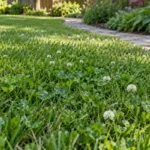

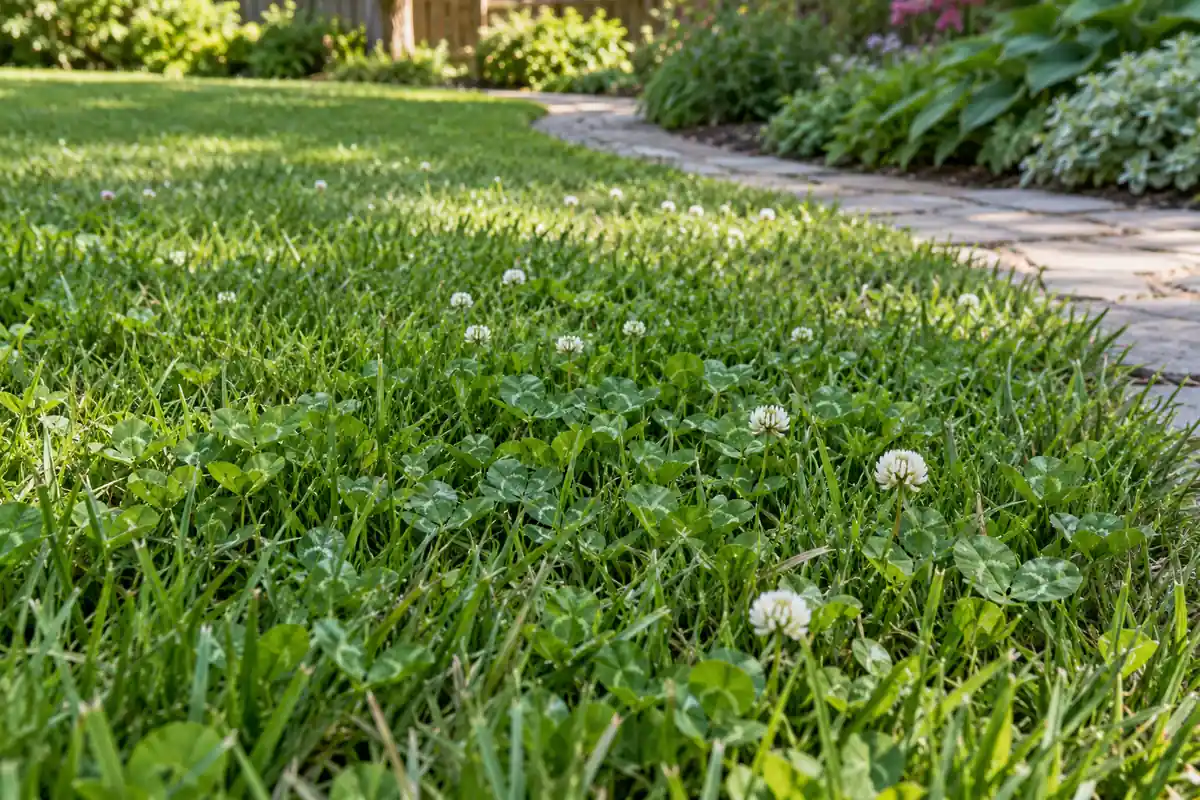
A clover lawn can add flowers and reduce some lawn inputs. The result depends on what grows alongside the clover and how the yard is used. Adding white clover to suitable grass is a different project from replacing every blade with clover. A sunny, lightly used front yard and a dog’s worn route to the gate need different treatment, even on the same property.
The attraction is easy to see: rounded leaves soften the grass, white flowers rise above them, and bees move between the blooms. What matters next is less visible. Seed needs contact with soil, young plants need protection, and a lawn that looks full in spring may change during summer heat or winter. Before removing healthy turf, choose a manageable area and decide which changes in appearance, maintenance and household use you can accept.
Which starting point fits your yard?
- Healthy grass, some sun, lighter use: keep the grass and overseed with locally adapted white clover.
- Weeds, bare patches or compacted tracks: correct the cause and prepare those areas before adding seed.
- Deep shade, constant running or a clover-only conversion: reassess the planting and use. Test a small area before committing the whole yard.
Seed quantity: use the rate for the actual product and planting method. Pounds of a grass-dominant bee-lawn mixture are not pounds of pure clover.
Key Takeaways
- Identify white clover by its leaves, flowers and creeping stems.
- Measure the planting area before opening the seed bag.
- Separate active germination care from cold-weather dormant seed placement.
- Change weed control before introducing a broadleaf lawn plant.
- Photograph seasonal gaps before deciding where to expand planting.
Table of Contents
Clover Lawn Choices Change Wear and Seasonal Cover
White clover, Trifolium repens, is a perennial legume. Its stems creep across the ground and root at joints, letting a patch expand beyond the original plants. Rounded groups of three leaflets often have pale markings; the flower heads are white or pink-tinged. The USDA Natural Resources Conservation Service’s White Clover Plant Guide distinguishes those rooting runners from the upright growth people sometimes associate with other clovers.
Check that identity before buying seed. White sweetclover belongs to Melilotus, a different genus, and is not interchangeable with low-growing lawn clover. A bag labeled simply “clover” leaves too much unanswered.
Microclover refers to small-leaved white-clover cultivars, including ‘Pirouette’ and ‘Pipolina’. Their lower growth and generally fewer flowers may appeal where a more uniform grass mixture matters. Smaller leaves do not remove the need to assess heat, moisture and winter performance.
| Choice | Reason to consider it | Tradeoff to accept |
|---|---|---|
| Grass with Dutch white clover | Retains turf and adds flowering patches | Uneven appearance and bees around flowers |
| Grass with microclover | Smaller leaves and a lower-growing clover component | Seed expense and possible repeat seeding; climate limits remain |
| Clover without grass | A predominantly clover appearance in a suitable, lightly used area | Wear and seasonal losses can expose soil without grass to occupy gaps |
Pure clover deserves a local assessment. Winter leaf loss and summer stress are among the reasons turf-to-pure-clover conversion is discouraged in Maryland. That regional warning is not proof that every clover-only planting fails everywhere. It does explain why removing sound grass is a larger commitment than adding clover to it.
Sunlight and Repeated Footsteps Set the Planting Area
Walk the lawn before choosing its replacement. Note where the grass is dense, where shoes repeatedly flatten it, and where puddles or exposed roots interrupt growth. Check sunlight across the day. A bright morning photograph can hide the fact that a building shades the area for the rest of the afternoon.
Deep shade is a poor starting point for white clover. A flowering lawn needs enough light to maintain plants and blooms. Where tree cover already defeats grass, choose suitable ground cover plants for the actual exposure. Clover also needs light to grow.
Repeated running creates another limit. Poor traffic tolerance is a stated characteristic of Dutch white clover in University of Minnesota Extension’s species profile. Keep the route to a gate, a dog’s fence-line run and concentrated play space out of a clover-only trial. A tougher, locally appropriate walking surface can sit beside a flowering patch.
Consider what “less watering” would mean on this site. Dry soil can limit clover establishment and persistence; cool, moist conditions suit white clover better than a hot, exposed patch that repeatedly dries out. Inspect existing clover nearby for signs of summer survival. A newly seeded area still needs its own moisture care.
Where nutrient or pH correction is being considered, choose a soil test matched to the amendment decision. Clover growth alone cannot tell you how much lime or fertilizer to apply. Resolve obvious drainage and wear problems separately; an analysis cannot move a busy footpath.
Seed Labels and Weather Determine Quantity and Timing
Read the species and the planting rate together
A packet of clover seed and a bag of grass-and-flower seed are different materials. Species, purity, germination information and mixture composition matter when comparing them, as outlined in University of Minnesota Extension’s turfgrass seed-purchasing guidance. Check whether the stated rate is for bare soil, overseeding existing vegetation or another use.
Measure the area you will actually sow, excluding beds and paths. Multiply the product’s rate by that area, keeping the units consistent. For example, an area of 500 square feet takes half the labeled quantity for 1,000 square feet. Use that calculation with the rate printed for your product and method.
A regional mixture example, not a pure-clover rate
For a Minnesota bee lawn, the University of Minnesota example per 1,000 square feet is 4 pounds of fine fescue, 1.1 ounces of Dutch white clover and 1.2 ounces of self-heal. Grass makes up most of that seed weight. The recipe describes a specific regional mixed lawn; it does not set the rate for a bag of clover seed or every existing lawn.
For separately purchased grass and clover, obtain a locally appropriate mixing recommendation. Do not spread each ingredient at its full stand-alone rate and assume the combination is balanced. Keep the label or photograph it so later gaps can be checked against what was planted.
Choose active establishment or dormant placement
Active establishment aims for germination during a locally suitable growing period, with moisture available afterward. Cold-weather placement aims to keep seed ungerminated until spring. Keep their preparation and care instructions separate.
Regional examples differ. Illinois Extension discusses active microclover overseeding from early spring through late summer. Minnesota’s mixed bee-lawn guidance favors late-fall dormant placement or a spring alternative. Neither sets a planting month for every US yard. Check regional Extension recommendations for the species and mixture you intend to grow.
Where dormant seeding is appropriate, prepare the site before the cold window arrives. Warm soil after a frosty night may still permit germination. Keep the chosen method’s aftercare instructions with the seed label, so a spring watering routine is not automatically applied to winter placement.
Prepare Exposed Soil Before Overseeding Existing Grass
Healthy grass with relatively few weeds can often be retained. Overseeding opens spaces within that turf for another plant. A weed-dominated or badly uneven lawn needs preparation beyond scattering seed: competing vegetation and the cause of failure must be addressed first.
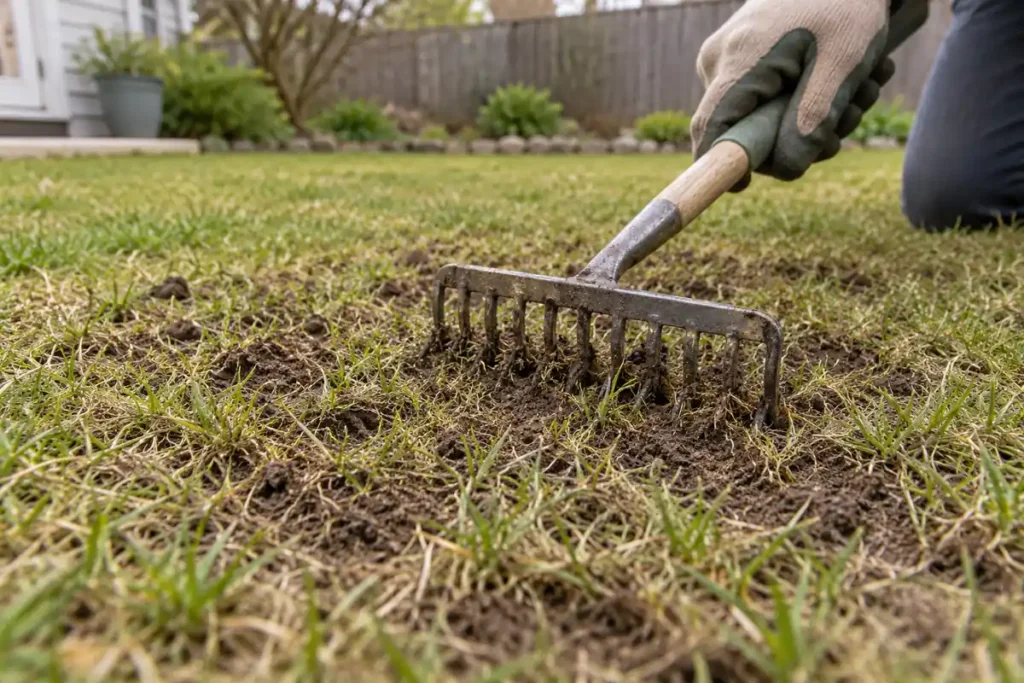
- Choose and mark a manageable area. Leave another route for people and pets. If it cannot be protected during establishment, reduce its size or change the location.
- Reduce the grass canopy as locally recommended. Rake away loose vegetation. Temporary close mowing for overseeding is preparation, not the height to maintain afterward.
- Check the surface by hand. Part the remaining grass at several points. Soil should be reachable; a springy mat of stems and dry clippings can keep seed above it. Aeration or more thorough surface preparation may be needed where compaction or dense turf prevents contact.
- Measure and distribute the planned seed. Use suitable equipment for the small seed and the measured area. Cover the whole area evenly. Save excess seed according to its storage instructions.
- Finish according to the selected planting method. Active sowing and dormant placement do not have identical raking and watering instructions. Protect the surface and monitor the conditions required by your regional method.
Renovation changes the starting point. Remove or control the unwanted vegetation by an appropriate method, correct unevenness or compaction, and prepare the exposed surface before sowing. Clover does not repair a drainage defect simply by covering it. Avoid stripping the whole yard when only a few patches need that work.
Check before sowing: press apart the grass and feel the surface. Firm soil with small openings is different from a thick, elastic layer of old stems. If seed would land on that layer, improve contact before spreading seed.
Moisture, Mowing and Flowers Need Different Care Stages
Protect germination before reducing irrigation
Low-input maintenance begins after establishment. During active germination, inspect the exposed soil itself. A dark, cool surface that feels damp under a fingertip is different from pale, dry soil between wet blades. Adjust gentle watering for rainfall and drying conditions, without leaving puddles or washing seed into low spots.
Once seedlings are established, irrigation needs change with the mixture, weather and soil. Do not continue frequent shallow watering indefinitely, and do not stop solely because a seed packet’s suggested germination period has elapsed. Check whether plants are actually present and rooted before changing care.
Let the grass and clover balance develop
New plantings need time before their mature appearance is evident. Look for clover foliage among the grass as the first evidence of establishment. When mowing resumes, avoid taking a tall stand down in one severe cut. Use maintenance guidance for the actual grass-and-flower mixture; the low cut used to open an overseeding site is not a recurring treatment.
Mowing example for Minnesota grass-dominant bee lawns
- Before overseeding: temporarily reduce existing turf to about 1 inch.
- First cut of the new stand: wait for grass about 5 to 6 inches tall; remove at most one-third.
- Established mixed lawn: maintain at least 3 inches, adjusting mowing to growth and flowering.
These University of Minnesota Extension heights describe that mixed system, not a mowing prescription for every grass species or a pure-clover stand.
Nitrogen fixation depends on the relationship between clover and root-associated bacteria. Nitrogen also cycles as plant material decomposes. That can reduce fertilizer demand over time, with the amount affected by growing conditions and management. Heavy nitrogen applications can favor grass over clover; more fertilizer is an unsuitable automatic response to missing flowers.
Broadleaf herbicides can remove the clover you intended to grow. This conflict is among the microclover maintenance limits documented by Illinois Extension. Review the lawn-care program before introducing seed, including products applied by a contractor. Hand-remove unwanted plants where practical to retain the desired mixture.
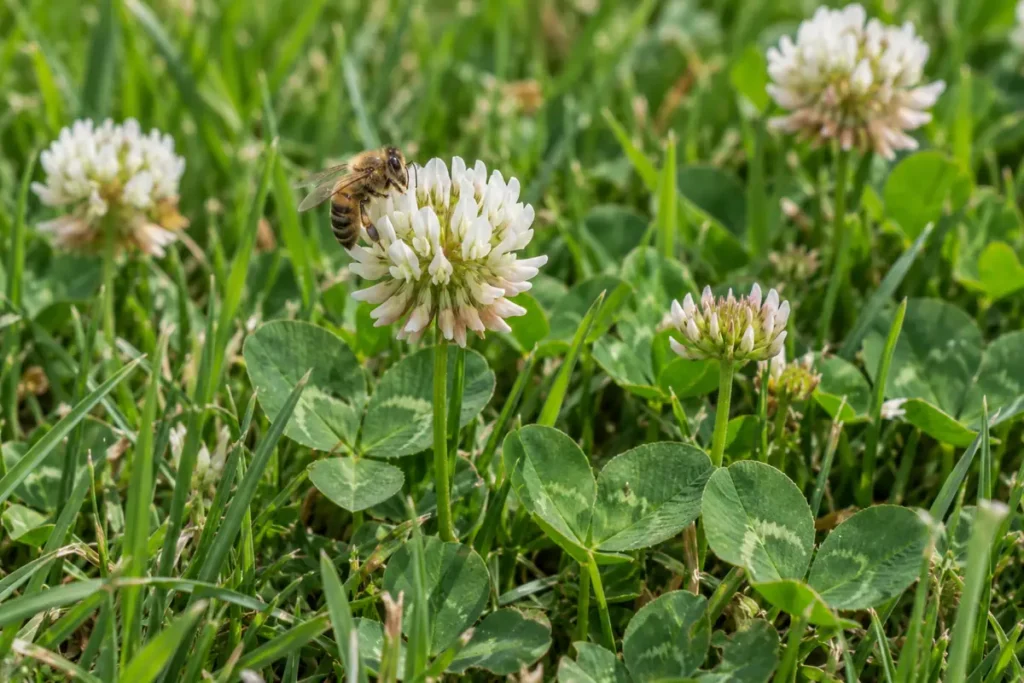
Flowers bring a use decision. A pale bloom with a faint honey scent may also have an audible bee moving across it. Leave flowering areas where that activity fits, and plan barefoot play elsewhere. Household concerns, including sting allergies, deserve consideration when deciding how much flowering lawn to grow. Mowing does not guarantee a bee-free area.
Clover supplies forage for some pollinators, but a clover lawn does not replace a varied native planting. Where space permits, keep different bloom times and plant types in garden beds as well. A lawn can retain its household function without carrying the entire pollinator planting.
Check Competition and Wear Before Reseeding Bare Patches
Record what failed, where and when. A close photograph of the plants and a wider photograph of the surrounding lawn answer different questions. Include a worn route, nearby shade or a low spot in the wider view. Repeating the same seed application without changing the limiting condition wastes both seed and a growing window.
| What you see | Check first | Change before adding seed |
|---|---|---|
| Few seedlings after the expected germination period | Seed label, soil contact, moisture and weather | Correct placement or care; confirm the local sowing window |
| Dense grass with little clover | Actual mixture, canopy competition and fertilizer use | Review inputs and establishment before increasing the clover amount |
| Leaves remain with few flowers | Plant maturity, light and mowing frequency | Allow suitable growth and flowering time; reconsider shaded sites |
| A narrow bare route returns | Repeated feet, running or compaction | Redirect use or change that surface |
| Cover thins during heat or winter | Seasonal pattern, soil moisture and remaining grass | Reassess local adaptation and mixture before expanding |
Some problems extend beyond the clover. When dead patches in the lawn affect both grass and clover, investigate the shared site conditions before assuming a seed problem. A patch that follows a drain, shade line or walking route gives more useful information than its size alone.
For a trial area, keep photographs of its best flowering week and its summer and winter condition. Compare bare ground, necessary watering, weed removal and whether people can use the space comfortably. Expand only when those results suit your yard. A successful small mixed patch is a better basis for the next planting than an attractive photograph from a different climate.
Conclusion
Start with the part of the lawn that can accommodate clover’s growth and flowers. Preserve useful grass, select the actual species and mixture, and prepare soil contact before sowing. Protect young plants, then adjust mowing, water and weed control to the established stand. Where the same worn strip or seasonal gap returns, change the site use or planting choice before buying another bag of seed.