

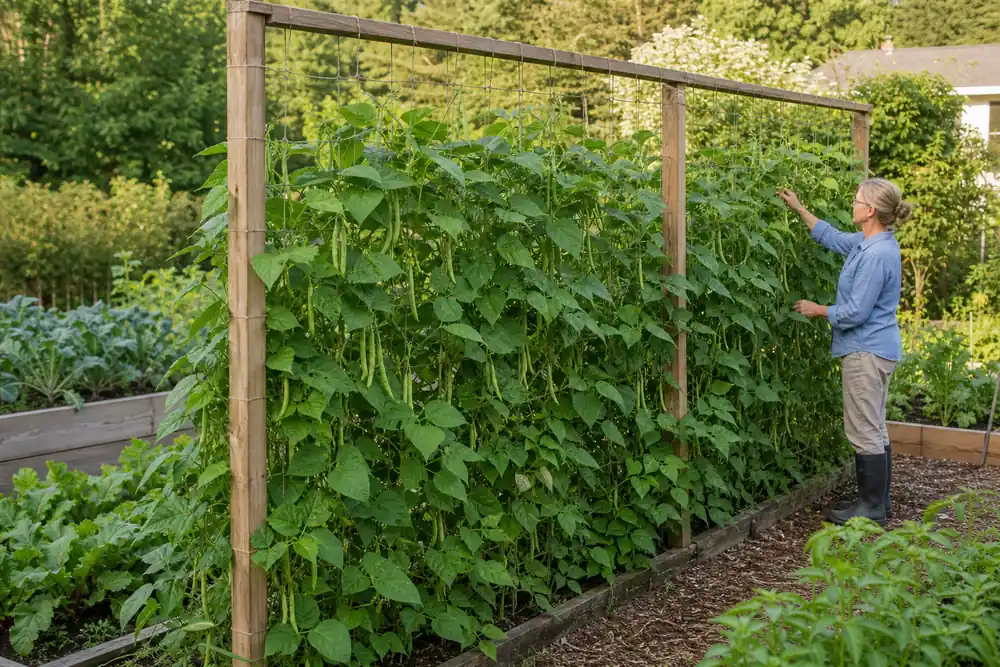
A pole bean trellis feels solid when bare and very different after vines cover it. By midsummer, stems have twisted into a dense green wall, wet leaves pull sideways after rain, and pods hang from every level. Thin stakes bow, loose twine sags, and shallow posts begin rocking exactly when the crop becomes hardest to move.
A reliable support starts 6 to 8 feet above the soil, gives each vine a rough vertical path, and transfers wind load into posts or anchors outside the root row. Choose the shape by bed width and access before planting. Pole bean roots and tangled vines leave little room for structural repairs later.
Match The Trellis To The Bed
Six feet is the practical minimum for most pole beans. Use a taller or stronger frame when the variety can exceed that height or the site catches wind.
Install every design before sowing. A frame that shifts under a firm two-handed shake needs deeper anchors or diagonal bracing.
Key Takeaways
- Build 6 to 8 feet above soil level for full-size pole bean varieties.
- Space plants 4 to 6 inches apart along a flat trellis.
- Set teepee legs deep and lash them where the poles cross.
- Use rigid posts and a top rail for string or netting systems.
- Anchor raised-bed trellises through the bed wall or into soil outside it.
Table of Contents
Pole Bean Trellis Height And Spacing
Most common pole beans climb to about 6 feet and may keep growing above that point. A finished height of 6 to 8 feet gives the vines enough vertical run and keeps pods within reach. The growth habit of pole beans reaches 6 feet or taller, and University of Minnesota Extension advises placing support at planting time.
Measure from the soil line, not from the bottom of the post. An 8-foot post driven 18 inches into firm ground leaves about 6½ feet of usable height. Loose raised-bed mix gives a post less resistance than native ground, so the buried section alone may not stop rocking. Fasten the frame to the bed wall or drive a separate anchor outside the box.
Along a flat trellis, sow seeds about 3 inches apart and thin to one plant every 4 to 6 inches. Keep parallel rows 2 to 3 feet apart when both rows have their own vertical support. Those pole bean spacing and height ranges come from Iowa State University Extension and leave enough room to pick without compressing the leaf wall.
A double-row frame inside one raised bed uses different geometry. Place the two lines of legs about 18 inches apart, lean them inward, and join them at a ridge. Plants stay on the outer faces, where sun and hands can reach them. Keep the open strip beneath the ridge as a watering path and free of a second crowded planting row.
| Measurement | Working Range | Why It Matters |
|---|---|---|
| Usable height | 6–8 ft above soil | Holds the main vine before it folds over the top |
| Plants on a flat trellis | 4–6 in apart after thinning | Balances leaf cover with harvest access |
| Separate trellised rows | 2–3 ft apart | Leaves a picking and airflow lane |
| Double-row frame legs | About 18 in apart | Creates a stable triangle without consuming the whole bed |
| Post embedment | At least 12–18 in | Resists twisting as wet vines catch wind |
A Bamboo Bean Teepee Fits A Small Square Bed
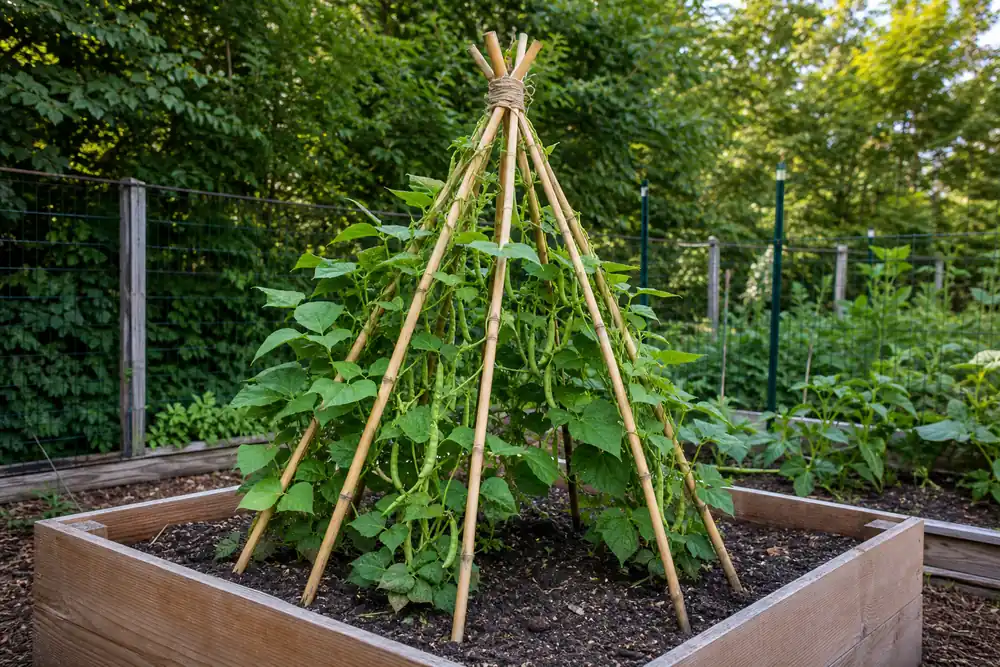
A bean teepee concentrates several vines around one compact footprint. It works well in a square raised bed, a broad in-ground patch, or a large container. A flat trellis would occupy more path space in those settings. The sloped poles guide vines toward one strong joint and spare a light horizontal rail from carrying the whole crop.
Use five to eight bamboo canes or straight branches 7 to 9 feet long. Push each leg 12 to 18 inches into the soil, leaving a circle 3 to 4 feet across. Gather the tops where they cross and wrap jute or UV-resistant cord around the bundle several times. Finish with two tight turns between the poles before knotting; those turns cinch the bundle and stop individual canes from sliding.
Plant two to four seeds near each leg, then keep the strongest one or two seedlings. Clemson Cooperative Extension uses a similar teepee pattern and places five or six seeds around each pole. Fewer vines per leg make the interior easier to inspect and reduce the mass pulling on the top knot.
Add one horizontal loop of twine around the teepee about 24 inches above the soil if smooth bamboo offers little grip. The rough cord catches a searching stem before it slides back down. Leave one side lightly planted or open so a hand can reach pods hanging inside the canopy.
A Double-Row Frame Holds More Vines In A Raised Bed
A double-row frame resembles a long A-frame. Two lines of bamboo, wood, or metal conduit lean toward a ridge pole, creating a triangle that resists sideways movement. This design spreads vine weight across many legs and keeps the center of a 3- or 4-foot bed open below the ridge.
Set paired legs about 18 inches apart and space each pair 3 to 4 feet down the bed. Lash every crossing to the ridge, then add one diagonal brace near each end. Run vertical strings from the ridge to a lower rail or ground anchor every 4 to 6 inches. Each plant gets a direct climbing line, so stems do not have to travel sideways through neighboring foliage.
The frame should lean inward evenly. One steep side and one shallow side transfer load into a twist, especially after rain darkens the leaves and makes the strings hum in wind. Sight along the ridge before tightening the braces. A straight ridge shares weight; a bowed ridge places it on the middle pair of legs.
Place the structure north of shorter crops in the Northern Hemisphere when possible. A mature bean wall casts a long afternoon shadow. The broader principles behind a trellis for warm-season vines still apply here: support strength, reach from both sides, and harvest access matter more than a decorative outline.
Cattle Panels Handle Wind And Repeated Use
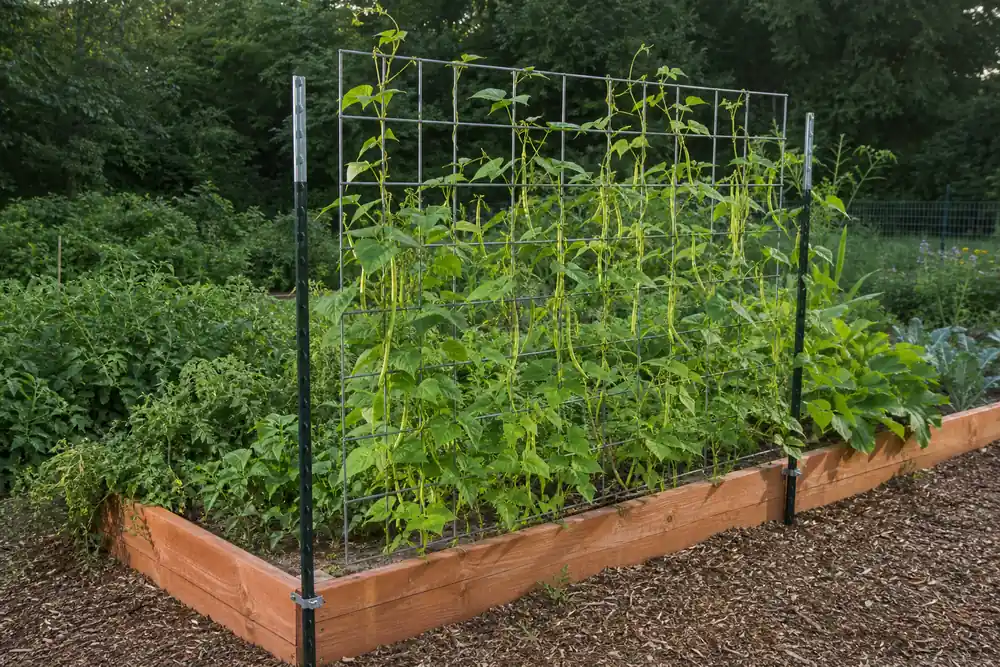
A cattle panel makes the strongest pole bean trellis for an exposed garden. The welded grid does not stretch, and each square gives twining stems a new edge to follow. Mount the panel as a vertical wall for easy picking or bend it into an arch when two beds face each other across a path.
For a wall, fasten the panel to metal T-posts. Treat the raised-bed boards as a secondary connection. Drive one post near each end and add a middle post on a long panel. Keep the lowest grid several inches above the soil so weeds can be cut without scraping stems. Tie the panel at several heights with exterior wire or heavy UV-resistant ties.
An arch needs equal anchoring on both sides. A narrow arch rises higher and pushes outward harder; a broader curve spreads the force and leaves more headroom. Check the path width after bending the panel, because bean leaves and pods will hang several inches inside the opening.
Pole-bean supports should stand 6 to 8 feet tall and withstand wind and rain, according to Clemson Cooperative Extension. A cattle panel meets that load well when its posts are in native soil. The panel can remain in place after frost, which saves the bed from repeated post holes.
String And Twine Make The Cheapest Long-Row Trellis
A string trellis uses two strong end posts, a rigid top rail or tensioned wire, and one vertical line per plant. The vines supply almost no stiffness of their own. If the top sags, every line moves inward and the row becomes a thick rope of leaves that is hard to pick.
Set the end posts first and brace them away from the row. A diagonal stake or buried guy line counters the inward pull from the top wire. Drive trellis stakes at least one foot into the ground; soft soil and an 8-foot frame often need 18 inches or more.
Use rough jute, sisal, or textured garden twine for the verticals. Tie each line to the top rail and secure the bottom to a low rail, landscape staple, or short peg beside the seed. Leave the line firm enough to stay vertical and loose enough that a gust can flex it without pulling out the anchor.
Natural twine may weaken during a wet summer. Rub a spare piece between your fingers at midseason. Fibers that feel fuzzy and separate under a gentle pull need a second line before the canopy gains more weight. Synthetic trellis twine lasts longer, though every piece must come out of the bed after harvest.
A Netting Frame Needs Full-Edge Tension
Garden netting creates a flat climbing surface with fewer individual strings to install. Choose mesh with openings large enough for a hand to pass through. Small mesh catches dead leaves, hides pods, and turns fall cleanup into slow picking through brittle stems.
Build a rigid rectangle from posts and a top rail. Fasten the net along the top first, then pull it evenly toward the bottom rail. Secure both side edges at several points. Tension only at the corners leaves a loose center that bellies under wet foliage.
Keep lightweight plastic netting away from mower paths and wildlife routes. A more visible cord net or welded wire reduces accidental tangles. At the end of the season, cut bean stems at the soil line and let the vines dry for several days. Dry stems crack away from the mesh with a papery sound; green vines cling and stretch the net during removal.
Anchor A Pole Bean Trellis In A Raised Bed
Raised-bed soil is designed to stay open and workable, which also makes it poor at gripping tall posts. Wind presses against the leaf wall, the post pivots through the loose mix, and the upper frame begins leaning even when the wood box feels solid.
The strongest setup places posts outside the bed in native soil. Bolt the trellis to the outer bed wall only as a secondary connection. Thin boards and corner screws contain soil; a sail of leaves creates a different load. Where outside posts are impossible, use metal brackets fixed near structural bed corners and extend each leg deep into the bed.
Keep post holes several inches from the bean row. Installing the structure before sowing protects the root zone and establishes exactly where seeds belong. Beans germinate faster in warm soil, so use soil temperature at planting depth to choose the sowing day after the frame is ready.
Containers need their own counterweight. A pole bean can grow in a 5-gallon or larger pot at least 12 to 16 inches deep; the support and foliage raise the center of gravity. The container depth and support guidance from the UC Master Gardener Program works best with a broad, heavy pot placed against a fixed railing or wall.
Train Pole Beans Before The Vines Tangle
Pole beans climb by wrapping the stem around a support. Young tips sweep in a circle until they touch something narrow enough to follow. Place each tip against its string, pole, or grid when it is flexible. One loose turn is enough; the plant continues winding as the stem lengthens.
Check the row every few days during warm weather. Redirect stems that have wrapped around neighboring plants or reached into a path. Avoid forcing an older stem through a hard bend. The surface feels slightly rough when young, then becomes fibrous and easier to split near a leaf joint.
Water at soil level and keep the root zone evenly moist as flowers and pods develop. A vertical canopy exposes more leaf area to moving air, and the soil below can still dry under a dense root system. A thin layer of mulch that slows soil moisture loss helps, provided it stays back from emerging stems.
Harvest often and support the trellis as you pull pods. Hold the cluster stem with one hand and snap the pod with the other. Repeated yanking works loose strings and can peel a vine away from the frame. For planting, feeding, moisture, and picking beyond the support itself, the full green bean growing process keeps the crop decisions separate from trellis construction.
Conclusion
A pole bean trellis succeeds when its load reaches the ground without twisting the frame. Six to 8 feet of usable height, direct climbing lines, firm end posts, and room to pick from at least one side handle most home crops.
Build before sowing and shake the empty structure with both hands. Tighten every soft joint now. By midsummer, the reward is visible from the path: straight vines wrapped around solid support and crisp pods hanging clear of the soil where they can be picked without fighting the canopy.
Frequently Asked Questions
What Is The Best Trellis For Pole Beans?
A cattle panel on T-posts is the strongest choice for windy gardens and repeated use. A double-row frame fits a 3- to 4-foot raised bed, and a bamboo teepee works well in a small square plot. The best design reaches at least 6 feet above the soil and stays rigid under a firm shake.
Will Pole Beans Climb A Trellis?
Yes. Pole bean stems naturally twine around poles, string, wire, and netting. Guide a young vine against the support once it begins reaching. It usually continues climbing without ties as long as the surface offers a narrow edge or rough texture.
How Tall Does A Bean Trellis Need To Be?
Build the trellis 6 to 8 feet tall above the soil line for most pole bean varieties. Use the shorter end when easy harvest matters and the taller end for vigorous cultivars. Include the buried post length when buying materials, so an 8-foot post does not become a 6-foot post after installation.
How Do You Make A Simple Bean Trellis?
Drive two 8-foot posts 12 to 18 inches into the ground, connect them with a rigid top rail or tensioned wire, and hang vertical twine every 4 to 6 inches. Anchor each line near a seed. Brace the end posts before planting so the top stays level under mature vines.