


Updated April 19, 2026
Most plants fit neatly into one category. Begonias do not. With over 2,000 recognized species, the genus is one of the five largest flowering plant genera on earth – and the difference between a tuberous begonia with blooms the size of a dinner plate and a grass-bladed species from Madagascar is not superficial. It runs all the way to the root system. Understanding that distinction is the fastest way to stop making the wrong choice at the garden center.
Key Takeaways:
- Match root type – fibrous, rhizomatous, or tuberous – before buying
- Wax begonias bloom continuously from late spring through the first frost
- Rex begonias need 50% humidity or higher to perform well indoors
- Tuberous begonias abort flower buds when temperatures exceed 90°F
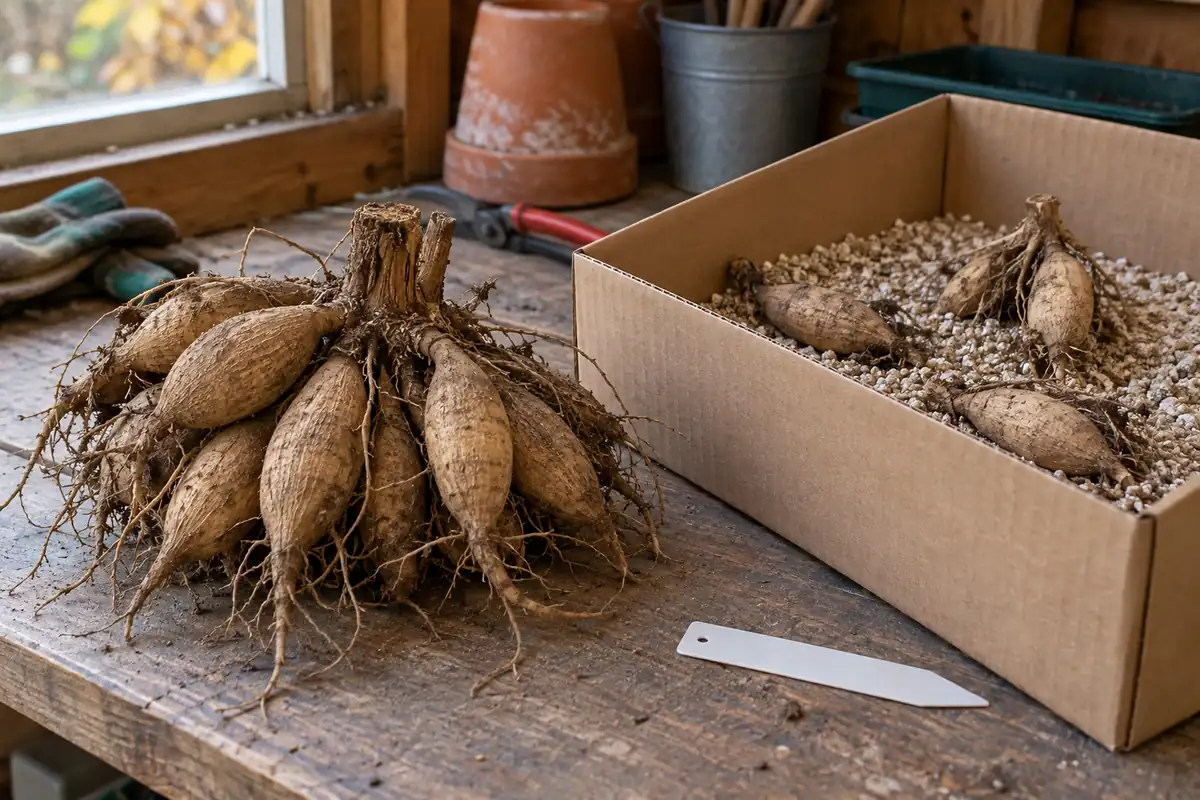
- Lift tuberous tubers before first frost and store dry at 50°F through winter
Table of Contents
Why Root Systems Define Begonia Types – The Classification Most Guides Skip
Walk into any begonia forum online and the most repeated question is “what type of begonia do I have?” People guess by flower color or leaf shape and are usually wrong. The more reliable answer comes from the base of the plant, because the three root systems – fibrous, rhizomatous, and tuberous – explain more about how a begonia behaves than any other single trait.
Fibrous-rooted begonias have conventional thread-like roots and grow year-round without a rest period. Rhizomatous begonias anchor through a thick, fleshy stem that creeps at or just above soil level, storing nutrients and driving growth; they slow down in winter but rarely go fully dormant. Tuberous begonias form a flattened, disc-shaped storage organ similar to a corm, die back completely in fall, and require a true dormancy period to survive into the following season.
The University of Florida IFAS Extension uses this three-part framework as the primary classification system because it predicts a begonia’s behavior more reliably than grouping by flower type or common name. It also explains why a wax begonia and an angel wing begonia look so different yet share the same fundamental care logic – both are fibrous-rooted, so both grow continuously, neither needs lifting, and both respond similarly to light and watering.
What rarely appears in mainstream guides: the American Begonia Society estimates that over 400 species remain undescribed in Borneo alone, and new species continue to be formally named. Begonia ferox, with dramatic black spine-like trichomes on dark leaf surfaces, was only described by researchers in 2013 from specimens in Southeast China. The genus is still being mapped. If a plant group can contain that many unknowns in a single region, it raises a real question about how narrowly the average garden center has defined what a “begonia” is.
Fibrous-Rooted Begonias – Wax and Cane Types That Forgive Most Mistakes
The fibrous group is where most gardeners start, and it earns that position. These begonias grow on conventional root systems, handle more variable conditions than the other groups, and rarely require anything unusual to perform.
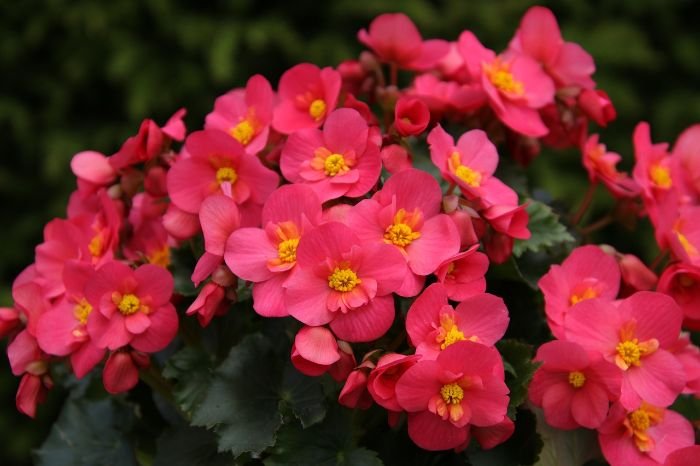
Wax begonias (Begonia semperflorens)
Semperflorens means “always flowering” in Latin, and these begonias come close to earning it. They produce small but dense clusters of red, pink, or white flowers continuously from late spring through the first frost, over foliage that runs from bright green to deep bronze. The bronze-leaved selections carry elevated anthocyanin levels, which is why they tolerate more direct sun than any other begonia type – some handle full sun exposure in northern climates when given consistent moisture.
Mature size runs 6-12 inches. Clemson University’s Home and Garden Information Center cites these as the most widely planted bedding begonias in the United States, ahead of impatiens in sun-exposed sites, precisely because of the long bloom window and tolerance range. They also self-clean, dropping spent flowers without deadheading – a practical advantage over many summer annuals.
One trait most gardeners appreciate only after the first season: wax begonias show stress visually before they fail, giving you time to adjust. Leaf edges curl and yellow slightly under drought before the plant declines, and they recover quickly from a deep watering in a way that tuberous types do not.
Cane and angel wing begonias
Cane begonias grow on stiff, segmented stems that visually resemble bamboo canes, reaching anywhere from 18 inches to 6 feet or more depending on the cultivar. The angel wing form – named for the large, asymmetrical leaves that taper to a point at both ends – is the most familiar type. Many carry naturally spotted or silvered foliage, and the hanging clusters of flowers, called pendulous cymes, appear year-round in warm indoor conditions.
The size variation within cane begonias is one of the most underused qualities in the group. A compact angel wing in a hanging basket behaves completely differently from a 5-foot specimen acting as a structural plant in a covered porch corner. Both are cane begonias, both share the same root system, but the spatial role and pot requirements are entirely different. Piedmont Master Gardeners note that cane begonias are among the best options for indoor-outdoor container plants because they transition between conditions without the shock that rex or tuberous types show.
Pro Tip: Cane begonias drop lower leaves as they elongate, and most growers read this as failure. It is a normal growth pattern. Cut the cane back by one-third in early spring to encourage branching from lower nodes, which produces a fuller silhouette over the following months rather than a bare-legged plant with foliage only at the top.
Rhizomatous Begonias – The Largest Group Most Gardeners Have Never Grown
Rhizomatous begonias are the most diverse group numerically – the American Begonia Society classifies hundreds of species and thousands of cultivars here – yet they get the least space in mainstream gardening content. The defining structure is the rhizome: a thick, fleshy stem that grows horizontally at or just above soil level, stores nutrients, and sends roots downward while producing new growth from the top surface.
Most rhizomatous types are grown as houseplants. They tolerate lower light than fibrous begonias, prefer shallow pots because their root systems stay close to the surface, and go through a winter slowdown without a true dormancy. Height stays manageable, typically 4 inches to 2 feet, which makes them practical for windowsills and interior shelves. The foliage is usually the reason to grow them – some species produce leaves up to 12 inches across, with spiraling, rippled, spotted, or banded patterns that share nothing visually with the wax begonias most people picture at the mention of the genus.
‘Escargot’, with its tightly spiral-rolled leaf that mimics a snail shell, and ‘Iron Cross’, with a distinct chocolate-brown cross marking on chartreuse-green foliage, are two of the better-known cultivars. Both demonstrate how far ornamental leaf variation extends within this single classification.
Rex begonias
Rex begonias (Begonia rex-cultorum) are technically rhizomatous, but Fine Gardening and most horticultural references treat them as a distinct category because their care requirements are more exacting and their ornamental focus is almost entirely on foliage rather than flowers.
The iridescent quality of rex leaves comes from specialized epidermal cells that refract light differently from ordinary leaf tissue. Colors cycle through greens, reds, purples, silvers, and near-blacks, typically in concentric zones across a single leaf. The trade-off is humidity. Rex begonias need 50% relative humidity or higher to maintain healthy leaf margins – below that threshold, edges brown and curl inward. Most homes in the US run at 30-40% relative humidity during winter heating season, which explains why these plants often perform well through summer and deteriorate steadily from November onward without any obvious change in watering or light.
An observation worth noting: rex begonias kept in a cluster of houseplants – not touching, but grouped within a foot or two – show better leaf quality than isolated specimens in the same room. The microclimate around grouped plants holds slightly more moisture near the foliage, and that difference becomes visible on rex leaves within two to three weeks in a dry house.
Tuberous Begonias – Peak Summer Color With a Clear Trade-off
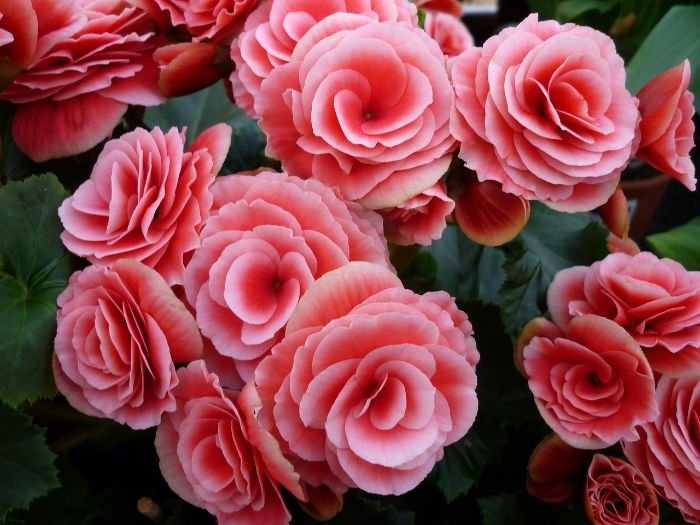
If you have ever seen a hanging basket trailing stems loaded with flowers wider than your palm, those are almost certainly tuberous begonias. Exhibition-type tuberous begonias produce blooms reaching 10-12 inches across – larger than any other type in the genus – and the color range covers white, yellow, orange, red, pink, and bicolors with a consistency and intensity that other groups cannot match at their peak.
The tuber is a flattened disc-shaped structure, concave on top and convex below. It stores energy through the winter dormancy and drives the following season’s growth and bloom. The concave side faces up – growing points emerge from that surface. Planting the tuber inverted is one of the most common mistakes with this group, and the plant rarely recovers once the emerging growth begins rotting from contact with standing moisture at the wrong angle.
The performance ceiling of tuberous begonias comes with a strict climate condition: flower bud formation slows above 85°F and stops almost entirely when daytime temperatures consistently exceed 90°F. In the Pacific Northwest, coastal New England, and higher elevations, this is rarely a problem. In the Deep South and Desert Southwest, peak summer heat arrives before these plants finish their best growth and shuts down flowering for weeks. That is not a failure of care – it is a climate mismatch. Gardeners in those regions generally find wax or cane begonias more reliable for summer color, treating tuberous types as a spring and fall plant rather than a summer centerpiece.
| Type | Root System | Bloom Season | Best Use | Winter Dormancy |
|---|---|---|---|---|
| Wax (Semperflorens) | Fibrous | Late spring to frost | Beds, borders, containers | None |
| Cane / Angel Wing | Fibrous | Year-round (indoors) | Pots, porch specimen plant | None |
| Rhizomatous | Rhizome | Late winter to spring | Houseplant, shaded border | Seasonal slowdown only |
| Rex | Rhizome | Spring to summer | Indoor foliage plant | Seasonal slowdown only |
| Tuberous | Tuber | Summer to early fall | Hanging baskets, pots | Full dormancy required |
Hardy Begonias and Wild Species – Beyond What Garden Centers Carry
Almost everything sold at retail is a hybrid or cultivar. The species behind those hybrids represent a different category of plant – often less showy, more self-sufficient, and occasionally capable of things their hybridized descendants are not.
Begonia grandis is the clearest example. It grows from small underground bulbils, survives USDA Zone 6 winters with a layer of mulch over the root zone, and naturalizes slowly in partial shade beds in a way no tuberous hybrid manages. The American Begonia Society notes it has been used medicinally in Asia since the 1400s, making it one of the most documented begonias in history – long before the ornamental breeding programs of the 19th century that produced the tuberous and wax types most gardeners know today.
The foliage is modest by begonia standards – green leaves with wine-red undersides, reaching 24-30 inches on arching stems – and the flowers are small pale pink clusters in late summer. The value of B. grandis is not the bloom. It is the return. For gardeners in zones 6 through 8 who assumed all begonias were strictly seasonal annuals requiring annual repurchase, this species is the exception worth trying once.
At the other end of the spectrum, species like Begonia ferox carry dark leaves covered in black, spine-like projections that give the leaf surface a texture closer to a cactus pad than a conventional begonia. Begonia rajah has leaf surfaces that visually resemble bubble wrap – discovered in the wild as recently as 1989, according to the American Begonia Society. Begonia bogneri, found in Madagascar in 1969, produces grass-like leaves that would not be recognizable as a begonia to anyone unfamiliar with the genus. These are collector plants, rarely available outside specialist nurseries, but they mark the outer boundary of what this genus actually contains. For anyone who wants to explore beyond retail, the American Begonia Society’s species introduction is the most organized starting point available.
Identifying a Begonia – Why Root and Stem Beat Flower Color Every Time
Flower color is the least useful identification clue. Most begonia types produce red, pink, or white flowers, and cultivars have been bred so far from their parent species that color tells you almost nothing about root system, care needs, or dormancy pattern. The reliable approach starts at the base of the plant.
Check the stem base and root system first. If there is a thick, fleshy stem creeping at or just above soil level with roots growing down from its underside, it is rhizomatous. If unpotting reveals a flattened disc-shaped structure with almost no conventional root growth, it is tuberous. If the roots form a conventional tangle of thread-like fibers with a clearly upright stem above them, it is fibrous-rooted – meaning wax, cane, or a related shrub type.
Leaf size and texture resolve most remaining questions. Wax begonias have small, rounded, glossy leaves rarely more than 3 inches across. Cane begonias carry large, asymmetrical leaves – often 6-10 inches – on clearly segmented stems, frequently with spots or silver markings. Rex begonias have metallic or iridescent foliage with concentric color zones. Standard rhizomatous types often have larger, more textured leaves in distinct patterns. Tuberous begonias have relatively plain, medium-large leaves that angle upward from the base with less visual drama than the other groups.
When flowers appear, size settles most remaining uncertainty. Tuberous begonias produce the largest blooms in the genus by a substantial margin – often 3-6 inches in garden forms, up to 12 inches in exhibition types. Rex begonias flower on slender stalks in small, often pale pink or white clusters that most growers consider secondary to the foliage. The contrast between those two types in bloom is clear enough to resolve almost any identification question on its own.
Conclusion
The question of which begonia to grow almost always has a clear answer once the root system question is settled. Fibrous types cover the widest range of conditions and forgive the most inconsistency – they are the right starting point for anyone new to the genus. Rhizomatous and rex types reward growers willing to manage humidity and use shallow pots; the foliage payoff is real, but so is the humidity requirement. Tuberous begonias deliver something genuinely impressive in the right season and the right climate, and almost nothing else comes close to their peak bloom size – but the dormancy cycle is a real commitment, not a detail to overlook.
For growers who want to go further, species begonias represent a category most gardeners have never considered, and B. grandis in particular offers something rare: a begonia that returns on its own in zone 6, with no lifting, no storage, no annual repurchase. The genus is large enough that there is almost certainly a type suited to any space, any light level, and any level of attention. The only step is knowing what you are actually looking at when you pick one up.
FAQ
What are the main types of begonias?
Begonias divide into three groups based on root system: fibrous-rooted, rhizomatous, and tuberous. Within the fibrous group, the main types are wax begonias (semperflorens) and cane begonias, including the angel wing forms. Rhizomatous begonias include the standard rhizomatous group and rex begonias, which are technically a subcategory but treated separately because of more demanding care requirements. Each root type drives different dormancy behavior, watering patterns, and seasonal performance.
What happens if you plant tuberous begonias in a hot climate?
Tuberous begonias begin slowing bud formation when daytime temperatures regularly exceed 85°F and stop producing flowers almost entirely above 90°F. In the Deep South or Desert Southwest, you may get an early flush of flowers in May or June, then a near-complete halt through July and August, followed by a second flush if temperatures drop in September. Gardeners in those regions generally find wax begonias or cane begonias more reliable for summer color, and use tuberous types in spring and fall when cooler temperatures allow the full bloom cycle to complete.
Can you grow begonias as perennials in the US?
In most of the country, begonias are treated as annuals because frost kills them. The reliable exception is Begonia grandis, the hardy begonia, which survives outdoors to USDA Zone 6 with a layer of mulch over the bulbils in fall. It naturalizes slowly in partial shade, returning each spring without lifting or storage. In zones 7 and above, it spreads gradually over several seasons. All other types – wax, cane, rex, rhizomatous, tuberous – need either indoor overwintering or to be repurchased each spring.
What is the difference between rex begonias and standard rhizomatous begonias?
Rex begonias (Begonia rex-cultorum) grow on the same rhizomatous root structure as standard rhizomatous types, so they share the shallow root system and creeping stem. The distinction in practice is foliage intensity and humidity tolerance. Rex begonias have been bred specifically for iridescent, multi-colored leaf patterns – greens, reds, silvers, and purples in concentric zones – and they require 50% relative humidity or higher to maintain clean leaf margins. Standard rhizomatous types are generally more forgiving of average home humidity and often carry interesting leaf textures and patterns with less demanding conditions overall.
What is the easiest begonia type for a first-time grower?
Wax begonias require less from the grower than any other type. They tolerate a wider light range than most, need no dormancy management, self-clean without deadheading, and bloom from late spring through first frost. Bronze-leaved varieties handle more direct sun exposure than any other begonia. For indoor growing, standard rhizomatous begonias offer similar forgiveness – they tolerate lower light than wax begonias, recover from missed waterings without the leaf damage rex types show, and do not require the humidity management that makes rex begonias difficult in dry climates.
How do I identify what type of begonia I have?
Start at the base of the plant rather than the flower. A thick, fleshy stem creeping at soil level means rhizomatous. A flattened disc-shaped structure at the base with minimal fibrous roots means tuberous. A conventional tangle of thread-like roots with an upright stem means fibrous-rooted – either wax, cane, or shrub type. From there, leaf size narrows it further: small and glossy points to wax; large and asymmetrical with spots or silver markings points to cane; metallic or multi-zoned foliage suggests rex. When flowers appear, tuberous begonias produce blooms 3-12 inches across – larger than any other group by a significant margin – which resolves most remaining identification questions.
How many species of begonias exist?
Over 2,000 species have been formally described, placing Begonia among the five largest flowering plant genera on earth. The count keeps rising. Begonia ferox, with distinctive black spine-like projections on dark leaf surfaces, was formally described in 2013 from specimens collected in Southeast China. The American Begonia Society estimates that 400 or more species from Borneo alone remain undescribed. Most retail begonias represent a narrow slice of this diversity – primarily a handful of hybrid groups derived from a small subset of the total species range.
Can you mix different begonia types in one container?
Mixing within the same root-system group works well. Wax begonias and cane begonias share similar watering and light preferences, so combining them in a large container creates no scheduling conflicts. Mixing tuberous begonias with fibrous types creates a problem in fall: fibrous types keep growing while tuberous ones need to wind down and dry out before the tuber goes into storage. Rex begonias in mixed containers often struggle because they need higher humidity than most container companions can tolerate without overwatering the pot as a whole.