


Updated July 28, 2026
Tomato companion plants work best when they solve a specific problem without crowding the tomato’s roots or canopy. Basil, French marigolds, sweet alyssum, parsley, chives, lettuce, radishes, and other compact crops can fit well around tomatoes when their mature size, water needs, and planting time match. Keep enough open space for airflow, watering, pruning, and harvest; a famous pairing is not useful when the bed becomes dense.
Start with one tomato and one companion job. Use low crops for soil cover, flowering plants for beneficial insects, or compact herbs for an extra harvest. Give the tomato its full recommended spacing first.
Key Takeaways
- Choose companions by function: beneficial insects, soil cover, extra harvest, or pest disruption.
- Keep the lower 8–12 inches of the tomato stem open for watering, pruning, and airflow.
- French marigolds have evidence for slowing glasshouse whitefly populations when planted from the start; they are not a cure for an established infestation.
- Potatoes, black walnut, and any crop that creates a dense, humid canopy deserve the greatest caution.
- In containers, one tomato usually needs most of the pot. Use a separate nearby pot for the companion when root volume is limited.
Table of Contents
Tomato Companion Plants Chart
Use this tomato companion planting chart as a shortlist, then compare each plant’s mature width with the space available around your tomato. “Good companion” does not mean zero competition. It means the plant can provide a useful role and remain manageable with sensible spacing.
| Companion | Useful role | Placement | Main caution |
|---|---|---|---|
| Basil | Compact herb harvest; flowers can support beneficial insects | 12–18 inches from the tomato stem | Needs pruning once it becomes broad |
| French marigold | Whitefly disruption; flowers for beneficial insects | At transplant time, between or along tomato rows | Choose compact Tagetes, not an oversized cultivar |
| Sweet alyssum | Low floral strip for hoverflies and other small beneficial insects | Bed edge or open gaps | Shear it back if it forms a damp mat |
| Parsley | Edible understory; flowers support beneficial insects | 12–18 inches away | Let only selected plants flower |
| Chives | Narrow upright growth and early flowers | Outer edge of the root zone | Divide expanding clumps |
| Garlic | Early-season crop with narrow foliage | In a defined row, harvested before peak tomato growth | Bulb lifting can disturb tomato roots |
| Lettuce | Fast spring harvest and temporary soil shade | Between young tomatoes | Remove as the tomato canopy closes |
| Spinach | Cool-season harvest before summer | Open ground between transplants | Usually bolts as tomato season warms |
| Radishes | Quick crop that uses early empty space | Short rows outside the stem zone | Harvest before roots and foliage become crowded |
| Carrots | Low canopy and a separate harvest layer | At the sunny edge of the tomato row | Deep shade reduces root development |
| Nasturtium | Flowers and possible trap-crop activity | Bed edge where vines can trail outward | Can sprawl into the tomato canopy |
| Borage | Long flowering period for pollinators | Outside the tomato’s mature canopy | A mature plant needs substantial room |
Several popular claims go beyond the available evidence. A companion does not automatically “feed” a nearby tomato, improve fruit flavor, or repel every pest. Living legumes use much of the nitrogen they fix, and most of that nitrogen does not move directly into a neighboring tomato during the same season. The reliable gains come from space use, flowering resources, harvest timing, and reduced exposure to a specific pest where research supports the effect.

For a broader crop-by-crop reference, use the main guide to companion plants for vegetables. Tomato pairings require extra attention to root space, canopy size, diseases, and harvest access.
Tomato Companion Planting by Goal
A long list of compatible plants does not tell you which one deserves space. Name the problem first, then select the smallest companion that can address it. This keeps the tomato as the priority crop and prevents a collection of “good” plants from turning into one crowded bed.
| Your goal | Best starting choice | How to use it | Success signal |
|---|---|---|---|
| Use early bare soil | Lettuce, spinach, or radishes | Plant before or at tomato transplanting and harvest early | The short crop leaves before tomato roots and shade peak |
| Support beneficial insects | Sweet alyssum or flowering parsley | Keep a small flowering patch at the bed edge | Flowers stay accessible and foliage remains dry |
| Slow glasshouse whiteflies | French marigold | Establish it with tomatoes from the start | Whitefly populations build more slowly; monitoring continues |
| Add an herb harvest | Basil, parsley, or chives | Place outside the open stem circle and harvest regularly | The herb stays below the first tomato branches |
| Cover a bed edge | Alyssum or controlled nasturtium | Direct growth away from the cage and path | Soil is shaded with no wet mat beneath the tomato |
Do not stack all five goals around one plant. A tomato in a normal home-garden bed usually needs only one or two companion types. For example, an early row of lettuce can finish before a French marigold reaches full size. In another bed, basil may supply the extra harvest and sweet alyssum can occupy one corner. Each plant should have a visible reason to remain.
Match the intervention to the setting. Whitefly evidence from a glasshouse does not guarantee the same effect against every outdoor pest. A flower strip may support beneficial insects, though it cannot replace sanitation or direct treatment during a serious outbreak. Goal-based planting keeps those limits visible and makes end-of-season evaluation much easier.
Best Companion Plants for Tomatoes
The best companion plants for tomatoes are small enough to manage and useful enough to justify their space. A strong tomato can spread several feet and develop a wide feeding root system. Plant the tomato first on the plan, mark its mature canopy, then use the remaining light and edge space.
Compact herbs for tomato beds
Basil is an easy pairing because regular harvest keeps it compact. Place it far enough from the stem that both plants can be watered at soil level. Pinch the basil frequently, or allow one plant near the bed edge to flower for insects. Parsley works in a similar way and tolerates some light shade once the tomato canopy expands.
Chives and garlic use narrow vertical space. Their advantage is architectural, not magical pest protection. Keep them in a defined line so lifting bulbs or dividing clumps does not tear through tomato roots. Mint is a poor in-ground choice because runners spread through the bed; keep it in its own pot if you want it nearby.
Flowers for beneficial insects
Sweet alyssum, marigolds, parsley flowers, borage, and nasturtiums can provide nectar or pollen. Put taller or spreading flowers at the ends of the row. Keep low flowers in small patches that can be cut back after rain. This arrangement supports insect activity without creating a continuous layer of wet foliage beneath the tomatoes.
Tomatoes are largely self-pollinating, so flowers should not be sold as a guaranteed yield booster. Their clearer role is supporting a more diverse insect community, including predators and parasitoids that use floral resources. The guide to flowers in companion planting explains how to separate that function from decorative planting.
Fast crops under young tomatoes
Lettuce, spinach, and radishes can occupy open ground early in the season. Their success depends on timing. Sow or transplant them early enough to harvest before the tomato reaches full width. Carrots need more time and consistent light, so place them along the sunny side of a tomato row and leave enough room to pull them cleanly.
These crops create an extra harvest, not free living mulch. Remove old leaves and harvested roots promptly. A thinning crop that remains beneath dense tomato foliage can trap moisture and make disease inspection difficult.
Marigolds: The Classic Pairing
Marigolds and tomatoes are a classic pairing with a narrower evidence base than many gardening claims suggest. The clearest result concerns French marigolds (Tagetes patula) and glasshouse whiteflies. A controlled study found that French marigolds grown with short-vine tomatoes from the beginning of the crop slowed whitefly population development. Adding marigolds after a heavy infestation produced little benefit. The researchers identified airborne limonene as the probable repellent mechanism. Read the PLOS One study on French marigolds and tomato whiteflies for the full trial.

Choose the right marigold
Choose a true marigold in the genus Tagetes. Calendula is often called pot marigold, yet it is a different plant. Compact French marigolds are the easiest match for a tomato bed because they remain lower than many African marigolds. Signet marigolds are compact and useful around containers, though the whitefly evidence is specifically tied to French marigolds.
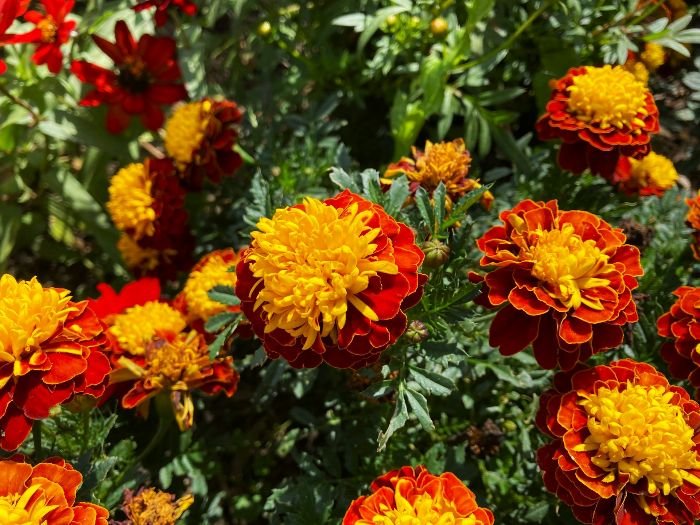
Check the cultivar’s mature width. A dwarf French marigold can sit about 12–18 inches from a tomato stem. Give a larger cultivar 18–24 inches or move it to the row end. The correct distance keeps the tomato’s lower leaves open and allows both root balls to develop without constant competition.
Plant early and set realistic expectations
Planting marigolds with tomatoes works best when both establish together. Set marigold transplants at tomato planting time, or place established marigolds into the prepared bed shortly before the tomatoes. A late addition may still provide flowers and visual diversity, though it should not replace direct control of an existing whitefly outbreak.

Nematode suppression needs an equally careful explanation. Some Tagetes species and cultivars can suppress specific root-knot nematodes when grown densely as a prior cover crop for weeks or months. One decorative marigold beside an infected tomato is not a soil treatment. Identify the nematode problem first and use resistant tomato varieties, rotation, clean transplants, or a planned marigold cover crop as appropriate.
Marigolds also have limits above ground. They do not prevent blight, correct poor fertility, or stop hornworms from finding tomatoes. Inspect their foliage for spider mites and remove badly infested plants before pests spread. The broader companion planting pest-control guide helps match a tactic to the pest that is actually present.
What Not to Plant With Tomatoes
Lists of bad tomato companions often mix disease risk, physical crowding, rotation advice, and weak folklore. The reason matters. Some plants belong in another part of the garden; others only need more distance.
| Plant or group | Why separation helps | Practical response |
|---|---|---|
| Potatoes | Share important diseases and can make harvest damage more likely | Use a separate bed and rotate the whole nightshade family |
| Black walnut | Roots, leaves, and hulls contain juglone that can injure sensitive tomatoes | Grow tomatoes well beyond the tree’s root zone |
| Corn | Large canopy and root demand; corn earworm is also tomato fruitworm | Give corn its own block away from tomatoes |
| Mature brassicas | Large cabbage, broccoli, and cauliflower plants occupy substantial root and canopy space | Use another row or harvest an early brassica before tomatoes expand |
| Fennel | Becomes large and is a poor fit inside a heavily fed tomato bed | Grow it in a separate strip where it can flower |
| Sprawling cucurbits | Squash and cucumber vines can close access and hold humid foliage near tomatoes | Trellis them in another row or direct vines away |

Peppers and eggplants can grow near tomatoes if spacing and disease management are strong. Their shared family makes crop rotation harder, and an outbreak can move through the whole planting. Treat them as a management decision, not an automatic forbidden pairing. The same principle applies to many disputed combinations: separate plants when they share a serious problem or occupy the same space at maturity.
How Close to Plant Tomato Companions
Start with the spacing on the tomato label. Determinate tomatoes may remain compact; vigorous indeterminate varieties can fill a much wider area. The companion belongs outside the tomato’s immediate stem zone and should remain reachable after the cage or trellis fills.
| Companion size | Starting distance | Good examples | Seasonal check |
|---|---|---|---|
| Small and regularly harvested | 12–18 inches from stem | Basil, parsley, dwarf French marigold | Leaves remain below the first tomato branch |
| Low, short-season crop | Outside an 8–12 inch open stem circle | Lettuce, spinach, radish | Harvest before tomato shade becomes dense |
| Spreading flower or herb | 18–30 inches from stem | Nasturtium, borage, large marigold | Growth stays out of the cage and path |
| Another fruiting crop | Use each crop’s full spacing | Pepper, eggplant | Canopies remain separate with open airflow |
Measure from stem to stem, then reassess after three or four weeks of warm weather. If leaves from two plants overlap deeply, thin or relocate the smaller companion. Avoid pushing water and fertilizer higher to compensate for a layout problem.
Seasonal Tomato Companion Schedule
Before tomato transplanting
Prepare the tomato support and irrigation route before adding companions. Early lettuce, spinach, radishes, garlic, or chives may already occupy defined strips. Mark the future tomato stem position so these crops do not fill its planting hole or immediate watering circle.
Start French marigolds early enough to transplant with the tomatoes. Small seedlings placed into the bed at the same time can establish without competing with a mature tomato root system. This timing also matches the whitefly research more closely than adding flowers after pest numbers rise.
Early tomato growth
During the first four to six weeks, train the tomato onto its support and keep companions within their assigned zones. Harvest spinach and lettuce as temperatures rise. Thin radishes and carrots on schedule. Pinch basil to encourage a compact form, and check that marigold foliage does not touch the tomato’s lowest leaves.
This is the easiest point to correct spacing. Roots have begun to spread, though smaller companions can still be moved with limited disturbance. Remove volunteers and weeds that turn a planned pairing into an unplanned thicket.
Flowering and peak harvest
Once tomatoes flower and set fruit, protect airflow and access. Cut back alyssum after a heavy flush, direct nasturtium vines away from the cage, and harvest herbs frequently. Remove yellow or damaged lower foliage from the bed. Inspect tomatoes and companions together for whiteflies, aphids, mites, chewing damage, and leaf spots.
Late in the season, do not replace every harvested companion. Open soil around a mature tomato can improve access and drying. Leave healthy flowering plants at the edge if they remain manageable, then remove diseased crop residue promptly after the final harvest.
Tomato Companions in Beds and Containers
A raised bed gives roots more shared soil volume, yet close planting still increases humidity. Position tomatoes where the trellis will not shade the whole bed. Use early greens between young transplants and move permanent flowers toward the corners. Water at soil level so dense planting does not keep leaves wet.
In a container, root volume is the hard limit. A large indeterminate tomato usually needs a container to itself. A very large pot may support one small basil or dwarf marigold near the rim, provided watering remains even. Separate pots placed side by side give the same visual and insect-support value with less root competition.
Container pairings need a daily moisture check during hot weather. Repeated wilting within a day of watering points to inadequate soil volume or excessive root demand. Move the companion to another pot before increasing fertilizer. Extra feed cannot replace root space or stable moisture.
Troubleshooting a Tomato Pairing
Judge a pairing by the tomato’s growth and the bed’s manageability. Check once a week during rapid growth. The following signals show which pressure needs attention.
- Lower leaves stay wet or develop spots: thin the companion, prune damaged tomato leaves, and restore airflow. Diagnose disease separately.
- New tomato leaves become smaller: check root crowding, moisture depth, and fertilizer history. Remove the least valuable companion first.
- The companion leans into the cage: prune it, support it, or move it before stems become intertwined.
- Harvest requires stepping into foliage: clear a path and relocate edge plants after the season.
- Pests build on both plants: identify the pest and remove a companion acting as a bridge or reservoir.
Companion planting cannot correct poor sun, compacted soil, an undersized pot, or irregular watering. Fix those conditions before adding more plants. If tomato foliage curls or distorts, use the dedicated guide to tomato leaves curling to separate heat, water, root, pest, and disease causes.
Record which companion was planted, its distance from the tomato, and the date it was removed or harvested. That simple record is more useful than copying a universal chart from a different climate. Review common companion planting mistakes before repeating a layout that became crowded.
Conclusion
Build the bed around the tomato, then add one companion for a clear purpose. Basil, parsley, compact French marigolds, sweet alyssum, and early greens are practical starting points. Keep the stem zone open, preserve airflow, and harvest short-season crops before the tomato canopy closes.
Marigolds deserve a place in the plan when expectations stay specific: use true Tagetes, plant early, choose a size that fits, and continue normal pest monitoring. A productive tomato bed is easy to water, inspect, prune, and harvest. If a companion makes any of those jobs harder, the pairing needs more space or fewer plants.
FAQ
What is the best companion plant for tomatoes?
Basil is one of the easiest choices because it stays manageable with regular harvesting. French marigold is useful when planted early for its evidence-backed relationship with glasshouse whiteflies. The best choice still depends on the job, available space, and local pest pressure.
How close can companion plants grow to tomatoes?
Keep an open circle of about 8–12 inches around the tomato stem. Place compact basil, parsley, or dwarf French marigolds roughly 12–18 inches from the stem, then increase the distance for spreading or tall plants. Follow the tomato variety’s full spacing first.
Do marigolds keep all pests away from tomatoes?
No. Research supports a specific effect from French marigolds on glasshouse whitefly populations when the plants grow together from the start. Marigolds do not prevent every insect, cure an existing infestation, or protect tomatoes from fungal and bacterial diseases.
What should not be planted next to tomatoes?
Keep potatoes and tomatoes in separate beds because they share important diseases and harvest can disturb both root systems. Keep tomatoes away from black walnut roots and avoid any companion that closes airflow, competes heavily, or blocks inspection and harvest.
Can basil and marigolds grow with the same tomato?
Yes, if the bed is large enough. Give the tomato its full spacing, place one compact basil and one dwarf marigold outside the immediate stem zone, and prune or remove either companion when foliage begins to crowd the cage.