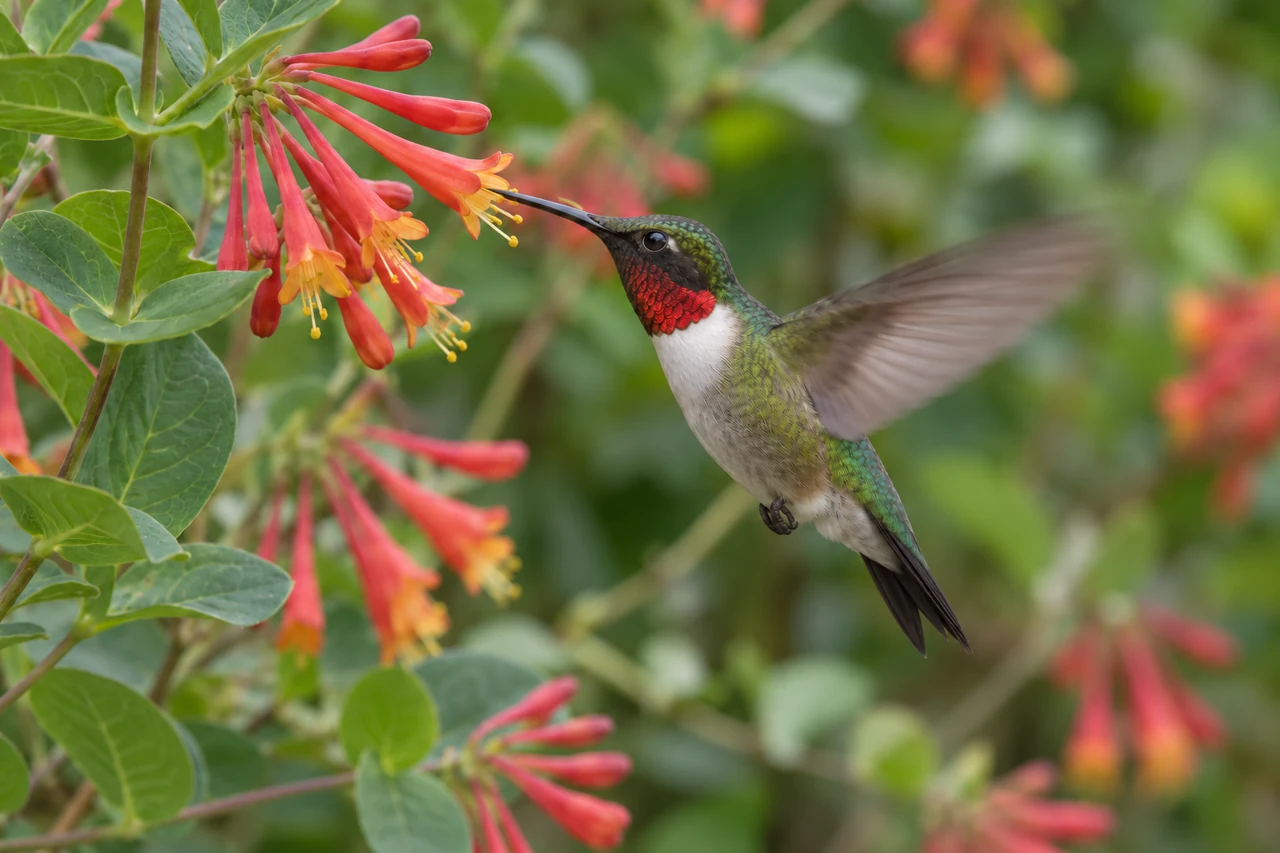
How to attract hummingbirds changes with your region, the season and the resources your garden supplies. Flowers supply nectar, small insects supply other nutrients, and trees or shrubs offer places to rest and shelter. A feeder can supplement that habitat if you can keep its sugar water fresh and its parts clean.
Start by finding out which hummingbirds visit nearby and when they are present. Then choose flowers for your actual sunlight and soil, including more than one flowering period. A moist-soil cardinal flower and a dry-site sage cannot simply be treated as interchangeable red blooms.
Make the feeder decision separately. A pretty location can expose birds to reflective glass or a stalking cat, and a large reservoir can hold far more nectar than local birds use. Small, maintainable changes are more useful than promises of a crowded feeder by the weekend.
Start with the missing resource.
- No nectar flowers
- Choose locally suitable plants with overlapping bloom periods, plus nearby perches and insect habitat.
- Using a feeder
- Mix 1 part plain white sugar with 4 parts water by volume. Use no dye, honey or sweetener substitutes.
- Nectar left from several days ago
- Discard it and clean the feeder. Refresh every 2-3 days, daily in very hot weather, and immediately if cloudy.
- No visitors
- Check local season and sightings, clean nectar, flower availability, territorial birds and glass or cat hazards.
Key Takeaways
- Check local hummingbird seasons before interpreting an empty feeder.
- Plant overlapping nectar flowers matched to soil and sunlight.
- Keep insect habitat, natural perches and gentle water available.
- Measure one part white sugar to four parts water.
- Clean feeders frequently and check glass and predator hazards.
Table of Contents
How to Attract Hummingbirds Starts With Local Birds and Seasons
In much of eastern North America, the ruby-throated hummingbird is the familiar regular breeding visitor. Western regions have additional species and different seasonal patterns. Some Pacific Coast locations have resident Anna’s hummingbirds as well as migrating visitors. Oregon State’s regional guidance distinguishes those birds from migratory Rufous hummingbirds; one state’s calendar cannot describe every garden.
Check recent nearby observations and seasonal records, such as eBird reports, before treating an unused feeder as a gardening failure; a report from another county shows that a bird was there, not that it will reach your yard tomorrow. Compare places close enough to share your climate and landscape.
Spring arrival generally advances northward in the East, with Gulf Coast sightings preceding those in northern states. Weather and location change the timing. Have suitable early flowers ready for the local season, then plan what remains available after those flowers fade.
Watch from a quiet position. A brief buzz, a bird pausing on a bare twig or a rapid visit behind the flowers can be easier to notice than a bird at the feeder. Record the date and flowering plant, using those observations to help distinguish a seasonal absence from a gap in the garden’s food supply.
Choose Nectar Flowers for Your Soil and Successive Bloom Periods
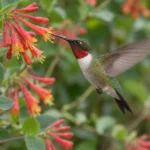
Start with exact botanical names and locally appropriate plants. Red or orange tubular flowers can be useful cues, and hummingbirds also visit other colors. Flower shape, accessible nectar, flowering time and a healthy plant matter more than making every blossom red.
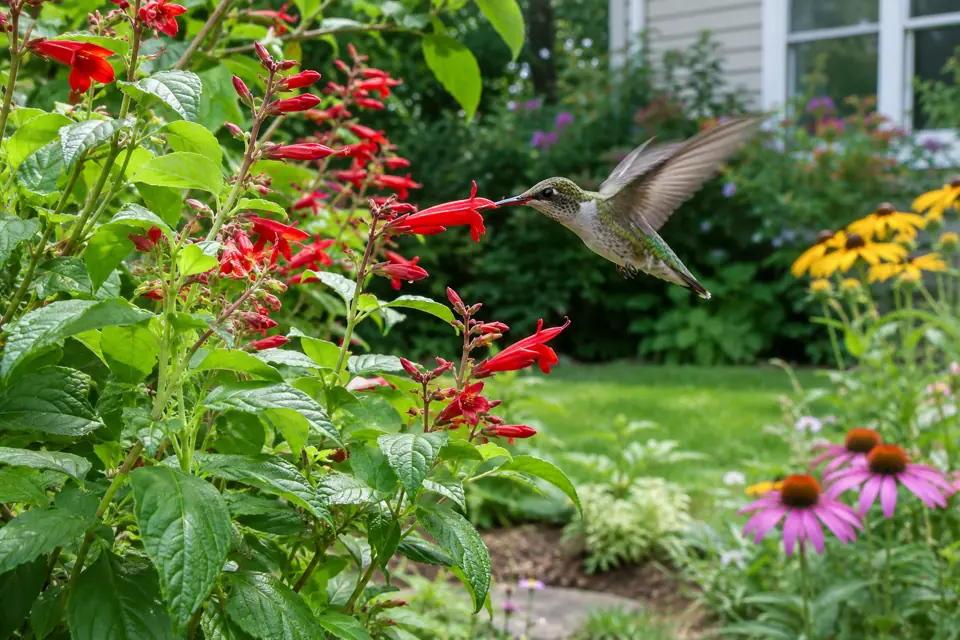
Arrange compatible plants in visible groups, leaving space for their mature growth. Three different flowering periods are more useful than several varieties that finish together. Use a local planting calendar and nursery information for the named species or cultivar. Winter hardiness does not establish local native status or moisture needs.
| Regional example | Plants to investigate locally | Season and site decision |
|---|---|---|
| New Jersey and suitable eastern sites | Eastern columbine, Aquilegia canadensis; scarlet bee balm, Monarda didyma; cardinal flower, Lobelia cardinalis | Rutgers’ NJ examples run April-May, June-August and July-September respectively. Cardinal flower needs moisture. These are local examples, not national dates. |
| Suitable Texas sites | Gregg sage, Salvia greggii; Turk’s cap, Malvaviscus arboreus var. drummondii; flame acanthus, Anisacanthus quadrifidus var. wrightii | Check county suitability, exposure and the actual flowering periods. Humid east Texas and dry western sites need different choices. |
| Warm Florida sites | Firebush, Hamelia patens; coral honeysuckle, Lonicera sempervirens | Check native form, mature size and freeze exposure. Firebush can become a substantial shrub; it is not a cold-climate perennial substitute. |
| Suitable Pacific Northwest sites | Red-flowering currant, Ribes sanguineum, with locally selected later-flowering plants | Use its early flowers as one seasonal contribution. Allow the shrub’s mature space and verify local growing conditions. |
The New Jersey hummingbird planting and care guidance provides the eastern sequence above. It also identifies coral honeysuckle as a vine, rather than a small bedding plant. Give it an appropriate support and room. Do not substitute another honeysuckle on the strength of a similar common name.
A dry, sandy border cannot supply the same root conditions as a moist rain-garden edge. Grow cardinal flower in the moist planting where locally suitable. If you cannot maintain its moisture needs, choose a different nectar plant suited to the dry site. Changing the plant is often more workable than forcing a wet pocket into an otherwise dry bed.
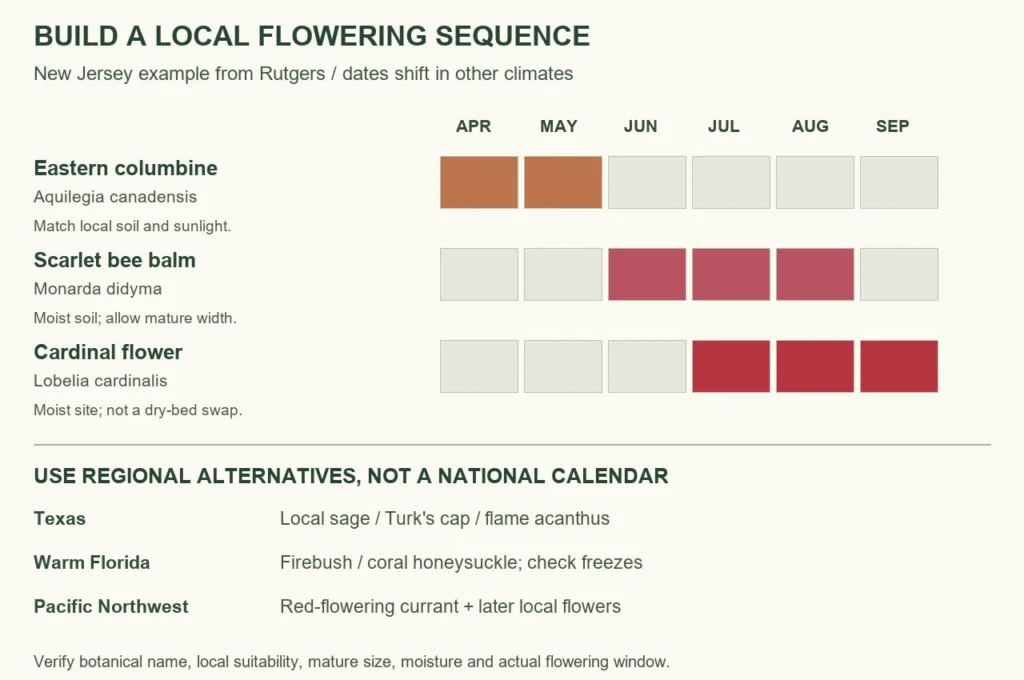
For Florida, UF/IFAS describes firebush with orange-red tubular flowers and a much larger mature footprint than many small perennials. Check the actual nursery plant’s identity, including compact forms, before describing it as locally native. In Oregon, red-flowering currant is an early nectar option; it does not flower all winter merely because some hummingbirds remain there.
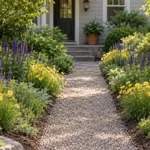
Revisit the planting during the growing season. If all flowers finish before late visitors arrive, add a suitable later bloomer when planting conditions allow. The wider mix of pollinator-friendly plants can also supply insect resources. Match that mix to local conditions and leave room for the plants already present.
Keep Insects, Perches and Gentle Water in the Garden
Sugar water supplies energy. Small insects and spiders add nutrients the birds need, including during nesting. A garden stripped of insect life offers less than its flowers suggest. The ruby-throated hummingbird, for example, eats insects and spiders and uses spider webs among its nesting materials. Tolerate modest, harmless feeding damage and avoid broad insecticide applications across blooming plants.
If an infestation needs attention, identify it and choose a targeted response. Do not spray a feeder or coat its support with a pesticide. Foliage, twigs and a range of plants support the food web; the different roles of wildlife plants extend beyond nectar alone.
Retain small trees and shrubs where they suit the site. Fine exposed branches give resting birds a view, and protected branches offer shelter. Look carefully for active nests before trimming. A purchased nest box does not replace this vegetation for hummingbirds.
Provide gentle water if you can maintain it. A fine mist or dripper can wet leaves and offer shallow bathing opportunities. Avoid a forceful spray or a deep, steep-sided bath as the only option. Check where the water lands: persistent muddy puddles and dirty standing water call for a change in the setup. Match the flow to water conservation in the garden, keeping the bathing area gentle and avoiding wasted runoff.
Habitat can be distributed across the yard. The shrub refuge need not sit immediately beside the feeder, especially where low cover gives cats a hiding place. Preserve natural shelter and choose the artificial feeding location with its separate hazards in mind.
Mix Sugar Water Accurately and Choose a Feeder You Can Clean
Use four measures of potable water for each one measure of plain white granulated sugar. For a small batch, that is 1 cup of water plus one-quarter cup of sugar. Dissolve it completely and let any warmed mixture cool before filling the feeder. The measurements describe the ingredients, not a final-volume mark on the reservoir.
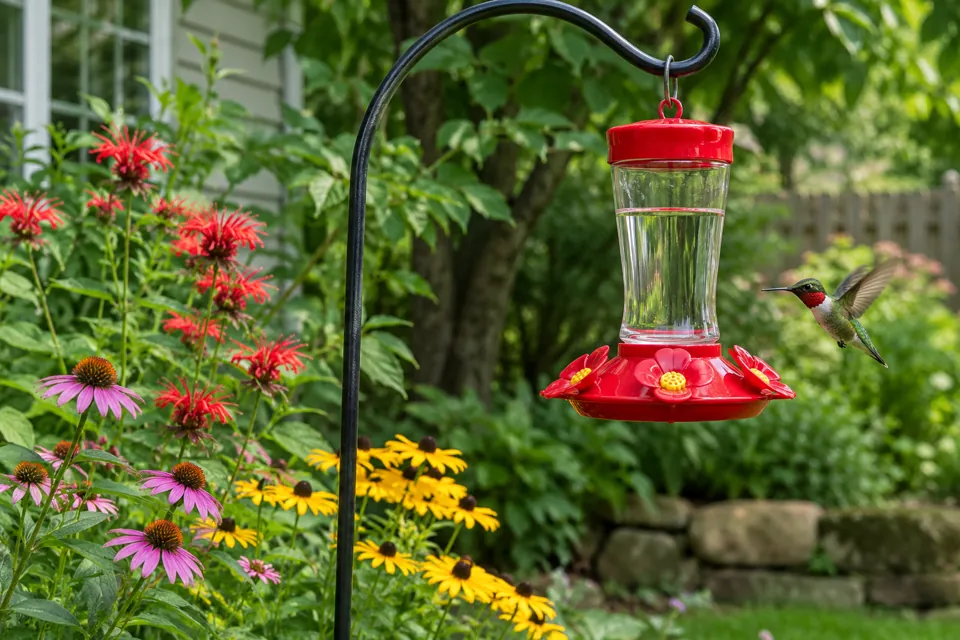
Use no honey, red dye, juice, brown sugar or artificial sweeteners. The feeder’s colored parts can supply a visual cue; the liquid should be clear. Diluted honey encourages microbial growth, and sweetener substitutes do not supply the same food energy.
Preparation recommendations differ. Cornell Lab permits small, freshly prepared batches without boiling when clean water is used, and recommends boiling water for larger stored batches. Audubon uses a brief boiling method. Neither preparation method washes residue out of a dirty feeding port. Keep mixing and equipment cleaning as separate jobs.
Choose a reservoir and base that come apart completely, so you can brush the inside, feeding holes and hidden recesses. Small feeders are useful when few birds visit: less sugar water sits unused, and a fresh small portion is easier to replace than a large bottle.
Shade slows heating and spoilage. Check bottle seals and ports for sticky drips. Warming air in an inverted bottle can push liquid out, attracting ants and wasps. Repair the leak or change the position or design. An ant moat uses plain water, kept clean; oils and insecticides do not belong beside the birds’ food. If ants still reach the feeder, check that the moat contains water and that a nearby branch, wire or fixture is not touching the feeder below it.
Clean the Ports Before Refilling and Shorten the Interval in Heat
Discard old nectar and clean the feeder every 2-3 days, with daily changes in very hot weather. Clean immediately if the liquid turns cloudy or if you find mold or film, regardless of the schedule. Do not wait for a sour smell, and do not top off an old batch with fresh solution.
Even an apparently quiet feeder can change over time. In a study comparing feeder solution and flower nectar, microbial communities developed in feeder solution even when hummingbirds were excluded. Most identified microbes were not known bird pathogens, and the study did not establish whether the communities harmed birds. It supports regular cleaning, not a claim that every microbe in a feeder causes disease.
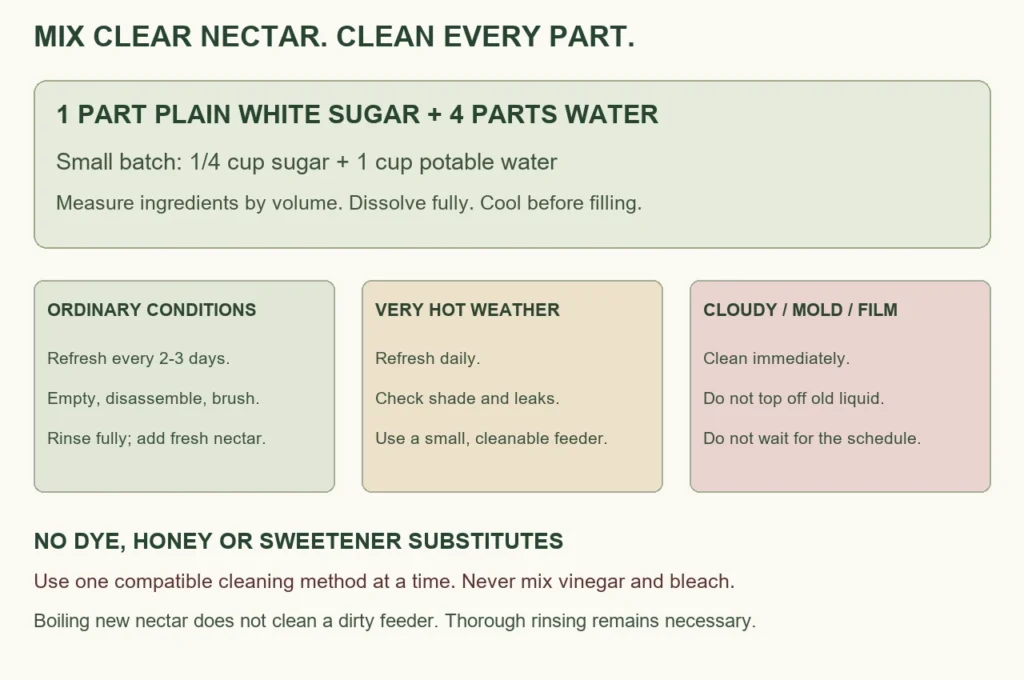
Take the feeder apart, empty it, and scrub the reservoir, base, ports and seams with suitable brushes and hot water; feel for a slippery film and look inside the narrow openings. Rinse thoroughly. If residue or mold remains where you cannot reach it, do not refill and put it back out; clean it properly using a compatible method or replace that feeder.
Audubon’s hummingbird habitat and feeder-care instructions include one part white vinegar to four parts water as a cleaning option, followed by three warm-water rinses. Check the feeder’s material and cleaning directions. Use one cleaning method at a time. Never mix vinegar with bleach or other cleaning products; bleach and vinegar can release toxic chlorine gas.
Give yourself a maintenance cue: note the refill date and the next check, then inspect sooner when weather becomes hot. Shade does not make a week-old solution acceptable. If you will be away and nobody can service the feeder, remove and clean it before leaving. Flowers can remain available without an unattended reservoir.
Check Reflective Glass and Cat Cover as Separate Hazards
Look at the glass from outside. Reflected sky or foliage can appear to be open flight space. A feeder hung for a good kitchen view can bring birds close to that reflection. Exterior screens or properly applied bird-collision treatments address the glass itself; moving a feeder alone is not a complete solution.
Cornell’s Bird Academy discussion gives a placement rule of thumb of within 3 feet of glass or farther than 30 feet, alongside treatment of the glass. This is guidance to reduce risk, not a guarantee that a window is safe. Evaluate the whole flight route and neighboring panes.
Cats create a different problem. Rutgers recommends at least 15 feet between a feeder and low vegetation where cats can hide. That distance concerns ambush cover, not window reflection. Keeping cats indoors and removing stalking opportunities matter more than making a decorative feeding corner.
A small garden may not accommodate a safe feeder position. Keep the flowers and omit the feeder if the glass and predator problems cannot be resolved. You can still contribute nectar habitat without putting an artificial food source in a hazardous spot.
Where several birds chase one another, try smaller feeding stations separated by sight barriers. Two reservoirs side by side may be easy for the same bird to defend. Observe the result and retain the cleaning and safety checks at each station, since more ports do not automatically mean more birds can feed undisturbed.
Read Empty Feeders and Seasonal Changes Before Changing the Garden
When no birds appear, work through the likely limits in order: local presence and season, fresh liquid, visible suitable flowers, safe access and territorial behavior. An untouched full feeder still needs cleaning. Do not add coloring or a stronger mixture to solve a problem you have not identified.
On a balcony, begin with a container plant that fits the light, wind and watering you can provide. Sound container gardening keeps those blooms growing. Treat nearby glass before considering a feeder, and respect the building’s rules. A flower-filled pot can be a stopover resource without becoming a nesting site.
For a small yard, mark an early-flowering group, a later group and existing woody shelter on a sketch. Check mature widths and root moisture before buying, and add water or a feeder only where its care and placement work. Keep the arrangement modest enough to maintain, then record which plants actually flower when local birds are present.
Fall feeding does not prevent hummingbirds from migrating. Journey North’s migration guidance rejects that concern. In migratory areas, keep a maintained feeder available for roughly 1-2 weeks after the last observed bird, allowing for late travelers. This is observation-based timing, not a nationwide removal date.
Where birds remain in winter, feeding requires reliable access to fresh, unfrozen solution and open ports. Follow local bird-care advice for freezing weather. An iced or neglected feeder does not help simply because it is still hanging. Resident western birds and seasonal eastern visitors need different plans.
Use the chase route to choose a second feeder site
Watch from indoors and note where the guarding bird perches and how it reaches the feeder. Stand at the proposed second spot and look toward that perch. If both feeders sit in the same open view, try a site screened by the corner of the house or dense foliage. Check the new spot for reflective glass, places where cats can hide and safe access for cleaning before hanging anything.
Keep the nectar mix and cleaning routine the same while testing the new position. Watch for uninterrupted feeding visits as well as chases. If both stations are still being guarded from the same perch, change the sight line again. If nobody visits either one, look for changes in flowering and seasonal bird activity before assuming a territorial bird is responsible.
Conclusion
Build around locally present hummingbirds, plants that flower through their season, insect life and natural shelter. Add a feeder only when you can mix, clean and place it properly. Watch the garden through changing weather and bloom periods, and correct the resource or hazard you can actually identify.