
Fruit production statistics for 2026 point to a concentrated U.S. fruit sector where a few crops carry most of the tonnage and a smaller group carries most of the dollar value. The latest USDA NASS annual releases show 15.84 million tons of noncitrus fruit utilized production for 2025 and 5.02 million tons of citrus production for the 2024-25 season, giving the current official fruit production picture about 20.86 million tons across those two reporting systems.
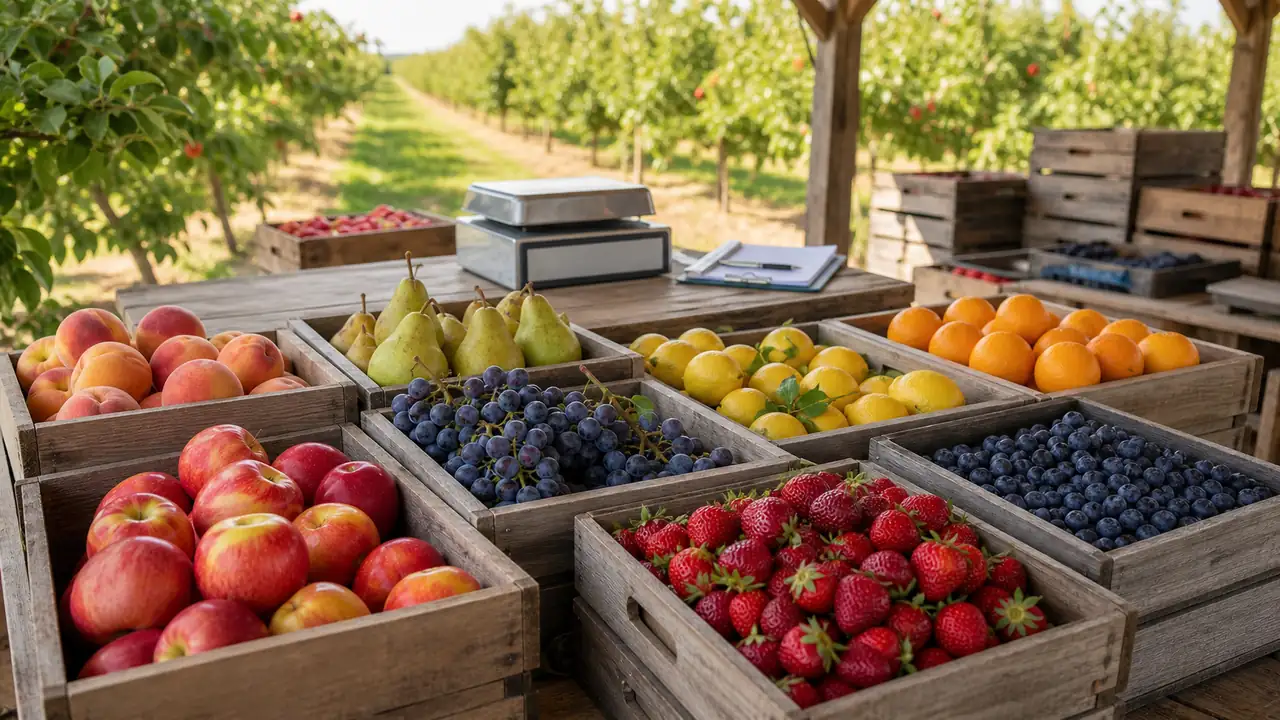
The strongest signal is crop concentration. Apples and grapes alone account for just over half of the combined tonnage in the latest official data. Grapes, strawberries, and apples account for nearly 60 percent of production value. A fruit display with apples, grapes, berries, citrus, pears, and peaches looks broad at retail; the production base behind it is narrow, regional, and highly crop-specific.
Key Takeaways
- Count 20.86M tons across latest official fruit data.
- Rank apples first by volume at 5.36M tons.
- Rank grapes first by value at $5.83B.
- Separate noncitrus data from 2024-25 citrus season.
- Watch California’s 84% share of U.S. citrus output.
Table of Contents
Latest U.S. Fruit Production Snapshot
Source: Garden Insider calculations from USDA NASS Noncitrus Fruits and Nuts 2025 Summary, published May 2026, and USDA NASS Citrus Fruits 2024 Summary, published August 2025. Citrus and noncitrus use separate crop-year periods, so combined totals are a current official snapshot across two NASS release calendars.
U.S. Fruit Production Volume – Apples And Grapes Carry The Base
The latest official U.S. fruit production picture is volume-heavy at the top. Apples reached 5.36 million tons of utilized production in 2025, and grapes reached 5.23 million tons. Together, those two crops accounted for 50.8 percent of the combined latest fruit tonnage across noncitrus and citrus data.
Oranges ranked third at 2.39 million tons in the 2024-25 citrus season. Strawberries followed at 1.56 million tons in 2025. Tangerines and mandarins reached 1.22 million tons, and lemons reached 1.11 million tons. The top five crops accounted for 75.6 percent of combined tonnage, so the national fruit supply is heavily clustered.
| Rank | Fruit crop | Latest production volume | Reporting period | Share of combined latest fruit volume |
|---|---|---|---|---|
| 1 | Apples, commercial | 5.36 million tons | 2025 | 25.7% |
| 2 | Grapes | 5.23 million tons | 2025 | 25.1% |
| 3 | Oranges | 2.39 million tons | 2024-25 | 11.5% |
| 4 | Strawberries | 1.56 million tons | 2025 | 7.5% |
| 5 | Tangerines and mandarins | 1.22 million tons | 2024-25 | 5.9% |
| 6 | Lemons | 1.11 million tons | 2024-25 | 5.3% |
| 7 | Pears | 756,300 tons | 2025 | 3.6% |
| 8 | Peaches | 684,750 tons | 2025 | 3.3% |
| 9 | Cultivated blueberries | 380,275 tons | 2025 | 1.8% |
| 10 | Cranberries | 373,442 tons | 2025 | 1.8% |
Home gardeners see the same hierarchy in miniature. Apples and grapes need years of structure, pruning, and site control. The homegrown apple tree and grape vine training decisions carry long-term weight because woody fruit crops build production over seasons.
Fruit Production Value – Grapes And Strawberries Lead The Money
Dollar value gives the fruit sector a second hierarchy. Grapes generated $5.83 billion in 2025 utilized production value, making them the highest-value U.S. fruit crop in the latest NASS noncitrus release. Strawberries ranked second at $4.40 billion. Apples produced the most tonnage and ranked third by value at $2.82 billion.
The top five fruit crops by value – grapes, strawberries, apples, cultivated blueberries, and oranges – made up 70.8 percent of combined latest fruit production value. That gap between tonnage and value is the main reason fruit production statistics need both measures. A crop can be large by weight and modest by dollars, or smaller by weight and unusually high by farm value.
| Rank | Fruit crop | Latest production value | Reporting period | Share of combined latest fruit value |
|---|---|---|---|---|
| 1 | Grapes | $5.83 billion | 2025 | 26.7% |
| 2 | Strawberries | $4.40 billion | 2025 | 20.2% |
| 3 | Apples, commercial | $2.82 billion | 2025 | 12.9% |
| 4 | Cultivated blueberries | $1.30 billion | 2025 | 6.0% |
| 5 | Oranges | $1.09 billion | 2024-25 | 5.0% |
| 6 | Peaches | $941 million | 2025 | 4.3% |
| 7 | Tangerines and mandarins | $865 million | 2024-25 | 4.0% |
| 8 | Sweet cherries | $734 million | 2025 | 3.4% |
| 9 | Lemons | $730 million | 2024-25 | 3.3% |
| 10 | Avocados | $508 million | 2025 | 2.3% |
Berry crops show the value side clearly. Cultivated blueberries produced 380,275 tons in 2025, far below apples or grapes, yet the crop generated $1.30 billion. That is the production-scale reason blueberries belong in the same data conversation as much larger tree-fruit crops. The growing side has the same constraint: blueberries need acidic soil and consistent moisture before yield becomes reliable.
Noncitrus Fruit Production – 2025 Volume Slipped, Value Rose
USDA NASS reported 15.84 million tons of noncitrus utilized fruit production in 2025, down 0.6 percent from 15.93 million tons in 2024. The value of utilized noncitrus production moved the other direction, rising from $18.88 billion in 2024 to $18.97 billion in 2025.
The crop-level movement was uneven. Pear utilized production rose 37.8 percent from 2024 to 2025, recovering to 756,300 tons. Apple utilized production rose 1.3 percent. Grape utilized production fell 3.4 percent, strawberries fell 3.0 percent, cultivated blueberries fell 3.7 percent, and cranberries fell 14.2 percent.
| Noncitrus crop | 2025 utilized production | 2025 value | Change in volume from 2024 | Production signal |
|---|---|---|---|---|
| Apples | 5.36 million tons | $2.82 billion | +1.3% | Large crop with modest value movement |
| Grapes | 5.23 million tons | $5.83 billion | -3.4% | Highest-value fruit crop |
| Strawberries | 1.56 million tons | $4.40 billion | -3.0% | High value from a smaller tonnage base |
| Pears | 756,300 tons | $348 million | +37.8% | Largest rebound among major listed crops |
| Peaches | 684,750 tons | $941 million | +0.5% | Stable volume, higher value |
| Cultivated blueberries | 380,275 tons | $1.30 billion | -3.7% | Small tonnage, high value |
| Sweet cherries | 371,860 tons | $734 million | +2.9% | High-value tree fruit |
| Cranberries | 373,442 tons | $270 million | -14.2% | Processed-market crop with volume drop |
These statistics come from the USDA NASS Noncitrus Fruits and Nuts 2025 Summary, published in May 2026. The report uses tons fresh equivalent for the main crop table, which keeps apples, grapes, strawberries, pears, peaches, berries, and other noncitrus crops in one comparable frame.
Citrus Fruit Production – California Dominates The 2024-25 Season
U.S. citrus utilized production totaled 5.02 million tons in the 2024-25 season, down 2 percent from 2023-24. The value of the citrus crop was $2.84 billion, down 4 percent from the previous season. California accounted for 84 percent of U.S. citrus production, Florida 13 percent, and Texas plus Arizona the remaining 3 percent.
Oranges remained the largest citrus crop at 2.39 million tons, followed by tangerines and mandarins at 1.22 million tons, lemons at 1.11 million tons, and grapefruit at 299,000 tons. Citrus still matters in the national fruit picture, and its state base is narrow. California’s citrus production alone was larger than the listed output of Florida, Texas, and Arizona combined.
| Citrus crop | 2024-25 production | Fresh utilization | Processed utilization | Value of production |
|---|---|---|---|---|
| All oranges | 2.39 million tons | 1.47 million tons | 926,000 tons | $1.09 billion |
| Tangerines and mandarins | 1.22 million tons | 796,000 tons | 427,000 tons | $865 million |
| Lemons | 1.11 million tons | 849,000 tons | 257,000 tons | $730 million |
| Grapefruit | 299,000 tons | 189,000 tons | 110,000 tons | $154 million |
| Total citrus | 5.02 million tons | 3.30 million tons | 1.72 million tons | $2.84 billion |
The USDA NASS Citrus Fruits 2024 Summary uses packinghouse-door equivalents for value. Citrus value is therefore a citrus-specific measure and should stay separate from farm-gate value definitions used for some noncitrus crops.
State Concentration – Fruit Production Is Regional
Fruit production is highly regional because perennial crops cannot move quickly. Washington produced 7.16 billion pounds of utilized commercial apples in 2025, about two-thirds of the U.S. apple total. California produced 4.67 million tons of utilized grapes, or 89.3 percent of U.S. grape utilized production. California also produced 84 percent of U.S. citrus in the 2024-25 season.
These state shares explain why weather events, water supply, labor availability, and disease pressure in a few places can move national fruit statistics. A late freeze in a vegetable bed can be replanted in weeks. A damaged orchard or vineyard changes production capacity for years.
| Crop or group | Leading state | Latest leading-state output | Approximate national share | Why it matters |
|---|---|---|---|---|
| Commercial apples | Washington | 7.16 billion lb utilized | 66.8% | Apple supply is deeply tied to one state |
| Grapes | California | 4.67 million tons utilized | 89.3% | Wine, table, and raisin grapes share a California base |
| Citrus | California | 4.21 million tons total production | 84.0% | California now dominates U.S. citrus volume |
| Peaches | California | 527,820 tons utilized | 77.1% | Processing and fresh peach supply are California-heavy |
| Cultivated blueberries | Washington | 192.4 million lb utilized | 25.3% | Blueberry output is spread across more producing states |
For small-space growers, this concentration is a useful reminder to match crop to site and climate. Dwarf fruit trees for small gardens make production possible in tight yards; climate fit still decides whether the crop becomes reliable or decorative.
Fresh And Processed Fruit – Production Numbers Measure Different Markets
Fresh and processed utilization split the fruit sector into separate markets. Citrus data makes that visible: in 2024-25, oranges had 1.47 million tons of fresh utilization and 926,000 tons of processed utilization. Lemons leaned fresh, with 849,000 tons fresh and 257,000 tons processed. Tangerines and mandarins were also mostly fresh.
Noncitrus crops carry the same fresh and processing split. Grapes divide into wine, table, and raisin uses. Apples divide into fresh, canned, juice, dried, and other uses. Cranberries appear in the same broad fruit production table, with most consumer demand tied to processed products.
| Crop | Main split to watch | Latest production signal | Research use |
|---|---|---|---|
| Grapes | Wine, table, raisin | 5.23 million tons utilized in 2025 | Value depends heavily on end use |
| Apples | Fresh, processed, juice | 10.72 billion lb utilized in 2025 | Volume and retail supply measure separate flows |
| Oranges | Fresh, processed | 1.47M tons fresh and 926K tons processed in 2024-25 | Citrus juice and fresh citrus need separate reads |
| Strawberries | Fresh, processing | 31.2 million cwt utilized in 2025 | Short shelf life makes fresh volume highly sensitive |
| Cranberries | Fresh, processed | 373,442 tons utilized in 2025 | Processing demand shapes production decisions |
Fruit statistics work best when utilization is visible. A ton of wine grapes, a ton of fresh strawberries, and a ton of oranges headed to juice face separate buyers, storage limits, labor windows, and price pressures.
What Changed In The Latest Fruit Data
The latest noncitrus release shows a small national volume decline and a small value increase. That pairing usually points to crop mix and price movement over one clear production shock. Pears rebounded sharply from 2024, apples edged up, peaches barely changed, and several berry or processing-heavy crops moved down.
Citrus moved through a regional split. Total citrus production fell 2 percent in the 2024-25 season, with Florida orange production down 32 percent from the previous season. California citrus increased 4 percent, which kept the national decline from becoming larger. The same national citrus number therefore contains two regional stories: California stability and Florida contraction.
| Metric | Latest value | Prior value | Change | What it shows |
|---|---|---|---|---|
| Noncitrus utilized production | 15.84M tons in 2025 | 15.93M tons in 2024 | -0.6% | Volume eased slightly |
| Noncitrus value | $18.97B in 2025 | $18.88B in 2024 | +0.5% | Value rose as volume eased |
| Citrus production | 5.02M tons in 2024-25 | 5.13M tons in 2023-24 | -2.2% | Citrus volume declined |
| Citrus value | $2.84B in 2024-25 | $2.97B in 2023-24 | -4.4% | Citrus value had the sharper decline |
| Pear utilized production | 756,300 tons in 2025 | 548,960 tons in 2024 | +37.8% | Pears had the standout noncitrus rebound |
The crop-level view also helps connect national statistics to garden decisions. Citrus remains climate-limited for most home growers, so growing citrus for vitamin C depends on variety, container strategy, winter protection, and local climate fit.
Source And Methodology Notes
The main noncitrus source is USDA NASS Noncitrus Fruits and Nuts 2025 Summary, released May 1, 2026. The main citrus source is USDA NASS Citrus Fruits 2024 Summary, released August 29, 2025. Noncitrus fruit uses 2025 crop-year data. Citrus uses the 2024-25 marketing season because the next full citrus annual summary is scheduled later in 2026.
Combined fruit totals add 2025 noncitrus utilized production to 2024-25 citrus production. That combined figure is the latest official production snapshot available in June 2026. Cite the crop-year periods beside it because the citrus and noncitrus release calendars use separate schedules. Crop values are shown in current dollars as reported by NASS, with noncitrus value of utilized production and citrus packinghouse-door value kept in their original source definitions.
| Data point | Source | Period | Measurement | Role |
|---|---|---|---|---|
| Noncitrus volume and value | USDA NASS Noncitrus Fruits and Nuts 2025 Summary | 2025 | Tons fresh equivalent and 1,000 dollars | Apples, grapes, berries, pears, peaches, cherries, avocados, and other noncitrus crops |
| Citrus volume and value | USDA NASS Citrus Fruits 2024 Summary | 2024-25 season | 1,000 tons and 1,000 dollars | Oranges, grapefruit, lemons, tangerines, and mandarins |
| State shares | NASS crop and state tables | 2025 or 2024-25 | Utilized production or total production | Washington apples, California grapes, California citrus, and other state concentration examples |
| Home-garden context | Garden Insider fruit growing guides | Evergreen internal context | Planting and care constraints | Crop-specific growing decisions |
Where To Start With The Data
Market research starts with value. Grapes and strawberries are the first two rows to check because they lead by dollars. Apples lead by volume.
Supply research starts with state concentration. Washington apples, California grapes, and California citrus show how much national fruit production depends on a few perennial growing regions.
Crop research starts by separating citrus from noncitrus. The production periods and value definitions use separate NASS conventions. Keep that separation intact before comparing oranges with apples, grapes, or strawberries.
Conclusion
The latest fruit production data shows a large, concentrated U.S. fruit sector. Apples and grapes carry just over half of the combined latest tonnage. Grapes and strawberries carry almost 47 percent of the combined latest value. Citrus adds another 5.02 million tons, with California producing most of it.
The cleanest way to use the data is to keep three layers separate: crop volume, crop value, and production region. When those layers line up, the signal is strong. When they split, as they do with strawberries, blueberries, citrus, and grapes, the number worth citing depends on the question being asked.
Frequently Asked Questions
How much fruit does the United States produce?
The latest official USDA NASS data shows about 20.86 million tons across 2025 noncitrus utilized production and 2024-25 citrus production. That combines 15.84 million tons of noncitrus fruit and 5.02 million tons of citrus.
What is the largest fruit crop in the United States by production?
Apples are the largest fruit crop by latest production volume, with 5.36 million tons of utilized commercial production in 2025. Grapes are close behind at 5.23 million tons.
What is the most valuable fruit crop in the United States?
Grapes are the most valuable fruit crop in the latest USDA NASS data, with $5.83 billion in 2025 utilized production value. Strawberries rank second at $4.40 billion, and apples rank third at $2.82 billion.
Which state produces the most citrus fruit?
California produces the most citrus fruit in the United States. USDA NASS reported that California accounted for 84 percent of U.S. citrus production in the 2024-25 season.
Why are citrus and noncitrus fruit statistics reported separately?
Citrus and noncitrus fruit use separate NASS annual reports, marketing seasons, and value definitions. Noncitrus data in the latest release covers 2025. The latest citrus annual summary covers the 2024-25 season.