


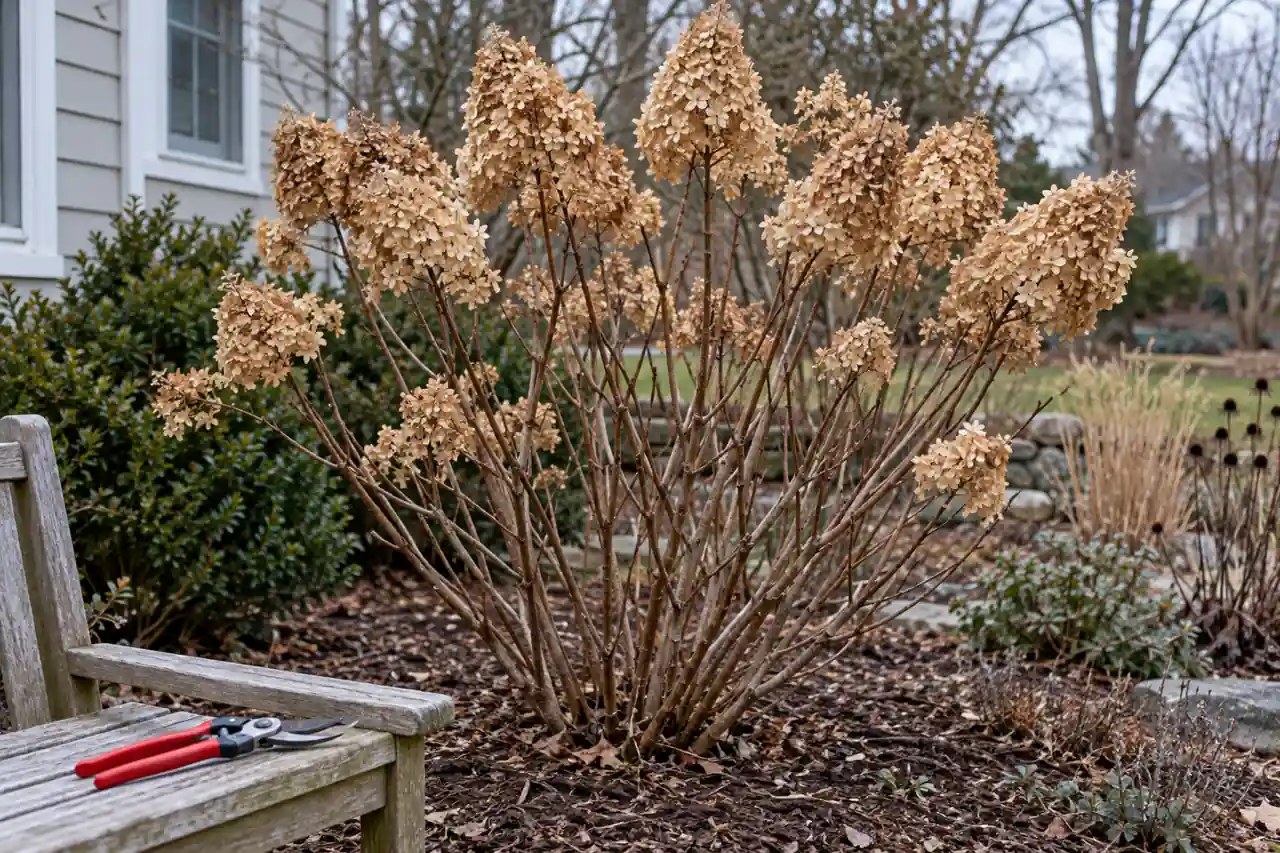
Decide when to prune a Limelight hydrangea by its growth stage: make planned structural cuts in late winter or early spring, before new shoots extend. A shrub covered in dry autumn flower heads rarely needs every stem shortened immediately. Those papery cones sit on an existing framework, and removing the cones is a different job from rebuilding that framework. Limelight flowers on the coming season’s growth, so the old-wood rules used for many bigleaf hydrangeas do not fit. Plant form changes the cuts, too. A multi-stem shrub has branches rising from its base; a trained tree has a permanent trunk that must remain intact. Before reaching for the pruners, separate faded flowers, genuinely damaged wood, crowded branches, and a plant that has simply outgrown its space. Each calls for a different response.
Choose the cut before choosing the date
Routine size or shape work: wait for the local dormant window before active spring growth.
Only dry flower heads: leave them for winter interest or clip the spent clusters without shortening the framework.
Tree form: work within the branching crown; preserve the main trunk.
Broken or hazardous wood: address the damage promptly, using professional help for large or elevated branches.
Key Takeaways
- Separate spent flower removal from changes to the framework.
- Preserve the permanent trunk when shaping a trained tree.
- Inspect dormant branches before committing to a uniform reduction.
- Reduce repeated hard cuts when long shoots keep flopping.
- Reassess spring regrowth before correcting an earlier pruning mistake.
Table of Contents
When to Prune a Limelight Hydrangea Before Budbreak
Small, unopened buds and bare branches give you a clearer view of the plant than a leaf-filled canopy. Limelight is Hydrangea paniculata ‘Limelight’, a panicle hydrangea whose flowers develop on current-season growth. Dormant pruning leaves time for new shoots to form and carry flowers later in the growing season. Once those shoots are extending, another reduction removes living growth that was already contributing to the season’s display.
Late winter or early spring is the default timing in University of Maryland Extension’s new-wood hydrangea pruning guidance. Let the seasonal stage determine timing in your own garden. A shrub beside a warm wall and one in an exposed northern yard break dormancy under different conditions. Examine the buds, recent weather, and your local Extension timing before scheduling major work.
Why fall advice differs
Fall pruning is an option in University of Minnesota Extension’s panicle hydrangea guidance. The same guidance suggests leaving dry flower heads until late winter or spring for their winter appearance. Maryland advises avoiding cuts close to winter dormancy. These recommendations do not support a blanket claim that every autumn cut destroys next year’s flowers.
For a homeowner without a specific local reason to prune in fall, postponing substantial reshaping keeps the decision simple. Leave sound branches in place, identify the stems that need attention, and return during the dormant window. Optional deadheading or removal of a broken branch does not require committing to a complete reduction.
Confirm the plant’s identity if the name came from a previous owner and no planting record confirms it. Cone-shaped flowers help identify the panicle group. A named cultivar needs a reliable planting record or label. Blue mopheads or oak-shaped leaves call for a different identification check. Differences in hydrangea flowering wood and mature size affect both the timing and the long-term space the plant needs.
Mark Strong Branches Before Reducing Size
A uniform haircut hides the decisions that matter. Follow each stem with your eye from its base to its tip. A strong branch with room around it has a different role from a thin shoot crossing the center, a cracked limb, or a branch rubbing against its neighbor. Their positions determine where a cut belongs.
Start by naming the problem. Is the shrub blocking a walkway, carrying crowded interior stems, or leaning only when its flowers are wet? The answer changes whether you shorten a retained branch, remove an entire unwanted stem, or leave the framework alone. Pruning without an objective makes it easy to remove useful wood simply because other branches were cut.
| What you find | Decision | What to preserve |
|---|---|---|
| Only faded, dry panicles | Leave them or remove just the spent clusters. | The supporting stem and its buds. |
| A clearly broken or dead branch | Remove the damaged portion or branch appropriately. | Sound wood and the adjoining branch junction. |
| Rubbing or crowded interior stems | Select the least useful stem for thinning. | A well-spaced framework, rather than equal stem lengths. |
| Healthy stems extending beyond the intended shape | Consider selective heading during dormancy. | Useful buds and enough framework to carry regrowth. |
| A recently planted or weak shrub | Limit unnecessary cosmetic reduction. | Healthy growth while rooting and vigor are assessed. |
Leaflessness alone does not prove that a stem is dead. Delayed buds, cold injury, and a branch that has finished its autumn leaf drop require different interpretations. If you cannot distinguish questionable wood from living wood, mark it and reassess as nearby buds begin developing. Clearly broken material is easier to identify than an intact dormant tip.
Listen and look during the damage inspection. A dry flower head rustles with a light touch; a cracked woody branch exposes a splintered surface and moves at the break. Those observations locate different problems. Do not bend intact branches repeatedly to test whether they will snap.
Crowded growth also slows leaf drying after rain. If spots develop on hydrangea leaves, assess the symptoms and site before treating pruning as the cure. Selective thinning improves spacing, but leaf damage still needs its own diagnosis.
Stand back before making the first cut. Which branches are creating the actual obstruction, and which are merely taller than their neighbors? Keeping that distinction in view prevents a local correction from becoming an unnecessary whole-plant renovation.
Place Heading and Thinning Cuts Where Growth Responds
Heading and thinning leave different structures behind. A heading cut shortens a retained shoot above a bud. A thinning cut removes an unwanted stem at its origin. Used selectively, the two operations address excess height and congestion separately; shearing every tip treats both problems as though they were identical.
Shorten a retained shoot above a bud
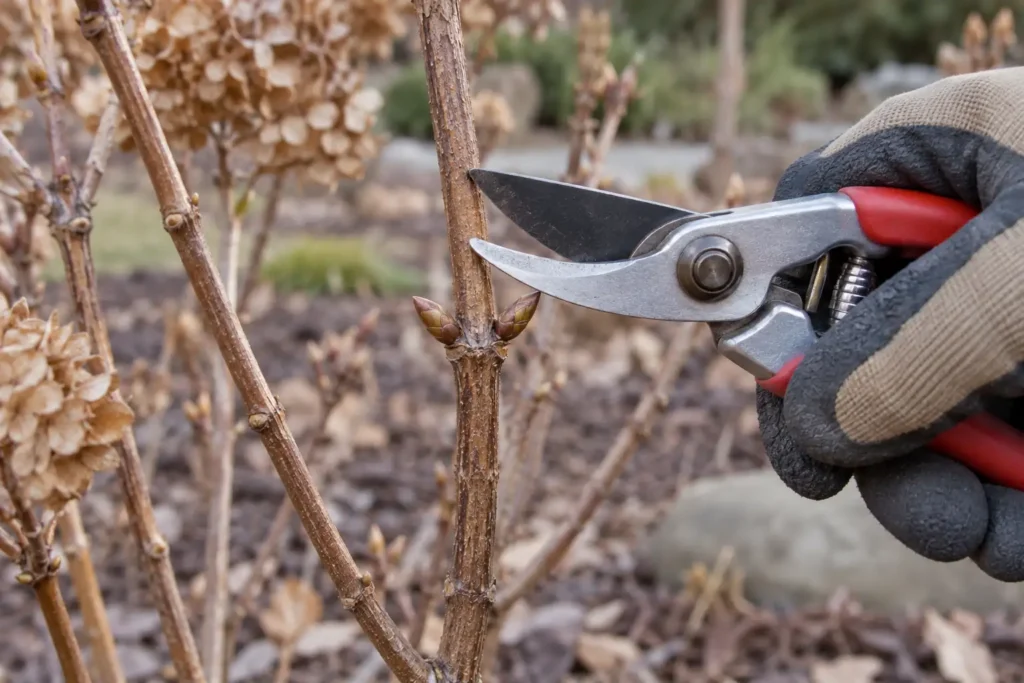
Find a sound bud below the section you intend to remove. On a small stem, University of Minnesota Extension places the high point of a heading cut about 1/4 inch above a bud. Keep the blades clear of the bud itself. A long bare stub leaves unnecessary wood beyond the growing point. Cutting through the bud removes the growth you intended to retain.
Match the tool to the stem. Sharp bypass pruners should make a clean cut on small wood without repeated crushing. If closing them takes excessive force or twists the branch, stop and use an appropriate larger tool. Hold the tool securely, keep the other hand clear of the blades, and avoid using a stem as leverage against neighboring buds.
Remove a selected stem at its origin
Trace a rubbing or weak interior stem back to its junction before cutting. Remove the unwanted stem without slicing into the adjoining retained branch. At a larger junction, preserve the natural collar and keep the cut out of the trunk. Large, elevated cuts deserve an assessment beyond a small-pruner demonstration.
The visible result of thinning is an opening between retained branches, not a row of shortened sticks. Reassess that opening before removing another stem. You need enough framework to distribute the coming growth, and a bare winter outline makes it easy to underestimate how much wood has already been removed.
Make a practice decision without cutting: touch the unwanted stem near its origin, follow it to the tip, and identify what remains after removal. If several branches disappear with that one cut, reconsider whether it is an ordinary thinning decision or a major framework change.
For deadheading, follow the dry panicle only as far as its supporting tip. Clip off the spent cluster, keeping most of the shoot intact. Cosmetic flower removal leaves the framework intact in University of Maryland Extension’s distinction between deadheading and structural pruning. It is optional, and removing faded Limelight flowers does not promise another autumn flush of bloom.
Preserve the Trunk of a Tree-Form Limelight
A trained Limelight standard has a permanent trunk beneath its branching crown. Its roots and trunk support the upper branches even though the plant is botanically a shrub. Instructions that reduce a multi-stem shrub near its base do not transfer safely to that trained shape.
Identify the trunk before choosing crown cuts. Follow it upward to the main branch junctions, then assess small crown shoots separately. Remove clearly damaged material, resolve selected rubbing growth, and shorten suitable retained shoots only where a crown adjustment is needed. Keep the established scaffold recognizable as you work.
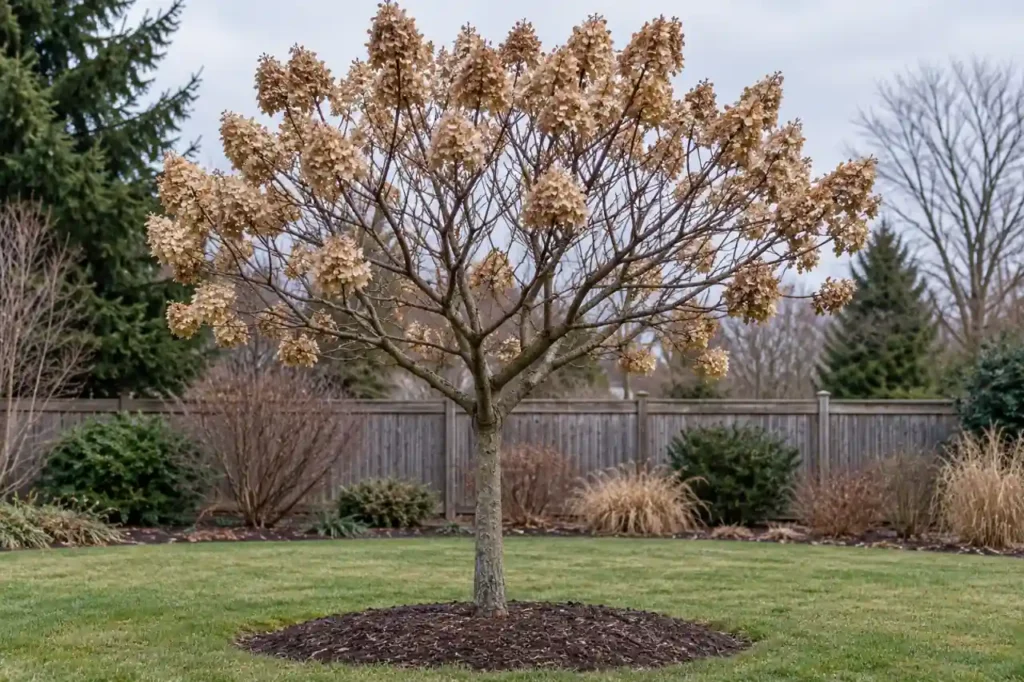
Cutting the main trunk down changes the plant’s form. Maryland’s pruning guidance permits that kind of renewal only when conversion back to a lower, shrubby shape is the intention. It does not preserve a tree standard. If the trunk has already been removed, healthy regrowth will not immediately restore the original raised crown.
Basal shoots also need a form decision. On a tree standard, shoots developing below the intended crown compete with the trained outline. Inspect where they originate before removing them; do not mistake one of the chosen trunks of a multi-stem standard for an unwanted sucker. A plant with an unfamiliar training history deserves closer inspection before irreversible cuts.
A heavy or split scaffold above a path is a safety problem. Keep people away from the affected area and obtain professional help when a branch is too large, high, or awkward to manage from the ground. The dormant schedule for elective reshaping should not delay addressing an unstable limb.
Long Replacement Shoots Explain Flopping After Hard Cuts
Hard pruning does not permanently make a full-size Limelight a dwarf. A vigorous shrub responds to severe reduction with replacement growth, and those shoots still need to carry large flower heads. Rutgers NJAES describes Limelight stems bending under dense panicles when the plant has been vigorously winter-pruned.
The Limelight growth and flower-weight description explains why another drastic reduction is an uncertain response to annual flopping. Examine the relationship between shoot length, branch support, and the plant’s space. A shrub that repeatedly grows into a narrow entrance has a size mismatch as well as a pruning problem.
Photograph the plant during flowering and again after leaf drop. The summer view records where stems lean under flower weight; the bare outline reveals whether those stems grew from a well-spaced framework or a crowded collection of replacement shoots. These views help locate the problem without treating every leaning branch as weak wood that must disappear.
Wet panicles change the load on a stem. Dry flower clusters feel light and papery; rain-darkened clusters hang more heavily. A recurring bend after rain is different from a branch that remains split or permanently kinked. Inspect the wood after the weather passes before deciding whether you are dealing with weight, injury, or both.
Pruning severity varies with form and vigor. University of Illinois Extension’s panicle guidance and individual Ask Extension cases describe reductions for particular situations. Those examples do not establish a safe fraction for every young shrub, tree standard, or stressed plant. Avoid treating a percentage as a substitute for examining the branches.
If sound growth repeatedly overwhelms the available space, relocating the shrub or choosing a naturally smaller cultivar addresses the continuing size problem. That decision carries establishment work and costs. Repeated severe topping also carries a cost: another season of regrowth whose final size and posture remain uncertain. Timing within the seasonal pruning cycle helps organize work; it cannot change the cultivar’s growth habit.
Protect New Growth After Late or Repeated Pruning
A Limelight cut after spring shoots have extended has already lost some of that season’s growth. Repeated trimming to correct the first cut removes more developing shoots. Stop, inspect what remains, and separate genuine damage from dissatisfaction with the temporary shape.
A Michigan Ask Extension response on Limelight pruning warns about cutting after active growth has begun. The consequence depends on how much flowering growth was removed and when the cut occurred. Delayed or reduced flowering is possible; one late cut does not prove that the plant is dead, and another cut cannot replace the missing shoots immediately.
On a recently planted or weak shrub, prioritize rooting and site conditions over cosmetic reduction. An intact stem with healthy developing leaves has a role in rebuilding growth. Unnecessary severe pruning adds another disturbance without resolving drought, poor drainage, or an unsuitable location.
Keep a record of the cuts and subsequent growth. If buds open along retained branches and new shoots extend, let that response develop before planning the next reshape. A branch that remains inactive as neighboring stems leaf out merits closer inspection, particularly where the wood is cracked, shriveled, or discolored.
No fertilizer recipe guarantees flowers after a late cut. Check moisture, light, and physical damage when the response is poor, then use local plant assessment for a continuing problem. By the next dormant season, the surviving framework and the direction of new shoots will give you a better basis for selecting cuts than the outline left immediately after pruning.
Conclusion
Keep a winter photo showing the branches you retained, then compare it with the flowering plant. If long shoots again bend heavily or the shrub again blocks the same path, reassess the framework and available space before repeating the previous reduction.
For the next pruning session, locate the permanent structure first and make only the cuts that answer an identifiable problem. A sound result leaves clean cuts above usable buds, room between retained branches, and an intact trunk beneath a tree-form crown.
Frequently Asked Questions
Should a container-grown Limelight be pruned more heavily?
A container alone is not a reason for a harder cut. Assess the plant’s vigor, trained form, and available growing space. A weak or recently planted specimen deserves limited cosmetic pruning during assessment of roots and site conditions. Repeatedly reducing a large cultivar does not make it permanently suited to a small container.
Can I remove dried panicles for an indoor display?
Dried clusters are optional winter decoration on the plant. Clip the spent cluster near its supporting tip if you want to collect it, leaving the structural shoot and buds in place. Taking a long stem also removes part of the structural shoot.
What if I cannot find a sound bud below a planned cut?
Pause that cut and inspect the stem again during the dormant-to-spring transition. Bud development on nearby branches helps reveal whether the stem is merely slow or has damaged tips. Avoid shortening intact wood to an arbitrary height when the growing points are uncertain.