Most gardens are net consumers of the ecosystem they sit in. They take water, take nutrients, take pest management – and give very little back. That is not a moral failing. It is what happens when a garden is built on inputs rather than systems.
Sustainable gardening flips that equation. Not through sacrifice or extra effort, but by working with four practices that rebuild what conventional gardening gradually erodes: composting restores the microbial life that fertilizers bypass entirely; rainwater harvesting stops nutrient-laden runoff before it reaches local waterways; native plants reconnect the insect relationships that make a garden self-regulating; and habitat features carry that effect through winter, when most gardens go quiet and most gardeners stop paying attention.
Each practice does real work on its own. Together, they compound. This article covers what each one actually does below the surface – and why the conventional alternative costs more every year to produce the same result.
Key Takeaways
- Swap one synthetic fertilizer application for finished compost and watch soil texture visibly change within a single season
- Install a rain barrel before the first autumn storm – that is when most annual runoff loss happens, not in summer
- Plant natives in blocks of at least three, not as single specimens scattered through a border
- Leave hollow plant stems at eight to twelve inches through winter – they are the main nest site for cavity-nesting solitary bees
- Clearing all leaf litter in fall is the single most damaging thing most gardeners do to local insect populations without realizing it
Table of Contents
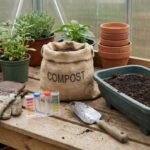
Composting – What Is Actually Happening Underground
Most people start composting to reduce waste or save money on fertilizer. Both are legitimate reasons. But they describe the least interesting thing composting does.
A synthetic fertilizer application works in week one. It delivers nitrogen, phosphorus, and potassium in forms plants absorb immediately – fast, measurable, reliable. It also bypasses the biological system entirely. Do that for five years and the soil biology that would otherwise do that work for free gradually disappears. The garden becomes dependent on the next application to function at all.
Compost works the other direction. Slowly in month one. Compounding over five years.
Healthy soil holds roughly one billion bacteria per teaspoon. In compacted suburban soil maintained on synthetic inputs for years, that number drops by 90 percent or more. When you add finished compost, you are not topping up a nutrient tank. You are reintroducing the organisms that run the entire soil system – the fungal networks that move water and minerals to roots, the bacterial films that protect against pathogens, the organic acids that unlock minerals already present in the soil but chemically inaccessible.
No fertilizer application does any of that. Full stop.
Why The Pile Gets Hot – And What That Heat Tells You
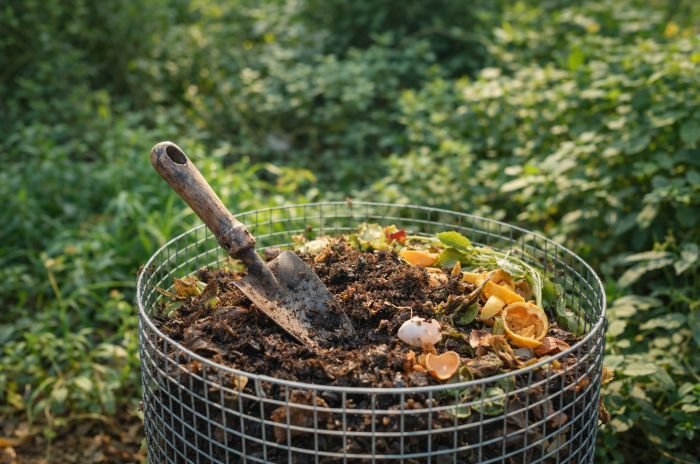
Push your hand six inches into the center of a well-built compost pile one week after building it. If it feels genuinely hot – not warm, hot – the pile is working. That heat is bacteria consuming simple sugars in a feeding frenzy, and it reaches 130 to 160 degrees Fahrenheit at the center. Hot enough to kill most weed seeds and plant pathogens sitting in the pile.
As the easy food runs out, fungi take over – breaking down lignin, cellulose, the woody material bacteria cannot handle. By the time the pile smells of forest floor and crumbles like dark chocolate cake, the microbial community has stabilized into something close to what healthy native soil looks like naturally. That transformation takes six weeks to six months, depending on how actively you manage it.
A pile that stays cold and smells of ammonia is telling you something specific. It is not broken – it is asking for more carbon.
The Ratio – And The Two Ways It Goes Wrong
Three parts carbon to one part nitrogen by volume is the standard guidance. What matters more is knowing what breaks down at each extreme.
Too much nitrogen – mostly grass clippings or kitchen scraps – goes anaerobic within days. Cold, wet, ammonia-smelling, useful to nothing. Too much carbon – mostly dry leaves or wood chips – stays cold indefinitely because bacteria cannot multiply fast enough without protein.
The fix in both cases is immediate. Add the missing ingredient, turn the pile once, and the temperature shifts within 48 hours. That feedback loop is what makes composting a learnable skill rather than a chore that either works or does not.
One practical note: shred dry leaves before adding them. Whole leaves mat together and create anaerobic pockets that slow the entire heap. A single pass with a lawn mower reduces them to fragments that break down three to four times faster.
What Compost Changes That Fertilizer Cannot
Sandy soil loses water fast – large particles leave gaps that water drains straight through. Clay compacts into dense plates that exclude air and suffocate roots. Compost improves both, not by changing particle size, but by binding particles into aggregates with a crumb structure – pores large enough to hold air between rains, small enough to retain moisture when it is dry.
Research from the Rodale Institute found that fields amended with compost annually for 10 years retained 15 to 20 percent more water per inch of rain than conventionally managed fields. In practical terms, that is the difference between watering twice a week and watering once. Or not at all during an average rainfall summer.
Within six to eight weeks of a compost application, mycorrhizal fungi begin forming associations with plant roots that extend their effective reach by a factor of ten to one hundred. The garden that has been composting for three years is not just more fertile – it is structurally different. It holds water differently, drains differently, smells different when you dig into it.
Think about the garden you have right now. How much of what it needs comes from a bag or a bottle? That number is also a rough measure of what the soil biology can no longer do on its own.
Pro Tip: The fastest way to know if compost is ready is the squeeze test. Take a handful and press it firmly. It should hold its shape briefly, then crumble when you open your hand. If it stays in a wet ball, it needs more turning and airflow. If it falls apart dry, it needs water before going on the bed.
Rainwater Harvesting – The Part Nobody Talks About Is The Runoff
The standard case for rain barrels is the water bill. That is real – but it is also the smallest part of the story.
When rain falls on a typical suburban property, most of it hits something impervious – roof, driveway, compacted lawn – and leaves the site within minutes. On the way out, it picks up whatever is sitting on those surfaces: fertilizer residue, pesticide particles, pet waste, fine soil particles. That mixture enters storm drains, and in most US cities, storm drains discharge directly into local waterways without treatment.
The runoff from a single neighborhood after a one-inch rain can carry enough nitrogen and phosphorus to trigger algal blooms downstream that deplete oxygen and kill fish for weeks.
That is what a suburban garden contributes to the watershed every time it rains and nobody captures anything.
The Scale Problem With A Single Barrel
A 1,000-square-foot roof sheds roughly 600 gallons per inch of rainfall. An average US home has a roof footprint of 1,500 to 2,000 square feet – meaning a one-inch rain generates 900 to 1,200 gallons of runoff from a single house. A standard 55-gallon barrel captures less than 10 percent of that.
Worth doing. But worth understanding the scale of what is still leaving the property.
A swale handles the rest. It is a shallow contoured channel – often just six inches deep and two feet wide – running along a fence line or property edge, planted with deep-rooted native grasses or sedges. It does not drain water away. It slows it down and lets it percolate into the soil. The plants in a swale need no separate irrigation – they live off the water they capture.
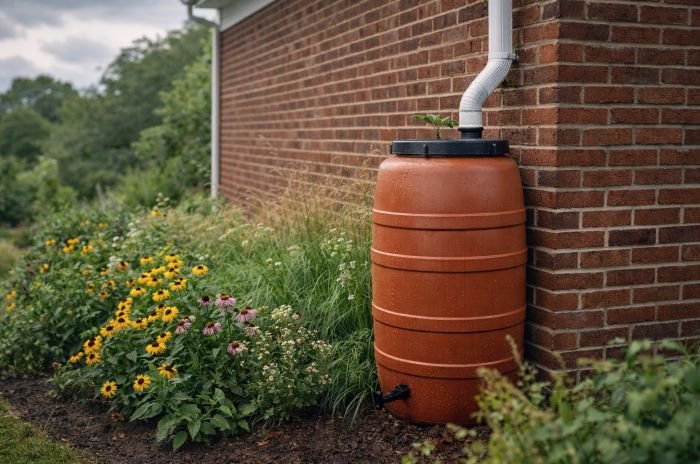
Even a modest swale along one edge of a flat suburban lot absorbs a significant portion of moderate storm runoff, and it can be dug with a spade in an afternoon. A rain barrel handling roof runoff combined with a swale handling surface runoff covers both main loss pathways without major infrastructure.
Here is something most people do not know: a household in Phoenix with full impervious surface coverage can theoretically meet around 80 percent of its outdoor watering needs from captured rainfall alone – in one of the driest cities in the US. The limiting factor is almost never rainfall. It is how much leaves the property before anyone captures it.
The Timing Most People Miss
The highest-value moment to install a rain barrel is before the first significant autumn rain. Not in spring, when garden enthusiasm peaks.
In most of the US, September through November brings substantial rainfall onto dry, compacted summer soil that cannot absorb it quickly. That water runs straight off. Capturing it in autumn fills barrels that irrigate fall-planted natives or cover crops without touching mains water – and it means the barrel has proven its value before the growing season even starts.
On Mosquitoes – The Concern That Stops People
Standing water breeds mosquitoes within five to seven days if left undisturbed. A fine mesh screen over the barrel inlet prevents adults from laying eggs. A tight-fitting lid eliminates the light that attracts them.
In practice, a barrel connected to an active garden empties and refills frequently enough during the growing season that stagnation is rarely an issue. The real risk is early spring and wet late summers, when rainfall exceeds garden demand and barrels stay full for weeks. Those are the two moments to check.
Observation: Gardeners who install rain barrels almost always start paying closer attention to actual rainfall patterns rather than forecasts. Once water has a visible quantity – a barrel level you can see rise and fall – irrigation habits shift on their own, often before any deliberate effort begins. Sizing options, overflow routing, and a state-by-state overview of collection rules are covered in the rainwater harvesting for gardens guide.
Native Plant Gardening – The Relationship Is The Point
Here is the standard argument for growing native plants: they need less water, less maintenance, and they look good once established.
All true. Also the least interesting thing about them.
The more important reason is that native plants carry encoded relationships with local insects that took thousands of years to develop. A drought-tolerant ornamental from another continent cannot replicate those relationships – not because it is poorly adapted, but because the local insects never learned to use it.
And without those insects, the garden loses the foundation of its own food web.
Entomologist Doug Tallamy spent years counting insect species on landscape plants across the eastern US. Native oaks support over 500 caterpillar species. Comparable non-native ornamental trees of similar size support fewer than 35. That is not a minor difference in biodiversity metrics. It has direct consequences for what lives in the garden.
Caterpillars are the primary food source for almost every nesting bird species in North America. A pair of chickadees raising a single clutch feeds their chicks between 6,000 and 9,000 caterpillars before the young leave the nest. A garden built entirely on non-native ornamentals cannot support that – not because it looks wrong, but because the insects are simply not there.
Within the first 48 hours of planting a local native species, specialist insects begin locating it. Not because they were waiting – because they are always searching, and they recognize the chemical signature of a plant they evolved alongside. A non-native planted in the same spot generates no such response.
Native Is Not One Category
A plant native to coastal California is not native to Illinois.
The relevant unit is the ecoregion – a geographic area with consistent soils, climate, and plant communities. A plant native to within 100 miles of your site supports substantially more local insect species than one native to a region 500 miles away with different seasonal timing and rainfall patterns.
The Audubon Society’s Plants for Birds tool and the Lady Bird Johnson Wildflower Center’s native plant database both search by zip code and filter by sun, soil, and moisture conditions. For most US gardeners, ten to fifteen genuinely local natives cover every condition on the property – from dry shade under established trees to wet margins near downspouts.
Plant In Blocks, Not Collections
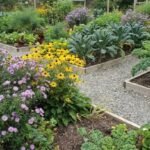
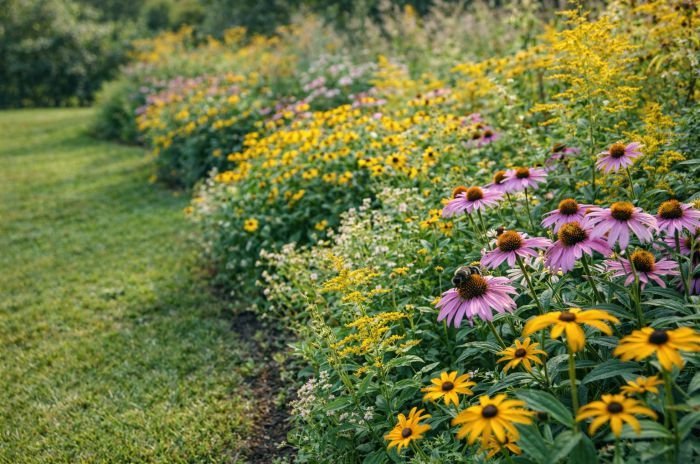
A single coneflower in a mixed border provides some pollinator value. Three coneflowers of the same species planted together form a recognizable foraging resource – bees that patrol a regular circuit will include it reliably. Five plants form a patch visible from a distance, reliable enough for specialist bees to build their foraging territory around.
Roughly 70 percent of all bee species in North America are ground-nesters, and many are pollen specialists: squash bees collect pollen only from cucurbit flowers, mining bees in the genus Andrena collect only from specific plant families. A garden with high diversity but low density of each species supports mostly generalist foragers. A garden with fewer species planted in meaningful quantities supports both.
The difference between a garden with 40 species at one plant each and a garden with 15 species at five plants each is not aesthetic. It is ecological function.
Converting Lawn Without Chemicals
Sheet mulching kills established lawn without herbicide and creates a planting bed in a single season. Lay cardboard directly over grass, overlapping edges by six inches to close any gaps. Saturate it thoroughly – wet cardboard suppresses growth effectively, dry cardboard lifts and gaps form. Cover with four to six inches of wood chip mulch.
The cardboard decomposes within one growing season. By the following spring, the soil underneath has measurably more earthworm activity than it had under turf. The grass does not come back.
Creating Habitats For Beneficial Wildlife – Most Of It Is About What You Stop Doing
The insects that control aphids, pollinate crops, and decompose organic matter do not need to be introduced to the garden.
They are already there. Or they would be, if the garden gave them somewhere to spend the winter.
The limiting factor for most beneficial insect populations is not food – flowers handle that. It is overwintering habitat: the specific places where insects spend the cold months as eggs, larvae, or pupae. Most of those places are in hollow stems, loose soil, decaying wood, and leaf litter.
A garden cleaned to uniform neatness every October removes most of those sites at once. The populations rebuild from scratch every spring – slower, smaller, and absent during the critical early weeks when pest pressure is highest.
What Lives Inside A Hollow Stem
Cavity-nesting solitary bees – mason bees, leafcutter bees, small carpenter bees – lay eggs in hollow stems and cap each cell with mud or leaf material. These bees are frequently more effective pollinators than honeybees for specific crops. Mason bees are roughly 120 times more efficient than honeybees at pollinating apples and cherries. They also fly in cold, drizzly early spring conditions when honeybee colonies do not leave the hive.
The stems they use are not specialized structures. Coneflower, Joe-Pye weed, elderberry, and many ornamental grasses all produce suitable hollow stems. The only management change: cut stems to eight to twelve inches rather than to the ground, and leave them until late March or early April when soil temperatures exceed 50 degrees Fahrenheit and adult bees have emerged.
A single six-inch stem stub houses three to eight individual bee cells. The functional equivalent of a purchased bee house. At no cost.
The Leaf Litter Layer Is An Ecosystem On Its Own
A two-to-three-inch layer of fallen leaves left under trees and shrubs through winter provides overwintering habitat for organisms most gardeners have never thought about.
Luna moth pupae overwinter in leaf litter. Firefly larvae – those same larvae that will become the lights in your summer garden – hunt through it for two full years before emerging as adults. Ground beetles spend winter under leaf litter and emerge in spring already present in the garden, ready to consume slugs, cutworms, and weed seeds from the first warm day. Without the leaf litter, they colonize slowly from adjacent areas – arriving weeks after the damage has been done.
One honest note here: if your garden has a serious slug problem right now, adding leaf litter will make it worse before it gets better. Ground beetle populations take one to two seasons to build to working density. That is a real tradeoff worth knowing before you start.
The practical approach for gardeners who do not want leaves across the entire garden: leave them under woody plants and in designated beds, and shred them with a mower first to prevent matting. Shredded leaves decompose faster, stay in place better, and retain the same overwintering habitat value as whole leaves.
Log Piles And The Succession They Start
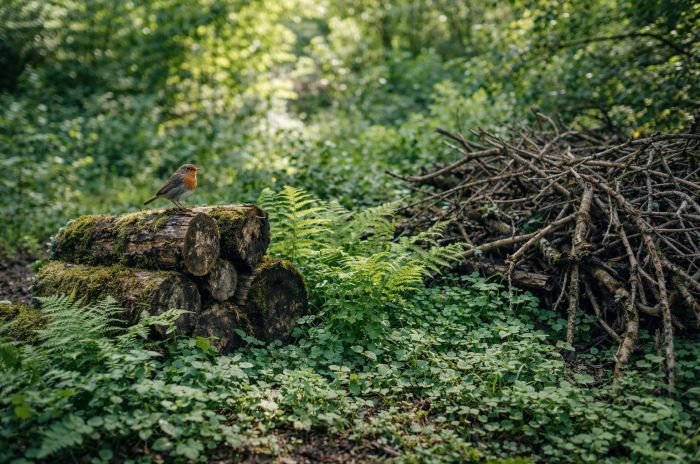
Stack four to six sections of untreated hardwood directly on soil in a partially shaded corner. Within one season, wood-boring beetles find it and begin excavating galleries through the interior. Some species take three to five years to complete their larval development inside a single log. Those galleries later become nest sites for other insects. Fungi colonize the surface, moss follows, and within two to three years the pile hosts a visible succession of organisms – a compressed version of woodland floor ecology in a space the size of a coffee table.
How The Four Practices Connect – And Why That Matters More Than Any One Alone
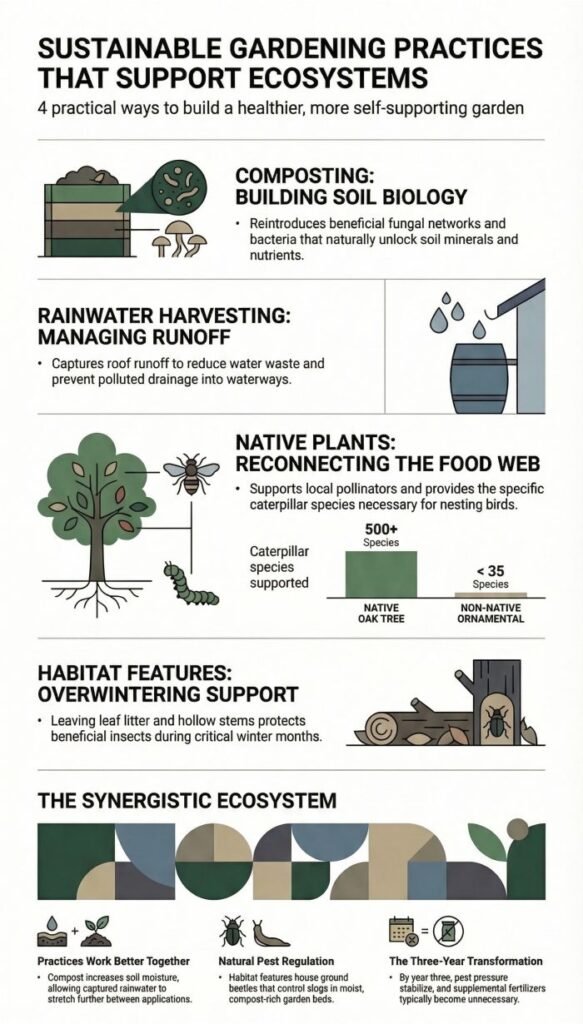
Each of these practices works in isolation. That is worth saying clearly, because it means there is no wrong place to start.
A compost pile improves soil whether or not the garden has native plants. A rain barrel reduces runoff whether or not there is a log pile in the corner. Start anywhere.
But when all four run together, they reinforce each other in ways that take a few seasons to become visible – and that no single practice achieves on its own.
Compost applied to a native plant bed improves water retention, which means the rain barrel supply stretches further between rains. Native plants attract specialist bees that pollinate food crops more reliably, reducing failed fruit set without any intervention. Leaf litter left under native plant beds provides overwintering habitat for the ground beetles that control slugs – the pest most likely to cause damage in a moist, compost-rich bed. The log pile at the garden edge extends that beetle community into areas the leaf litter does not reach.
The system becomes self-reinforcing. That is the point.
| Practice | What It Directly Does | What It Enables For The Others |
|---|---|---|
| Composting | Builds soil biology, improves water retention | Native plants establish faster; rain barrel supply stretches further |
| Rainwater harvesting | Reduces runoff, provides unchlorinated soft water | Keeps compost pile moist; irrigates natives through establishment year |
| Native planting | Rebuilds insect food web, low maintenance once established | Hollow stems for cavity bees; leaf litter for overwintering beetles |
| Habitat features | Sustains beneficial insect populations year-round | Ground beetles reduce slug pressure in compost-rich, moist beds |
What A Realistic Timeline Looks Like
Year one: soil texture improves noticeably with compost. Water bill drops measurably with the rain barrel. Native plants establish root mass but may not flower reliably until the following season. Habitat features go in quietly and nothing dramatic happens.
Year two: native plants flower and begin attracting specialist pollinators. First cavity-nesting bees colonize hollow stems left from the previous autumn. Ground beetle activity increases around habitat features.
Year three: pest pressure stabilizes. Aphid outbreaks that previously required intervention resolve on their own within a week. Supplemental fertilizer becomes unnecessary. The garden starts doing more of its own maintenance.
Gardeners who expect immediate results tend to abandon sustainable practices before the system has time to build. Three seasons is not a long wait for a garden that then runs largely without purchased inputs.
But it requires patience with a process that happens mostly underground and out of sight.
Conclusion
Start with the soil.
If a basic soil test shows organic matter below three percent – which is the case in most maintained suburban gardens – compost is the intervention that makes everything else work better. Below that threshold, native plants struggle to establish, water drains before roots can use it, and beneficial insect populations cannot build to the density where they actually regulate pest pressure.
Fix the soil first. The other three practices become significantly more effective once it is building.
Once organic matter is climbing, add one practice per season and pay attention to what changes – not the dramatic changes, but the small ones. A bed that stays moist two days longer after rain than it did the previous year. A hollow stem in October with a mud cap where a mason bee sealed a cell over summer. A chickadee working through the seed heads of a plant that was not cut back in fall. A patch of leaf litter that went quiet all winter and comes alive in March with beetles you had never noticed before.
Those are the signals that the system is functioning – not performing for appearances, but operating as a self-sustaining piece of the larger ecosystem it sits within.
FAQ
What is the difference between compost and mulch – and can they replace each other?
They do different jobs and work best used together. Compost is a finished biological product that integrates into soil and feeds the microbial community directly. Mulch is a surface layer – wood chips, straw, shredded leaves – whose main role is reducing evaporation and moderating soil temperature. Wood chip mulch applied to the surface slowly decomposes and adds organic matter over one to two years, but that is a slow process compared to incorporating finished compost directly at planting time. The most effective approach is compost worked into the bed with wood chip mulch applied over the top.
Is rainwater harvesting legal everywhere in the US?
Most states allow it with no restrictions. A small number of western states historically limited collection due to prior appropriation water law, but most have relaxed those rules significantly in the last decade. Colorado, which had the strictest restrictions, now permits up to 110 gallons per household for outdoor use. Texas and Oregon actively incentivize it with tax rebates. Regulations have changed frequently as drought conditions have shifted policy priorities – check your state’s department of natural resources for current rules rather than relying on older sources.
What happens if you plant native plants from the wrong region?
Plants sold as native at garden centers are sometimes native to the continent but not to the local ecoregion. A plant native to the southeastern US planted in the Pacific Northwest may grow well but support very few local insects, because those insects did not evolve alongside it. The co-evolutionary relationships that make natives ecologically valuable are local, not continental. A plant native to within 100 miles of your site supports substantially more local insect species than one native to a region 500 miles away with different soils, rainfall patterns, and seasonal timing.
Can you create meaningful wildlife habitat in a small urban garden?
A 200-square-foot urban garden can support a functional beneficial insect community with a few specific elements: at least one native plant species that blooms in each of three seasons, uncut stem sections left standing through winter, a shallow water source changed every two to three days, and some area of undisturbed ground. Ground-nesting bees – roughly 70 percent of all bee species in North America – need nothing more than a small patch of bare or lightly vegetated soil to excavate nest tunnels. A spot six inches in diameter is enough for a single nest. Small spaces with the right features regularly outperform large gardens that are managed too tidily.
What happens if you stop using synthetic fertilizer without adding compost?
Plants grown on synthetic inputs for multiple seasons are in soil with depleted microbial activity – the fertilizer fed the plant directly and bypassed the biological system rather than feeding it. Removing synthetic inputs without building organic matter causes a transition period of reduced yield or vigor, typically lasting one to two seasons, as the soil microbiome slowly rebuilds. The practical approach is to overlap: reduce synthetic inputs by half in year one while applying compost twice during the season, then eliminate them entirely once a soil test shows organic matter increasing past three percent. Going cold turkey works eventually but is harder on established plantings and slower overall.
How long before sustainable practices produce visible results?
Ground beetles, which overwinter as adults, respond within the first season – if habitat features are in place by October, a larger population emerges the following spring already in the garden. Cavity-nesting solitary bees respond within one to two seasons as they begin colonizing hollow stems. The change most gardeners notice first is not insect counts but pest behavior: an aphid outbreak that previously required intervention resolves on its own within a week. That shift typically happens in the second or third season after habitat changes are made – and once it does, it holds.